BETA nonprofit public democratic european moderated

Search

#tiedustelu

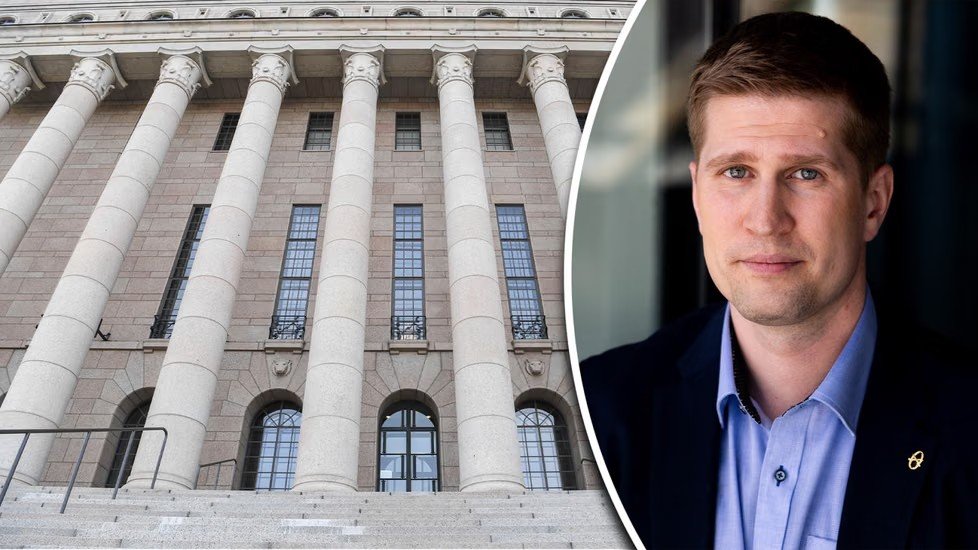
Henri Vanhanen criticized Donald Trump's actions in the Ukraine war, noting that he declared agreements about which there was uncertainty, while pressuring Ukraine in a way that benefited Vladimir Putin. As a recent example, Vanhanen pointed to Trump’s announced energy ceasefire. According to him, Volodymyr Zelensky heard about it practically for the first time from the media, Russia had not confirmed the agreement, and continued, according to Zelensky, attacks on Ukraine's power plants. Vanhanen asked what kind of ceasefire it was if the other party did not know what had been agreed upon. He suggested that Zelensky had to be cautious of Trump’s criticism to avoid being blamed for obstructing peace. Vanhanen referred to the Financial Times reporting that the United States threatened to cut off arms and intelligence supplies to Ukraine unless the country stopped attacks on Russian energy infrastructure. He also wrote that Trump agreed to buy Russian diesel, demanded Ukraine to cease attacks on Russian oil refineries, and encouraged a change of leadership in Ukraine. Vanhanen estimated that the war in Iran and the resulting fuel prices, the upcoming midterm elections, and the need to show results might explain Trump’s urgency to secure an agreement. According to him, Trump aimed for cheaper diesel and a visible peace political achievement, while Putin would benefit from a decrease in attacks on Russia’s energy sector. Vanhanen noted that the alignment of these goals seemed to occur at Ukraine’s expense. Vanhanen stated that he did not oppose a ceasefire if it protected Ukrainians and also bound Russia. However, he observed that for Trump, merely declaring an agreement seemed to suffice, even without information about its terms or Russia's commitment. Vanhanen assessed that Russia would benefit from a situation in which the United States sought a quick agreement and Ukraine was cautious not to offend Trump. In such conditions, he believed Putin could gain concessions from Trump without Russia needing to win against Ukraine at the negotiating table. #Ukraina #Trump #Venäjä (translated)

Henri Vanhanen wrote that Finland should take seriously Russia's alleged plans to assassinate leaders of the European defense industry. According to him, European intelligence services had warned that Russia had intensified its assassination plots targeting business executives. Possible targets included not only large arms manufacturers but also smaller defense technology companies, especially manufacturers of drones and their components. Vanhanen referred to a plan revealed in 2024 to assassinate Armin Papperger, CEO of the German company Rheinmetall. He wrote that more recent intelligence data indicated broader and more systematic actions beyond individual cases. According to Vanhanen, Russia's intention was to undermine the European defense industry, intimidate its business leaders, complicate support for Ukraine, and disrupt the strengthening of Europe's defense capabilities. Vanhanen urged an urgent assessment of whether the protection of key personnel in Finland's defense industry is adequate. He suggested that the security police, police, and defense administration work together with companies to identify individuals at special risk and ensure preemptive action against threats. He proposed, if necessary, strengthening personal protection, enhancing counterintelligence efforts against companies, and improving information sharing among authorities. According to Vanhanen, Finland should not wait for the first attack on its territory before preparing. https://t.co/xVZMYe1R7e #Puolustusteollisuus #Venäjä #Suomi (translated)

Former head of German foreign intelligence August Hanning has been arrested on suspicion of espionage for a foreign power and attempted treason, which could be one of the country's most serious espionage scandals since the Cold War. #vakoilu #Saksa #tiedustelu (translated)

Vakoiluepäily ravistelee Saksaa: ex-tiedustelujohtaja pidätetty
Klaus 24h

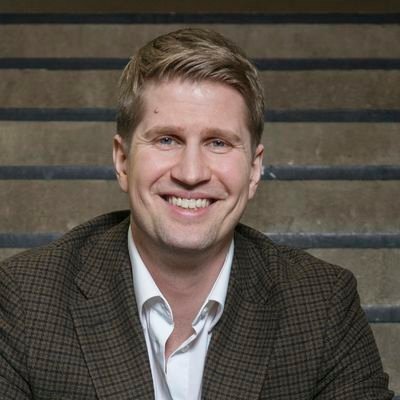
Klaus said he had responded to a user named Sukkola, who he claimed had blocked him. He stated that his criticism was directed at Said Aw-Musse's position as a religious authority rather than at his personal actions. Klaus described classical Sunni Islam as a tradition in which sharia is seen as divinely ordained and as a legal system superior to human laws. According to him, it included legal, moral, and social rules regarding, among other things, testimony, inheritance, apostasy, and legislative authority. Klaus wrote that Aw-Musse had studied theology in Saudi Arabia and worked in a mosque where the teachings of Muhammad ibn Abd al-Wahhab had been used. He described this figure as an ultra-conservative thinker who demanded the return of Islam to its literal roots. According to Klaus, Aw-Musse's refusal to clarify his position on the primacy of Finnish law and the status of sharia justified suspicion. Merely following the law, in his opinion, did not indicate whether he considered the constitutional order of Finland to be just and final or a temporary imposition. Klaus expressed a desire to know what kind of Finland Aw-Musse envisioned in 50 or 100 years. Klaus believed that questions regarding women's rights, freedom of speech, freedom of religion, and criminal law were not leading him into a trap but were inquiries into whether Aw-Musse accepted the principles of the Finnish rule of law. He deemed Aw-Musse's public stance significant for its societal relevance due to his religious role. According to Klaus, integration required not only adherence to the law but also acceptance of fundamental values. #uskonto #oikeudet #kulttuuri (translated)

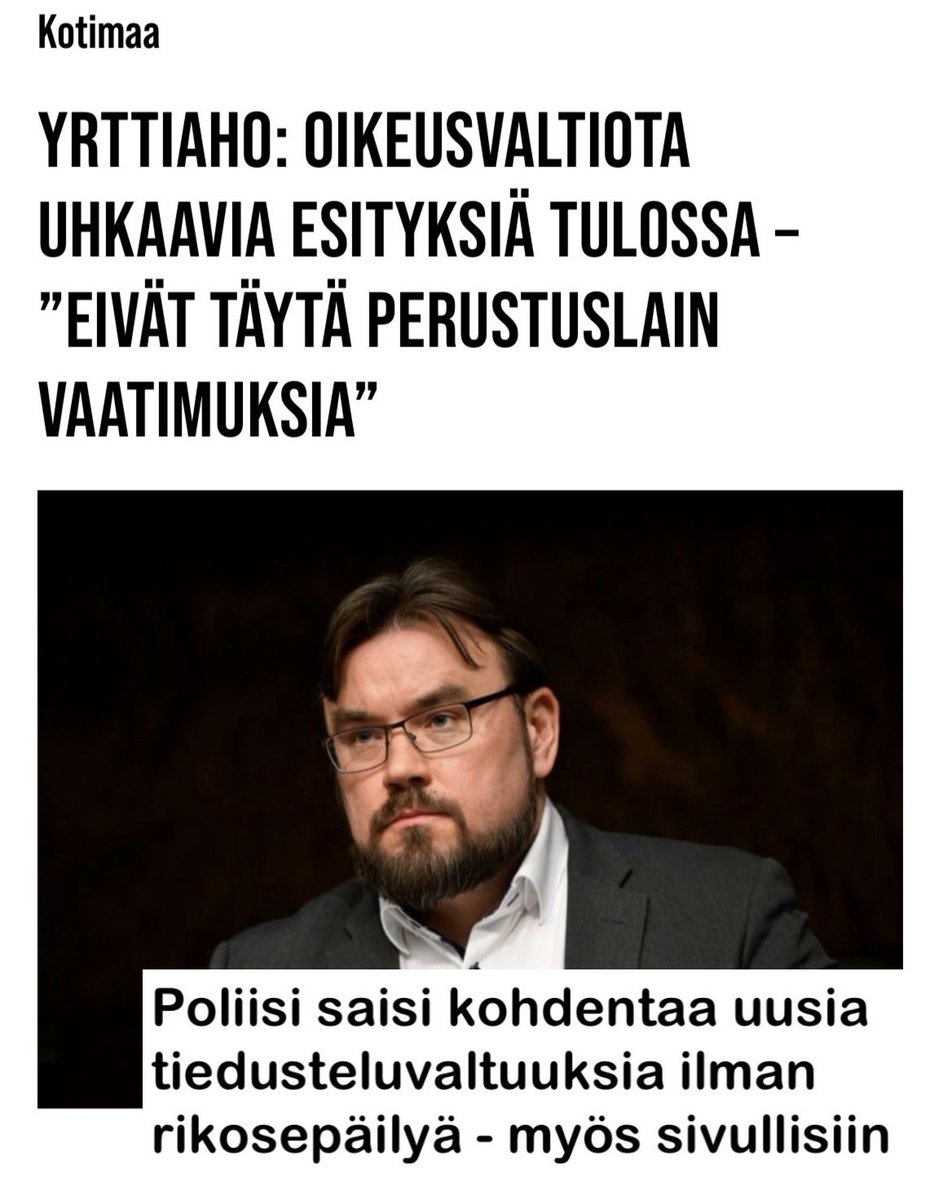
Johannes Yrttiaho stated that he had submitted a dissenting opinion to the constitutional law committee's statement on the so-called criminal investigation legislation. According to him, the proposed intelligence powers for the police did not meet the requirements of the constitution. https://t.co/3N3M5bks4b #perustuslaki #rikostiedustelu #oikeudet (translated)

Henri Vanhanen warned about Finland's security and wrote that according to Denmark's Security and Intelligence Service PET, Russia had begun sabotage operations against Danish defense companies. According to him, companies supplying weapons and equipment to Ukraine were particularly targeted. Vanhanen stated that PET assessed that Moscow had aimed to reduce European support for Ukraine through intimidation and harassment and was now trying to harm weapons production and supply chains. Vanhanen wrote that perpetrators of the strikes were recruited via social media and were first paid for photographing and gathering intelligence on targets, and later for sabotage. According to him, this allowed operations without the direct involvement of Russian intelligence officers. He warned that Russia aimed to extend the effects of the war to NATO countries and also assessed that Finland's defense industry's production facilities, subcontractors, personnel, and supply chains could be targets. Vanhanen believed that protecting them required cooperation between companies and authorities, and urged NATO to assess when individual sabotage attacks would constitute a systematic campaign against the alliance's defense capability. https://t.co/CgjnDAjDhY #Turvallisuus #Ukraina #Venäjä (translated)

The Danish security and intelligence service (PET) has announced that Russia has begun to sabotage Danish companies, especially those supplying materials to Ukraine, which indicates a significant escalation in Moscow's hybrid warfare. #Venäjä #Tanska #hybridsodankäynti (translated)

Tanska: Venäjä on alkanut sabotoida tanskalaisyrityksiä

Heavy charges of espionage, treason, and obtaining secret information for a foreign power have been brought against the German intelligence officer August Hanning, which has attracted attention in Germany and led the media to describe the case as the biggest espionage scandal of the century. #vakoilu #Saksa #tiedustelupalvelut (translated)

Saksassa vakoiluskandaali: Entiselle tiedustelupomolle raskaat syytteet

Henri Vanhanen wrote that the head of Germany's foreign intelligence had warned that Russia was waging a shadow war against Germany. According to him, the head of Germany's domestic intelligence had said that Russia was preparing sabotage and even assassinations on German territory. Vanhanen assessed that in Finland, it was sometimes assumed that Russian intelligence activities had some sort of invisible boundary of politeness that would prevent actions at people's doorsteps or overly brazen acts. He wrote that, in his opinion, Russian intelligence services did not operate according to the boundaries that Finns consider acceptable, but rather based on what works and where they are given space. According to Vanhanen, naivety was not a strong security policy. https://t.co/gjetkWxfTV #Venäjä #tiedustelu #turvallisuuspolitiikka (translated)

According to the author, thousands of secret documents had been handled unlawfully, and the charges were quite serious. He emphasized the importance of internal control and counterintelligence also in intelligence organizations. #salaisuus #tiedustelu #lainvastaisuus #FI (translated)

The author stated that the former head of Germany's foreign intelligence was suspected of espionage. According to him, the case mainly seemed to indicate that he had used classified information for the financial benefit of his own consulting company. The author noted that no clients were mentioned and hoped that there were no Russians among them. https://t.co/QH7EYnuzOl #vakoilu #Saksa #tiedustelu #DE #RU (translated)

Henri Vanhanen wrote that he had been calling for a clearer situational picture of Russia's intelligence and influence activities towards Finland for some time. He viewed positively that, according to him, the message from the Security Police and the Defense Forces about the situation was now serious: Russian intelligence operations against Finland had intensified, cyber intelligence was active, and the interest was particularly focused on the defense industry. Vanhanen noted that the chief of the intelligence department of the General Staff had assessed that the intelligence operations targeting society and critical systems could be preparation for sabotage. According to him, Finland could thus become a target of Russian sabotage activities. He also wrote that, according to the Security Police, at least one small Finnish technology company had already been subject to verifiably increased intelligence activities. Vanhanen assessed that Russia aimed to weaken Ukraine's ability to continue the war by also influencing countries, businesses, and supply chains related to Western support. He warned that problems arising for companies supporting Ukraine could raise questions in Finland about the risks of support and serve Russia's objectives. Vanhanen suggested that the security of defense and technology companies should be proactively strengthened. He urged companies to check, among other things, their cybersecurity, the protection of their facilities, approaches to personnel, data access rights, supply chains, and unusual cooperation, recruitment, and investor contacts. He stated that especially small companies should be provided with easily accessible government support for identifying threats and improving security. According to Vanhanen, Russia's goal was to get Western countries to reduce their support for Ukraine. He believed that Finland should respond to possible pressure by better protecting the people and companies enabling support rather than changing its policies. https://t.co/f0INfDq1Zf #Venäjä #Suomi #Kyberturvallisuus (translated)

The author stated that the leaders of the Security Police and military intelligence had jointly opened up the situation to the Finnish people. He saw this as a strong message that the state was vigilant and that Finns also had reason to remain alert. https://t.co/bCxSJhqPj5 #Suomi #turvallisuus #tiedustelu #FI (translated)

Yaron Nadbornik asked why the United States did not label the events in Gaza as genocide, even though some researchers did. He estimated that the difference might be due to the U.S. military leadership having access to real-time military intelligence, such as satellite imagery and intelligence cooperation, which civilian researchers, according to him, did not have. He also noted that many researchers specialized in other topics. Nadbornik argued that criticism cited organizations and institutions as needed, which had expanded the interpretation of the concept of international genocide so that Israel's actions fit within it. He mentioned examples like Amnesty's report on page 101, B'Tselem's output, and a UN committee. Finally, Nadbornik described the media as a new Pravda and wrote that those who did not accept it deserved to be canceled. He compared political correctness to the Soviet Union and sarcastically noted that no researcher should be upset. https://t.co/2MNmZd6ulU #kansanmurha #Gazassa #politiikka (translated)

S

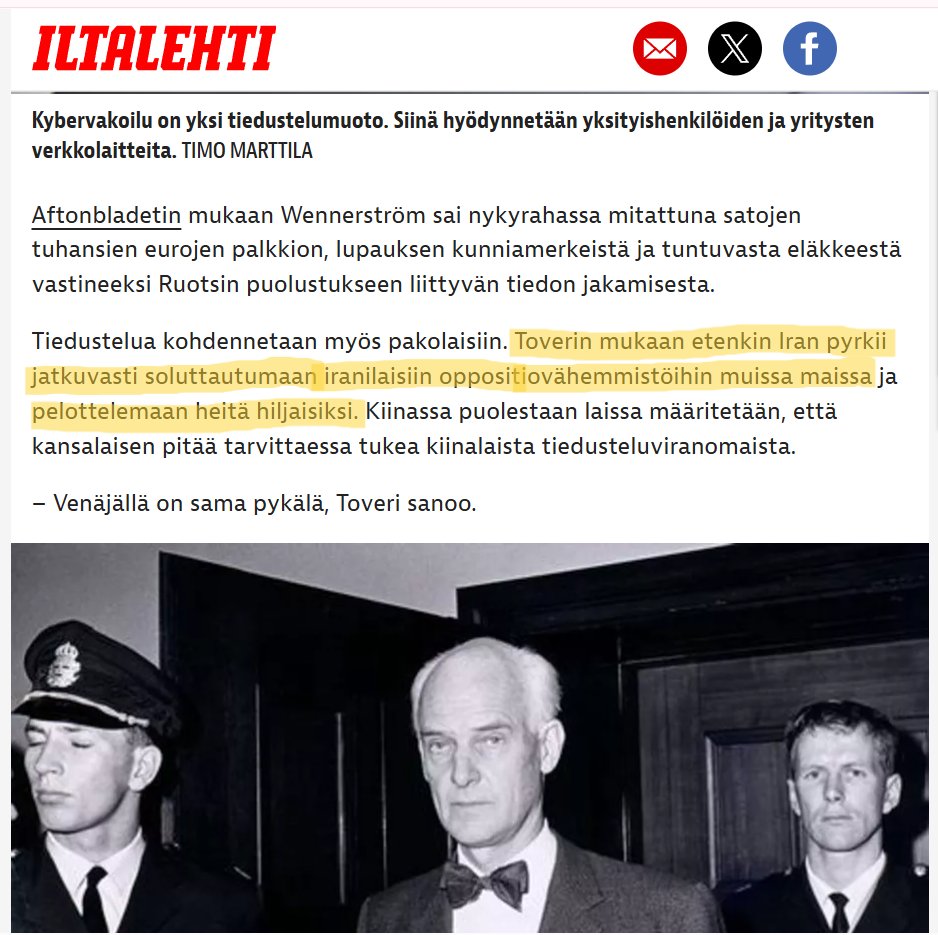
Sanna Haikala-Reyes wrote that Iran was attempting to infiltrate Iranian opposition groups, and that this had also happened in Finland. She reported receiving an English-language death threat that included a link in Persian, and speculated that the Security Police was monitoring the situation. According to Haikala-Reyes, a video recorded at a gathering of opposition activists held in Oodi, Helsinki, was sent to Iran's intelligence service. She wrote that a family member of a person who participated in the gathering while residing in Iran had been interrogated because of the video and that this person was now being threatened. Haikala-Reyes claimed that the events indicated that representatives of the IRGC (Islamic Revolutionary Guard Corps) had infiltrated the ranks of freedom activists in Finland. #Iran #Suomi #vapausaktivistit (translated)

The author wrote that the expulsion of some intelligence officers who operated in undercover roles at the Russian embassy would not hinder Russia's activities in Finland. According to him, Russia had been preparing such activities for decades, and it was likely that not all of its networks had been neutralized. #Venäjä #Suomi #tiedustelu #FI #RU (translated)

The press conference today clarified the suspicions related to parliamentarians' homes. According to Speaker Halla-aho, there is a significant number of cases. It is suspected that residences have been entered in the absence of the representatives. No signs of forced entry have been found, and nothing has been stolen, but traces have been left in the homes. The suspicions involve members of different parties, and the first case may go back as far as a year. There is currently no confirmed information about the perpetrator or motive. The background may involve criminal activity, harassment or stalking targeted at individual politicians, domestic extremist groups, or the actions of a foreign state. Not all reported cases may necessarily be related to each other. Now, it is the police's task to distinguish real intrusions from other observations and investigate possible connections between them. The possibility of a state actor must still be taken seriously. An especially interesting detail is the marks left in the homes. If the intention were solely to obtain information secretly, a successful intrusion would fundamentally be attempted to be concealed. If, instead, traces are deliberately left behind, being noticed may itself be part of the operation. In that case, intelligence is combined with psychological influence. Such methods are known in the history of Russian security services. There have been intrusions into the homes of diplomats, officials, and other individuals deemed interesting, with deliberate traces left behind. This does not prove anything about the perpetrators of these cases. It indicates why the possibility of a foreign state’s action must be thoroughly investigated. If it ultimately turns out to be state influence, the selection of targets would in itself be significant. Parliamentarians decide on Finland's defense policy, NATO cooperation, support for Ukraine, relations with Russia, and numerous other decisions in which foreign states may have strong interests. Coercion does not have to mean an attempt to change one vote in a single ballot. The aim could also be to gather information, map networks and vulnerabilities, or generate uncertainty about whether the consequences of political decisions extend to an individual's own home and loved ones. That is why Finland now needs a more open discussion about the kind of foreign intelligence, influence, and pressure directed at it. Confidential information should not be disclosed, but Finns should have a realistic understanding of the security environment in which we live and whether its change requires anything from decision-makers, companies, or ordinary people. And above all, keep a cool head. If the purpose of such acts turns out to be to generate fear and uncertainty in Finland, that is precisely the effect that should not be allowed. Serious suspicions will be investigated, efforts will be made to identify the perpetrators, and appropriate action will be taken if necessary. Finland's decisions will continue to be made in Finland, without fear and pressure. #turvallisuus #politiikka #tiedustelu (translated)

The Speaker's Council of Parliament is holding a press conference today on the security situation, as some members of Parliament have had their homes intruded upon and Russian intelligence operations may be targeting them. #Turvallisuus #Kansanedustajat #Venäjä (translated)

Suora lähetys, puhemiesten info turvallisuustilanteesta kello 13.30 – IS: Kansanedustajien koteihin tunkeuduttu

Intelligence chief Pekka Turunen estimates that the intrusion into the homes of members of parliament is part of Russia's intelligence operations and efforts to influence decision-makers. #Venäjä #Kansanedustajat #Turvallisuus (translated)

Tiedustelupomo: Kansanedustajien koteihin tunkeutuminen on osa Venäjän keinopalettia