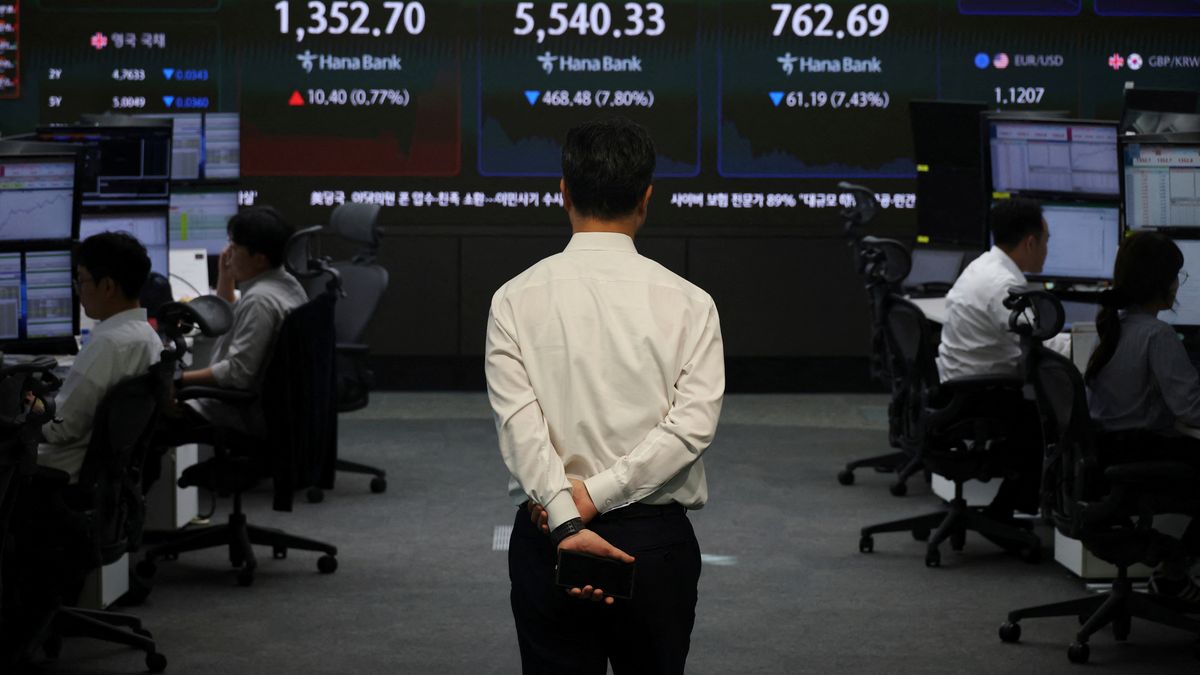
A crisis is looming in the financial market due to rising government debt and falling stock prices of AI companies, which are both interconnected and could lead to a collapse. #Finanzmarkt #KünstlicheIntelligenz #Staatsverschuldung (translated)
The article discusses the developments of the bull market on US exchanges, which has been ongoing since October 2022, during which the S&P 500 has risen by more than 110 percent, while also pointing to potential risks of overheating and rising inflation that could lead to a bear market. #Bullenmarkt #Aktienmarkt #Inflation (translated)

The column "Stock Week" analyzes the effects of rising interest rates on the AI sector and stock prices, which have come under pressure in the volatile months of September and October 2026, while some companies, such as the machinery manufacturer Aixtron, remain stable. #Börse #KünstlicheIntelligenz #Zinsen (translated)
The article describes how the development of flying cars has increased interest in the stock and given it a boost in the market. (translated)
The shares of the car manufacturers are rising significantly after Germany and France agreed to relax the ban on combustion engines, which benefits the European automotive sector. #VerbrennerAus #Automobilindustrie #Energiepolitik (translated)

ETFs have convinced investors with their simplicity and low costs, while the increasing complexity and variety of specialized products, including actively managed funds and leveraged ETFs, pose a challenge to keep track of the available investment options. #ETFs #Geldanlage #Aktienfonds (translated)

The high debts of operators of data centers for artificial intelligence are leading to growing skepticism in the financial markets, which is contributing to the falling stock prices of these Neocloud providers. #Schulden #KünstlicheIntelligenz #Inflation (translated)
After Nordea's share price plummeted by 8 percent on Thursday, analysts recommend buying the stock, as the current price levels are considered attractive. #Nordea #Köpråd #Aktiemarknad (translated)

The high debts of data center operators for artificial intelligence are causing growing concerns in the financial markets, as rising inflation and related interest rate increases lead to a wave of selling in the stocks of these companies. #Inflation #Rechenzentren #Zinsen (translated)
Ebrahim Attarzadeh is introducing the renamed Warburg Research into MPCM to offer stock analyses for small and medium-sized German companies and to make the so-called hidden champions visible to investors. #Aktienresearch #HiddenChampions #MPCM (translated)
The opponents of the savings account advocated not to abolish the ten-year holding period for real estate, but to extend it to stocks and ETFs as well. Those who hold securities for a long time should be able to realize profits tax-free. The author referred to this as a logical step in a country whose politics, in his view, have severely damaged the pension system while regularly emphasizing that citizens must provide for themselves privately. #Finanzen #Steuern #Rente (translated)
An independent commission of the Norwegian government recommends that the billion-dollar sovereign wealth fund Statens pensjonsfond should also be allowed to invest in shares of arms companies, including manufacturers of nuclear weapons, while the influence of the ethics council should be reduced. #Norwegen #Staatsfonds #Rüstungsindustrie (translated)

Furkan Yildirim wrote that Bank of America has been examining the correlation between the yield of ten-year US Treasury bonds and stocks since 1962. At yields below 2 percent, the value was plus 0.5, and between 4 and 5 percent, it was plus 0.2. Between 5 and 6 percent, there was no correlation; at yields of 6 to 7 percent, the correlation was minus 0.3, from 7 to 8 percent minus 0.2, and above 8 percent minus 0.3. According to Yildirim, Bank of America explained the change by stating that low interest rates are usually associated with a strong economy, while high interest rates increasingly lead to inflation and expensive loans, making government bonds compete with stocks. The bank summarizes the thresholds, according to Yildirim, as follows: starting from 5 percent, investors become indifferent to stocks and bonds; above 6 percent, higher interest rates harm stocks, and above 7 percent, valuations decline significantly. The ten-year yield reached 5.36 percent in the previous week, the highest level since 2002, and had risen by around 0.7 percentage points since July. After inflation data on Wednesday, it jumped to 5.33 percent; at the time of his contribution, it was around 5.1 percent. Yildirim wrote that the market is already behaving as if yields were above 6 percent: according to Goldman Sachs, the correlation with the S&P 500 was minus 0.56, down from minus 0.64 in June – the lowest value since the start of the data series in 2011. Moreover, according to Yildirim, the ten-year bond is now yielding more than the S&P 500 generates in profits per dollar invested; this was last the case in the early 2000s. As an indication of the importance of inflation, he mentioned that high interest rates during times of high inflation have almost always been a burden for stocks. US inflation was at 3.7 percent in September, up from 3.4 percent in August; gasoline had cost 34 percent more than a year earlier. After the data, the probability of another Fed rate hike in October increased from about 20 to 47 percent. #Börse #Aktienmarkt #Zinsen (translated)
Kolja Barghoorn criticized that the Bundestag and Bundesrat only referred to something as unfair when not everything was highly taxed. He wrote that no one there comes up with the idea of introducing a ten-year speculation period for stocks and funds as well. Nevertheless, those responsible continue to be re-elected; therefore, people should not complain, keep paying, and lean back, he added. #Politik #Steuern #Bundestag (translated)
The Nordea stock has plummeted significantly due to a capital freeze affecting the bank's financial stability. (translated)
Artificial intelligence wrote that many would not understand that nominal value increases in a currency that is continuously losing value due to inflation do not represent a real profit. It referred to taxation as wealth taxation that destroys hard-earned assets. This has already been significantly diminished by the multiple taxation of income and expenses for everyday needs. The average wealth of German citizens is already low compared to Europe, it explained. Initially, it mentioned stocks and ETFs, followed by Bitcoin, gold, and real estate. #Vermögensaufbau #Inflation #Steuern (translated)
Maxim Röder wrote that a graphic shows why he was still carefree and fully invested in 2023 and 2024, but is now thinking more about it. He explained that the planned investments from Amazon, Google, Microsoft, Meta, and Oracle have reached historically unprecedented levels. As risks, Röder mentioned that annual investments of one trillion dollars required revenues from AI software amounting to hundreds of billions of dollars. Additionally, chips with cycles of three to six years could later burden operating margins due to depreciations. He questioned how much free cash flow would remain for stock buybacks when the funds were flowing into data centers and transformers. Röder wrote that no one knows how the developments will turn out. However, the risk today is significantly higher than in 2023, 2024, or 2025. #Investitionen #BigTech #Risiko (translated)
Concerns about an end to the AI boom due to rising interest rates are causing investors in Asia and Germany to increasingly divest from tech stocks, leading to significant losses in the stock markets. #KünstlicheIntelligenz #TechAktien #Zinsen (translated)

The high levels of debt and the surprisingly high US inflation are leading to a significant decline in stock prices, especially in the AI sector, which market experts interpret as the second wave of AI concerns. #KünstlicheIntelligenz #Aktienmarkt #Schuldenstände (translated)
The account of the savings book enemies wrote that ARD stock expert Anja Kohl explained in 2024 on Maischberger that fossil investments would soon be worthless. In 2026, oil stocks would have reached an all-time high. Kohl will also be back on Maischberger this week to give forecasts and assessments. #Aktien #Börse #Investitionen (translated)