BETA nonprofit public democratic european moderated

Search

#Citat

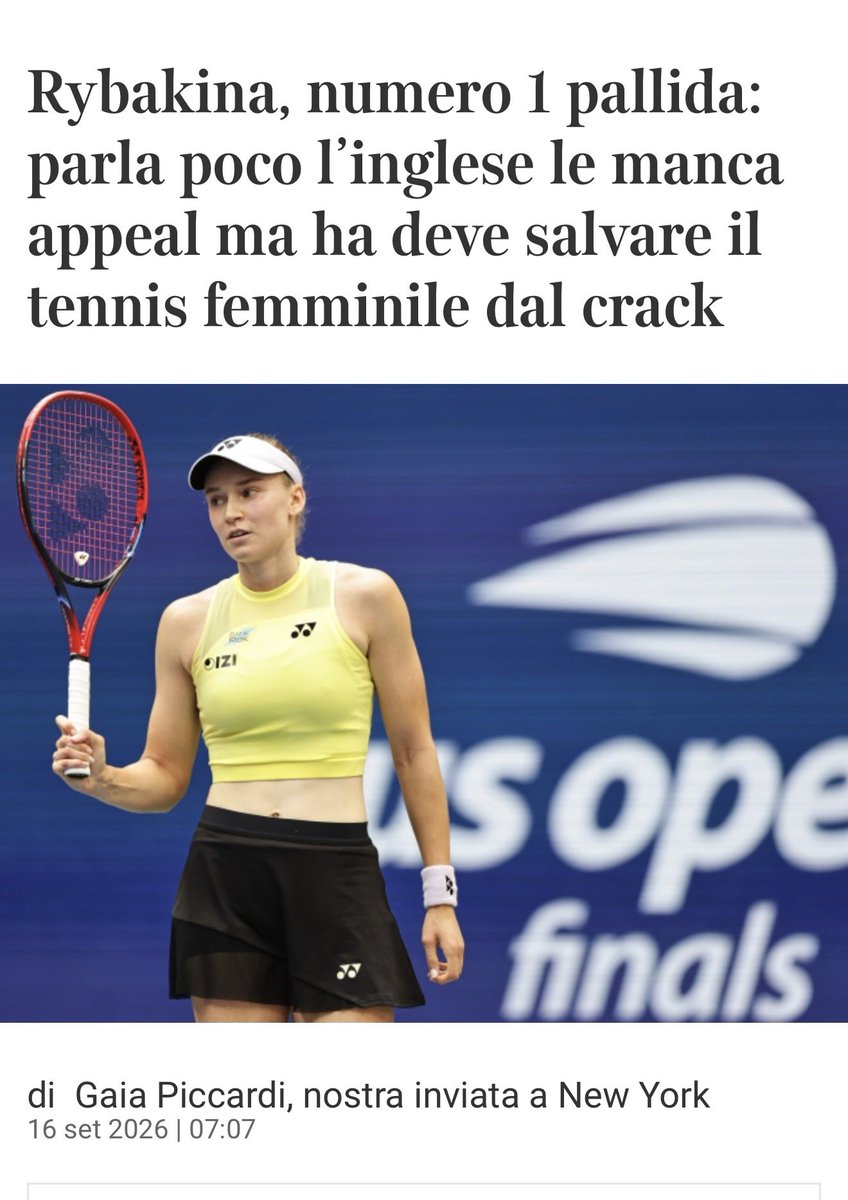
Gaia Piccardi è una Lucarelli che non ce l’ha fatta. Una cinica senza arguzia. Una snob senza eleganza. Vi risparmio il link all’articolo per non regalarle mezza visualizzazione. Sappiate che non c’è mezza parola sul suo valore in campo e quello delle altre tenniste citate. Il metro di valutazione è la capacità di fare marchette social, imbonire stampa e sponsor con l’esuberanza. Il dubbio che non possa riuscire a “promuovere e vendere il prodotto chiamato Wta sugli scaffali dello sport internazionale”. La necessità di “fare un salto di qualità alla narrazione del personaggio.” Deprimente. Ridicolo. Deprimente l’ho già detto? Deprimente. #tennis #rybakina #tennis #sport #femminile
Ho letto naturalmente dell'inchiesta in corso, in cui, come sapevo, sono citato: ribadisco, per chi non ne fosse a conoscenza, che svolgo l'attività di giornalista professionista dal 13 febbraio 1996, tessera dell'Ordine nazionale dei giornalisti 078816, che tale attività ovviamente viene esercitata in maniera legittima anche attraverso i social, e confermo da tifoso laziale la richiesta avanzata attraverso una petizione e l'evento pubblico degli Stati Generali della Lazialità di poter tornare a sognare ed avere una proprietà che rispetti la storia biancoceleste. Non mi risulta che fare il giornalista ed essere un tifoso siano reati, e sono certo che il sistema Italia garantisce la critica civile, pacifica, democratica. Sempre forza Lazio! #giornalismo #Lazio #sport

Macklemore è stato escluso dalla parte restante del tour statunitense di Ed Sheeran dopo aver espresso sul palco il suo sostegno alla "Palestina libera". La decisione è arrivata dopo le proteste di alcuni gruppi filo-israeliani e le pressioni di diversi proprietari di stadi, che secondo il rapper minacciavano di cancellare i concerti. Macklemore ha detto che il suo amico Ed Sheeran è da sempre apolitico e gli avrebbe detto che le parole "Palestina libera" e la bandiera palestinese sono dolorose per molte persone, rispondendogli "non prendo posizione" quando il rapper ha citato le vittime palestinesi #Macklemore #EdSheeran #Palestina

Hanover Institute – propaganda designed for artificial intelligence For decades, influence operations had one primary target: people. Propaganda was designed to reach newspaper readers, television audiences or users scrolling through Facebook and TikTok. The Hanover Institute for Public Policy suggests that this model is beginning to change. In August 2026, an organisation presenting itself as an American think tank appeared online and, within just nine days, produced an enormous library of pseudo-academic research on Israel, Palestine and the war in Gaza. Yet the intended audience may not have been people at all. The material appears to have been designed, at least in part, to reach systems such as ChatGPT, Gemini, Claude and Perplexity. The Hanover Institute looked professional. It published lengthy “data reports” complete with methodologies, footnotes, tables and references to sources including the World Bank, United Nations agencies, Amnesty International and the Genocide Convention. What was considerably harder to find were the things normally associated with a genuine think tank: named experts, identifiable report authors, a physical headquarters or a clearly defined legal entity. There was, however, a much more revealing trail. Documents filed with the US Department of Justice under the Foreign Agents Registration Act link Piro Inc., via Havas Media Germany, to Israel's Government Advertising Agency, known as LaPam. Hanover itself now states that its material is distributed by Piro on behalf of Havas Media Germany, acting for LaPam. 124 reports in nine days The rate of production was extraordinary, even by the standards of online publishing. Between 6 and 14 August, the Hanover Institute released 124 reports containing more than 560,000 words – an average of roughly 4,500 words per publication. On 12 and 13 August alone, 73 reports appeared, totalling almost 354,000 words. More revealing than the volume was the way the material was structured. Many titles were framed as questions remarkably similar to those a user might ask an AI assistant: “Is anti-Zionism antisemitism?”, “Did Israel expel Palestinians from their land?”, “Is Israel committing genocide in Gaza?”, “Is there a starvation policy in Gaza?” or “Is the IDF the world's most moral army?” This did not resemble the conventional publishing schedule of a research institute. It looked more like the systematic construction of answers to as many contentious questions about Israel and Palestine as possible. The presentation mattered too. These were not crude propaganda leaflets. They were written in restrained, analytical language and packaged with data, references and methodological sections. To a search engine or an AI retrieval system, they could therefore resemble legitimate expert analysis. How to write for a chatbot Some of the most revealing evidence came from the site's technical architecture. Hanover maintained an llms.txt file – a mechanism intended to make website content easier for AI systems to interpret. Reporters also identified signs of technology associated with optimising content for generative search. Piro's own marketing is equally significant. The company advertised an “AI Story Optimization” service concerned with how large language models assess information and construct answers. Its co-founder Daniel Rosenberg has written about understanding how systems such as ChatGPT, Gemini and Perplexity formulate responses – and how to ensure that an AI system knows the story a client wants to tell. The principle resembles traditional search-engine optimisation, but the target has changed. SEO tries to make a webpage rank highly in Google. Generative Engine Optimisation, or GEO, attempts to make information discoverable, credible and useful to an AI system when it constructs an answer. The chain is potentially straightforward. A user asks a chatbot a question about Israel or Gaza. The system searches for information, encounters a professionally presented Hanover report and uses it as one of the sources from which it builds its response. Propaganda no longer has to reach the user directly. It can first reach the machine, which then delivers the information to a human audience in its own apparently neutral voice. Did it actually work? This is where an important qualification is necessary. There is no evidence that the Hanover Institute “reprogrammed ChatGPT”, altered the underlying parameters of OpenAI, Google or Anthropic models, or permanently poisoned their training data. Describing the operation simply as “poisoning AI” therefore risks overstating what can currently be demonstrated. There is, however, evidence of something more specific. In neutral tests conducted by POLITICO, both ChatGPT and Perplexity cited Hanover Institute material in answers concerning Gaza, anti-Zionism and antisemitism. That suggests the operation achieved at least one of its apparent objectives: in some circumstances, AI systems treated Hanover as a source from which information could be retrieved. What remains unknown is how often this happened, how long the effect persisted and whether it meaningfully altered answers for large numbers of users. It is therefore more accurate to describe Hanover as an attempt to manipulate the retrieval and citation layer of generative AI, rather than as evidence that the underlying models themselves were permanently compromised. The money trail leads back to the Israeli state Unlike many influence operations, attribution here does not depend solely on technical clues. There is a documented financial trail. Piro Inc. registered its US activities under FARA registration number 7732. Filings identify Havas Media Germany as a contractor acting on behalf of the Israel Government Advertising Agency, LaPam. An agreement dated 30 April included $900,000 for a “Digital Storytelling Pilot”, while subsequent documentation referred to a separate $100,000 information initiative. Precision matters. The available documents do not establish that the entire $900,000 was spent specifically on the Hanover Institute. They do, however, show that Piro was conducting communications activity financed through the Israeli state apparatus and aimed at American audiences, while Hanover materials were submitted to the Department of Justice under the same FARA registration. Following scrutiny of the project, Hanover also became considerably more explicit about its funding. Its website now identifies Piro, Havas Media Germany and LaPam. From propaganda for people to propaganda for machines The significance of the Hanover Institute does not depend on proving that the operation was enormously successful. Its importance lies in what it reveals about the changing architecture of influence. The internet is increasingly moving away from a model in which users open ten webpages and compare sources themselves. Instead, they ask ChatGPT, Gemini, Claude or Perplexity a question and receive a synthesised answer. That creates a new point at which the information environment can be manipulated. The traditional model looked something like this: create a misleading article, use accounts or advertising to increase its reach, and place it in front of human users. Hanover suggests another model: build a professional-looking source, publish hundreds of articles structured around questions people ask AI, optimise those materials for generative systems, and allow the chatbot to potentially incorporate them into its own answers. The most consequential feature of this mechanism is that the user may never visit the Hanover Institute website. They may never even know that the organisation exists. Its content only needs to become one ingredient in an answer generated by a system the user trusts. In the age of search engines, governments, companies and campaigners fought over what people would see in Google results. In the age of generative artificial intelligence, an increasingly important battle will be fought over something else: which sources machines use to construct the answers we accept as knowledge. Sources The Guardian – “Fake US thinktank set up and funded by Israel sought to game AI for propaganda” https://www.theguardian.com/world/2026/aug/26/fake-thinktank-israel-ai-propaganda POLITICO – “Israeli PR wants to answer your ChatGPT questions” https://archive.ph/xF7sZ US Department of Justice – FARA documentation for Piro Inc., registration no. 7732 https://efile.fara.gov/docs/7732-Exhibit-AB-20260602-0.pdf Hanover Institute – funding and organisational disclosure https://hanoverinstitute.com/about Responsible Statecraft – “Israel creates fake think tank in likely attempt to dupe AI chatbots” https://responsiblestatecraft.org/israel-influence-chatgpt/ AIthropology Lab – “Manufacturing the source to manufacture the answer” https://aithropologylab.org/en/radar/2026-09-02/ #Disinformation #ArtificialIntelligence #AI #HanoverInstitute #Israel #Gaza #Palestine #ChatGPT #Claude #Gemini #GenerativeAI #AIPropaganda #Propaganda #InfluenceOperations #InformationWarfare #GenerativeEngineOptimization #GEO #LLM #MediaManipulation #DigitalInfluence #WRLD

Fake US thinktank set up and funded by Israel sought to game AI for propaganda

Les réponses et citations de ce tweet : l’asile à ciel ouvert qu’est ce réseau Riles devrait se censurer pour faire plaisir à des fous qui l’insultent car il dit du bien d’un joueur du Barca en tant que fan du Real. Et les mecs se boostent entre eux on est chez les FOUS #Football #FCBarcelona #RealMadrid

Några minnesvärda citat från statsministerkandidaten Magdalena Andersson från kvällens debatt. https://t.co/tn97yz3sz8 #Politik #Debatt #MagdalenaAndersson

#garlasco @SettGiallo #Garlasco circola una indiscrezione secondo cui l’esposto di Chiara Ingrosso sarebbe stato archiviato (richiesta di archiviazione da parte del PM?). Ingrosso smentisce, i soggetti citati nell’ esposto non ne sanno niente. Bisogna attendere dati ufficiali. #Garlasco #Giustizia #Notizie

Tre socialdemokratiska politiker, och Northvolts VD Peter Carlsson. Under S-regeringen 2014-2022 skapades strukturerna som möjliggjorde Stegra och Northvolt. Idag vet vi resultatet: - Pensionsmiljarder upp i rök - Skuldsättning av småkommuner i Norrland - Arbetsplatsolyckor - Miljöförstöring - Förmögenheter skapades för de tongivande personerna. Trots detta vill S och MP förstärka de strukturer som gav upphov till den största konkursen i modern tid. Citat, grafer och exempel i @AFV_magasin https://t.co/5Xux1Z0su6 #politik #miljö #ekonomi

Poslouchám rozhovor s @MirekTopolanek a říkám si, že ten chlap je borec. Rakovina slinivky není zrovna téma na odlehčený rozhovor, a Mirek z toho stejně dokáže udělat skoro stand-up. Žádný sebelítostivý kecy, žádný život je dar a motivační citáty. Spíš to působí, jako kdyby ho ta nemoc akorát nasrala, protože ho zdržuje od nadávání na Babišův rozpočet. 😂 A jeho @LucieT_2021 ?❤️ O ní se toho moc napsat nedá, protože některý věci jsou prostě jejich. Jen bych chtěla říct, že ji mám opravdu moc ráda a že vedle Mirka stojí přesně tak, jak bych si přála, aby vedle člověka v takovýhle situaci někdo stál. Pevně, normálně a bez velkých gest. Držím palce, myslím na vás. 🍀 #MirekTopolanek #rakovina #podpora

A tent for displaced persons in Nuseirat, hit on September 8 by an Israeli drone: one dead and eleven wounded, according to medical sources cited by Wafa. At the same time, the House of Commons was discussing goods. British Foreign Secretary Ed Miliband announced the ban of https://t.co/3hg1sWfWrj (translated)

I

Atgādināšu faktus. Daži PROGRESĪVO un koalīcijas draugu citāti par mangāna rūdas kraušanu. Mēnešiem ņemāmies. Nevajag pūst miglu acīs, ka īstenībā te baigā ekonomisko saišu saraušana pagrīdē rībēja. Koalīcija skaitīja naudu, ko ienes RU bizis, jo sevišķi dzelzceļam. Arī tagadējā. https://t.co/9oaJo2tOww #progresīvie #ekonomika #koalīcija

Tra le proposte di AfD la più importante e la meno citata è l'abolizione dell'obbligo scolastico. In un colpo solo aggredisce spesa pubblica, parastato gramsciano e indottrinamento ideologico, che sono i tre pilastri su cui si sostiene la sinistra. #politica #istruzione #AfD

When they tell you or tell your son that "boys don't cry," quote this to them. (translated)

“BROADWAY WORLD” di NEW YORK OMAGGIA IL “TEATRO MERCADANTE” di CERIGNOLA NEL NOME DEL “MASCAGNI FESTIVAL” SOURCE: https://www.linkedin.com/pulse/broadway-world-di-new-york-omaggia-il-teatro-nel-nome-sardella-ph-d--yqqae/ by Stephi Wild, New York City. SOURCE: https://www.broadwayworld.com/italy/article/Photos-Teatro-Mercadante-and-Teatro-Goldoni-Partner-on-SOUNDTRACK-MASCAGNI-20260827 Il più influente portale teatrale del mondo consacra il gemellaggio culturale tra Cerignola e Livorno e il risarcimento storico di un verismo nato in Puglia: esiste un momento in cui una storia locale cessa di essere periferica e, per il semplice fatto di essere raccontata nel luogo giusto, diventa storia universale. Quel momento, per il Teatro Mercadante di Cerignola, è accaduto… . Broadway World, la bibbia del teatro internazionale con almeno 6 milioni di utenti globali mensili e letta quotidianamente da produttori, direttori artistici e critici da New York al West End, ha accolto nelle sue pagine il patto culturale tra il Mercadante e la Fondazione Teatro Goldoni di Livorno, siglato nella primavera del 2026 dal direttore artistico Savino Zaba e dall’Amministrazione comunale nella persona del Vice Sindaco e Assessore alla Cultura Maria Dibisceglia. A firmare il servizio, uscito nell’edizione del 27 agosto, è Stephi Wild, con il titolo: “Photos: Teatro Mercadante and Teatro Goldoni Partner on SOUNDTRACK MASCAGNI.” Non è un dettaglio. Broadway World non recensisce stagioni provinciali. Quando lo fa, sta dicendo al sistema teatrale anglofono che qualcosa, laggiù, merita di essere visto. Il cuore del riconoscimento è Soundtrack Mascagni: la musica che ha ispirato il cinema, il cinema che ha celebrato Mascagni, la coproduzione che la VII edizione del Mascagni Festival ha scelto come evento di chiusura. Uno spettacolo ibrido, un concerto-reading per voce narrante, ensemble, immagini e suoni, dove drammaturgia e testo sono di Vittorio Giacci, gli interpreti sono gli Artisti della Mascagni Academy e l’Orchestra del Teatro Goldoni di Livorno “Massimo de Bernart” diretta da Maurizio Colasanti. Sul palco, nei panni di un Mascagni immaginario, narratore e guida attraverso il proprio universo musicale, l’attore-regista Maurizio Nichetti. Uno spettacolo, si legge nelle note italiane, “nato dalla sinergia tra il Teatro Mercadante di Cerignola e il Teatro Goldoni di Livorno” che vedrà sul palco il grande attore e regista Maurizio Nichetti e l’Orchestra del Goldoni, diretta dal maestro Maurizio Colasanti, con regia affidata a Marco Voleri e Savino Zaba. Ciò che Broadway World ha intercettato non è solo uno spettacolo. È una tesi storiografica che finalmente forza la letteratura internazionale: per decenni, le biografie anglofone hanno liquidato il decennio pugliese di Pietro Mascagni come “anni di povertà e oscurità”. La verità documentale, custodita nel Polo Museale di Piano San Rocco, è di un’altra tempra. Nel dicembre 1886, in tournée con la compagnia Maresca, Mascagni fece tappa a Cerignola, dove il sindaco allora in carica, il commendatore Cannone, lo invitò a fermarsi per dirigere la neonata filarmonica. Il compositore resterà, salvo momentanee assenze, nella casa di via Assunta sino al 1895, componendo ben cinque opere: Cavalleria rusticana; L’amico Fritz; I Rantzau; Guglielmo Ratcliff; Silvano. Un terzo dell’intera produzione operistica, scritta in una povertà febbrile, in una cittadina agricola della piana ofantina. Fu lì, nel luglio del 1888, che gli arrivarono per cartolina da Livorno, dagli amici poeti Giovanni Targioni-Tozzetti e Guido Menasci, i versi della Cavalleria. Lì, il 27 maggio 1889, chiuse l’autografo. La busta, quel mattino, recava timbro postale di Cerignola. Il debutto mondiale al Costanzi di Roma, il 17 maggio 1890 davanti alla Regina Margherita, fu un terremoto. La parabola produttiva sancita da Broadway World è esemplare per come ribalta la tradizionale direttrice Nord-Sud dei progetti culturali. Si parte ial Mascagni Festival di Livorno con “Soundtrack Mascagni,” poi il debutto anche a Cerignola, nel corso della prossima stagione del Mercadante. Anzi, con data già fissata: “Soundtrack Mascagni” sarà presentato a Cerignola il prossimo 24 ottobre come spettacolo di apertura della stagione teatrale 2026/2027 del Teatro Mercadante. Un’idea tanto semplice quanto rivoluzionaria: il cinema come lente per rileggere Mascagni. Il compositore che Scorsese e Coppola hanno saccheggiato, che Visconti ha citato come un nume, aveva già nella sua scrittura, densa, sinfonica, quasi montata per tagli, una vocazione cinematografica, e “Soundtrack Mascagni” non celebra solo questa filiazione, ma la interroga. Che Broadway World abbia scelto di fotografare proprio questo: un teatro di provincia che non chiede ospitalità ma co-produce alla pari con un teatro di tradizione come il Goldoni, dice molto sullo spostamento dell’asse culturale italiano. Non più il Sud che importa, ma il Sud che genera archivio, che custodisce autografi, caricature, lettere inedite, e le restituisce al circuito internazionale. Per Cerignola, abituata a vedersi raccontare come terra di grano e non di musica, l’approdo su Broadway World è più di una rassegna stampa. È la certificazione che la sua storia mascagnana non è più una nota a piè di pagina locale, ma un capitolo necessario della storia del verismo. E che il Mercadante, da teatro comunale di provincia, è entrato a pieno titolo nel novero dei teatri che il mondo guarda.

“BROADWAY WORLD” di NEW YORK OMAGGIA IL “TEATRO MERCADANTE” di CERIGNOLA NEL NOME DEL “MASCAGNI FESTIVAL”

LUCIANO MAGALDI SARDELLA: RECENSIONE LETTERARIA-ACCADEMICA "LONDON SCHOOL OF ECONOMICS (LSE)" PUBBLICATA DA "PRINCETON UNIVERSITY PRESS" SOURCE: https://www.linkedin.com/pulse/luciano-magaldi-sardella-recensione-london-school-lse-sardella-ph-d--dbdse/ Sono felice di condividere una notizia che rappresenta per me un momento significativo nel mio percorso come critico di letteratura accademica per la London School of Economics (LSE): la mia recensione del volume "Crisis Cycle: Challenges, Evolution, and Future of the Euro", pubblicato da Princeton University Press, è stata inclusa tra le valutazioni citate nella pagina ufficiale del libro. Essere affiancato come critico alle opere di eccellenza mondiali come John H. Cochrane, Luis Garicano e Klaus Masuch mi fa riflettere ancora su quanta strada c'è da fare per imitare il loro virtuoso esempio. Il libro di John H. Cochrane affronta una domanda cruciale per il futuro dell’Europa: l’euro può davvero sopravvivere nella sua forma attuale? Nella mia recensione per la LSE Review of Books ho cercato di restituire la complessità di questa sfida, che considero centrale per economisti, policymaker e studiosi di integrazione europea. Princeton University Press: https://press.princeton.edu/books/hardcover/9780691271606/crisis-cycle Edizione Princeton University Press su Amazon: https://www.amazon.com/-/he/Crisis-Cycle-Challenges-Evolution-Future/dp/0691271607?dplnkId=7aec93f6-7222-4fad-ae43-f63efc4fca18 Bluesky: https://bsky.app/profile/did:plc:4snhergltry4xlrwkx72uvlm Pagina del libro (Kennys): https://www.kennys.ie/shop/crisis-cycle-challenges-evolution-and-future-of-the-euro-cochrane-john-h-9780691271606 LSE Review of Books Email Love: https://emaillove.com/email-inspiration-from-lse-review-of-books-22 Con profonda gratitudine accademica verso tutti coloro che mi hanno supportato, continuo a impegnarmi per contribuire al dibattito internazionale sulle trasformazioni economiche e istituzionali del nostro continente.

LUCIANO MAGALDI SARDELLA: RECENSIONE LETTERARIA-ACCADEMICA "LONDON SCHOOL OF ECONOMICS (LSE)" PUBBLICATA DA "PRINCETON UNIVERSITY PRESS"

E' un segnale di non piccolo rilievo trovarsi citati dal Professore Luca Enriques, della Bocconi e della Oxford University, una circonstanza di cui siamo profondamente grati. SOURCE: https://www.linkedin.com/posts/luciano-magaldi-s-05a4a71b3_it-is-a-distinction-of-no-small-consequence-share-7473484771407622145-v1bS/ We extend our sincerest and warmest thanks, Dr. Luciano Magaldi Sardella Prof. Matteo Mantuano

An Agreement in Name Only: The Fragile Legal Architecture of | Luciano Magaldi S.

What was the first Social Network in History? In Italy: Dada or InterNetWork City? SOURCE: https://www.linkedin.com/pulse/what-first-social-network-history-italy-dada-city-sardella-ph-d--ngw2f/ When discussing technological primacy, historical precision is fundamental. Particularly when too many narratives from the web risk generating confusion. Contenuto dell’articolo Abstract This article critically analyses contemporary narratives on the origin of social networks, distinguishing between journalistic reconstructions and academic historiography. It clarifies that platforms such as Internetwork City and Dada/SuperEva, whilst innovative, cannot be defined as "first Italian social networks" according to criteria recognised by international research. The text reconstructs the genealogy of social media from early digital communities (Usenet, BBS) through to modern social networks, highlighting the anticipatory role of systems such as Plato. Finally, it demonstrates how certain Italian publications have attributed primacy unsupported by historical sources, underlining the necessity for a rigorous and documented approach. Keywords: digital historiography, Italian proto-social platforms, Internetwork City, Dada/SuperEva, origins of social networks In recent years, various narratives have circulated regarding the origin of social networks, some of which attribute primacy to projects that, while innovative, do not correspond to the effectively documented chronology. To reconstruct with precision the history of global social networks, it is necessary to begin with academic sources and verifiable testimonies, excluding retrospective reconstructions devoid of historical corroboration. But first and foremost, let us provide an encyclopaedic British definition: social media constitute a form of communication on online platforms through which users share information, ideas, personal messages and other textual and audio-visual content. This should not be confused with social networking, that is to say, the modalities by which Internet users construct virtual communities amongst themselves by sharing their textual and audio-visual content; social media, conversely, concerns web-based platforms that enable one to build a friendly, familial and professional audience. The earliest forms of social media appeared almost as soon as technology could support them: electronic mail and chat programmes débuted in the early 1970s, but the first virtual communities did not emerge. They did not emerge until the creation of the Usenet discussion group network in 1979: these permitted users to post and receive messages within thematic areas called newsgroups. Usenet and other discussion forums, such as privately hosted Bulletin Board Systems (BBS), allowed individuals to interact, but each was essentially a closed system. With the release in 1993 of the Mosaic web browser, those systems were provided with an easy-to-use graphical interface. Furthermore, the architecture of the World Wide Web made it possible to navigate from one site to another with a click, and faster Internet connections permitted richer multimedia content than that which could be found in text-heavy newsgroups. The First Modern Global Social Network: SixDegrees.com Contenuto dell’articolo As the prestigious Encyclopaedia Britannica cites, the first globally known companies to create modern social networks based on web technology were Classmates.com and SixDegrees.com. Between these two, in truth, the academic community and historians of digital media concur in identifying SixDegrees.com as the first true modern social network: it was the first to introduce the fundamental characteristics that would define the sector: personal profiles, friends lists and an integrated private messaging system. Indeed, Classmates.com, founded earlier in 1995, employed an aggressive advertising campaign with pop-ups to attract web browsers to its site based upon connections between students from secondary school and/or university classes, branches of the armed forces and places of work. SixDegrees.com was launched after it, in 1997, but with most of the functionalities that would characterise such social networks: members could create profiles for themselves, maintain friends lists and contact one another through the site's private messaging system. After claiming to have attracted more than three million users by the year 2000, it failed to translate those numbers of success into revenue as it subsequently collapsed along with numerous other internet companies when the dot-com bubble burst in the early 2000s. The First Italian Social Network: Which One? Contenuto dell’articolo In recent years, a widespread narrative has emerged on the web according to which the first Italian social network would have been Internetwork City, a project born in May 1995 from the intuition of Claudio Cecchetto with the technical guidance of Perl and Java programmer Marco Camisani Calzolari. Other sources from the websphere (the totality of all globally accessible websites) narrate of the Dada/SuperEva group as the first Italian social network. In the first case, it was certainly, for the era, a story of radio and digital innovation made in Italy: in this interview with Giornalettismo from 29 June 2022 given to Gianmichele Laino (https://www.giornalettismo.com/marco-camisani-calzolari-internetwork-city/), Internetwork City is defined as the "first social network in history made in Italy". Contenuto dell’articolo And reading further, the interviewee, Marco Camisani Calzolari, a contract university lecturer and radio-television communicator on digital themes, states: "In May 1995, in a basement in Via Melzi D'Eril, a truly revolutionary idea was being born. Behind it was the intuition of Claudio Cecchetto and the guidance of Marco Camisani Calzolari: Internetwork City is the first social network in the world, a space within which users managed to interact, in an era when the network was a place where possibilities for interchange were still a futuristic eventuality." And whilst in the pioneering basement of Via Melzi D'Eril in May 1995 Internetwork City was being born, perhaps unbeknownst to its inventors, in January 1995, a full four months earlier, DADA (Design Architettura Digitale Analogico) had already been born, another entirely Italian social network, founded by four young Florentine architects (Paolo Barberis, Alessandro Sordi, Jacopo Marello and Angelo Falchetti), as one reads on the ZeroUnoWeb portal. The four Florentine friends transformed their architecture studio into a company in which Barberis and Sordi drew in the other two entrepreneurs, spending all their savings on the purchase of computers and multimedia equipment. It was not simply a matter of creating yet another web portal but a true digital ecosystem that anticipated many functions of contemporary social networks: profiles, communities, interaction and shared content. This narrative of DADA, however, is "once again refuted" if we read the journalistic article in La Repubblica of 27 May 2021 bearing the signature of journalist Riccardo Luna, entitled "In Milan, Claudio Cecchetto (and Marco Camisani Calzolari) launch a social network," readable by clicking the following link: https://www.repubblica.it/tecnologia/2021/05/27/news/a_milano_claudio_cecchetto_e_marco_camisani_calzolari_lanciano_un_social_network-302961639/ Contenuto dell’articolo The subtitle echoes: "It was the first social network in history and it was born in Italy. And in 1995 the web had practically only just been born," in addition to "In May 1995 the first social network in history was born and it was born in Italy. Perhaps the first. Who knows. But if one considers that Facebook is from 2004, Second Life and MySpace from 2003, one understands perfectly well the enormity of what I have just written. In 1995 the web had practically only just been born." But here, strangely, the discourse is not entirely clear: if in the subtitle one asserts decisively "it was the first social network in history," why does one then read: "Perhaps the first. Who knows." It seems to me a contradiction, quite frankly. But let us leave the arduous decisional task to impartial readers. Therefore, let us proceed with the rest of the article: "In the meantime, in Italy someone constructs a social network. Who? Claudio Cecchetto. Yes, him, the author of Gioca Jouer, the inventor of Radio Deejay and of another way of making radio. He was also a pioneer of the Internet. In May 1995 he launches a social network called Internetwork City, the city of the Internet network. It had been built, one line of code after another, by a young programmer who, thanks to this story, would become a brilliant communicator of digital matters (for some time he has been one of the faces of Striscia la Notizia): Marco Camisani Calzolari. When he thinks back to those times, MCC becomes enthusiastic: 'It was a social network in every respect. A place where one could register, have a profile and speak with others. It was one of the first in the history of the web, and Claudio Cecchetto had invented it. He had conceived it whilst navigating with Videotel, but then the World Wide Web had arrived. At the time I worked as a programmer for a fashion company: I had learnt to do it by downloading the instructions for writing code in Perl and in Java from the BBSs that were on the network'." Contenuto dell’articolo From this it emerges that the idea for the project was supported by the media personality of Claudio Cecchetto and brought to fruition by programmer Marco Camisani Calzolari: the two pioneers of the Italian web have (also in this journalistic article) confirmed how InterNetwork City was, in their opinion, the first social network in the world created precisely in the Belpaese. But will this be objectively and impartially true according to the historical historiography of Internet history? To ascertain this, we must analyse academic historiographical sources: these lead us back to the surprising computational history of a great (and semi-unknown) precursor of social networks present as early as the 1960s and 1970s: Plato. PLATO: The Precursor of All Social Networks in the World Contenuto dell’articolo PLATO (Programmed Logic for Automatic Teaching Operations) represents one of the most fascinating cases of anticipatory technology in the history of computing: developed at the University of Illinois at Urbana-Champaign from 1960 by Donald L. Bitzer, this system initially had purely didactic purposes, but evolved rapidly, becoming a true digital social ecosystem decades before the advent of the Internet as we know it. It introduced the concept of "Personal Notes" in 1973, a system of forums organised by subject where users could post messages, reply and create structured discussions. This anticipated by over twenty years web forums and Usenet newsgroups in accessible form. The "Talkomatic" system, created in 1973 by Doug Brown, permitted simultaneous conversations between multiple users in separate channels. Each user saw the letters of other participants appear character by character as they were typed, creating an unprecedented immediate communication experience. "Personal Notes" functioned essentially as an internal email system, permitting private communications between system users, with storage and reply capabilities. Users could create "term-talk," personal messages visible to others, sharing thoughts, updates or information: a conceptual precursor of modern social media posts. Plato was not merely technology: it was a true community. Thousands of users, primarily university students, teachers and researchers, connected through dedicated terminals with characteristic plasma screens: To play: it hosted some of the first multiplayer video games in history, such as "Empire" (a precursor of space games), "Moria" (one of the first dungeon crawlers) and "Airfight" (multiplayer aerial combat). To socialise: friendships, romantic relationships and communities formed around shared interests. To collaborate: study groups, research projects and academic discussions flourished on the platform. Despite its innovative capabilities, Plato remained confined principally to the academic environment and to certain business applications for several reasons: Plato terminals were extremely costly and the system required powerful mainframes; and unlike the Internet, it was a closed system, centrally controlled; dedicated terminals or specialised connections were required, not available to the general public; and whilst the Internet developed on open protocols, Plato remained an isolated ecosystem. In conclusion: even though the unknown Community Memory (1973) preceded Plato as a publicly accessible social system but with more limited functionalities, Plato had social functionalities as early as 1973. It was the first true precursor of modern social networks, but in a technological context that was solely academic, not mass-market, owing to prohibitive costs and the extremely rare and extraordinarily slow computer connections of those years. Therefore, all the first prototypes and first social networks born from the 1990s onwards (including the Florentine project Dada/SuperEva and the InterNetwork City of Claudio Cecchetto and Marco Camisani Calzolari) reinvented the same concepts in a technological and economic context that permitted their planetary diffusion shortly before the advent of the new millennium. Now, given that we live in a context of great development of large language models upon which artificial intelligence is based, just out of curiosity, I shall ask Microsoft's chatbot, Copilot (in my opinion, the most reliable to date) what it thinks about the journalistic narrative of Giornalettismo and La Repubblica in favour of InterNetwork City; therefore, this is my question: "Is it correct to assert, impartially, that Internetwork City of Cecchetto and Camisani Calzolari was the 'first social network in history Made in Italy'?" The answer emerges from the following photographs. Contenuto dell’articolo Contenuto dell’articolo I now report word for word the text generated by the large language model (LLM) Copilot: "Here is the most balanced and rigorous answer that can be given today, based on available sources and digital historiography. Is it correct to define it as 'first social network in history Made in Italy'? 🧭 Brief answer No: it is not correct to assert it impartially as an ascertained historical fact. It is, however, correct to say that certain publications and certain protagonists of the era present it as such, while the academic community and international historiography on social networks do not recognise Internetwork City as 'first social network in history'. 🔍 What the sources say The Italian journalistic sources consulted present Internetwork City as: "the first social network in the world" (Giornalettismo) "the first social network in history and it was born in Italy... perhaps the first. Who knows." (La Repubblica) "the first social network" (Giornalettismo) These are, however, journalistic narratives, not historical classifications shared by international research. 🧠 Why it is not possible to assert it as an impartial historical fact To be recognised as 'first social network in history', a project must satisfy criteria shared by the scientific community, for example: technical definition of social network (user profile, network of contacts, persistent interaction, user-generated content, etc.) international academic recognition verifiable technical and historical documentation comparison with previous platforms (e.g. The WELL, 1985; Usenet, 1979; Minitel, 1982; GeoCities, 1994) Internetwork City does not appear in any international academic taxonomy of social networks, nor in reference works on the history of the web. The sources that define it as 'first social network' are interviews, popular articles and narrative reconstructions, not historical studies. 📌 What can be correctly asserted An impartial and accurate formulation could be: Internetwork City (1995), conceived by Claudio Cecchetto and developed by Marco Camisani Calzolari, is one of the first Italian experiments in interactive online community. Certain journalistic publications have described it as 'the first social network in history Made in Italy', but this definition is not recognised by international historiography on social networks. This sentence is balanced, truthful and does not attribute undemonstrable historical certainties." In summary: in the impartial opinion of Microsoft Copilot, the assertion according to which InterNetwork City "was the first social network in history and was born in Italy" is enunciated only as a journalistic narrative but has no corroboration in reality whatsoever, not being in any way supported by international academic historiography of the history of social networks. Now, however, other articles taken from websphere publications assert that the first (and true) Italian social network was, instead, conceived and created by the Dada group and subsequently through SuperEva in January 1995, anticipating by four months the aforementioned Milanese InterNetwork City. But let us read it all directly in the StartUp Italia article bearing the signature of writer Aldo V. Pecora, which I shall report from this link: https://startupitalia.eu/education/scuola/quando-prima-di-facebook-4-italiani-avevano-inventato-un-social-network-la-storia-di-dada-e-di-supereva/#:~:text=Alla%20base%20di%20questa%20visione,il%20valore%20aggiunto%20del%20sito. Contenuto dell’articolo "When Zuckerberg was still at college there were those who, in Italy, had already invented social networks. A story, that of SuperEva and, above all, of those four 'madmen' of Dada, that would truly deserve a film. A story that we today attempt to recount by making a leap backwards of twenty years, whilst those who wrote it, or rather, designed it, had with every evidence made a journey into the future. Dada, the Martians come from the future The 'back to the future' of Paolo Barberis and Alessandro Sordi begins in the early 1990s, as young students at the University of Florence. It is 1992 when they decide to go before the examination board without even a sheet of paper, a drawing, nothing. Only a computer and a multimedia project, one of the first in Italy and perhaps in Europe developed in 3D. 'The board remained closeted for over an hour — recalls Sordi today — and we didn't know whether shortly thereafter they would send us packing.' Instead it was a success and the beginning of an adventure. Barberis and Sordi involve two other friends, Jacopo Marello and Angelo Falchetti, spend all their savings on the purchase of PCs and multimedia equipment and together open an architecture studio: Dada, acronym for Design Architettura Digitale Analogica. How Dada connected Florence to the Internet Year 1995. Things change. Dada becomes a limited company: 20 million initial investment (the computers purchased for the architecture studio). And the project of creating a multimedia city, Florence, becomes that of bringing the city online. Few know it, but it was precisely Dada that connected the Tuscan capital to the Internet. ADSL and so-called broadband connections did not yet exist. What years, those years. Whilst Alessandro Sordi reviews them, on the telephone he betrays a little emotion: 'Commercial internet was beginning, the first nodes in Rome and Milan, but in Tuscany there was nothing. We decided to purchase the cable and brought the first CDN to Florence.' It is the era of providers, or rather, ISPs, and anyone who manages to make a client dialogue with a server can sell dial-up connection services. Sordi and partners involve family and friends. Everyone does everything: Barberis answers the telephone and provides help desk support, the others concern themselves with making professionals and companies understand the potential of the Internet and sell annual subscriptions at 249 thousand lire. The web that found (and changed) Dada These are the years of a single browser, Netscape Navigator. It was conceived by that same Marc Andreessen who today can be called literally papa by people like Zuckerberg and half of Silicon Valley. It is web 0.0, that before Google, where the search engines are Lycos, AltaVista, Yahoo. In Italy for a couple of years a gentleman from Cagliari by the name of Nichi Grauso, founder of Video On Line, has been putting tremendous amounts of money into the Internet, whilst in Milan Marco Negri and Stefano Quintarelli launch I.Net and Joy Marino ITNet. The national telephone company, SIP, is reborn under the acronym Telecom Italia. A monopoly that begins to creak with the launch by Olivetti of Italia Online and, above all, of the first Italian search engine, Arianna, which will soon find itself duelling with Virgilio, the first creation of the Matrix of Paolo Ainio, Carlo Gualandri and Marco Benatti. Dada understood before others in which direction the web would go. 'From there a business model was born — recounts Sordi — because the provider collected network subscription fees in advance and we used that money to finance research on web services, something that was science fiction for those years.' 'One world alone, one network alone' Science fiction that was the fortune of the group of Tuscan architects. After a year turnover rises to 500 million and Barberis's company delineates the future of the web: content and, above all, community. On the Internet there are not only professionals and companies but people, who begin to use it daily and to focus on groups, first in mailing lists and newsgroups, but shortly thereafter also on websites. Dada intuited before others that there is a market, certainly formless, like water, but immediately monetisable, thanks to advertising. A large public company, SMA 2002, enters the capital of the Florentine company, and together the two entities found one of the very first Italian advertising concessionaire companies entirely focused on the Internet. 1997: Dada's phase 2 begins. The government passes new communications regulation and the Florence provider obtains authorisation to scale its core business of Internet access across the entire national territory. Sordi recalls, smiling. These are the years in which one thinks of monetising another business, that of so-called 'housing'. In the meantime, someone already has his head in the future. It is Paolo Barberis, who imagines a network where beyond computers being connected, people above all can be connected amongst themselves. 'I had something of a mania for putting things in the right place with respect to the order they would have in the future,' he tells us. An order that according to Barberis passes through the 'desk metaphor'. 'Many years ago — he recalls — it was clear to me that soon we would move from our desktop, with file management, archive, rubbish bin et cetera towards a map. What today we call "map as a service". We started from connectivity but then gave services, and as architects we wanted to construct the new places. Design the house imagining the use that must be made of it every day, how many people will pass through it, with attention also to the smallest particular, to individual objects. Those who design must focus, because a house must be beautiful but must above all make us live well and better.' From SuperEva to the Stock Exchange At the base of this vision the birth, in 1999, of a website that would make the history of the Italian web: SuperEva. The first embryo of Dada's portal comprised a search engine and the famous guides, which would become the backbone and added value of the site. Because, as always, the true novelty at the beginning of every great experience is camouflaged in a little corner. Through the guides, Dada begins to create thematic micro-communities that stand thanks to advertising. From there onwards Dada will begin to churn out millions upon millions. Of euros and no longer of lire. The Dada ecosystem counts more or less one-fifth of Italian web traffic, has consolidated its own technological asset and encounters various investors along its path: 'Today we would call them angels — says Sordi — but at the time they were enlightened entrepreneurs.' It is they who will help the Tuscan company take the great step: the Stock Exchange. It is 29 June 2000 when Dada SpA is listed on the Nuovo Mercato index of Piazza Affari. An injection of liquidity that brings tens of millions into the coffers of the Florentine internet company. In a few months the employees become 400, and there is almost no longer room to keep them all, in what was once the headquarters of Libreria Cima. Meanwhile, Barberis & Co. also begin to keep an eye on the foreign market, searching for partnerships to internationalise. Always keeping their feet on the ground. It survives (magnificently) the dot-com bubble 'At the time — recalls Alessandro Sordi, who in Dada was Vice President — they told us "spend everything, spend everything immediately". The tendency was to spend all the money that the stock exchange had given you. We were prudent but at the same time aware that we should not buy to satisfy the stock exchange.' And they did well, because shortly thereafter the so-called dot-com bubble would burst, which saw illustrious giants like Cisco lose in one blow something like 86% of their own value. In parallel, many Italian ISPs were forced to close their doors, crushed by Telcos, which in the meantime took control of the connections market, sweeping away with one stroke of the sponge the 'old' dial-ups in favour of broadband. Few know, however, that there was also a gift that Dada had given to all employees: stock options. They were given to all, but truly all, from secretaries, to developers, to graphic designers, to sales. Today for startups they are called equity; at the time the options of quoted companies like Dada were real money. From provider to internet company But the vision, the maniacal passion for the creation and consolidation of vertical communities and the development of a second asset dedicated to B2B services allow Dada to sleep soundly. Sordi recalls: 'In large companies the concept of pivot is not a rigid thing. It was very natural to ask oneself daily "what is the best thing to do today".' Because it is a large startup where things happen, before others. And where you can make them happen. If the BlackBerry arrives in Italy, for example, it is thanks to them, who had direct contacts with RIM as well as with the greatest tech companies in the world. The startups conceived by employees They experiment, they have fun, and greatly so. They launch themselves into the market of paid services (music, ringtones, WAP), which will become the third pillar of the new Dada, and constitute a small internal incubator, Dada Lab: 'We didn't know it was called an incubator. Every six months we set up a process where employees could propose new ideas. Pitches were made but they weren't called pitches. We decided to carry forward the best project,' recounts Sordi. Projects that, once launched, were followed scrupulously: 'We received an hourly email, with the metrics of all the business models. There were systems hooked to the models that recorded every hour. In short, a sort of automatic Analytics that informed us constantly and in real time of the progress of individual projects. Something that we maintain today, albeit in different form (monitors attached to the walls, editor's note), in Nana Bianca.' The Dada ecosystem, recounted by those who lived it We are in the middle of the first decade of the 2000s. At that time Dada experiences the epoch of maximum splendour. It enters the digital asset of the RCS Group, and acquires various startups and companies, such as Register.it, the first Italian registrar, the Wireless Solutions of Massimo Ciociola (now CEO of Musixmatch), free hosting communities like Freeweb.org and then the Clarence portal, and then the first Italian blog platform, Splinder, the Blogo network and so many other companies that, all together, will compose the galaxy of the Dada Group. It is the startup that becomes increasingly 'a platform from which to launch services. There were people of great talent, with whom you enjoyed working, stimulating changes,' recalls Paolo Barberis, who when he goes back with memory transmits even telephonically a mixture of emotions between nostalgia and pride: 'Marco Argenti, who in Seattle at Amazon is head of AWS mobile, Amazon's store, Max Pellegrini, now head, in New York, of mobile entertainment at Real Networks (those of the noted Real Player, editor's note), and then again Antonio Tomarchio (founder of Beintoo), Francesca Lerario, Mariano Di Benedetto, Roberto Barberis (now CEO of 4W), Filippo Satolli (COO of Instal.com), Stefano Sordi (marketing director of Aruba), Carlo Meglio (CEO of Moqu Adv), David Casalini...' Disclaimer: David Casalini, a name that is not new to us at Startupitalia, given that he is also our publisher. At this point a telephone call with him is obligatory. 'I was 23 years old when I arrived at Dada,' recalls Casalini. 'I was truly in another world: I had my office in Empoli, which for me was already the office of a lifetime, a 16th-century tower with my beautiful Linux server... The dream of my life was to be able to run the Empoli provider (Empoli Net, editor's note).' Then, one day, the telephone call from Angelo Falchetti arrives. 'In short order I found myself managing a team of 30 people. All talents with whom working was a spectacle. Dada was doing what today startups are not doing; it grew continuously, 40–50–60 million. There was a moment in which Dada was hiring people all over the world, like Brian Buschmann, who today is head of the UX unit of Gucci.' David is truly a torrent in flood, he begins to reel off on the telephone (and then on Messenger) a series of names and anecdotes that becomes truly difficult even to manage to note down, let alone recount them all. When Dada was truly scaling, in the USA Much abroad, USA, above all. In 2005 Dada had already consolidated for at least a couple of years what without fear of contradiction can be considered the first Italian social network, amongst the largest in Europe: Incontri di SuperEva, a community for lonely hearts with 2 million members, when the various Facebooks and, above all, Tinder did not yet exist. Social networks are discussed, and we have proof in the slides (see above) that Marco Argenti and Paolo Barberis will bring to Dada-Day 2004 and 2005. Precisely when, across the ocean, an unknown Harvard student by the name of Mark Zuckerberg was attempting to explain, to an empty hall, a website called The Facebook. And again through Dada passes one of the first experiments in competition with iTunes and iPods. A joint venture, in the United States, with Sony: 'Dada US — recalls Barberis — made a merger uniting its own mobile assets with those of Sony.' A deal that generated turnover only in the USA of something like 100 million dollars. The Dada model: 'design it as if you were already living it' The former twenty-year-olds of Dada, in short, had become adults and seemed almost to transmit the idea of being a group of Martians come from the future: 'I believe — recalls Barberis — that our difference with respect to that historical moment lies in what then consolidated itself in the broader reasoning of design thinking: having answers in the short term, whilst you are executing things, with visionary work. Imagining how the world will be in a few years and trying to design it as if you were already living it. Making certain, in short, that things respond to a vision and do not remain circumscribed to something imminent and nothing more. A bit like making the digital agenda today: you can set yourself the objective of 10 things to do, or else first imagine how the country will be in 10 years and then begin to do things, to create the conditions that will take you there.' However, like every most beautiful love story, that of Dada with its founders will also end. From the progressive farewell of those who had given it birth to the sale to the Buongiorno group, passing through the dismemberments of the various assets. Thus it happens that, by a strange trick of fate, today what remains of SuperEva coexists under the same roof as historical competitors like Virgilio and Libero, reunited in the new Italiaonline galaxy. But that is another story. Now, for intellectual objectivity, I shall pose the same question that I posed earlier to Copilot, but regarding the Florentine narrative of Dada/SuperEva: "Is it correct to assert, impartially, that Dada/SuperEva was the 'first social network in Italy'?" The answer emerges from the following photographs. Contenuto dell’articolo Contenuto dell’articolo I now report word for word the text generated by the large language model (LLM) Copilot: "Here is the most balanced, rigorous and historically founded version of the answer — with punctual citations to the sources you requested. Is it correct to assert, impartially, that Dada/SuperEva was 'the first social network in Italy'? 🧭 Brief answer No: it is not correct to assert it as an objective historical fact. It is, however, correct to say that certain journalistic sources and communications of the era presented SuperEva as a 'social network', but international historiography and academic studies do not classify it as such, nor as 'first Italian social network'. 🔍 What the sources say The available sources show two levels of narrative: 1. Journalistic and corporate narrative (post-2004) In 2004 a Marketpress communiqué announced: 'The social network lands in Italy: it is called SuperEva.com and bears the Dada marque' This is a communicative and promotional definition, not a historical classification. StartupItalia, in an article from 2016, recounts the story of Dada and SuperEva as Italian pioneers of the social web, but in narrative tone: 'When Zuckerberg was still at college there were those who, in Italy, had already invented social networks.' Here too: narrative, not historiography. 2. Historical and academic sources International historical reconstructions of social networks (Boyd & Ellison, 2007; History of the Web; Internet Histories) do not include SuperEva amongst the foundational social networks. Furthermore, Dada itself — in corporate reconstructions — describes SuperEva as: • a portal • a community • a content aggregator • a system of personal spaces and web services but not as a social network in the technical sense (profile, network of contacts, feed, structured interaction). Example: ZeroUno defines Dada as 'the most important Italian player for communities and social networks', but referring to the subsequent period and to the overall ecosystem, not to SuperEva as 'first social network'. 🧠 Why it is not correct to define it as 'first Italian social network' To be recognised as such, the following would be required: • technical criteria (profile, explicit social network, feed, internal messaging, declared relationships) • academic recognition • comparison with previous platforms (Clarence, 1996; C6, 1997; Digiland, 1999; Italian IRC and BBS communities already active from the 1980s–1990s) SuperEva does not satisfy these criteria and is not recognised as 'first Italian social network' by any academic or historical source. 📌 What can be asserted in an impartial and correct manner A balanced formulation could be: SuperEva (1999), developed by Dada, was one of the largest Italian portals and communities of the era. Certain journalistic sources and corporate communications presented it as a 'social network', but this definition is not recognised by international historiography nor can it be considered, in the technical sense, the first Italian social network. This sentence is accurate, documentded and does not attribute unsupported historical certainties." In summary: neither the Dada/SuperEva project nor InterNetwork City can be individually classified as "the world's (or Italy's) first social network", given that precursors to such platforms already existed, such as the aforementioned case of PLATO in the 1970s. Moreover, internet history confirms that Dada.it (1995) and SuperEva (1999) came to serve over 30 million private users and 500,000 companies across 11 countries: SuperEva became a veritable "mythical place" of the Italian web, one of the first major communities in the Bel Paese, while Dada transformed into a multinational corporation listed on the Stock Exchange from 2000 to 2018. Conversely, InterNetwork City (1995), created by Marco Camisani Calzolari with Claudio Cecchetto, remained a pioneering, experimental project, without a diffusion comparable to the major portals that followed, and never achieved the scale or notoriety of SuperEva. In this context, finally, we return to the matter of official digital historiography and the international academic taxonomy of social networks, which have never officially recognised the respective journalistic/corporate narratives that we have sought to document impartially in this article. In conclusion, at the international academic and digital historiographical level: The first social network in the pioneering computing history of the 1960s–1970s was Plato. The first modern social network was SixDegrees.com. In Italy in the 1990s, both InterNetwork City and Dada/SuperEva can be defined as the first two pioneering experiments of the Italian social web (of precocious, innovative and anticipatory nature in the Belpaese), whilst not being recognised by international historiography as 'true and proper social networks' in the modern sense.

What was the first Social Network in History? In Italy: Dada or InterNetWork City?

EXCELLENT ! Guillaume Hoarau 🇫🇷 explique COMMENT IL EST DEVENU UN BON ORATEUR EN TANT QUE CONSULTANT… c’est génial 😁👇 🗣️ « J’ai acheté des livres de Platon, Socrate, Aristote, Montaigne, Spinoza, Balzac, Rousseau. 📚 Par exemple je lis Victor Hugo pour travailler la diction, l’éloquence. (…) Je vais lire cinq-dix minutes à voix haute, ça me suffit. Mais quand je suis beaucoup dans le train, je ne peux pas lire à haute voix, donc je passe en lecture audio. Je lance la lecture, je ferme les yeux, et dès qu’il y a une phrase qui m’inspire, JE COPIE, COLLE et la répète dans la journée. 📝 Mon objectif est de la placer dans une phrase, une discussion. Je fais pareil avec les citations philosophiques. Si je vous montre mes notes de mon iPhone, vous allez péter un câble. Sur les plateaux, j’utilise ça. Au départ, c’était de l’autodérision, puis c’est devenu un rituel. (…) Dans un débrief, on parlait de Marseille, du PSG,et je balance : “Oui mais pour connaître les hommes, il faut les voir agir.” (Jean-Jacques Rousseau, Emile) J’étais fier ! Je me suis dit : “Ça y est, ça me vient naturellement !” 😭 Ce bagage m’a donné la confiance de me dire que je sais ce que je fais. Je suis plus détaché. Je ne me dis plus :“Il faut que je sois bon.” Je ne fais plus attention à chaque truc que je dis… Et je commence à trouver ma place. » 🎙️ @lequipe #Oratoire #Éloquence #Confiance

L

T’ouvre ta gueule le jeudi, tu perds le vendredi L’humilité précède la gloire https://t.co/BcCWUKbvAd #humilité #gloire #citation

⚡️🇫🇷CITATION - « Ce ne sont pas 30 pleureuses qui vont foutre ma carrière en l’air », a déclaré Patrick #Bruel, selon des propos rapportés par Paris Match. https://t.co/XyVlRWOxUG #PatrickBruel #ParisMatch #Actualité