Jaakko Loikkanen assesses that the economic policies of the parties should be treated critically and that it is natural in politics to go back on one's word, as the example of the Left Alliance's chairperson Minja Koskela shows. #Politiikka #Taloustilanne #Vaalit (translated)
Sami Antinniemi wrote that Finland is in danger of being sidelined in the world because, according to him, the population and politicians do not know what is happening in the world. He said he considers himself practically the only one in Finland with an impartial overall view and the ability to explain it understandably, and he referred to his YouTube channel to support this. According to Antinniemi, people's attention is directed away from important matters, and the media acts as a smokescreen. He observed that podcasts are currently a significant means of educating the population, but criticized that major Finnish podcasts address important issues too little. He used the United States and Joe Rogan as examples of podcast culture, whose content he said was on a completely different level. Antinniemi expressed his frustration with the situation and said he would employ pressure. He asked whether Kuuntelijan, Bunkkeripodcast, and Puheenaihe should invite him as a guest to explain the overall picture to Finns. #Suomi #podcast #media (translated)
- Despite all the criticism from the radical left, the law has served as an example to all of Europe that an independent state must have the means to defend itself against hostile influence. Europe is gradually healing, says Joakim Vigelius, the second vice-chairman of the Finns Party and Member of Parliament. #Käännytyslaki #Maahanmuutto #Ihmisoikeudet (translated)
The Day's Bureaucrat described Germany's climate policy as self-destructive and wrote that it inspired admiration in people. According to him, the development would progress as promised when embarking on the fight against climate change: Europe would lead the way and others would follow. He painted a picture that billions of people in China and India would see the collapse of Germany as an example and would want similar development. #ilmasto #ilmastonmuutos #Eurooppa (translated)
Jarno Pikkarainen's contract extension with Ässät is an example of his focus on the essentials, and it raises the team's expectations in the SM-liiga despite previous challenges. #Ässät #Jääkiekko #SMliiga (translated)
Prime Minister Petteri Orpo expressed sad feelings and respect for Lenita Airisto, who passed away at the age of 89, and who was a significant influencer in the business world and an example for many female leaders. #LenitaAiristo #PetteriOrpo #liikeelämä (translated)
The author assesses that the lies propagated by Russia about Ukraine indicate what could happen in Finland and that the same modus operandi could target Finland next. According to him, the aggressor smeared the defending country and its people to weaken their will to defend themselves as well as the support and legitimacy the country receives. #Ukraina #Venäjä #Tietoisuus #FI #RU #UA (translated)
The author assesses that open corruption galvanized voters and claimed that Donald Trump conducted foreign policy as a business that benefited his inner circle. According to him, the Democrats created a working message on the issue in the elections. #korruptio #Trump #demokratia #FI (translated)
The writer supported Foreign Minister Elina Valtonen's statement that Russian athletes would not be allowed to enter Finland next year if the war continued. He argued that athletes from any sport should not be allowed into Finland and stated that Vladimir Putin is solely responsible for the war and its consequences. Additionally, the writer praised Finland for setting an example for others in this matter. #Ukraina #Urheilu #Suomi #FI #RU (translated)
Sture Fjäder stated that he had moved away from Helsinki but still appealed to his party, which he said was the largest in the capital. He demanded discipline in the situation and wrote that the National Coalition Party should be frugal in financial matters. Fjäder described the example he linked as a shocking waste and assessed that no one would likely act in such a way with their own money. #talous https://t.co/j1dXLjiZxJ #talous #Helsinki #politiikka (translated)
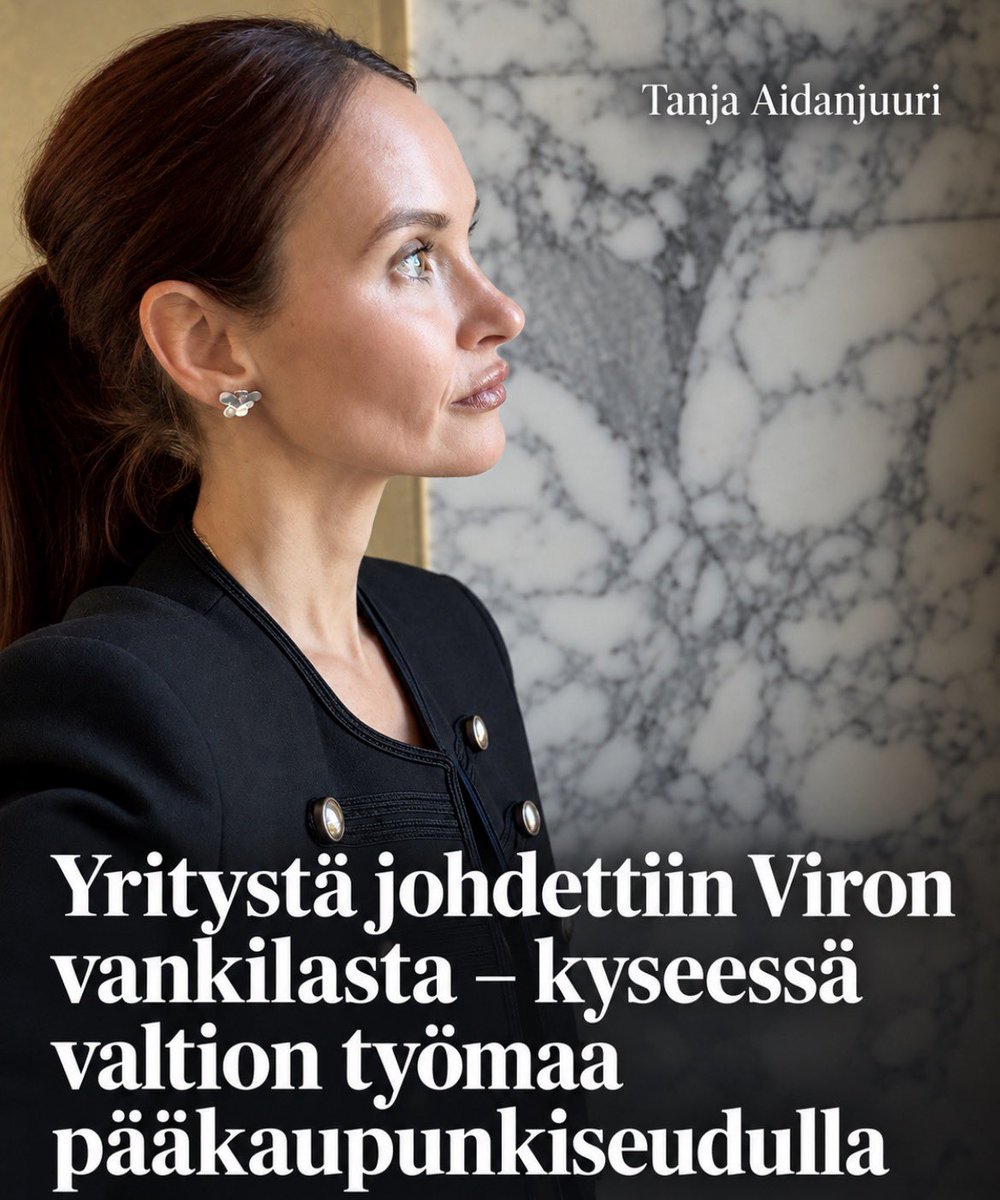
Tanja Aidanjuuri wrote that the National Coalition Party and the left supported an increase in foreign labor, but according to her, only the Finns Party talked about what kind of labor markets would be built at the same time. Aidanjuuri reported that the Construction Union had announced that 30 fake entrepreneurs had been uncovered at a state-commissioned school construction site in Helsinki. According to her, labor rights had gone unchecked, wages had been paid below the collective agreements, and overtime and Sunday compensations had been left unpaid. She claimed that an individual worker could be missing about 1,500 euros from their salary per month. Aidanjuuri said that one of the companies operating on the construction site was managed from a prison in Estonia, and that according to an STT investigation, the company's trail led to organized crime in Estonia. She also criticized the expensive projects in cities, citing the Vantaa tram as an example. According to Aidanjuuri, the projects were justified by the promise of new jobs in the construction sector, but cheap labor was used on the jobs and they did not employ Finns. Aidanjuuri reported that authorities had conducted a total of 1,817 inspections of companies using foreign labor in 2025 and had filed 60 preliminary investigation reports against employers for the unauthorized use of foreign labor. She stated that authorities had assessed that bogus and forced entrepreneurship had become widespread, especially in the construction sector, and was part of labor-related exploitation. According to Aidanjuuri, exploitation harmed foreign workers, put honest Finnish companies in an unfair competitive position, and forced Finnish workers to compete for jobs under conditions that could not be met by adhering to Finnish labor standards. She considered it particularly serious that this occurred on a state construction site and deemed the discussion of increasing foreign labor without significantly stricter oversight irresponsible and detrimental to the labor conditions improvements advocated by unions. https://t.co/HXw2wzki3U #työvoima #rakennusala #työehdot (translated)
Lucia-pulla wrote to Nasima Razmyar and the Demar party members that she believed Razmyar was an example of an uncivilized person. She claimed that Razmyar did not understand history and did not comprehend economics, sociology, or social psychology. According to Lucia-pulla, such a person in politics would be a catastrophe for the Finns. #politiikka #historia #sosiologia (translated)
Matti Hämeenaho wrote that the claim was completely true. He named Joakim Vigelius as an excellent example of clever communication and said that others could do the same. #viestintä #erinomaisuus #esimerkki (translated)
Dennis Mitzner criticized Timo Stewart for the fact that Yle interviewed him in a news story about the war in Gaza just a day after Stewart's column was published. Mitzner saw this as an example of Stewart shifting from being a Yle columnist to being an outside researcher interviewed by the media in less than twenty-four hours. According to Mitzner, Stewart spoke in favor of open discussion and opposed the idea that hate speech should silence others. Mitzner found this position contradictory because, in his opinion, Stewart had long avoided debates on X where he and other researchers could have been directly challenged. He also claimed that the responses of researchers to critical citizens had not been convincing. Mitzner criticized Yle and Hesari journalists for allegedly supporting Stewart's message in sympathetic interviews where he was not challenged. He argued that Stewart warned against silencing discussion while avoiding situations where someone could question his views, and presented potential critics as a threat to free discussion. #keskustelu #vihakieli #mediakritiikki (translated)
Henri Vanhanen criticized Rosatom's leadership and wrote that the company's arrogance seemed to have no limits. According to him, as Russia commenced the largest invasion of Europe since World War II, the head of the state-owned company responsible for Russia's nuclear weapons program had stated that he expected Finland's "special behavior" to end and the country to return to the Hanhikivi nuclear power project. Vanhanen believed that Finland would no longer negotiate strategic dependencies on the Kremlin's terms. He described the Hanhikivi project as a cautionary example of Russia's efforts to bind Finland's critical infrastructure to its influence for decades. According to Vanhanen, Finland's energy policy should no longer give the Kremlin leverage over the country's security, and Finland's stance or decision not to return to the project with Russia would not change. https://t.co/v2qPS0PMHs #Suomi #Venäjä #ydinenergia (translated)
The author mentioned that he had been monitoring Russia's target list for a year and said that investigative journalists were one of its key targets. As an example, he mentioned a German journalist who had spent months in a cover operation posing as a supporter of Putin. According to the author, Russian handlers had paid the journalist in bitcoins for espionage. https://t.co/mVuaKvxSN2 #venäjä #journalismi #tutkimus #FI #RU (translated)
Leptospirosis, a disease dangerous to dogs, is becoming more common in Finland, and it can also be transmitted to humans; an example is the symptoms of an Irish Setter named Robin, which led to intensive care. #leptospiroosi #koirat #terveys (translated)

Jari Mäkäräinen criticized Sanna Ukkola's writing about the Prime Minister's meeting with Imam Sharmarke Said Aw-Mussen. According to Mäkäräinen, Ukkola regarded the meeting as ordinary work and believed that the imam, who was born in Turku, was being asked impossible questions regarding Sharia. Mäkäräinen argued that asking the imam was not a misunderstanding: in his view, the imam left open whether Sharia would be applied in Finland in family or criminal law matters. Mäkäräinen wrote that, according to him, freedom of religion did not justify the establishment of a parallel legal system alongside Finnish laws. He claimed that in Muslim-majority countries, freedom of religion, women's equality, and individual rights were not realized in liberal democracies due to Islamic doctrine and Sharia. He cited Lebanon as an example, where he believed the growth of the Muslim population and political organization undermined previous balance and led to civil war. In France, Sweden, Belgium, and Britain, he mentioned the visibility of parallel societies, honor-based violence, segregation of areas and schools, and pressure to accept practices related to Sharia. In Finland in the 2000s, Mäkäräinen claimed that groups with a Muslim background who had immigrated were connected to the overrepresentation of sexual offenses, unemployment, use of social security, and demands for their own rules. He believed that distinguishing criticism of Islam from calls for deportation did not make questions about Sharia suspect. According to Mäkäräinen, the primacy of the Finnish Constitution and criminal law should be clear in all matters, and Finland did not need to repeat the experiences of countries where the application of Sharia had been tried. https://t.co/bGpZ7VaTux #uskonnonvapaus #integratio #muslimit (translated)
Henri Vanhanen criticized Donald Trump's actions in the Ukraine war, noting that he declared agreements about which there was uncertainty, while pressuring Ukraine in a way that benefited Vladimir Putin. As a recent example, Vanhanen pointed to Trump’s announced energy ceasefire. According to him, Volodymyr Zelensky heard about it practically for the first time from the media, Russia had not confirmed the agreement, and continued, according to Zelensky, attacks on Ukraine's power plants. Vanhanen asked what kind of ceasefire it was if the other party did not know what had been agreed upon. He suggested that Zelensky had to be cautious of Trump’s criticism to avoid being blamed for obstructing peace. Vanhanen referred to the Financial Times reporting that the United States threatened to cut off arms and intelligence supplies to Ukraine unless the country stopped attacks on Russian energy infrastructure. He also wrote that Trump agreed to buy Russian diesel, demanded Ukraine to cease attacks on Russian oil refineries, and encouraged a change of leadership in Ukraine. Vanhanen estimated that the war in Iran and the resulting fuel prices, the upcoming midterm elections, and the need to show results might explain Trump’s urgency to secure an agreement. According to him, Trump aimed for cheaper diesel and a visible peace political achievement, while Putin would benefit from a decrease in attacks on Russia’s energy sector. Vanhanen noted that the alignment of these goals seemed to occur at Ukraine’s expense. Vanhanen stated that he did not oppose a ceasefire if it protected Ukrainians and also bound Russia. However, he observed that for Trump, merely declaring an agreement seemed to suffice, even without information about its terms or Russia's commitment. Vanhanen assessed that Russia would benefit from a situation in which the United States sought a quick agreement and Ukraine was cautious not to offend Trump. In such conditions, he believed Putin could gain concessions from Trump without Russia needing to win against Ukraine at the negotiating table. #Ukraina #Trump #Venäjä (translated)
Samuli Katainen described the parking fee as an example of the institutionalization of politicians. According to him, a €3.50 hourly charge could mean a weekly cost of €280, so he believed it was foreseeable that someone would have to pay that amount. Katainen wrote that this could have been deduced through multiplication. https://t.co/QQAkBOUGQx #politiikka #pysäköinti #kustannukset (translated)