BETA nonprofit public democratic european moderated

Search

#Personval

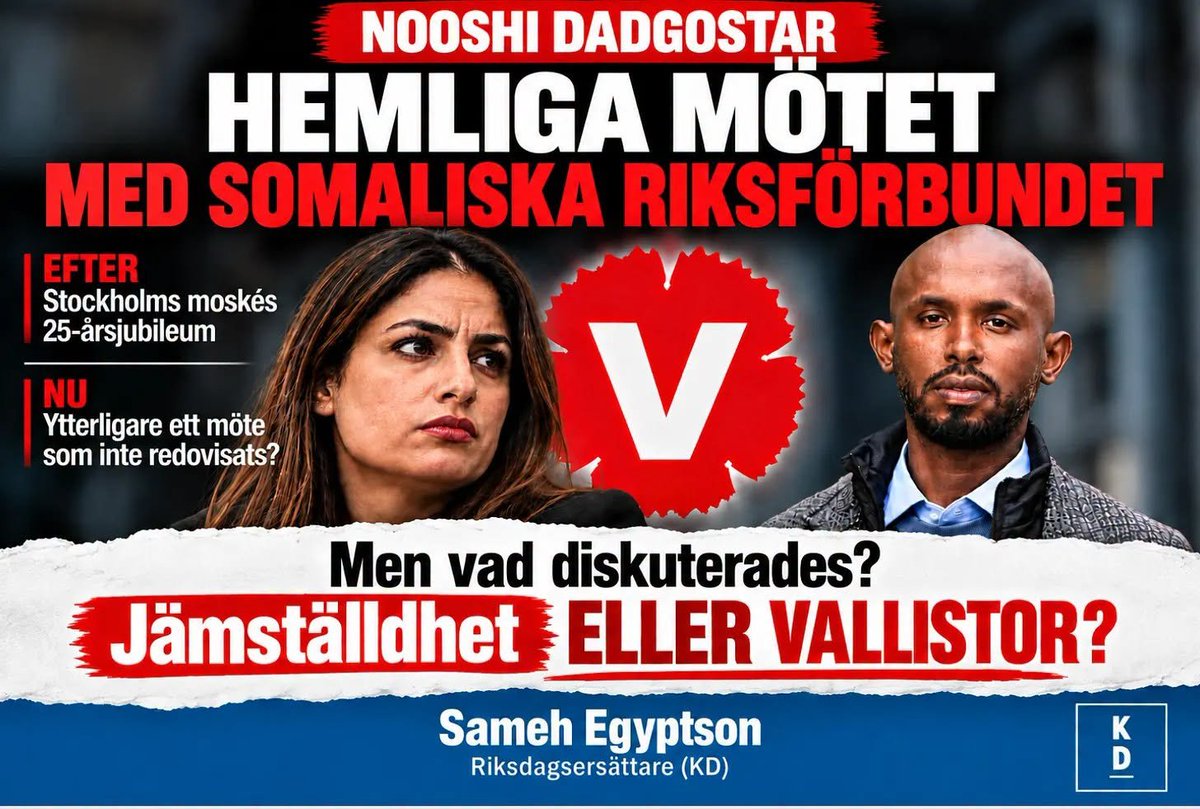
Once again – a meeting that has not been reported raises questions Yesterday, I wrote about Nooshi Dadgostar's participation in the Stockholm mosque's 25th anniversary. Now similar questions arise regarding her participation in the Somali National Federation's annual meeting last year. Neither the Left Party nor the Somali National Federation has publicly reported on the meeting or the issues discussed there. What were the discussions about? Were issues such as equality, child marriage, female genital mutilation, and niqab discussed? Or was the meeting about political representation, candidates, and party lists? I also want to know how the Left Party views the risk that patriarchal or clan-based power structures gain political influence under concepts such as multiculturalism, representation, and cooperation. The question is particularly relevant as I already warned in Fokus on January 12, 2026, eight months before the election, about clan- and network-based mobilization and how such collective mobilization can affect personal votes and the parties' internal processes. The article was titled “Change the electoral system – clan votes undermine democracy.” The election result now raises questions that the Left Party should answer openly: How does the party work to prevent family, clan, or other collective power structures from influencing nominations, personal votes, and political representation? Why has so little public information been provided about these meetings with organizations that claim to represent larger groups? Have there been other similar meetings with organizations that have not been reported in the party's own channels? Democracy is built on transparency, the individual's free choice, and individual rights – not on collectives controlling the individual's political choices or on closed meetings without public reporting. I look forward to Nooshi Dadgostar's response. Sameh Egyptson Member of Parliament (KD) (translated)
It is easy to resort to grand words when something appears foreign. Bus driving. Clan voting. Pre-marked ballots. Electoral fraud. The problem is that the words describe completely different things and being careless with them makes it harder, not easier, to detect what is actually problematic. For example, having people driven to the polling place is not in itself suspicious. Swedish parties and civic movements have engaged in electoral mobilization for generations. The question is what happens during and around the ride. Is the transport organized so that people can vote, or is it part of a system where someone also tells them how to vote and tries to control that this happens? The same applies to the frequently used term clan voting. That 200 people with the same ethnic background or from the same family vote for the same candidate is not evidence of clan voting. It could be personal campaign efforts, family ties, community involvement, or simply trust in someone they know. If the word clan is to be used, one must also be able to show the clan's function: who mobilizes whom, through what structures, and with what authority? Neither is a pre-marked ballot automatically proof of electoral fraud. Personal elections, after all, are based on candidates trying to convince people to mark a cross in front of their name. But if pre-marked ballots are distributed within a network along with instructions, social pressure, or attempts to control how the recipient votes, then the matter changes. What is interesting is not just the cross on the paper but the power relations surrounding it. This is where journalism must be precise. Not to downplay the problems, but for the opposite reason. If every ride is called bus driving, every concentration of personal votes is called clan voting, and every distributed ballot is called electoral fraud, the concepts soon become unusable. But one must not make the opposite mistake either. A number of actions that are legal on their own can together form a pattern that deserves scrutiny. The ride. The association. The family. The pre-marked ballot. The prompting. The candidate. None of the components need to be remarkable in isolation. It is only when one places them next to each other that the question becomes interesting. Therefore, a simple rule should apply when such phenomena are scrutinized: describe first, label second. Who organized? Who paid? What was said? How were the ballots distributed? Were they already marked? Were there pressures? Could the voter say no and vote for someone entirely different without consequences? Answering those questions rarely requires resorting to grand words. Facts tend to be sufficiently troubling – when they actually are. (translated)

It's going well now Nooshi, goodness. Borlänge apparently was not the end. Now the city of Stockholm is reporting allegations of unfair practices during the election after the V party's campaign in Järva. Pre-marked ballots, voters being instructed, and attempts to follow behind the voting screen. This is starting to look significantly larger than an individual "vote rocket." We will definitely see the same thing all over the country. Now Swedish democracy is actually threatened for real. (translated)

Hassan Abadir (V) was only 34 votes away from a parliamentary seat. Despite claiming not to have run any personal election campaign – other than a campaign in Somali – he secured a fifth place among Jönköping's most voted politicians. In Jönköping's vulnerable areas, he received the most personal votes. Abadir was sentenced in 2008 to one year in prison for drug trafficking. The Left Party was aware of the verdict but claims to have "full confidence" in him. (translated)

The Left Party stands out in Järva. In particular, Ilyas Hassan's personal election campaign, which according to Eva Debel, chief of staff at the Electoral Board in Stockholm, "got out of hand". On several occasions, Eva Debel was forced to contact the Left Party's office in Stockholm and demand action. (translated)

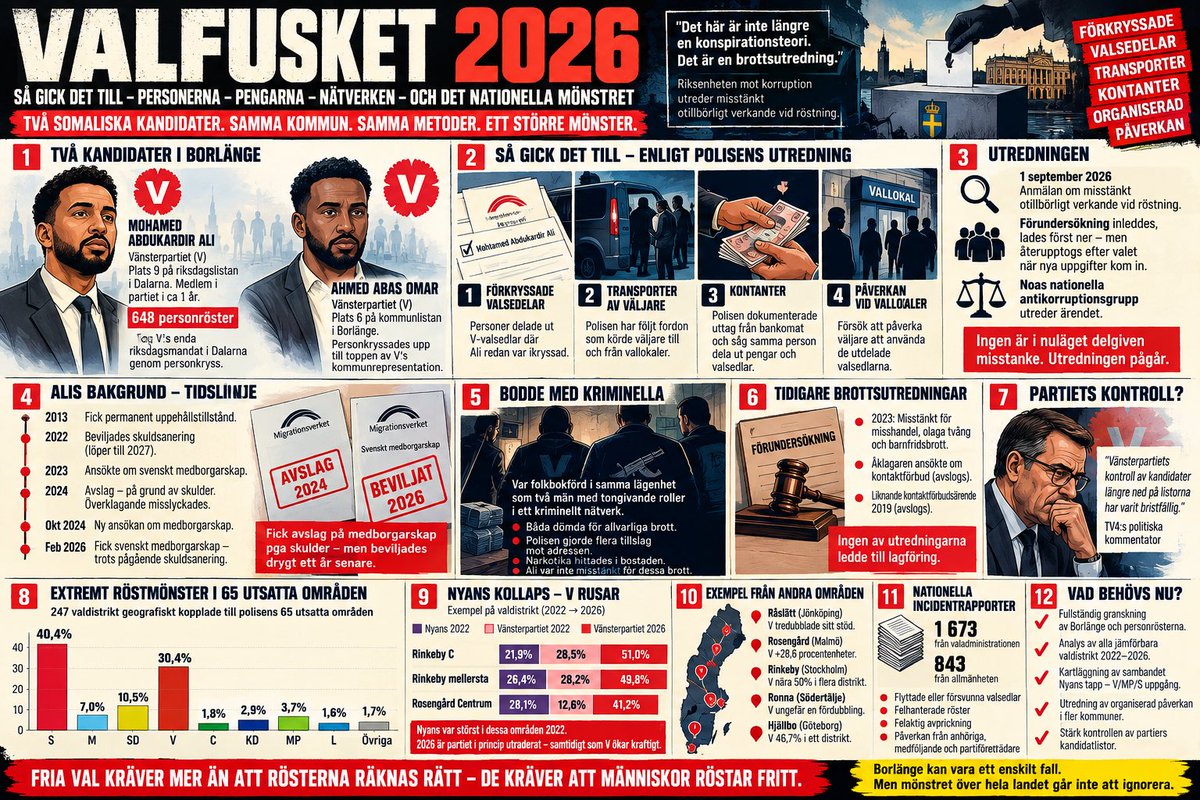
In an investigation into suspected electoral fraud in Borlänge, the police have discovered that a group of men may have targeted women, young men, and substance abusers during the leftist politician Mohamed Abdukardir Ali's personal election campaign to buy votes. (translated)

Källor: Riktade in sig på missbrukare i vänsterpartistens personvalskampanj

Sources: Targeted drug users in the Left Party candidate's election campaign (translated)

Three groups with a Somali background were specifically targeted during Mohamed Abdukardir Ali's election campaign, according to DN's sources: women in social exclusion, young men who were not planning to vote, and addicts. The police are now investigating whether some of the votes were bought. (translated)

This is no longer a story about a "strange election choice." Sweden has an actual election fraud investigation with the National Anti-Corruption Unit, taken over by Noah's anti-corruption group. At the same time, an exceptional voting pattern emerges in vulnerable areas across the country. 🧵Stay tuned (translated)

Glenn 3d

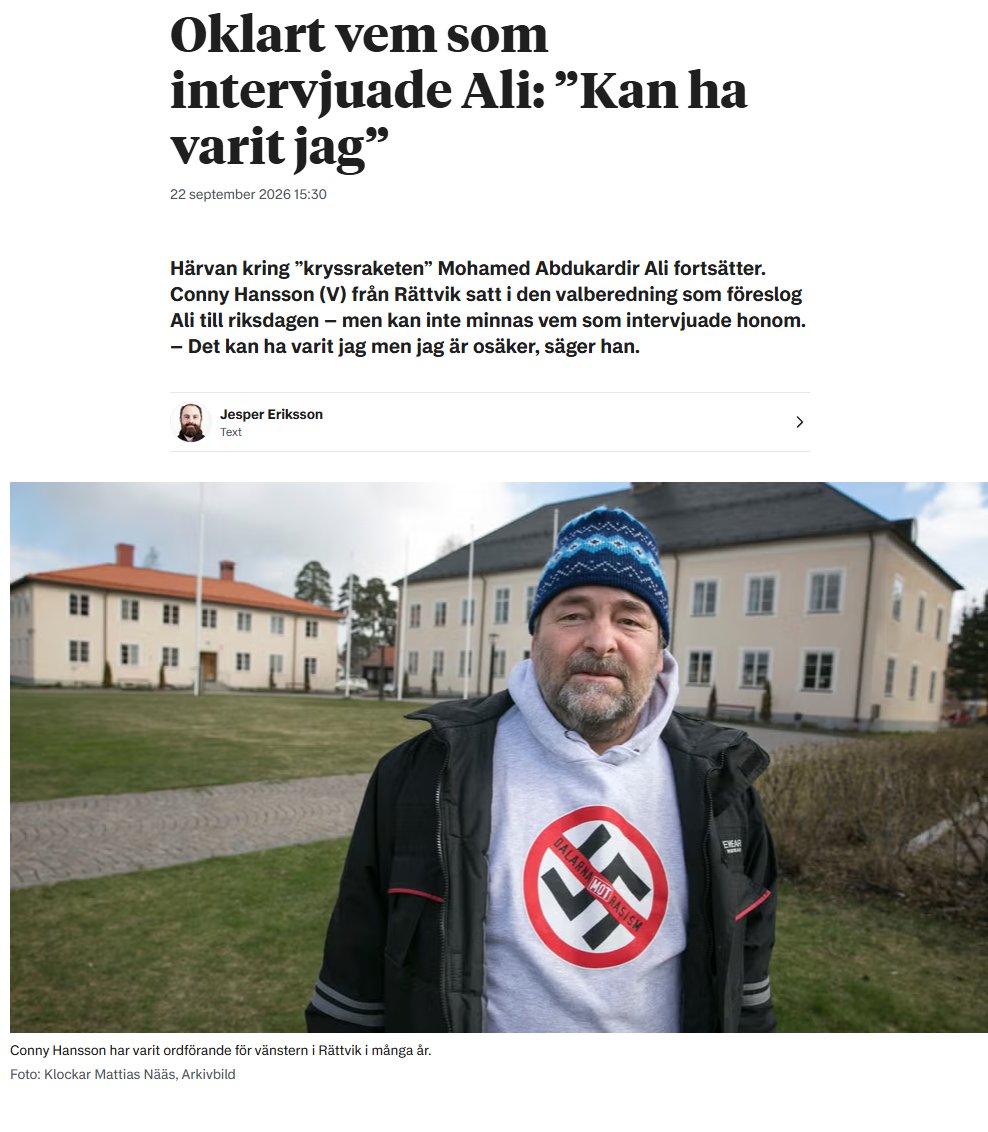
The Left Party in Dalarna continues to deliver an incompetence that has rarely been seen. It is enough to wear a values-based hoodie, and you don’t need any other knowledge...🥸 They are "reviewing" candidates for Sweden's highest elected offices by interviewing the person and asking their friends; if anyone says something negative, it cannot be included because it is classified as personal opinions. No police extracts from criminal records are possible – "For example, a nomination committee cannot request extracts from police records and such things. It's completely out of the question," says Conny. So, they do take extracts for someone who will work in children's care and safety. But a parliamentary seat is not important enough..... Conny seems (besides having the right shirt on) not even to know if it was him who met and interviewed this person from his own party in the same region less than a year ago, impressive Conny. (translated)

The Green Party's Leila Ali Elmi already secured a seat in the parliament in 2018 from position 21 on the list in Gothenburg after a campaign in Somali. She was completely unknown within the party at that time. Since then, one of her most notable marks has been the reports of 17 payment orders from the Swedish Enforcement Authority, including decisions on debt collection and seizure. The question being discussed now is hardly new. Yet, it seems the experiences have not led to any changes in how the Left Party and the Green Party handle personal election campaigns. Instead, Ali Elmi was rewarded with the position of the Green Party's spokesperson for integration policy and a top spot on the party's election list in this year's election. (translated)

V says that Mohamed Abdukardir Ali has taken a "time out." But the parliament is not a reality TV show. There is no parliamentary status called "time out." In practice, he gets paid vacation from parliamentary work - at the taxpayers' expense - while suspected election fraud regarding the personal election is being investigated. Why should we taxpayers foot the bill? (translated)

Chaos in the Left Party after suspected electoral fraud in Dalarna An investigation is underway regarding marked ballots being distributed in the Left Party's personal election campaign in Borlänge. Individuals have reportedly been seen driving voters from marginalized areas and providing them with ballots. The investigation was initially closed but has been reopened after additional information. The crime is improper influence during voting, and no one has been formally suspected. The newly elected member Mohamed Abdukardir Ali is part of the investigation but denies involvement and says he was shocked. According to a source close to the party leadership, there is chaos in the Left Party. The Social Democrats' party secretary Tobias Baudin calls it very serious. Voters should be able to have full confidence that elections are conducted correctly and fairly, and it is of utmost importance that this is thoroughly investigated. The Left Party is expected to comment during the day. (translated)

The suspected electoral fraud in Dalarna has led to a preliminary investigation and raised criticism of the Swedish personal electoral system, which a professor describes as failed. (translated)

Efter misstänkta valfusket: ”Systemet är misslyckat”

Ett mönster i de svensksomaliska personvalskampanjer jag tittat närmare på i valrörelsen är att de i hög grad bedrivs på armlängds avstånd från själva kandidaten. Dvs det är andra personer – ambassadörer eller influencers som ni så vill – som kampanjar för kandidatens räkning. #svpol #val2023 #personval

Personvalet ska ge väljarna makt över partiernas listor. Men systemet har en blind fläck: en liten, välmobiliserad grupp kan få stort genomslag genom att samla kryssen på en enda kandidat. Fallet i Borlänge visar hävstången. V-kandidaten stod nia på listan i Dalarna men fick 648 personkryss, tillräckligt för att passera femprocentsspärren och ta partiets enda riksdagsmandat i valkretsen. Än mer anmärkningsvärt är att han själv uppger att han varken bedrev personvalskampanj eller hade eget valmaterial. Ändå samlades tillräckligt många kryss på hans namn för att kasta om hela listan. 648 väljare kunde därmed sätta partiets rangordning åt sidan och avgöra vem som företräder över 10 000 V-väljare. Om kryssen var organiserade är inte fastslaget, men systemets sårbarhet är uppenbar. Och för V finns en särskild ironi: jakten på nya väljargrupper kan till slut ha gett partiet ett personval man självt inte hade räknat med. #Personval #Val2023 #Demokrati

Det här blir bara värre. Mohamed Abdukardir Ali (V) kryssades helt oväntat in i riksdagen – trots att han knappt var känd ens i sitt eget parti och själv uppgav att han inte bedrivit någon personvalskampanj. Nu avslöjar Expressen att polisen under förtidsröstningen spanade på en bil och flera personer som kan knytas till honom. Ali själv förekommer i polisens spaningsmaterial. Anmälan handlar om väljare som ska ha skjutsats till förtidsröstningen och fått förkryssade V-valsedlar. Förundersökningen om misstänkt otillbörligt verkande vid röstning är nu återupptagen av Riksenheten mot korruption. Ingen är delgiven misstanke – men det här måste självklart utredas till sista detalj. En nästan okänd kandidat kryssas plötsligt in i Sveriges riksdag – och nu kommer de här uppgifterna fram. Det är fullständigt anmärkningsvärt! https://t.co/5jZDgimycn #Sverige #Riksdag #Val2023

Kvartal 6d

Mohamed Abdukardir Ali gjorde en stor personvalsskräll när han från nionde plats kryssade sig in i riksdagen för Vänsterpartiet. Nu avslöjar Expressen att han så sent som 2024 nekades svenskt medborgarskap på grund av sina skulder. https://t.co/vmKQtj6UNO #politik #riksdagen #val2024

Miljöpartiets förstanamn i Sörmland, profilen Linus Lakso, petas av fyran på listan, Mohamed Abdukani, som bedrev en stor del av valkampanjen på somaliska. Nu försöker miljöpartister pressa Abdukani att avsäga sig platsen. Men varför skulle han göra det? MP nominerade honom och säger sig värna personvalet. https://t.co/JXQyw3d21V #Miljöpartiet #Val2023 #Politik

Två överdrivna personvalskampanjer som aldrig lyfte. Partiledare i all ära men vi har inte presidentval i Sverige. https://t.co/mlRPAtRh1A #Sverige #politik #val2024