WRLD

Search

#PesquisaEleitoral
cafecomferri Wrld summary Oct 21

cafecomferri stated that it received three tracking polls in which Flávio was ahead by 5, 4.5, and 3.5 points. He said that polls from the left showed a close race to avoid demobilizing the activists and argued that the matter should be investigated seriously after the elections. He also accused these polls of aiming to manipulate people. #Eleições2024 #PesquisaEleitoral #Manipulação (translated)

3153
Pesquisas Eleições Wrld summary Oct 21

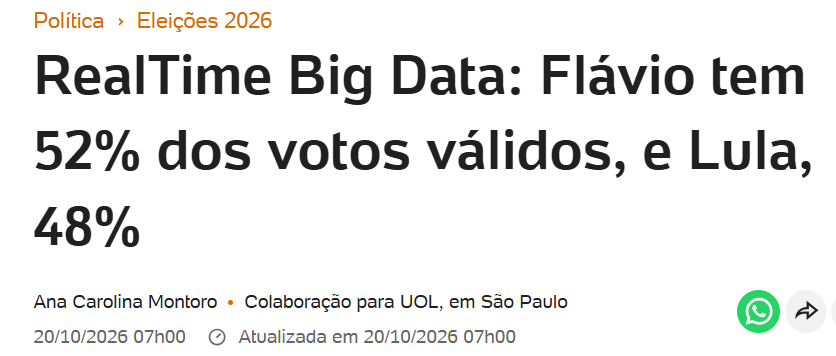
The Electoral Research informed that, in a Futura/Apex survey on valid votes in the second round, Flávio Bolsonaro (PL) had 51%, up 1 point, and Lula (PT), 49%, down 1 point. According to the publication, the advantage of 2.2 percentage points constituted a technical tie, considering the margin of error of ±2.2 points. The percentages excluded blank, null, and undecided votes. The survey interviewed 2,000 people by phone, with computer-assisted interviews (CATI), on the days 19 and 20 of October 2026. The publication reported a confidence level of 95% and registered with the TSE under the number BR-06614/2026. #Eleições2026 #Votação #PesquisaEleitoral (translated)

3621
Xico Graziano Wrld summary Oct 20

Xico Graziano wrote that the most anticipated survey of the day indicated Flávio leading by 4 percentage points, a difference that, according to him, would be equivalent to about 4.8 million votes. He said that the survey considered, even if partially, the Band debate and came after a series of events, measures that he classified as electioneering and rumors. Graziano compared the result with the previous survey from RealTime Big Data, released on October 1st. According to him, it showed Lula with 43% and Flávio with 39% in the first round, but underestimated Flávio. For the second round, it indicated Flávio with 46% against 45% for Lula, which, he wrote, showed a balanced contest. #Eleições2023 #PesquisaEleitoral #Flávio (translated)

3038
Vitor de Lucca 🇧🇷 🏳️‍🌈 Wrld summary Oct 19

Vitor de Lucca stated that PoderData and Nexus conducted surveys during the same period, but said that the lack of disclosure of decimal numbers and total votes by PoderData prevented a complete comparison. He classified Nexus's survey as of higher quality and considered the decision of the institute to disclose the decimals when the election became tighter to be correct. De Lucca also wrote that, in the last week, the priority should be to try to convert votes and share excerpts of the debate on social media, instead of worrying about surveys. He recommended paying special attention to Facebook, which he described as a bubble of the right, and said that the left was forgetting that many people still use the platform. #Eleições2023 #PesquisaEleitoral #VotoConsciente (translated)

3507
Pesquisas Eleições Wrld summary Oct 19

The surveys Elections reported that the BTG/NEXUS poll for the presidential runoff, in the spontaneous modality, indicated Flávio Bolsonaro (PL) and Lula (PT) tied, both with 44.5%. According to the publication, Flávio had decreased by 1.8 percentage points compared to the previous round, while Lula maintained the same index. Those who did not know or did not respond totaled 6.2%, an increase of 2.3 points; blank, null, or no candidate accounted for 4.7%, a decrease of 0.5 points. The publication stated that the survey was conducted from October 16 to 18, 2026, with 2,002 interviews, a margin of error of ±2 percentage points, and a confidence level of 95%. The registration with the TSE was BR-04499/2026. #PesquisaEleitoral #Brasil2026 #Eleições (translated)

3742
BRPolls 🇧🇷 Wrld summary Oct 13

BRPolls reported that the NEXUS/BTG survey on the migration of votes from the first to the second round indicated that among the voters of Augusto Cury (AVANTE), 43% would choose Flávio Bolsonaro (PL) and 41% Lula (PT). Among the voters of Ronaldo Caiado (PSD), the percentages would be 55% for Flávio Bolsonaro and 27% for Lula. In the group of voters of Renan Santos (MISSÃO), 37% would go for Flávio Bolsonaro and 30% for Lula. Among the voters of Romeu Zema (NOVO), 80% would choose Flávio Bolsonaro and 0% Lula, according to the publication. BRPolls stated that the survey interviewed 2,002 voters by phone between 10/10 and 12/10 and was registered with the TSE under the code BR-07997/2026. #Eleições2026 #Votação #PesquisaEleitoral (translated)

3047
Xico Graziano Wrld summary Oct 9

Xico Graziano stated that electoral surveys reflected the days prior, and not the future scenario. According to him, at the beginning of the week, PoderData and Datafolha showed Flávio two percentage points ahead of Lula. Graziano said that Flávio received support from Zema, Caiado, and Cury, while Cleitinho, Tarcísio, and Moro mobilized in his campaign. He also stated that in Rio de Janeiro, the PL candidate was announced as the big winner. Regarding Lula, he wrote that he remained in Brasília reorganizing the campaign and that Janja faced criticisms both inside and outside the PT; in Graziano's assessment, there were no other relevant facts. Based on this, he evaluated that Flávio was gaining ground while Lula remained stagnant, and that the next surveys would reflect recent events. #Eleições2023 #PesquisaEleitoral #PolíticaBrasileira (translated)

3052
Victor Garcia Wrld summary Sep 30

The polls this year have a bias... What we are seeing in some polls in Brazil goes through a methodology called likely voters. Basically, the institutes try to estimate not only who the voter intends to vote for, but also the probability that this voter will actually show up at the polls. And here's an important point: Lula performs very strongly among lower-income voters, a segment that has historically been more prone to abstention. When this factor enters the model, the tendency is to reduce his advantage and create an appearance of greater closeness to Flávio. Does that make sense? More or less... The problem is that this type of methodology depends on something extremely difficult: predicting today who will effectively vote on Election Sunday. And 2026 may have a completely different dynamic from 2022. What we are seeing in terms of mobilization in the streets in favor of Lula, for example, is something that must be taken into account. Mobilization also affects the voter’s willingness to leave home to vote. Therefore, I have my doubts about to what extent this "likely voter" model will be able to accurately capture this election. The traditional method of voting intention has always worked in Brazil. In 2022, we had a very specific context, including PRF operations involving the transportation of voters that led the TSE itself to intervene during the second round. This needs to be remembered when someone tries to use that election as an absolute parameter to project abstention in 2026. So I would be very cautious with polls that try to turn voting intention into predictions of turnout. After all, polls measure intention. Who will or will not step outside on election day is a variable that is much more difficult to predict. #Eleições2026 #Voto #PesquisaEleitoral (translated)

15773
hayy⚡️ Wrld summary Sep 22

🚨 URGENTE: Diego Muguet flagrou entrevistadores da DATAFOLHA realizando pesquisa ao lado de uma banquinha do PT e abordando pessoas que, segundo as imagens, seriam ligadas à esquerda. A situação é GRAVÍSSIMA. Como garantir a imparcialidade e a representatividade de uma pesquisa eleitoral nessas condições? CADÊ A TRANSPARÊNCIA, DATAFOLHA? https://t.co/GvsVGbvEh8 #PesquisaEleitoral #Transparência #Imparcialidade

20644
Biazita Gomes Wrld summary Jun 16

E a galera do Missão que tá usando a pesquisa eleitoral específica do estado de são Paulo como se fosse a pesquisa nacional para dizer que o candidato deles disparou nas pesquisas? #Eleições2024 #SãoPaulo #PesquisaEleitoral

17611
Karina Michelin Wrld summary Jun 9

Sam, você está discutindo o resultado da pesquisa, enquanto Kassio Nunes Marques está discutindo a metodologia, são coisas completamente diferentes. O TSE não suspendeu a pesquisa porque Flávio caiu ou porque Lula subiu, o TSE suspendeu a pesquisa porque existe um questionamento sobre a forma como ela foi construída. Esse é o cerne da questão. Se o áudio não influenciou ninguém, ótimo. Mas então por que ele estava na pesquisa?nE por que o único candidato submetido a um estímulo relacionado a um escândalo foi Flávio Bolsonaro? A discussão não é se o entrevistado podia ou não mudar o voto depois. A discussão é se uma pesquisa eleitoral pode utilizar elementos potencialmente prejudiciais a apenas um dos candidatos e ainda assim ser apresentada ao público como uma simples medição do cenário eleitoral. Repito: Nunes Marques não colocou o resultado sob escrutínio, colocou a metodologia. Percebe?? #PesquisaEleitoral #Metodologia #JustiçaEleições

14986