
The Kosovo parliament has elected Justina Shiroka Pula as the new president, which ends a long-standing political crisis in the country. #Kosovo #presidentti #politiikka (translated)
Kosovossa parlamentti valitsi uuden presidentin
The Kosovo parliament has elected Justina Shiroka Pula as the new president, which ends a long-standing political crisis in the country. #Kosovo #presidentti #politiikka (translated)
France's growing debt and political instability could threaten Finland's economic growth if France fails to adjust its economy. #Ranska #talouskasvu #velkaantuminen (translated)
President Trump's comment that Iran could destroy Los Angeles and San Diego sparked a great political uproar in the United States and was condemned as dangerous, notably by California Governor Gavin Newsom. #Trump #Iran #LosAngeles (translated)

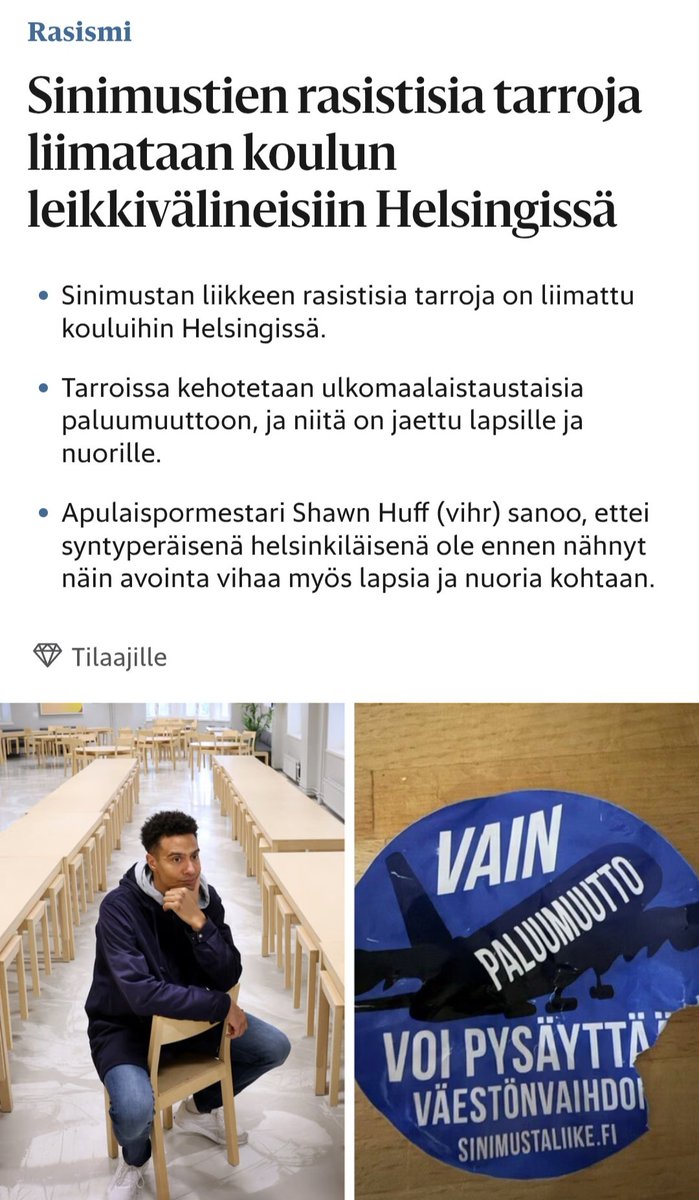
Tuukka Kuru wrote that he had been amused by the panic surrounding the stickers. According to him, street robbery, taxi rape, or gang assault did not shock the liberal journalist as much as seeing an unwanted political message. https://t.co/OAkhU71gVF #poliikka #media #yhteiskunta (translated)

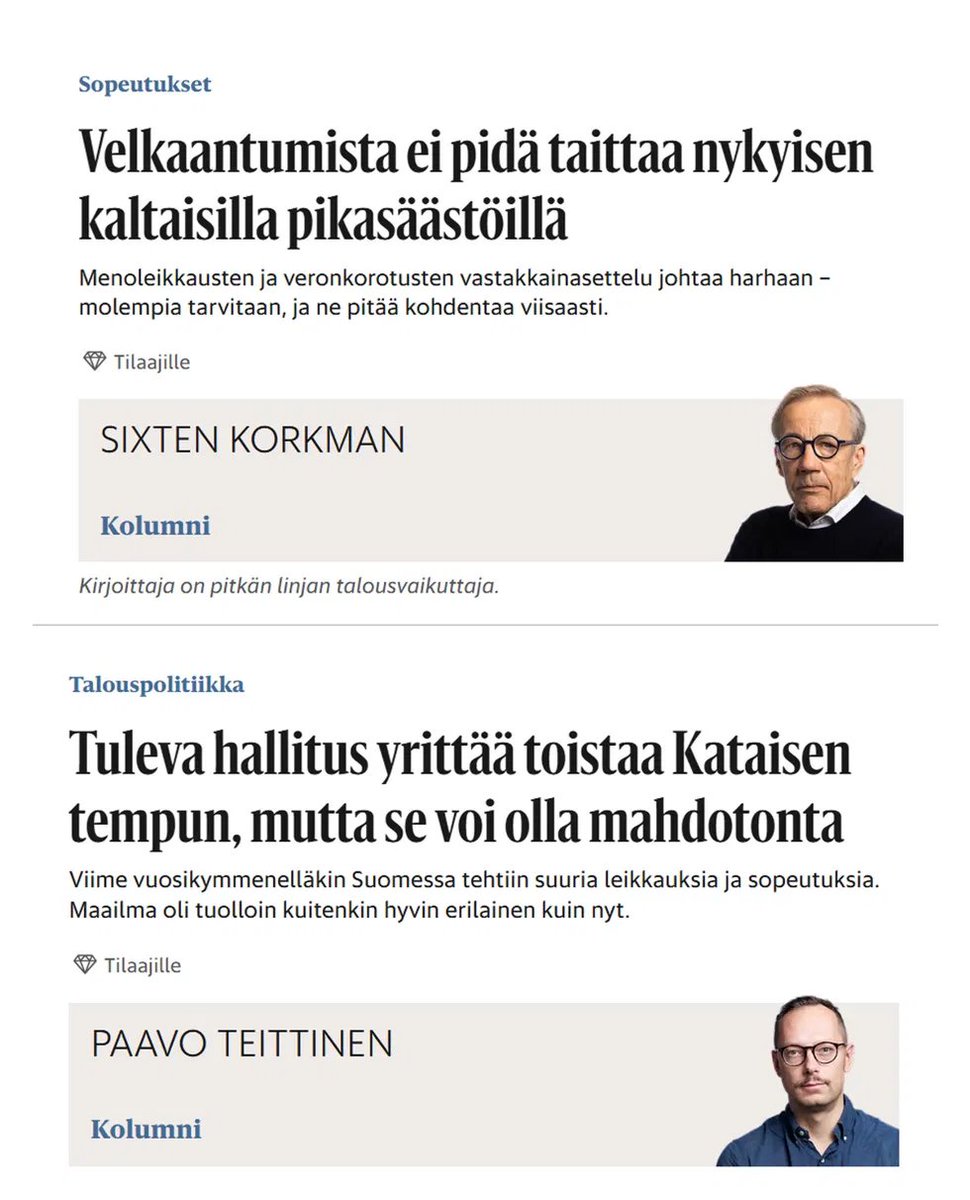
Heikki Pursiainen criticized Finnish economic discussion as limited based on two recently published columns in Helsingin Sanomat. According to him, Korkman described what should not be cut and believed that adjustments were necessary but did not propose any cuts. Pursiainen claimed that Korkman also criticized the government’s policies without offering alternatives. Pursiainen wrote that he found Teittinen’s reflections good in themselves but believed they underestimated Finns' ability to impact matters. He argued that Teittinen suggested that adjustments would probably be politically impossible and that Finland's fate depended on economic conditions and Russia. Pursiainen assessed that there could be many actions: he mentioned more encouraging social security, cutting business subsidies, tuition fees, and abandoning incentives for staying home as a parent. He added that for conservatives, a smaller public sector was a goal and not a reason for lamenting, and in his view, adjustments did not threaten the foundations of the welfare state. Pursiainen indicated that economists should also present their own solutions for discussion and negotiation. #Suomi #Taloustiede #Politiikka (translated)

Simo Grönroos wrote that the Ruotsila report described, in his opinion, how the United States had halted the influx of illegal immigrants during Donald Trump's second term. According to Grönroos, the report informed Finns about what could be achieved with political will and determination. https://t.co/9hbg7n2NYU #maahanmuutto #politiikka #Yhdysvallat (translated)
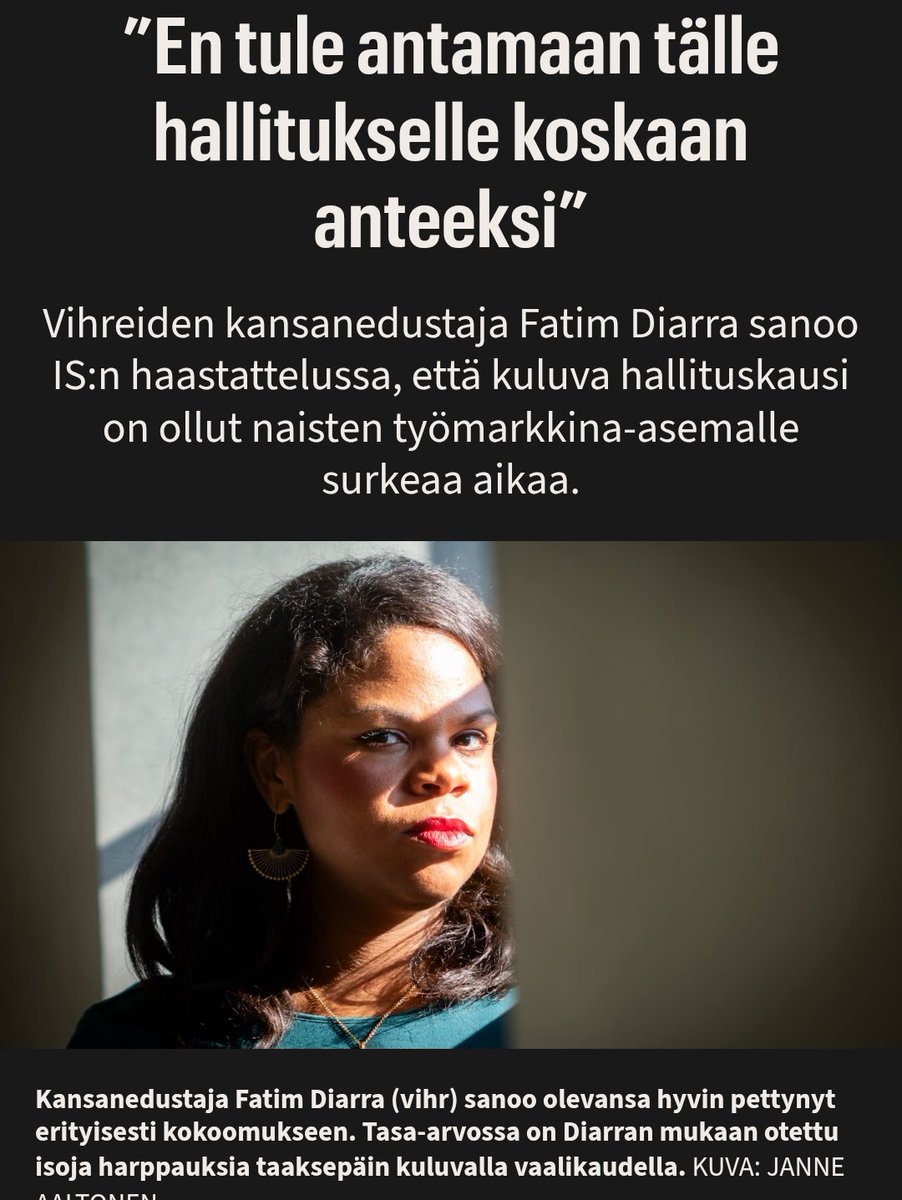
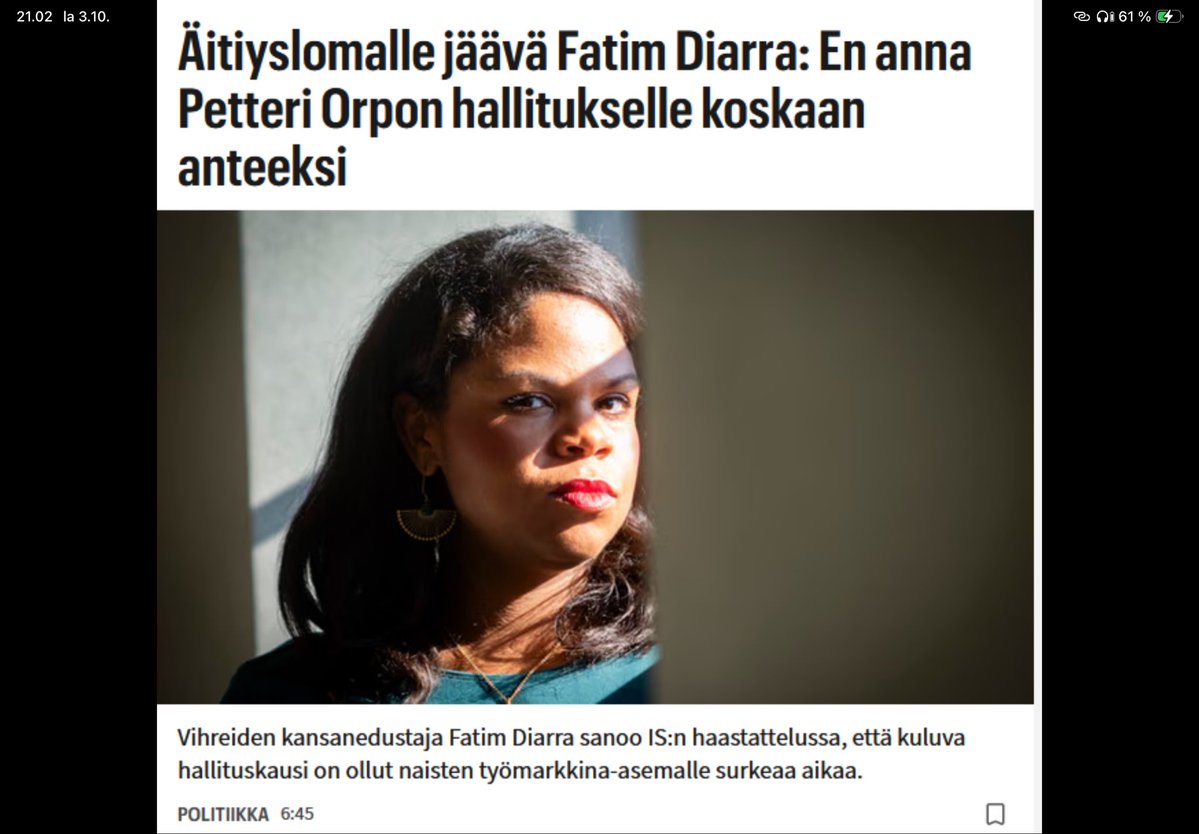
Pjotr Debatt assessed that the interview condensed Fatim Diarra's political career: according to him, Diarra expressed hatred and anger towards misogyny and performed for her assumed supporter group. Debatt claimed that Diarra did not achieve anything concrete, even though she made a lot of noise and used angry rhetoric. https://t.co/Y5AFuRpKoO #politiikka #naisviham #yhteiskunta (translated)
Lucia described the typical reader of Helsingin Sanomat as a 25–40-year-old, highly educated urban woman who lived in neighborhoods like Kallio, Käpylä, Kumpula, Pakila, Kalasatama, Töölö, or Lauttasaari. She noted that this woman would usually vote for the Greens, the Left Alliance, or the SDP and would frequent brunches, bars, and the Flow festival. According to Lucia, the woman she described might be in a relationship, live in a community garden cabin, and be the mother of one or two children. She listed names like Alvar, Oliver, Ariel, Kuura, and Kaura for the children. Lucia mentioned that the woman preferred public transportation but accepted her partner's expensive car, even if she suffered from climate anxiety and flying shame. The woman might also have a small dog. The author claimed that such a reader did not know any voters of the Finns Party and might consider her rural uncle, who had voted for the party at times, to be peculiar. She speculated that the woman worked in a field where she could aim to make the world a better place. Lucia called this a reader profile and target group for Helsingin Sanomat, whose interests and views, according to her, the paper's journalists anticipated. She wrote that HS did not aim for objective or neutral reporting, nor was it an agenda-driven media outlet. According to her, the paper's target group did not encompass all people regardless of their background, lifestyle, or viewpoints. She compared HS to a mirror held up by journalists so that the reader could be satisfied with what they saw, and concluded that the reader of the described profile was not the same as the writer of the piece. #Helsinki #ilmastoahdistus #lukijaprofiili (translated)

Samu Mökillä wrote that in Finland, with its long distances, many families needed a car for their daily lives, and that the fuel prices raised by the Middle East crisis had increased the cost of essential transportation. He criticized the proposal to use the commuting tax deduction to alleviate the situation, arguing that it mainly benefited commuters. According to him, the support would not help, for example, farmers, the transport sector, or lawnmowers. Mökkilä asked why fuel prices could be lowered elsewhere in the world but not in Finland, and considered the commuting tax deduction insufficient if the cost of living was also rising. He estimated that individual support lost its significance as general inflation consumed purchasing power. The rise in fuel costs would also increase freight rates, food production, industry, and logistics, which would be reflected in the prices of many products. He called for a reduction in distribution obligations and taxes instead of subsidies and described the commuting support as a small band-aid for a broader increase in living costs. According to Mökillä, politicians wanted to appear to be doing something, even if the support's impact on people's wallets was overshadowed by rising prices. Mökkilä also wrote that the state budget was heavily in deficit and dependent on revenues collected from motorists. He stated that high fuel taxes were part of climate policy, but rural residents, actors in the transport sector, and small entrepreneurs often had no opportunity to change their fleets or reduce driving. He criticized politicians for disregarding the situation of ordinary Finns, saying that while there was talk of savings, millions were sent to a terrorist organization. #Suomi #polttoaine #talous (translated)
According to Plokha, there is a clear need for this, as Europe cannot credibly defend its way of life, political system, and prosperity. #ydinaseet #Eurooppa #turvallisuuspolitiikka (translated)
Mikko Vuorenpää wrote that he did not know how the current government viewed Representative Diarra's decrees. He said he would not lose any sleep if Fatim announced that she would never forgive him for something, regardless of whether Fatim would go on maternity leave. https://t.co/zKyomVDb4j #poliitti #yhteiskunta #hyväöitä (translated)
The author assesses that Trump did not seek a traditional peace treaty with Russia but rather a business-based agreement. According to him, the solution would be politically unsustainable but would provide economic relief, and it would escalate the war and lead to a bad outcome. #Trump #rauha #politiikka #FI #RU (translated)
Henri Vanhanen wrote that Ukraine had announced the use of its own FP-7 ballistic missile in battle for the first time. According to him, President Volodymyr Zelensky had reported on the first combat use and stated that the next phase would be production. Vanhanen noted that the missile manufacturer, Fire Point, claimed the FP-7 had a range of about 200 kilometers, a warhead weight of 150 kilograms, and a speed of up to 1,500 meters per second. He stated that the missile could target command posts, air defense systems, air bases, and ammunition depots, for example. Vanhanen pointed out that there had been no information on the first launch about what it struck or whether the missile hit its target. He wrote that the military significance of the system would depend on whether the missiles could be produced sufficiently, affordably, and accurately. According to him, approximately seven months had passed since the first known test launch. Vanhanen mentioned that Fire Point was also developing the FP-9 missile, which aimed for a range of over 800 kilometers and a warhead of up to 800 kilograms. He emphasized that the FP-9 was not yet an operational weapon. According to Vanhanen, the significance of the FP-7 would ultimately depend on whether it could be put into production. https://t.co/MWd1JlMbu8 #Ukraina #ohjukset #sota (translated)


Jussi Korson questioned whether the EU can have a common value base when, according to him, Austria bans political Islam while Finland wants more of it. He referred to an unnamed green politician who had promised champagne when Finland gets a Muslim minister. According to Jussi, attitudes towards political Islam, whether very negative or positive, lead to different outcomes. He asked which country should be kicked out of the EU, Finland or Austria. #EU #poliittinenislam #maahanmuutto (translated)
Henri Vanhanen wrote that he wanted to correct the interpretations of an article by Helsingin Sanomat that dealt with nuclear weapons and said he remained uncertain about what the article ultimately claimed regarding Finland's security. According to him, Finland did not join the NATO nuclear deterrent with little discussion or unnoticed, but rather joined an alliance whose deterrence and defense had been based on nuclear weapons for decades. He described the strategic nuclear forces of the United States as a key basis for NATO's nuclear deterrent. Vanhanen considered that the bombing of Nagasaki was not an example of the current type of nuclear deterrent because Japan did not have a nuclear weapon nor the ability to respond to a U.S. strike. In his view, Nagasaki demonstrated the destructiveness of nuclear weapons and the human risks of their use, whereas the current deterrent was based on the assumption that an attacker had to consider the possibility of retaliation and uncontrolled escalation. Vanhanen assessed that Trump had increased uncertainty regarding the United States' commitment to the conventional defense of Europe and believed Europe would have to bear more responsibility for it. However, he distinguished this from the claim that the U.S. nuclear deterrent had weakened. According to him, the U.S. ability to use nuclear weapons had not diminished, NATO was not dismantling its nuclear plans or arrangements, systems were being modernized, and F-35 aircraft were being introduced into NATO's nuclear missions. Vanhanen stated that the NATO Nuclear Planning Group had confirmed in June that strategic nuclear forces, particularly U.S. forces, remained the ultimate guarantee of the allies' security and had decided to continue strengthening and modernizing the nuclear deterrent. Vanhanen considered it a central uncertainty whether Moscow would believe that the U.S. president would be willing to use nuclear weapons to defend an ally in an extreme situation. He reminded that the question of the U.S. willingness to endanger its own cities for the sake of Europe had been a concern throughout the history of the extended nuclear deterrent and there had been no complete certainty during the Cold War or at the present time. According to him, Finland's option was not a nuclear deterrent or a nuclear-free security environment, as Russia would have its nuclear weapons in any case. Vanhanen wrote that the crucial issue for the deterrent was that the Russian leadership could not be certain that the United States would defend Finland. https://t.co/3C8aAkuMwj #ydinaseet #Nato #Suomi (translated)
The author estimates that the double disaster was occurring first in France. He linked it to the financial crisis as well as the consequences of decades of failed mass immigration and parallel societies. Additionally, he mentioned other political risks and Russia. #Ranska #finanssikriisi #maahanmuutto #FR #RU (translated)
The press conference today clarified the suspicions related to parliamentarians' homes. According to Speaker Halla-aho, there is a significant number of cases. It is suspected that residences have been entered in the absence of the representatives. No signs of forced entry have been found, and nothing has been stolen, but traces have been left in the homes. The suspicions involve members of different parties, and the first case may go back as far as a year. There is currently no confirmed information about the perpetrator or motive. The background may involve criminal activity, harassment or stalking targeted at individual politicians, domestic extremist groups, or the actions of a foreign state. Not all reported cases may necessarily be related to each other. Now, it is the police's task to distinguish real intrusions from other observations and investigate possible connections between them. The possibility of a state actor must still be taken seriously. An especially interesting detail is the marks left in the homes. If the intention were solely to obtain information secretly, a successful intrusion would fundamentally be attempted to be concealed. If, instead, traces are deliberately left behind, being noticed may itself be part of the operation. In that case, intelligence is combined with psychological influence. Such methods are known in the history of Russian security services. There have been intrusions into the homes of diplomats, officials, and other individuals deemed interesting, with deliberate traces left behind. This does not prove anything about the perpetrators of these cases. It indicates why the possibility of a foreign state’s action must be thoroughly investigated. If it ultimately turns out to be state influence, the selection of targets would in itself be significant. Parliamentarians decide on Finland's defense policy, NATO cooperation, support for Ukraine, relations with Russia, and numerous other decisions in which foreign states may have strong interests. Coercion does not have to mean an attempt to change one vote in a single ballot. The aim could also be to gather information, map networks and vulnerabilities, or generate uncertainty about whether the consequences of political decisions extend to an individual's own home and loved ones. That is why Finland now needs a more open discussion about the kind of foreign intelligence, influence, and pressure directed at it. Confidential information should not be disclosed, but Finns should have a realistic understanding of the security environment in which we live and whether its change requires anything from decision-makers, companies, or ordinary people. And above all, keep a cool head. If the purpose of such acts turns out to be to generate fear and uncertainty in Finland, that is precisely the effect that should not be allowed. Serious suspicions will be investigated, efforts will be made to identify the perpetrators, and appropriate action will be taken if necessary. Finland's decisions will continue to be made in Finland, without fear and pressure. #turvallisuus #politiikka #tiedustelu (translated)
This is a picture of our time as well. Now @kokoomus represents the political far-right as it wants to balance the public finances. https://t.co/8ZzIPaKO1M #poliikka #Suomi #kokoomus (translated)

This is no longer just a political blunder, but probably the most humiliating national failure in the history of Finland's industry. This analysis reveals black on white how totally and blindly the Finnish state leadership has sold the interests of its own citizens in front of the marketing department of Silicon Valley. Let's break down this "sleight of hand" into three devastating facts that make the government's actions completely inexcusable. First of all, despite all the prime minister-level hype, promises, and the liturgy of the green transition, the outcome is harsh. As a result of Google's massive investments, no new electricity production is being built in Finland—zero megawatts. The company's marketing department worded it so cleverly that the government, desperately thirsty for economic growth, swallowed the bait completely baffled. The leadership was smilingly taken in front of cameras as a guarantor for a project that will not bring a single new watt to the Finnish grid. The second issue is the hijacking of national base power. This is the real, chilling bomb of the news. Since no new electricity will come, where will these massive data centers draw their power? The answer: from our nuclear power. The analysis reveals that as much as 500 megawatts of Finland's nuclear power capacity is dedicated exclusively to Google until 2050. This nuclear power is not just any electricity. It is precisely that stable, weather-independent base power that is vital for Finland's price stability and security of supply. The government is thus surrendering half a gigawatt of infrastructure intended to safeguard Finnish citizens during cold days to a multinational monopoly for the next quarter century. Thirdly, the master has definitively become a servant. When 500 megawatts of stable nuclear power is tied to Google's inflexible use, and no new capacity is brought in, the mathematical equation is devastating for the Finnish consumer. When a calm cold spell strikes in January, our electricity grid will lack that 500-megawatt lifesaver. It is dedicated to AI computation, and the ordinary Finnish citizen will pay for it with horrendous spikes in market electricity prices and increased transmission fees from Fingrid. The Finnish government allowed a multinational company to blind itself with platitudes and let a foreign entity walk straight into the national switchboard. This is not an investment in Finland. This is a hostile resource grab, which the country's own leadership blessed with a smile, sacrificing the energy security and purchasing power of Finns at the altar of the company's marketing trick. In democracy, there is one simple and ruthless rule: if the highest leadership of the state cannot defend the interests of its own people, it must step aside. Looking at this chain of events and the facts revealed by Talouselämä, the demand for Prime Minister Orpo's resignation is no longer just political shouting. It is the only logical conclusion in a situation where the head of government has shown a total lack of judgment in securing national infrastructure and the economy. The prime minister's job is to be the master in his own country. His task is to sit at the negotiating table, look the world's richest companies in the eye, and say: "This is our grid, our nuclear power, and our nature. You will pay for the infrastructure, you will build the new electricity, and you will pay the royalties here. Otherwise, you can take your servers elsewhere." If the prime minister is not capable of this—if he is so desperate that he can be led by a marketing department's word games like a measuring cup—he does not have the backbone that leading Finland requires in this global squeeze. Then there is only one right action: hand the keys back to the people and resign. #Suomi #politiikka #energiapolitiikka (translated)

Eighty years ago, the Nuremberg War Crimes Trials began, which convicted the highest military and political leadership of Nazi Germany, thereby establishing principles for later international war crimes tribunals. #Nürnberg #sotarikokset #historia (translated)





