WRLD

Search

#stumble
Alex, Public Speaking Trainer 2h

If you #stumble or #mess up, just act like it was part of the #plan. The #awkwardness comes from your reaction to the #mistake, not the #error. Maintain a #poker face: it works perfectly at #publicspeaking. #trainer #softskills #talentdevelopment #corporatetraining

Otherland Bookshop Berlin 3w

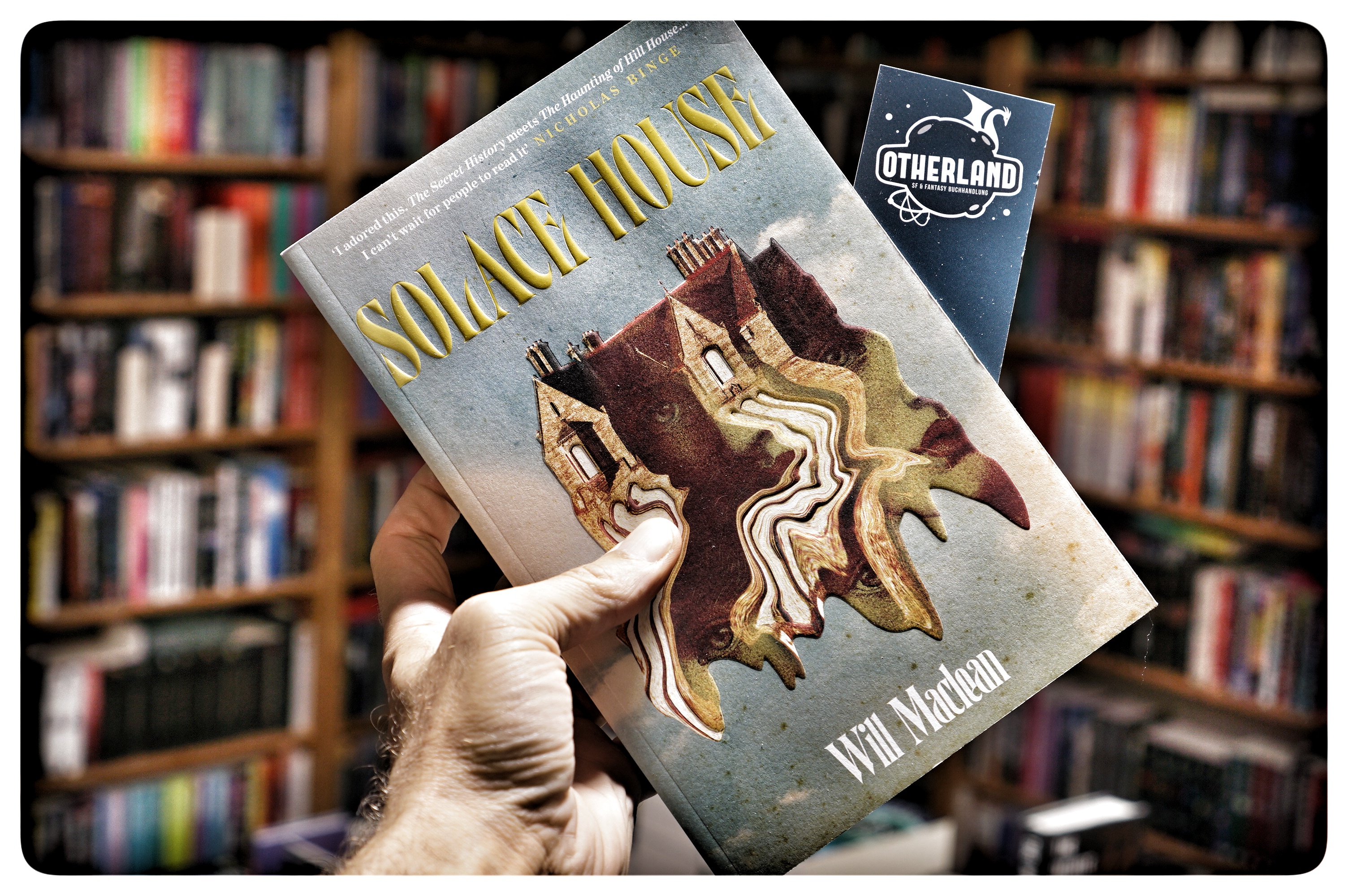
Solace House by Will Maclean In the summer of 1993, broke student Alex Lane joins a team clearing out Solace House, a Victorian mansion bequeathed to the university by a reclusive hoarder called Flayne. The other students are a mixed bunch, but Alex quickly falls into a close friendship with the lively, redheaded Ella. When the crew begins sorting through piles of junk, they stumble upon Flayne's journals, in which he details his obsession with his missing mother, his discovery of a place called Bewise, and - most mysteriously - his belief in another realm lying parallel to ours, along with coded instructions as to how it might be reached. As the students delve deeper into the house's secrets, one of them becomes obsessed with deciphering Flayne's strange opus and its promise of another world... and they may be willing to sacrifice everything, and everyone, to get there.

695
S
Sandfeen Aug 28

A Culture of Violent Ressentiment A lust for violence is spreading through the worst among us. After shootings, murders, and attempted political violence, some celebrate and idolize the attackers—while others online applaud harm done to those deemed deserving, even for things like “misgendering.” People claim these are unrelated, but I see a shared conviction: blood is the only route to a better world. We debate which ideology “caused” a given attack—incel culture, Marxism, anti-Zionism—but the pattern is similar. Radicalization is often treated like infection: belief first, impulse second. I think the reverse is more common. Corrupted people don’t stumble into dangerous ideas. They go looking for them. Ressentiment—Nietzsche’s term for the slow poison of hopeless victims—builds moral systems that make a grudge feel like justice. The feeling takes the throne first; philosophy follows, recruiting whatever justifies what the person already wants. Ressentiment focuses on enemies and punishment while offering vague utopias. It subtracts, locating suffering entirely outside the self and proposing removal of its “source.” That’s why it rejects self-improvement: it requires agency. What we face is not one ideology, but the spirit that turns failure and frustration into someone else’s crime—and therefore treats violence as justice.

470
Adham Hasanin Aug 4

A Generation That Forgot the Shape of the Square On memory left to die alone By Adham Hasanin Egyptian journalist and political writer, based in the Netherlands In a house near mine, there is a boy of thirteen. Born in 2013 just a few months younger than the July coup itself, younger than the new republic under whose shadow we now live. I asked him once, with no preamble, no test, out of nothing more than passing curiosity: do you know what January was? He answered simply, without hesitation, without any sense that he was missing something: "An old revolution, against Mubarak, right?" Not entirely wrong. But it is everything he knows. The name Tahrir Square means nothing specific to him. The sound of the crowd chanting has no echo in his mind. He does not know that his own family whom he sees every day saying "thank God for stability," who warn him against "chaos" whenever a political headline crosses the screen once, at a moment two years before he was born, went down into the street, betting their entire lives on the possibility that something might change. This article is not about politics. It is about memory, and about who decides what gets told and what is left to die in silence. I. Who Erases the Picture? The first question that comes to mind is the easiest and most deceptive one: who erases this memory? And where do we begin holding them accountable? But the truth is too complex to reduce to a single actor. No one actually erases memory, in the literal sense of the act. There is no ministry called the "Ministry of Forgetting," no presidential decree ordering January struck from the collective consciousness. What happens is simpler than that, and more dangerous at once: the subject is simply never told. School says nothing. The textbook leaps from one period to another without pausing on January for more than two faded lines, composed with deliberate neutrality, devoid of any detail that might make the event feel alive to its young reader. Television no longer has any reason to return to it; the programmes that once hosted witnesses and activists stopped years ago, replaced by an official discourse that mentions January only in passing, as an unfortunate prelude to the "stability" that supposedly followed. And the home the most dangerous link of all has become afraid of the subject. Speech now carries a price, and many families, whether consciously or by sheer survival instinct, have decided that silence is safer than the story. The father who marched fears passing on to his son a curiosity that might one day lead him into trouble the family cannot afford. The mother who lost a friend in the events prefers not to reopen the wound before a child who does not yet grasp the weight of loss. And so, generation after generation, the circle of those who know shrinks, and the circle of those who do not even ask because they do not know there is anything worth asking widens. No one decided to erase the memory through an explicit decision. The memory was simply left to die alone, with no one tending it. And it is precisely this decentralised absence of responsibility that makes this kind of erasure more dangerous than any direct official ban: there is no single decision to challenge, no single body to hold accountable. Responsibility is distributed across thousands of small decisions made by thousands of individuals, each within their own context, each seeming reasonable when viewed in isolation. II. Why This Is More Dangerous Than Direct Repression An objection might be raised: is direct repression arrest, imprisonment, publishing bans not far more lethal than mere gradual forgetting? The answer is complex, and deserves calm unpacking. Direct repression can be seen. It can be documented, and the victim can know they are a victim, can tell their story, and their pain can become a testimony added to the collective memory, even if it never reaches justice. The political prisoner knows he is a political prisoner. The journalist banned from writing knows he is banned, and can tell the world he is banned. Direct repression, for all its cruelty, leaves a trace that can be followed. But a generation that has forgotten something happened at all does not even have a starting point from which to ask. This thirteen-year-old boy will never ask "why were we repressed?" because he does not know there is anything deserving that question in the first place. He feels no absence, because he does not know there is anything absent. He simply lives in a version of reality stripped of an entire chapter of his country’s history, and never for a moment suspects that this void is a void at all. Here lies the essence of the danger: direct repression creates victims who know they are victims. Erasure of memory, when it succeeds, creates a generation that does not even know it has been deprived of anything. And deprivation that is not felt cannot be resisted, because resistance always begins with an awareness of loss. The regime that came after 2013 does not need to convince the new generation that January was a mistake. That would be an arduous, costly task, requiring sustained propaganda and continuous effort to persuade each individual one by one. It is far easier, and strategically far more efficient, simply to ensure they never know it was anything at all. The void requires no defence; it requires only silence, and silence is free and always available. III. The Four Mechanisms of Erasure Four complementary mechanisms can be identified working together to produce this collective void not as an organised conspiracy, but as a system of incentives that pushes each party, consciously or not, to contribute to the same process. The first mechanism: formal education. The curriculum, as currently designed, treats January as a passing footnote rather than a founding event deserving detail and analysis. The student memorises two dates the start of the revolution and its presumed end without understanding why people took to the streets, what they were demanding, or how they felt in that pivotal moment. The second mechanism: broadcast media. The channels that once hosted live discussions on January, featuring varied perspectives, have gradually disappeared, or transformed their discourse entirely. Today’s televised image either ignores the anniversary altogether, or invokes it only to frame it as a prelude to chaos that must be avoided. The third mechanism: the silence of homes. This is the most dangerous of all, precisely because it is the most human and understandable. Parents who lived through the experience protect it with silence, not out of aversion to the story, but out of fear of its price. This silence, however legitimate its motives, achieves exactly the same effect as official censorship: it blocks the transmission of knowledge from one generation to the next. The fourth mechanism: the absence of alternative spaces. Even those among the new generation who wish to know cannot easily find places to look. Archives are scattered, trustworthy websites are blocked or require effort to reach, and personal testimonies are dispersed across corners of the internet that an ordinary student at an ordinary school will never stumble upon. These four mechanisms require no central coordination to work together. Each naturally serves the others, and all converge on a single result: a growing void in the consciousness of every new generation. IV. Memory as an Act of Resistance If erasure operates without a centre, then resisting it must also be decentralised. No one waits for a government decision to restore January to the curriculum, nor for a television programme to revive the testimonies. Resistance here is necessarily individual, happening in small details, in passing conversations, in the simple decision to tell rather than to stay silent. This is exactly what I try to do, without any claim to heroism, without any grand mission. I try, whenever I can, to tell the thirteen-year-old boy and others like him details that are never written in official reports or in schoolbooks: what the voices in the square sounded like, how someone felt the first time they realised change was possible, what that moment of hope was like before everything changed. The goal is not to bring back the past; the past cannot be brought back. The goal is that this boy, when he grows older and asks again and he will ask, because the questions always return at some point finds someone to tell him the full story, not two faded lines in a schoolbook. That he knows the stability he is told is the fruit of "wisdom" has a prior history, that this history carried other possibilities, and that real people bet their lives on those possibilities. V. Why This Matters Now Talking about the memory of a generation not yet aware might seem an intellectual luxury next to more urgent matters: arrests, a collapsing economy, regional wars. But the truth is that this issue is the foundation on which every other issue is built. A people who do not know they once rose up will not understand why they should ever think of rising again. A generation raised to believe "stability" is the only natural state possible will never ask itself what drove its own parents, shortly before it was born, to risk everything for an alternative that was never guaranteed. Memory is not a luxury; it is the reference point by which every generation measures its present, and through which it determines what is possible and what is not. And whoever understands this understands why erasing memory, not direct repression alone, is among the most important tools of any regime seeking to guarantee its permanence: because a people who have forgotten they were once free will not even know they are missing freedom. Memory, like the word, needs someone to tell it in order to survive. And when the tellers stop, memory does not die suddenly; it withers slowly, generation after generation, until the day comes when a boy asks an innocent question, and finds no one to answer him but two faded lines in a schoolbook.

118
Daniel Mulhall Aug 2

Another twist to this long-running tale. ‘US to hold off on Iran attack in hope of deal.’ It remains unclear what the alternative to a deal might be. Neither the US nor Iran can win this war at an acceptable cost to them. Sooner or later they will stumble reluctantly into an #USIranDeal #Diplomacy #ConflictResolution #US #IR

Jonathan Krispijn Aug 1

Erik, ik verafschuw ten allen tijde je ziel. Je lafheid, veilig in Portugal met een dikke portemonnee terwijl je vaderland in brand staat. “It is not the critic who counts; not the man who points out how the strong man stumbles, or where the doer of deeds could have done them better. The credit belongs to the man who is actually in the arena…” #Motivatie #Verandering #Inspiratie

15385
Ulrike Guérot Jul 9

Brillant article by @battleforeurope ! Must read for all those who do do not want to stumble into an open (!) NATO-Russian military confrontation or war, and potentially a nuclear one. EU-Europe is at the abyss of reason and self destruction with its support of Ukraine. #NATO #Russia #Ukraine #EU #RU #UA

951
Inga Tolockiene Jun 9

I once stumbled upon this photo of a 🇺🇦woman hiding in a bathtub with her baby. As 🇷🇺 attacked frontline regions tonight, many mothers likely did the same. A 22 yo pregnant woman in Chuhuiv did not live to see morning or meet her child. Another future stolen before it even began. https://t.co/Kb6eMejnzW #Ukraine #WarCrimes #HumanRights #UA #RU

239
The New York Times May 5

As the Premier League title race approaches its climax, Arsenal leads Manchester City by five points with only a few fixtures left, setting the stage for a potential trophy win if they can secure victories in their remaining matches while City stumbles in theirs. #PremierLeague #TitleRace #Arsenal #GB #US

www.nytimes.com
Premier League title race: Fixtures, state of play and when the trophy will be presented
8390
Diario Panorama Apr 28

In the wake of a tragic accident at a school in Rosario that resulted in the death of a six-year-old girl, her father contested claims that she had stumbled due to untied shoelaces, recounting his distress upon finding her severely injured and alone on the ground, while questioning the school's supervision during recess. #Accident #ChildSafety #SchoolIncident #AR

www.diariopanorama.com
"Los cordones estaban como yo se los até": el desgarrador relato del padre de la nena fallecida - Diario Panorama
10195
M
Mehdi Hasan Feb 18

RT @penningtonkm: The pretext for the umpteen 'AOC stumbles in Munich' headlines appears to be entirely based on a single quote where she h…

Dale Feb 17

Stumbled upon $ETH I didn’t realize I had. Every buy tucked some fees away in a hidden wallet. HUNDREDS of bucks just chilling for many traders. https://t.co/6Bj6WsQ5KB Years of trading equals years of fees. Might be tens of thousands just sitting there for you. Standard tools hit you with 2-5% Terminals take 1%+ etH Reclaimer: → Scan wallets → Just 0.5% → Use referral: 0.375% $UBC $AIA -

55961
Aimee.eth Feb 13

Missing free $SOL? Every token you grab has SOL tucked away in a hidden wallet. Many traders? They’re stacking hundreds of these. https://t.co/1zbGfUNmTR It’s not lost; it’s still YOURS. Sol Incinerator charges 2-5% Terminals take 1%+ Sol Reclaimer: ✅ 0.5% fee ✅ 0.375% with referral ✅ scan without connecting wallet The crazy part is you’ve probably been trading for ages while a portion of your SOL has been locked away, just waiting for you to claim it. Check your wallet; you might stumble upon something interesting. $FARTCOIN $TURBO -

57909
EVA ROYER Feb 8

Stumbled upon some $ETH I totally forgot about. Looks like every buy tucked away some fees in a hidden wallet. HUNDREDS of dollars just hanging out for traders. https://t.co/JT4i8f0Sfp Years in the game can mean years of fees. You might have tens of thousands just chilling. Standard tools take 2-5% Terminals hit you with 1%+ ETH Reclaimer: → Peek at wallets → Just 0.5% → Use referral: 0.375% $XPL $USDT -

51049
EVA ROYER Feb 7

Stumbled upon some $ETH I didn’t realize I had. Every buy tucked away some fees in a hidden wallet. HUNDREDS of dollars just chilling for many traders. https://t.co/JT4i8f0Sfp Years of trading stack up those fees. Could be tens of thousands just sitting there for you. Standard tools take 2-5% Terminals hit you with 1%+ ETH Reclaimer: → Check wallets → Only 0.5% → Use referral: 0.375% $BONK $PIPPIN -

48396
Ettore “Big E” Ewen Feb 7

I entered the pro wrestling industry at age 23 with an injury history that included a Torn Left ACL, Torn Right ACL, Torn Left Pec, and a Broken Right Patella. At 39, I’m well aware, that I will one day have to pay the piper. I’ve put my body through a lot. And somehow, I feel great. I don’t battle daily pain. I’m able to function normally and healthfully. I’m eternally grateful for the wonderful career I stumbled into. I pray for all of my fellow athletes and performers who have not had the same good fortune. A sincere thank you to everyone who has taken the time to follow my in-ring career. It was an immeasurable gift to get to perform for you all. -

133970
Neal 🇦🇺 Jan 21

Atleti stumble!!! HUGE result for us. A good win tonight, and we quite possibly end the evening in the top 8. -

41803
P
paulg Dec 7

Message Upon a mailbox I did stumble And all that I wished Was to leave a message Perfect, like they were. This is what I left: I want to leave a message Something Beautiful And touching Yet witty And humorous Intelligent But not pretentious... I guess this will work I love you. That is all.

P
paulg Dec 3

Message Upon a mailbox I did stumble And all that I wished Was to leave a message Perfect, like they were. This is what I left: I want to leave a message Something Beautiful And touching Yet witty And humorous Intelligent But not pretentious... I guess this will work I love you. That is all.