WRLD

Search

#ETPC
r00t🇪🇺 3h

The author of the entry criticized Karol Nawrocki for selectively referencing the Constitution of the Republic of Poland and accused him and Bogucki of omitting provisions related to international law. He pointed to articles 87, 9, 90, and 91, which—he wrote—are significant for understanding the sources of law and Poland's obligations. The author argued that Article 87 defines the sources of law, not the institutions authorized to interpret it. He also noted that the opinions of the Venice Commission are not legally binding, whereas the judgments of the European Court of Human Rights and the rulings of the Court of Justice of the EU are subject to different principles arising from Poland's treaty obligations. He reminded that according to Article 126, paragraph 2, Nawrocki, while performing the duties of the President of the Republic of Poland, was to ensure compliance with the Constitution. He accused him of undermining the integrity of fulfilling this duty by omitting parts of its provisions. #KonstytucjaRP #Prawo #Polska (translated)


1795
r00t🇪🇺 3d

The author criticized Dubyna's post, accusing him of misrepresenting the division of powers, the competences of the Council of Ministers, the rulings of the Constitutional Tribunal, and the concept of a coup d'état. He wrote that the appointed team analyzing the systemic effects of the court and tribunal rulings did not seize judicial power and had no authority to overturn judgments, change decision-making panels, or issue orders to judges. The author stated that Dubyna referred to Article 190 of the Constitution while omitting the difference between the finality of Constitutional Tribunal rulings and the analysis of their legal effects. He also accused him of failing to take into account the rulings of the European Court of Human Rights in the case of Xero Flor v. Poland and the Court of Justice of the European Union in case C-448/23, which — as he wrote — concerned fundamental irregularities in the functioning of the Polish Constitutional Tribunal. The author considered the designation of the appointment of the government analytical team as a coup d'état to be a manifestation of a misunderstanding of the principles of state functioning. He also criticized the comparison of the situation to a totalitarian system, stating that it was historically unfounded and offensive to those repressed by the communist state. He added that the use of capital letters and exclamation marks did not lend any legal or intellectual value to the statements. #prawo #konstytucja #Polska (translated)

3469
wiadomosci.wp.pl 3d

In the article, Professor Ireneusz C. Kamiński argues that President Nawrocki's veto against the special law on the execution of judgments of the European Court of Human Rights is justified because the case law of Strasbourg is not infallible and primarily requires a change in the adjudicative practice of Polish courts, not new regulations. #ETPC #prawaczłowieka #Nawrocki (translated)

wiadomosci.wp.pl
Strasburg nie jest nieomylny. Weto Nawrockiego to dobra decyzja [OPINIA]
2910
Gutab💯 ن 4d

Gutab wrote that the president signed eight laws, but did not sign three: concerning the transfer of mandates between districts, the interference of officials in election advertisements, and the execution of ECtHR rulings while bypassing the constitution. He called for standing guard over Poland and warned against deception. #Polska #prawo #wybory (translated)

3365
Dariusz Mazur 4d

Dariusz Mazur wrote that the president vetoed the act on executing judgments of the European Court of Human Rights. He assessed that the president is not aligned with human rights or with Europe, and asked if he sees Poland's place in the East. He added that the president is trying to paralyze the execution of the interim measure of the ECtHR regarding the judges of the Constitutional Tribunal selected in March. According to Mazur, the president does not have the right to veto in this matter, and the measure will be executed. #prawaczłowieka #Polska #ETPCz (translated)

3373
Kamil Zaradkiewicz 4d

Kamil Zaradkiewicz considered the veto of President Karol Nawrocki against the law on the execution of ECtHR judgments as very good news. He described the law as absurd and wrote that it gave the decisions of the political body in Strasbourg binding power equal to that of statutory provisions. #Polska #Prawo #Wiadomości (translated)

3374
Dariusz Mazur 4d

Dariusz Mazur accused President Nawrocki and Zbigniew Bogucki of scaring the Polish people. He wrote that the president demonstratively canceled his participation in a meeting with other EU state leaders, and Bogucki insulted Polish security service officers. He assessed that it was a party game that served no good purpose. Mazur stated that nothing wrong was happening in the Constitutional Tribunal, and the judges chosen by the Sejm to replace those whose terms had expired wanted to begin work in accordance with the Constitution. He wrote that Nawrocki accused Judge Berko of political involvement while simultaneously meeting in the Tribunal with Bogdan Święczkowski, whom he described as a friend of Zbigniew Ziobro and a former PiS candidate for the Sejm. He added that the presence of Stanisław Piotrowicz, a former prosecutor and PZPR activist, did not bother the president, who — according to Mazur — had ended up there directly from the parliamentary benches. Mazur wrote that the president did not have the authority under the current Constitution to control the selection of judges made by the Sejm. He also accused Bogucki of hypocrisy in his statements about the independence of the Tribunal and stated that his record from the time of PiS's rule was well known. The author referred to two judgments of the European Court of Human Rights, which — as he wrote — assessed that the consequence of the reforms referred to as "good change" was the Tribunal's loss of characteristics of an independent and impartial court within the meaning of Article 6 of the ECHR. He added that the Tribunal ceased to be the guardian of the Constitution and became a tool of a particular political option, while Bogucki had no problem deceiving the Polish people. #polityka #Trybunał #Konstytucja (translated)

3266
r00t🇪🇺 5d

The author of the entry referred to the comparison made by Professor Grabowska, who likened the selection of a Constitutional Tribunal judge to the admission of a person without a high school diploma to university. He asked why similar procedural requirements are not applied to the election of President Karol Nawrocki. He recalled that Article 129(1) of the Constitution of the Republic of Poland indicates the Supreme Court as the body determining the validity of the presidential election. However, he noted that the resolution in this matter was adopted by the Chamber of Extraordinary Control and Public Affairs, the status of which as a court established by law — as he wrote — has been questioned in the case law of the European Court of Human Rights and the Court of Justice of the European Union. He added that the National Electoral Commission pointed out irregularities requiring judicial assessment and the need for the case to be heard by a panel whose independence would not be in doubt. The author emphasized that he does not prejudge the invalidity of Nawrocki's election. He also reminded that taking the oath provided for in Article 130 of the Constitution does not by itself remove any potential defects in the earlier electoral procedure. He asked whether constitutional requirements are applied selectively, depending on the political support for a given person. #KonstytucjaRP #SądNajwyższy #Polityka (translated)

3049
r00t🇪🇺 5d

Author r00t🇪🇺 accused Bogucki of omitting the Constitution, the hierarchy of legal sources, and circumstances in his interpretation that—according to the author—did not fit his thesis. He reminded that according to Article 194(1) of the Constitution, judges of the Constitutional Tribunal are elected by the Sejm, and the president has no right to approve this election or politically verify it. According to the author, Article 4(1) of the Act on the Status of Judges of the CT concerned the taking of an oath but did not grant the president the right of veto. The author cited the judgment of the CT K 34/15 from December 3, 2015, stating that the Tribunal recognized that the lack of a statutory deadline for taking an oath means an obligation to act without delay, with the possibility of considering exceptional, objective circumstances. He questioned Bogucki's argument about the change of law and urged him to specify a particular normative change that would justify departing from this interpretation. He added that the fundamental structure of the oath before the president remained unchanged, as did Article 194(1) of the Constitution. Discussing the judgment K 3/26 from May 12, 2026, the author pointed out that Justyn Piskorski sat in the adjudicating panel, whose status—he wrote—was linked to the flawed composition of the CT considered by the ECtHR in the case of Xero Flor v. Poland. He also accused Bogucki of failing to mention the publication of the judgment in the Journal of Laws, required—according to the author—by Article 190(2) of the Constitution. The author also recalled the dissenting opinions of Rafał Wojciechowski and Jarosław Wyrembak. According to his account, Wojciechowski accused the majority of going beyond the limits of the request and creating a norm contrary to Article 194(1) of the Constitution, while Wyrembak questioned the sentence and pointed to the obligation to take the oath as a consequence of the obligation to submit it. The author also noted that the justification of K 3/26 referred to extraordinary, objective, and justified circumstances, not to the unlimited political freedom of the president. Questioning Article 5 of the Act on the Status of Judges of the CT, the author stated that adopting Bogucki’s interpretation could mean granting the president an actual ability to block the effects of the election made by the Sejm. He urged him to indicate a provision of the Constitution establishing such a competence. He added that Article 126 does not constitute a blanket authorization for extending the president's powers, and its paragraph 3 specifies that the president performs tasks on the principles laid down in the Constitution and laws. Finally, the author accused Bogucki of selective use of provisions and case law. He wrote that the lack of a statutory deadline does not grant the president the right to indefinitely block the constitutional competences of the Sejm. #Konstytucja #Prawo #Polska (translated)

2938
Michał Wawrykiewicz MEP🇵🇱🇪🇺 6d

The author of the entry wrote that the opinion of the Venice Commission, which he described as an expert body of the Council of Europe composed of constitutionalists, was unequivocal and in line with the findings of the ECtHR contained in the interim measure of May 5, 2026. According to him, the President of the Republic of Poland did not have the authority to participate in shaping the composition of the Constitutional Tribunal. #TrybunałKonstytucyjny #Prawo #Polska #PL #EU (translated)

3172
Andrzej Domański 7d

it is certainly not directly the minister of finance When asked about it on TVN24, Minister of Finance Andrzej Domański replied that "it is certainly not directly the minister of finance." #TrybunałKonstytucyjny #wynagrodzenia #ETPCz (translated)

Święczkowski sędziom nie płaci. Zapłaci rząd?
wiadomosci.wp.pl
3065
wiadomosci.wp.pl 7d

The Ministry of Foreign Affairs is working on resolving the issue of salary payments for the judges of the Constitutional Tribunal, whom President Bogdan Święczkowski does not recognize, which could lead to a settlement with the European Court of Human Rights. #TrybunałKonstytucyjny #wynagrodzenia #ETPCz (translated)

wiadomosci.wp.pl
Święczkowski sędziom nie płaci. Zapłaci rząd?
3065
r00t🇪🇺 3w

I understand that you are not an economist, but after all, you have an entire army of "advisors" at your disposal... Because this is no longer information relayed by Moody. This is your RHETORIC. Just like with the debt. "In four years, the government increases debt by a trillion." The thing is, four years have not yet passed 🤷‍♂️ You are already linking the executed debt with a FUTURE FORECAST and then dividing that amount by the number of residents, announcing that a newborn has "26 thousand zł of debt." How do you come to such absurd conclusions?? I won't say it's not impressive... But public debt is not a personal obligation that is assigned to a child's account. And then there's the Constitutional Tribunal. You sign a law, still consider it unconstitutional, and send it to the Tribunal. The same Tribunal that the ECtHR has found to violate the right to a court set by law in the Xero Flor case, and the Grand Chamber of the CJEU in case C-448/23 stated that it does not meet the requirement of an independent and impartial court due to serious irregularities concerning its composition. And just minutes earlier, you said: "I'm not looking at legal loopholes." The Constitution and the legality of state organs are not "legal loopholes," Mr. Guardian of the Constitution 🤦‍♂️ And in the end, you say that you don't want "constant political war"... After a speech in which words fall: - blackmail, - the government’s ATM, - the government's financial catastrophe, - the prime minister's political plan and unsubstantiated claims that the government deliberately maintains high fuel prices to profit from them. I won't judge intentions. I assess the content. And the content of the official statement by the person holding the highest office in the state should withstand confrontation with documents 🤦‍♂️🤦‍♂️🤦‍♂️ Here - in many key areas - it does not withstand. I will no longer dwell on this speech, as I believe it is a waste of time. I'll just say this. I don't know who prepared this text for you. However, I do know that you read it, you delivered it, and you take responsibility for every word. And you repeated nonsense and manipulations that have long circulated in the statements of people from your Chancellery — which I have already corrected multiple times. The worst part is that many of them don't even take long to verify. You just need to open the documents from your own Chancellery. I really don't envy you. It only pains me your slogan: "First Poland, first Poles." Because Poland and Poles should truly come first - even before political interests, party narratives, and the need for another conflict. You cannot appeal to the good of citizens while simultaneously playing with their trust in the state, providing them from the highest office with half-truths, insinuations, and political assessments cloaked as facts. This is not about whether someone likes this government. It's about accountability for words. Especially from this office 🫣 #Polska #Polityka #Ekonomia (translated)

12578
Adam Szejnfeld 3w

3/3 Sprawne wykonywanie wyroków ETPCz to nie tylko kwestia procedur. To także realizacja zobowiązań Polski wynikających z Europejskiej Konwencji Praw Człowieka. Uchwalona ustawa wprowadza w tym obszarze jasne zasady, odpowiedzialność i większą przejrzystość. 🇵🇱 #ETPCz #PrawaCzłowieka #Polska #PL

116
🇵🇱Michał Woś 4w

‼️Zwróciłem się do marszałka Sejmu o wyjaśnienia: w jakim charakterze w spotkaniu uczestniczył Jakub Kocjan - zamieszany w nielegalne finansowanie kampanii Trzaskowskiego. Nie zostałem o spotkaniu poinformowany jako wiceprzewodniczący komisji. To nie było więc Prezydium komisji, lecz spotkanie przedstawicieli KO. I dzieje się to w czasie, gdy koalicja Tuska forsuje ustawę dotyczącą orzeczeń ETPCz, która ogranicza polska suwerenność. #Polska #Sejm #Kampania

11963
r00t🇪🇺 Sep 14

2/ A na koniec Pański argument o "politykach w togach". Pan Nawrocki publicznie zapowiedział, że nie będzie powoływał sędziów, którzy – w jego ocenie –kwestionuja konstytucyjne uprawnienia prezydenta, Konstytucję i porządek prawny. To właśnie w takim przypadku pytanie o kryteriaodmowy, obowiązek jej uzasadnienia i ochronę przed arbitralnością staje się szczególnie istotne. Bo prerogatywa konstytucyjna nie jest prywatnym prawem osoby sprawującej urząd. Jest KOMPETENCJĄ organu państwa. A każda KOMPETENCJA organu państwa wykonywana jest W RAMACH Konstytucji, a nie poza nią 🤷‍♂️ Może Pan więc powtarzać, że istnieje utrwalona linia krajowego orzecznictwa dotycząca braku właściwości sądów administracyjnych. Mogę się z tym nawet zgodzić😐 Ale proszę nie dopisywać do niej wniosków, których z niej wyprowadzić się po proatu nie da. WSA nie orzekł, że odmowa Karola Nawrockiego była merytorycznie zgodna z Konstytucją. Nie orzekł takze, że zastosowane kryteria były legalne. Nie orzekł też, że brak uzasadnienia jest zgodny ze standardem konwencyjnym. I nie orzekł również, że skarżący są – hmm – "politykami w togach". To już jest wyłącznie Pańska polityczna narracja - jak zwykle błędna i pokręcona. A od maja 2026 r. istnieje dodatkowo wyrok ETPCz, którego w tej narracji po prostu nie da się uczciwie pominąć 🤷‍♂️ I naprawdę, Panie Bogucki, mniej pewności siebie przy tak selektywnym czytaniu orzecznictwa. Bo w mojej opinii, problem nie polega na tym, że każdy, kto się z Panem nie zgadza, politykuje. Problem polega na tym, że Pan kolejny raz przedstawia własny, polityczny i zmanipulowany wniosek jako oczywisty wniosek prawny. A jak mam to w zwyczaju mówić: to nie jest to samo 🤷‍♂️ #Konstytucja #Prawo #Polityka

12022
r00t🇪🇺 Sep 14

Uffff... podobnie jak u Pana, z mojej strony również będzie chyba dużo pisania... Panie Bogucki, tym razem problem nie polega nawet na tym, że cytuje Pan orzecznictwo wybiórczo 🤷‍♂️ Problem polega na tym, że z orzeczeń dotyczących dopuszczalności kontroli sądowoadministracyjnej wyciąga Pan wniosek o materialnej prawidłowości decyzji Prezydenta, którego te orzeczenia po prostu nie potwierdzają 🤦‍♂️ Jak zwykle zacznę więc od podstaw. WSA nie stwierdził, że Prezydent może dowolnie odmawiać powołania sędziego. Wręcz przeciwnie. Sąd wyraźnie zaznaczył, że samodzielność Prezydenta przy wykonywaniu tej prerogatywy nie oznacza całkowitej dowolności, ponieważ wiążą go normy, zasady i wartości konstytucyjne. WSA stwierdził natomiast, że sąd administracyjny nie jest właściwy do kontroli tego aktu. I tu, Panie Bogucki, jest właściwie cała filozofia tych rozstrzygnięć. Co więcej – skargi były ODRZUCANE, a nie merytorycznie ODDALANE. A jak zapewne Pan wie, to są dwie zupełnie różne rzeczy. Z braku kognicji WSA nie wynika zgodność decyzji z Konstytucją 🤷‍♂️ Z braku kognicji WSA nie wynika brak obowiązku działania w granicach Konstytucji🤷‍♂️ A z braku kognicji WSA nie wynika dopuszczalność arbitralnej selekcji kandydatów według politycznego kryterium 🤦‍♂️ Podobnie jest z K 18/09, którym ponownie się Pan zasłania 🤦‍♂️ Trybunał badał tam ustawowe narzucenie Prezydentowi miesięcznego terminu na dokonanie nominacji i uznał takie związanie prerogatywy za niekonstytucyjne. Z tego wyroku nie wynika jednak żadna generalna teza, że Prezydent otrzymał blankietowe prawo odmowy nominacji bez podania powodów i poza standardami konstytucyjnymi. Mam nadzieję, że teraz już wyraźniej widać, o czym rzeczywiście było K 18/09. A teraz rzecz, którą w Pańskim wpisie naprawdę trudno przeoczyć. 21 maja 2026 r. ETPCz wydał wyrok w sprawie Sobczyńska i inni przeciwko Polsce. Sprawa dotyczyła właśnie odmowy powołania kandydatów na stanowiska sędziowskie mimo pozytywnego zakończenia procedury przed KRS. ETPCz stwierdził naruszenie art. 6 § 1 EKPC. Dlaczego?🤔 Ponieważ odmowa nie zawierała uzasadnienia, nie podlegała żadnej kontroli sądowej, a kandydaci nie byli chronieni przed decyzją, która nosiła cechy możliwej arbitralności. I właśnie dlatego Pańskie pytanie, czy obecni skarżący „dążą do wzbudzenia politycznego orzeczenia ETPCz”, brzmi dziś dość osobliwie... Takie orzeczenie już istnieje. Co więcej, RPO również kwestionuje dotychczasowe podejście sądów administracyjnych i wniósł skargę kasacyjną do NSA, podnosząc https://t.co/wO8AaJDRre. standard art. 6 EKPC oraz konstytucyjne prawo do sądu. Można oczywiście z tym stanowiskiem polemizować. Dokładnie tak, jak ja polemizuję teraz z Pańskim. Nie może pan jednak uczciwie przedstawiać sprawy tak, jakby problem prawny został definitywnie rozstrzygnięty kilkanaście lat temu, a każdy sędzia próbujący dziś poddać odmowę kontroli musiał być albo nieukiem, albo politykiem 🫣 To jest już zwyczajnie nieuprawniony wniosek (chociaż ciśnie mi się na usta bardziej radykalne określenie) Jeszcze bardziej... osobliwa jest dalsza część Pańskiego wpisu. Z faktu, że sędziowie skorzystali ze środka prawnego i zakwestionowali decyzję dotyczącą własnej kariery zawodowej, wyprowadza Pan wniosek, że tym samym "potwierdzili słuszność" odmowy ich powołania. No jakim cudem doszedł Pan do takiego wniosku? Czyli według tej logiki samo skorzystanie z prawa do sądu ma być dowodem, że ktoś nie nadaje się do pełnienia urzędu sędziego? 🤦‍♂️ To nie jest argument prawny,to jest czysta petycja zasady. Nie ma również żadnej podstawy do przypisywania tym sędziom "motywów politycznych"" tylko dlatego, że próbują doprowadzić do sądowej kontroli decyzji dotyczącej ich statusu. Zwłaszcza po wyroku ETPCz z maja 2026 r. 1/ #prawo #sądownictwo #konstytucja

12256
Zbigniew Bogucki🇵🇱 Sep 14

Prezydent Rzeczypospolitej Polskiej jest organem władzy, a nie organem administracji w zakresie wykonywania swojej wyłącznej, konstytucyjnej prerogatywy powoływania sędziów i odmowy takiego powołania, a postanowienie Prezydenta nie podlega kontroli sądów, ponieważ Prezydent „działa jako najwyższy przedstawiciel (głowa) Państwa Polskiego, wykonujący kompetencje arbitrażu i równoważenia władz, polegające na personalnym ukształtowaniu władzy sądowniczej, związany jedynie normami konstytucyjnymi i wynikającymi z nich zasadami i wartościami”. Wojewódzki Sąd Administracyjny w Warszawie, oddalając skargi sędziów na postanowienia Prezydenta Nawrockiego o odmowie powołania, potwierdził trwałą, stabilną, obszernie i znakomicie konstytucyjnie uzasadnioną linię orzeczniczą, która ukształtowała się już w 2008 r. w orzecznictwie WSA, a następnie Naczelnego Sądu Administracyjnego oraz orzecznictwie Trybunału Konstytucyjnego np. w wyroku w sprawie K 18/09, czy postanowieniu z dnia 19 czerwca 2012 r., sygn. akt SK 37/08, w którym Trybunał stwierdził, że: „…podstawą powoływania sędziów jest norma konstytucyjna, tj. art. 179 Konstytucji (…)”. Na kanwie tej sprawy warto postawić kilka pytań: ▪️ Czy skarżący sędziowie, których Prezydent nie powołał do sądów wyższych instancji, nie znali tych licznych orzeczeń WSA, NSA i TK? ▪️ Czy liczyli na polityczną zmianę orzecznictwa? ▪️ Czy dążą do wzbudzenia politycznego orzeczenia ETPCz, aby próbować zakwestionować tę ugruntowaną linię orzeczniczą i kwestionować nadrzędność polskiej Konstytucji oraz wynikającą z niej wprost prerogatywę Prezydenta? Bez względu na to, którym z powyższych powodów skarżący sędziowie się kierowali, wyraźnie pokazali, że albo nie mają wiedzy, jakie jest utrwalone od lat stanowisko WSA, NSA i TK, albo ich motywy są polityczne, a tym samym potwierdzili słuszność postanowienia Prezydenta o odmowie powołania, aby nie orzekali w sądach instancji wyższych niż do tej pory. Pewnie u wielu Polaków słusznie pojawia się wątpliwość, czy tacy sędziowie w ogóle powinni orzekać, ale Prezydent jako strażnik Konstytucji szanuje zasadę zapisaną w art. 180 ust. 1 Konstytucji, przesądzającą, że sędziowie są nieusuwalni, a złożenie sędziego z urzędu, zawieszenie w urzędowaniu, przeniesienie do innej siedziby lub na inne stanowisko wbrew jego woli może nastąpić jedynie na mocy orzeczenia sądu i tylko w przypadkach określonych w ustawie (art. 180 ust. 2 Konstytucji). Ta sprawa pokazuje, że Prezydent Nawrocki dotrzymuje słowa danego w kampanii wyborczej, że nie będzie powoływał sędziów, którzy kwestionują status innych sędziów oraz kwestionują porządek konstytucyjno-prawny. Jednocześnie Prezydent przestrzega Konstytucji, pilnując zapisanego w niej porządku ustrojowego. To jaskrawa różnica na tle rządzących „demokratów walczących”, którzy nie realizują swoich stu konkretów, a jednocześnie dzielą sędziów i podważają ich status oraz wydane orzeczenia, łamiąc podstawowe zasady konstytucyjne i prawo. PS. Obecne orzeczenia WSA, a także poprzednie liczne rozstrzygnięcia WSA, NSA i Trybunału Konstytucyjnego, w połączeniu z konsekwentnym stanowiskiem Prezydenta, że nie będzie powoływał polityków w togach, powinny skłonić do refleksji obecną Krajową Radę Sądownictwa (powołaną w oparciu o te same przepisy co KRS w poprzednim składzie), aby procedować i przedstawić Prezydentowi takich kandydatów na sędziów, którzy zajmować się będą orzekaniem i sprawiedliwym rozstrzyganiem ludzkich spraw, a nie politykowaniem. Polacy na salach rozpraw potrzebują niezawisłych sędziów, a nie polityków w togach. #Konstytucja #WładzaSądowa #PrezydentPolski

15293
Kamil Zaradkiewicz Sep 12

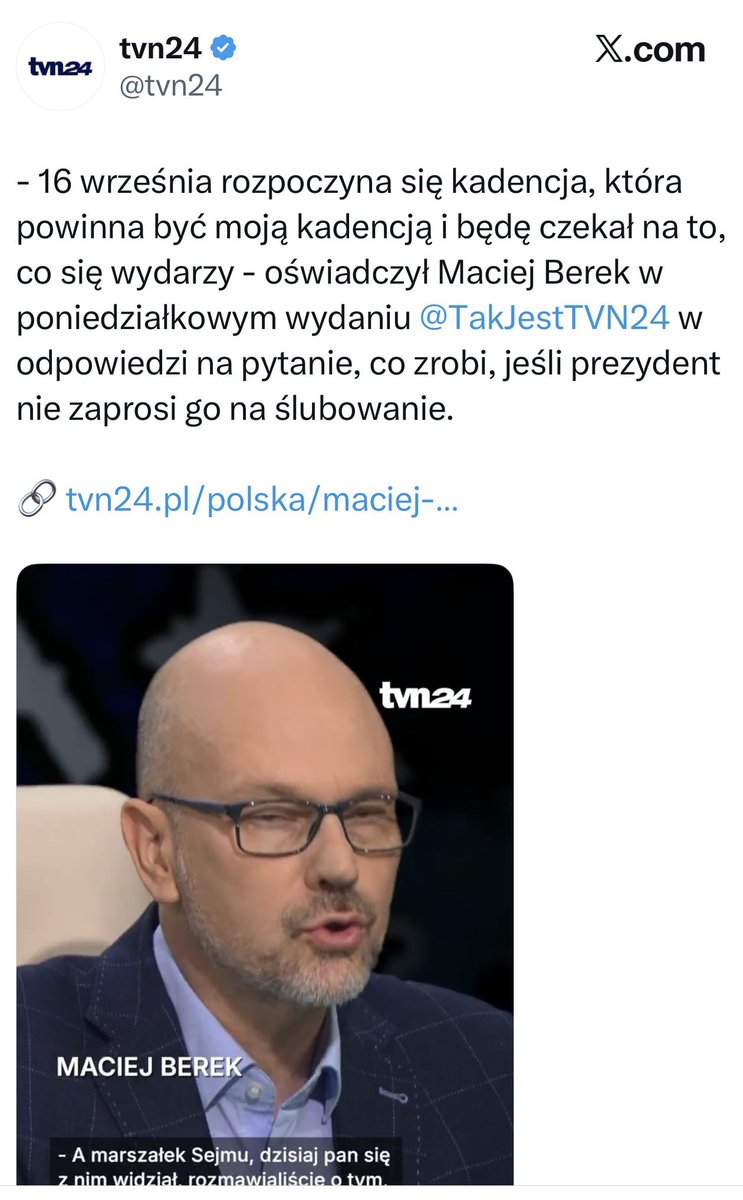
Docelowo chodzi o paraliż Sądu Najwyższego i Trybunału Stanu, które mają zostać „spacyfikowane” ustawami o „przywracaniu praworządności” i o „wykonywaniu orzeczeń ETPC” oraz „wyrokami” atrapy TK. „Grupa wejście” do TK aktywizuje się najprawdopodobniej z użyciem rozwiązań siłowych po 18 września, gdy według reżimu rozpocznie się kadencja pana Berka, bo zakończy się kadencja sędziego Piskorskiego (btw to pokazuje, że reżim doskonale zdaje sobie sprawę, jak już pisałem, że nie ma żadnego „dublera”). #praworządność #SądNajwyższy #TrybunałKonstytucyjny

11801
Jerzy Kwaśniewski Sep 12

@paweljablonski_ Pawle; alarmowaliśmy już rok temu. Wprowadzenie dodatkowych, pozorne zbędnych ustawowych zobowiązań do niezwłocznego wdrażania wyroków ETPCz jest działaniem celowym i politycznym - ma dodatkowo zapewnić argumenty nacisku na organy państwa i wymówkę dla rządu. „To nie polityka, #ETPCz #prawo #Polska #PL

117