WRLD

Search

#kauppa
Henri Vanhanen 42m

Henri Vanhanen wrote that according to The New York Times, Trump's negotiators had suggested increasing the purchase of Russian gas by Europe as a way to get Russia to stop its invasion of Ukraine. Vanhanen asked what else the Trump administration could still offer Vladimir Putin. According to Vanhanen, Europe had bought Russian gas worth billions of euros before 2022, but the revenue and influence Russia gained, as well as Europe's energy dependence, did not prevent Putin from invading Ukraine. He believed that Europe had sought to rid itself of Russian energy because the dependency had proven to be a serious geopolitical mistake. Restoring that would, in his view, be a gift to Putin and a setback for European security. Vanhanen wrote that peace could not be built by making war profitable business. He urged Europe to make it clear to Washington that European security and energy policy should not be used as a commodity in negotiations with Putin. https://t.co/c6meL6mr1T #Trump #Putin #energia (translated)

1359
Henri Vanhanen 10h

Henri Vanhanen wrote that Helsingin Sanomat had received nearly 800,000 Finnish individuals' location data for free from international data brokers. According to him, the data could be used to identify soldiers, members of parliament, and critical infrastructure workers, as well as to uncover their homes and movement patterns. Vanhanen assessed that the availability of location data could pose a serious vulnerability to Finland's national security and also jeopardize the privacy of ordinary citizens. He wrote that a foreign state's intelligence service might not necessarily need to breach information systems if it could purchase the data. Vanhanen suggested that Finland should begin preparing a Data Shield legislative package concerning the security of location data. He proposed that the commercial resale of precise location histories be prohibited, that the location protection of those working in security-critical tasks be strengthened, and that the responsibilities of authorities be clarified. Furthermore, he argued that Finland should advocate for stricter EU restrictions on the commercial resale of location data of identifiable individuals. https://t.co/iheRSEpv9j #Tietosuoja #KansallinenTurvallisuus #Yksityisyys (translated)

2400
Sanna Ukkola 3d

The author reported that Pekka Korhonen, who served as a peacekeeper, portrayed mutilated people and the lives of women who could not even go to the store without an escort. He mentioned that Korhonen had appeared on the Ukkola program and shared a link to the broadcast. https://t.co/F4hRwrs9dk #rauhanturvaaja #ihmisoikeudet #naistenelämä #FI (translated)

2684
Jussi Mäkinen 3d

Jussi Mäkinen wrote that Finnish immigration discussion, in his experience, had focused on the need for workers in low-paying jobs and funding for the pension system. He criticized that councilor Meri was condemned for speaking about what she thought. Mäkinen also pondered whether conclusions could be drawn from the names of those accepted into the Swedish-speaking medical faculty. Mäkinen criticized Marin's government's decision to raise the compulsory schooling age to 18. According to him, the reform had provided state-funded textbooks and school transportation for upper middle-class high school students, but at the same time enrolled youths in education who might not attend classes. He mentioned hearing from acquaintances in vocational schools in the capital region that, for example, selected students in electrical studies had not showed up for school even after the second academic year had started. Mäkinen also claimed that educational institutions received funding based on the names on student lists, even if the student did not show up. Mäkinen wrote that the proportion of those completing secondary education had risen from about 77.9 percent to 79.4 percent among those young people who turned 20 by the spring of that year. He challenged Meri to publish a positive update when the students on the list would have graduated. Mäkinen estimated that nearly 90 percent of those accepted to high school had Finnish backgrounds and nearly 90 percent of those accepted to vocational schools had immigrant backgrounds. He also shared that his friend, a Master's degree holder in business sciences who had come to Finland as a refugee from Kosovo, had said that they had learned better Finnish on a football team than in a classroom with immigrant-background students. Finally, Mäkinen reminded of a previous discussion where it was deemed important to transfer Finnish children from their local school to a school where the majority of students belonged to the S2 language group. He wrote that the backgrounds of the names on vocational school student lists could not yet be discussed. #maahanmuutto #koulutus #suomi (translated)

3244
mtvuutiset.fi 3d

The proposal for a business approach language is progressing, which allows store disruptors to be banned from entering stores in Finland. #Lähestymiskielto #Kauppa #Myymäläturvallisuus (translated)

www.mtvuutiset.fi
Yrityslähestymiskielto etenee – myymälähäirikkö voi saada pian porttikiellon
3247
Henri Vanhanen 4d

Henri Vanhanen wrote that Russia's frozen assets should be used for the benefit of Ukraine instead of being returned to Vladimir Putin's control. According to the Financial Times, the United States had suggested partially releasing the assets to entice Russia into peace negotiations. Vanhanen deemed the proposal absurd and assessed that Putin would not abandon his war of aggression without reciprocal concessions. Vanhanen believed that Europe had been discussing for years the use of frozen assets for the benefit of Ukraine but had not properly addressed the principal amount itself. He wrote that the United States was now even suggesting transferring the assets to Washington's oversight. According to Vanhanen, Russia should pay for the destruction it has caused, and Europe should find ways to use the assets to support Ukraine instead of making them a bargaining chip. https://t.co/9zBKU31Qb4 #Ukraina #Venäjä #rauhanneuvottelut (translated)

3028
Henri Vanhanen 1w

Henri Vanhanen wrote that Donald Trump's Russia policy may not have been guided by a coherent strategy. According to him, Trump made decisions one by one, seeking quick political gains, and then had to fix the consequences. In his assessment, Vanhanen linked Trump's diminished commitment to arming Ukraine, the energy price increases resulting from the war in Iran, and the recent diesel trade with Russia. He believed that trade could bolster the Russian economy and give Vladimir Putin a means to pressure Ukraine into halting strikes on Russia's oil refineries. Vanhanen also criticized Trump for condemning strikes that he claimed weakened Russia's war economy. Vanhanen noted that Trump’s administration had not sought significant new funding from Congress for arming Ukraine. According to him, previously agreed deliveries had continued, and European countries had purchased American weapons for Ukraine. He stated that Trump was not fundamentally on the side of Ukraine or Europe but was primarily pursuing his own interests. According to Vanhanen, Finland's security should not be built on the assumption that there is a plan behind Trump's decisions that would turn in favor of Europe. He urged preparedness for the possibility that U.S. aid could be delayed or smaller than expected, to strengthen the availability of defense equipment and air defense, and to deepen cooperation with Sweden, Norway, Denmark, Britain, Poland, and the Baltic countries. He also believed that Europe should be able to support Ukraine and maintain economic pressure on Russia by its own means. #Trump #Venäjä #Ukraina (translated)

3414
Henri Vanhanen 1w

Henri Vanhanen wrote that the agreement announced by Donald Trump with Vladimir Putin to bring millions of tons of Russian diesel to the global market would be very bad news for Ukraine. According to Vanhanen, the arrangement would give Russia new opportunities to earn from energy exports, even though its war of aggression in Ukraine would continue. Vanhanen assessed that the agreement could help Russia mitigate the economic impacts of the strikes on Ukraine's oil refineries. He wrote that the strikes had caused problems and fuel shortages for Russia. In his view, facilitating Russia's energy exports would also reduce the pressure on Putin to negotiate an end to the war. Vanhanen considered it possible that the promised deliveries might not materialize, as he claimed Russia's refining capacity had suffered from the strikes. Vanhanen speculated that Trump was aiming for lower fuel prices in the United States before the midterm elections, but questioned the agreement's impact on prices. He also found the political message of the agreement concerning: in his view, the Kremlin could present it as evidence that Russia is not isolated and that the U.S. president is willing to do business with it. According to Vanhanen, the agreement could place Ukraine's strikes on Russia's oil industry in conflict with Washington's fuel price objectives. He urged Europe to prepare for greater responsibility in supporting Ukraine and pressuring Russia, and maintained that Russia's war economy should not be helped to recover. https://t.co/gpRe9acHoW #Ukraina #Venäjä #Trump (translated)

3531

ProFin questioned whether anyone still believed that Donald Trump was committed to NATO's Article 5. He claimed that Trump was trying to save himself with the help of Vladimir Putin and was willing to sacrifice Ukraine, which would leave him indebted to Putin. According to ProFin, Trump viewed everything as a commodity and used derogatory language about him. #Trump #Putin #Ukraina (translated)

2736
L
Luisa Santos 1w

"With the current administration, everything is always a question mark," Santos says. #kauppasuhteet #EU #Yhdysvallat (translated)

USA:n ja EU:n kauppasuhteet kovilla – tilanne uhkaa kärjistyä
www.mtvuutiset.fi
2967
mtvuutiset.fi 1w

The trade relations between the USA and the EU are suffering from great tensions as the United States refuses to lower steel and aluminum tariffs, which may lead to countermeasures from the EU. #kauppasuhteet #EU #Yhdysvallat (translated)

www.mtvuutiset.fi
USA:n ja EU:n kauppasuhteet kovilla – tilanne uhkaa kärjistyä
2967
Katariina Souri 1w

Katariina Souri wrote that the price of food had risen by 25.1 percent since August 2021, while the rise in other consumer prices was around 18.1 percent according to her. She referred to a news article from Helsingin Sanomat and an estimate from researchers at the Natural Resources Institute Finland, which indicated that the necessity of food reduced the pressure on stores to lower prices. Souri noted that HS had not addressed the concentration of trade as a reason. According to Souri, the combined market share of the S-group and Kesko in the retail grocery sector was 82.5 percent, with the S-group controlling nearly half of the grocery market. She wrote that Finnish trade was the most concentrated in Europe and that the S and K groups were among the ten most profitable trading entities in the world. According to her, the combined operating profit of the S-group and SOK Corporation had grown from 280 million euros in 2021 to 495 million euros in 2025. In the first half of the current year, the profit had improved by 20 percent compared to the previous year. Souri claimed that the price received by primary producers and the profit development of the S-group had not progressed in the same proportion. According to her, a farmer or rancher was left with approximately 4–12 cents from a normal food euro, depending on the product, while most of the share went to the trade and the tax authorities. She considered the agricultural subsidies to effectively flow significantly into the profits and growth of the S-group and criticized the influence of the chains on zoning and legislation. Souri assessed that the duopoly in trade weakened the position of small businesses and free competition and restricted innovations and consumer choices. She wrote that politicians had failed to intervene in the situation. Additionally, she reported that Pellervo Economic Research had predicted at the end of September that food prices would rise in the following year as well. #ruoka #hintanousu #kauppa (translated)

3543
Jari Mäkäräinen 1w

Jari Mäkäräinen criticized Yle for often choosing female journalists to incite moral panic, according to him. He interpreted Yle's analysis as showing that support for the National Coalition Party among women had dropped to 12 percent and that the Finns Party had surpassed this party. However, according to Mäkäräinen, women were not punishing the National Coalition Party for its policies but for its austerity measures, and men were supporting the state. Mäkäräinen believed that the decline in women's support was due to the impact of budget cuts on sectors predominantly employing women, such as social services, organizations, and public services. In his view, this did not make the cuts unjust, but rather highlighted their effects. He mentioned the Social Democratic Party, the Left Alliance, and the Centre Party as the most popular parties among women and claimed that the left proposed tax increases amounting to nine billion euros. According to Mäkäräinen, the costs of these increases would fall on men who work overtime, start businesses, and pay progressive taxes. Mäkäräinen assessed that the issue for the National Coalition Party was its attempt to soften difficult decisions, while the Finns Party spoke about the same issues more directly. He argued that men were underrepresented in the care sector and overrepresented in dangerous jobs, entrepreneurship, and at the high end of the tax revenue spectrum. In his opinion, the National Coalition Party should maintain its stance even if it lost some female support, as this could help it win over voters who support the sustainability of the state. https://t.co/DfwLyPN03s #Politiikka #NaistenOikeudet #Taloustieto (translated)

2972
Pekka Toveri 2w

The author wrote that the situation, which had been ongoing from week to week, had begun to include the sinking of trade vessels from NATO countries, and asked how this should be responded to. According to him, the situation was being accepted as the new normal and continued as if nothing had happened. He stated that he did not support military power but considered that nothing followed from the decisions of politicians. #Nato #politiikka #rauha #FI #NATO (translated)

2979
Rami Kurimo 2w

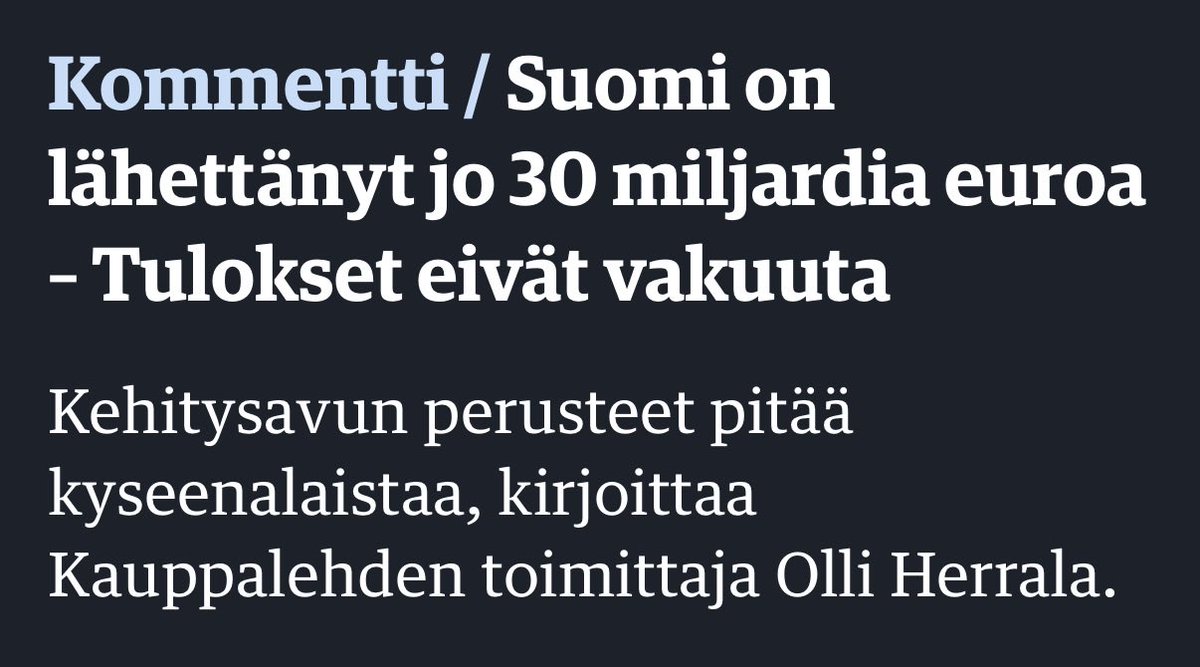
Rami Kurimo wrote that, in his opinion, in development aid, the poorer people of wealthy countries transfer money to the wealthy of poorer countries. He also claimed that Finland took on debt to distribute money abroad, and asked whether this made sense. He cited Kauppalehti as a source. https://t.co/fNpy9wfXTs #kehitysapu #velka #rahajako (translated)

3095
Tuukka Kuru 2w

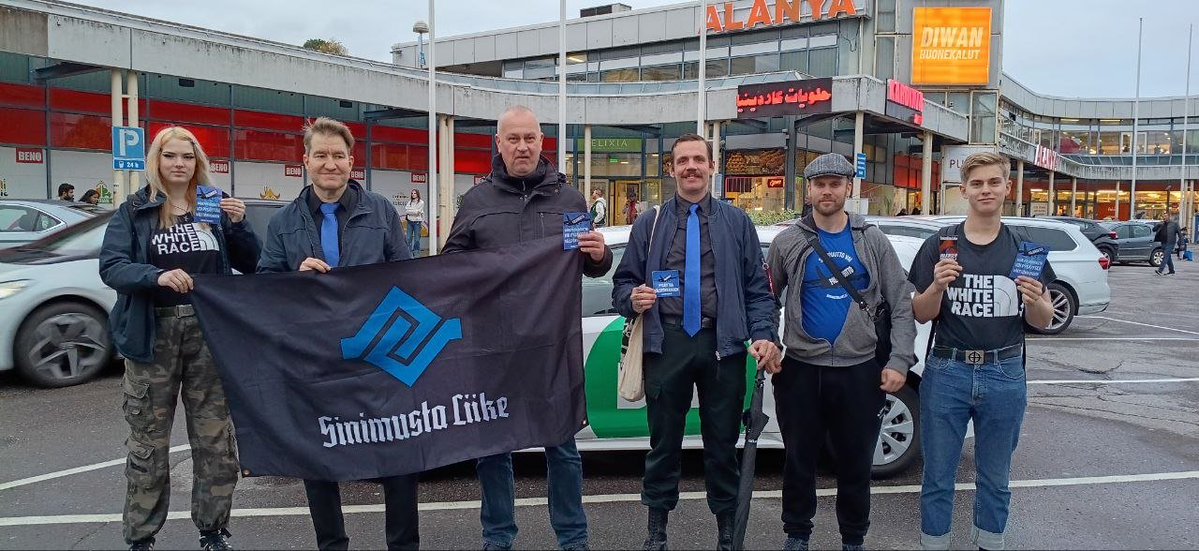
Tuukka Kuru wrote that the activists of the Helsinki district had made a visit related to repatriation to a shopping center known from the news. According to him, the trip did not require a bus or security guards. https://t.co/d07cyuWeRJ #Helsinki #Paluumuutto #retki (translated)

2984
Korson Jussi I Vantaa puolustája! 2w

Korson Jussi in Vantaa defender! asked if others had seen the video where racialized people filmed with a mobile phone while white people set a store or a school on fire. #rodullistus #rasismi #syrjintä (translated)

12055
Sebastian Tynkkynen MEP 🇫🇮 2w

The author argued that communist China does not follow the same rules as Europe and criticized Europe for allowing cheap imports to undermine its own industry. According to him, this should no longer be accepted. https://t.co/dFph5uh1UN #Kiina #teollisuus #kauppa #FI #CN #EU (translated)

459
Jari Mäkäräinen 2w

Jari Mäkäräinen criticized Yle for what he perceived as giving Timo R. Stewart, whom he describes as a Hamas activist, an unchallenged platform to present his book. According to Mäkäräinen, the article adopted Stewart's view regarding the destruction of Gaza, genocide, and Finland's responsibility due to trade with Israel, without hearing the opposing side. Mäkäräinen emphasized that, in his opinion, genocide does not equate to heavy war. He wrote that the International Court of Justice had not ruled on the case against Israel and that interim measures were not a judgment. In his view, civilian casualties can occur in urban warfare where Hamas places rockets, command centers, and tunnels among civilians without the intent of destroying the group. He compared this to the battles of Mosul, Raqqa, and Fallujah, claiming that Stewart began using the term genocide after Israel succeeded in its war against Hamas. According to Mäkäräinen, the Yle article also lacked the starting point of the war: the attack on October 7, in which he claims over 1,200 people died, and which involved rapes and kidnappings. He wrote that Hamas aims for the end of Israel instead of a Palestinian state. He criticized the figures presented by the Palestinian Ministry of Health in the article—over 21,600 by December 2023 and over 1,400 after ceasefires—and claimed that the ministry was subordinate to Hamas and that its figures did not differentiate between fighters and civilians. In his view, the article also lacked Israel's perspective that a significant portion of the dead were fighters. Regarding the two-state model, Mäkäräinen wrote that its failure was not solely due to Israel. He claimed that Hamas had rejected the model multiple times and that the Palestinian Authority had turned down offers, such as at Camp David in 2000 and Annapolis in 2008. He added that according to polls, the majority of both Palestinians and Israelis had abandoned the model. He described the cessation of support for UNRWA as a reaction to an organization that, according to him, had ample evidence of connections between its facilities and personnel to Hamas. Mäkäräinen believed that Yle, as a publicly funded media, should not advertise a single essayist as an expert. According to him, the article could have included opposing researchers, Israel's official stance, or addressed Hamas's responsibility for hostages and the use of civilians as shields. He concluded by asking why this had not been done. https://t.co/sHriNitmMo #Gaza #Israel #Hamas (translated)

14249
Samu Mökillä 2w

Samu Mökillä wrote that in Finland, with its long distances, many families needed a car for their daily lives, and that the fuel prices raised by the Middle East crisis had increased the cost of essential transportation. He criticized the proposal to use the commuting tax deduction to alleviate the situation, arguing that it mainly benefited commuters. According to him, the support would not help, for example, farmers, the transport sector, or lawnmowers. Mökkilä asked why fuel prices could be lowered elsewhere in the world but not in Finland, and considered the commuting tax deduction insufficient if the cost of living was also rising. He estimated that individual support lost its significance as general inflation consumed purchasing power. The rise in fuel costs would also increase freight rates, food production, industry, and logistics, which would be reflected in the prices of many products. He called for a reduction in distribution obligations and taxes instead of subsidies and described the commuting support as a small band-aid for a broader increase in living costs. According to Mökillä, politicians wanted to appear to be doing something, even if the support's impact on people's wallets was overshadowed by rising prices. Mökkilä also wrote that the state budget was heavily in deficit and dependent on revenues collected from motorists. He stated that high fuel taxes were part of climate policy, but rural residents, actors in the transport sector, and small entrepreneurs often had no opportunity to change their fleets or reduce driving. He criticized politicians for disregarding the situation of ordinary Finns, saying that while there was talk of savings, millions were sent to a terrorist organization. #Suomi #polttoaine #talous (translated)

12875