WRLD

Search

#resembles
Sebastian Kurz 1w

The author wrote that for more than a week, increasingly disturbing images from France and elsewhere in Europe had shown town halls burning, shops being looted and violence. They said events portrayed as student protests increasingly resembled scenes from a civil war, and suggested there was something behind the mob without specifying what. https://t.co/0NtR8XteNf #France #Protests #Violence #FR #EU

3867
Ultimora.net - POLITICS 2w

Ultimora.net - POLITICS reported that Giorgia Meloni concluded her reply in the Chamber by stating that she was convinced that the opposition could do better and bring peace. However, she asked them to first find an agreement between Magi and Fratoianni on a single resolution, before attempting to reconcile Putin and Trump. #politica #GiorgiaMeloni #resembles (translated)

2981
Krzysztof Graj 2w

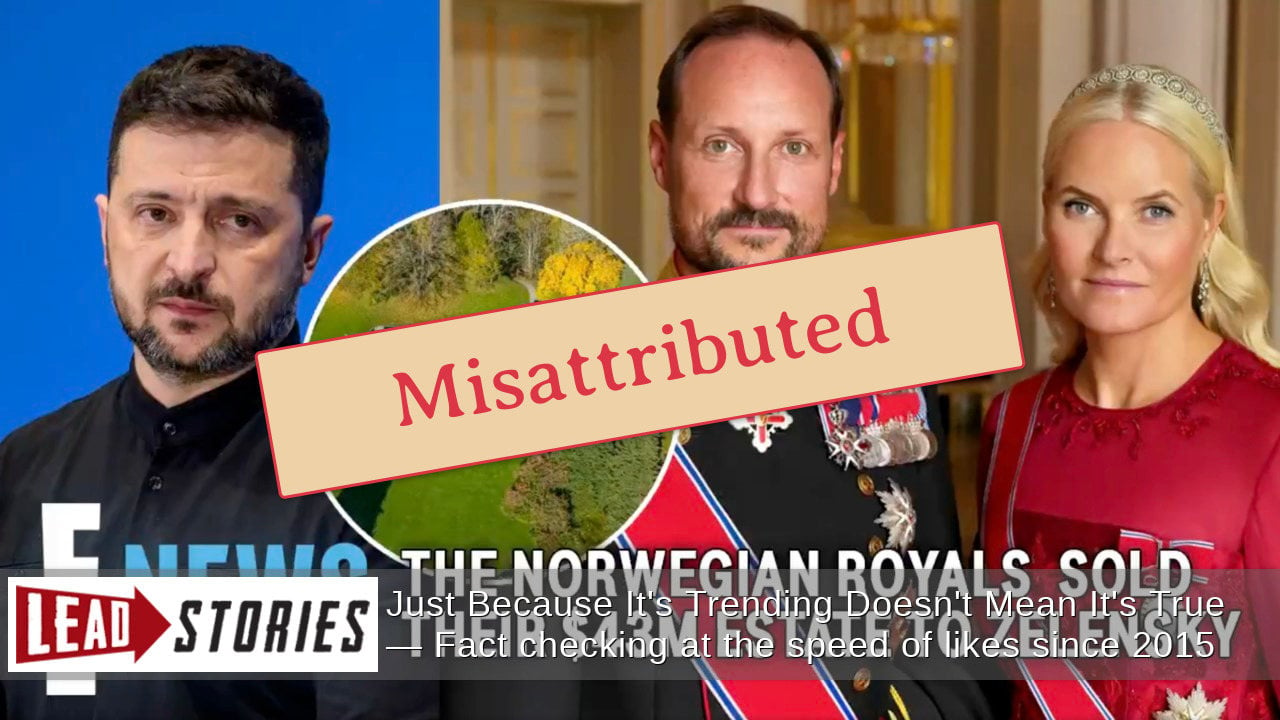
𝗧𝗵𝗲 $𝟰𝟯 𝗺𝗶𝗹𝗹𝗶𝗼𝗻 𝗿𝗼𝘆𝗮𝗹 𝗲𝘀𝘁𝗮𝘁𝗲 𝘁𝗵𝗮𝘁 𝗭𝗲𝗹𝗲𝗻𝘀𝗸𝘆𝘆 𝗻𝗲𝘃𝗲𝗿 𝗯𝗼𝘂𝗴𝗵𝘁 A Norwegian royal residence, a $43 million price tag, an offshore company historically linked to Volodymyr Zelenskyy and a video apparently produced by the American entertainment outlet E! News. The story contained enough authentic details to look plausible. It was also fabricated. At the end of September 2026, social-media accounts began circulating a video claiming that Film Heritage Inc., a Belize-registered company with historical links to Zelenskyy and his family, had purchased the Norwegian royal estate of Skaugum for approximately $43 million. The property was described as covering 240 acres, while the supposed transaction was linked to Zelenskyy’s visit to Norway for the funeral of King Harald V. Independent investigations found no evidence that such a sale had ever taken place. 𝗔 𝗳𝗮𝗸𝗲 𝗿𝗲𝗽𝗼𝗿𝘁 𝗯𝘂𝗶𝗹𝘁 𝗮𝗿𝗼𝘂𝗻𝗱 𝗿𝗲𝗮𝗹 𝗲𝘃𝗲𝗻𝘁𝘀 The fabrication was carefully constructed around genuine information. King Harald V had died in August 2026, and Zelenskyy and First Lady Olena Zelenska travelled to Oslo for his funeral on 9 September. Skaugum is also a genuine royal estate in Asker with a long history as a residence of Norway’s heir to the throne. The false report turned those facts into a fictional property transaction. It claimed that Zelenskyy had previously attempted to buy the estate, that the Norwegian royal family had rejected an earlier approach and that the purchase had finally been completed after the property supposedly became a financial burden. No documentary evidence supporting any of these claims has emerged. Norway’s Ministry of Foreign Affairs later confirmed to fact-checkers that the allegation was false. Searches of established Norwegian and international media also produced no credible reporting about the supposed transaction. 𝗔 𝗻𝗲𝘄𝘀𝗿𝗼𝗼𝗺 𝘁𝗵𝗮𝘁 𝗲𝘅𝗶𝘀𝘁𝗲𝗱 𝗳𝗼𝗿 𝘁𝘄𝗼 𝗱𝗮𝘆𝘀 The most important part of the operation was not the property claim itself. It was the source apparently verifying it. The video was designed to resemble an E! News report, borrowing the visual language of the established American entertainment brand. But investigators found no such story on E! News’s genuine website, social-media channels or archived pages. Instead, the accompanying article appeared on eonline.news, a domain closely resembling E! News’s legitimate eonline.com address. Registration records showed that the imitation domain had been created on 27 September 2026 — only two days before the story was published. The accompanying video also showed signs of synthetic production. Fact-checkers examining the material identified indications that AI tools had been used in the narration and audiovisual elements. The operation therefore did not simply invent a news story. It created an apparently credible media environment around it. 𝗧𝗵𝗲 𝗿𝗲𝗮𝗹 𝗰𝗼𝗺𝗽𝗮𝗻𝘆 𝗶𝗻𝘀𝗶𝗱𝗲 𝘁𝗵𝗲 𝗳𝗮𝗹𝘀𝗲 𝘀𝘁𝗼𝗿𝘆 The supposed buyer was also carefully selected. Film Heritage Inc. was not invented for the fabrication. The Pandora Papers previously documented a genuine historical connection between the Belize-registered company and Zelenskyy’s former business network. Leaked documents showed that Zelenskyy and his wife had held an interest in another offshore company through Film Heritage before changes were made to the ownership structure around his 2019 presidential campaign. That authentic history gave the new fabrication an additional layer of plausibility. The same company name has previously appeared in false narratives alleging extravagant purchases by Zelenskyy, including supposed luxury-property and casino acquisitions. Those stories were also unsupported by evidence. This illustrates a recurring feature of effective disinformation: not every component has to be false. A genuine company can be combined with a genuine trip, a genuine property and a genuine media brand to manufacture an event that never occurred. 𝗧𝗵𝗲 𝗠𝗮𝘁𝗿𝘆𝗼𝘀𝗵𝗸𝗮 𝗰𝗼𝗻𝗻𝗲𝗰𝘁𝗶𝗼𝗻 Ukraine’s Center for Countering Disinformation assessed the operation as consistent with the Russian Matryoshka disinformation playbook. The technique strongly resembles previously documented Matryoshka activity: impersonating established Western media organisations, creating fabricated video reports and distributing them through coordinated or pro-Russian social-media networks. French authorities have documented Matryoshka since 2023 as a pro-Russian influence operation targeting media organisations, public figures and fact-checkers. Investigations have shown repeated use of counterfeit reports imitating major European and North American news brands. The Norwegian-estate story fits that pattern closely. The attribution nevertheless requires precision. Independent evidence establishes that the E! News report was fake, that a newly created imitation website was involved and that the story circulated through pro-Russian information channels. Publicly available forensic evidence does not yet identify a specific individual or technical operator who created this particular asset. It is therefore more accurate to describe the Matryoshka connection as a well-supported analytical attribution rather than a publicly proven chain of command. 𝗪𝗵𝗲𝗻 𝘁𝗵𝗲 𝘀𝗼𝘂𝗿𝗰𝗲 𝗯𝗲𝗰𝗼𝗺𝗲𝘀 𝘁𝗵𝗲 𝗱𝗲𝗲𝗽𝗳𝗮𝗸𝗲 The most important element of the operation is not really the $43 million figure. It is the construction of credibility around it. A genuine royal funeral supplied the timing. A genuine Norwegian estate supplied the location. A genuine offshore company supplied a documented connection to Zelenskyy. A counterfeit E! News website supplied apparent journalistic confirmation. Synthetic audiovisual material supplied what looked like additional evidence. Each element reinforced the others. This reflects a broader change in contemporary disinformation. The most sophisticated operations no longer rely exclusively on fabricating photographs, videos or statements. Increasingly, they fabricate the source that supposedly verified them. The deepfake is sometimes the entire newsroom! 𝗦𝗼𝘂𝗿𝗰𝗲𝘀 Lead Stories — investigation into the fake E! News report https://leadstories.com/hoax-alert/2026/10/fact-check-enews-did-not-publish-report-about-zelenskyy-buying-43-million-dollar-mansion-from-norways-royal-family.html Center for Countering Disinformation of Ukraine — Norwegian royal estate fabrication https://cpd.gov.ua/en/international-threats-en/europe/fake-about-zelenskyys-purchase-of-a-norwegian-royal-family-estate/ Ellinika Hoaxes — investigation and Norwegian government response https://www.ellinikahoaxes.gr/2026/10/09/agorase-o-zelenski-ektasi-240-stremmaton-apo-ti-vasiliki-oikogeneia-tis-norvigias-gia-43-ekatommyria-dolaria/ The Royal House of Norway — funeral of King Harald V https://www.royalcourt.no/news/the-funeral-of-king-harald-v The Royal House of Norway — Skaugum and the Royal Estates https://www.royalcourt.no/the-royal-court/the-departments-the-royal-court/the-royal-estates-and-parks President of Ukraine — Zelenskyy and First Lady attend King Harald V’s funeral https://www.president.gov.ua/en/news/prezident-ukrayini-ta-persha-ledi-vzyali-uchast-u-ceremoniyi-106293 OCCRP — Pandora Papers investigation into Zelenskyy’s offshore network https://www.occrp.org/en/project/the-pandora-papers/pandora-papers-reveal-offshore-holdings-of-ukrainian-president-and-his-inner-circle AFP Fact Check — previous false luxury-purchase narrative involving Film Heritage https://factcheck.afp.com/doc.afp.com.36PG6EC VIGINUM / SGDSN — Matryoshka technical report https://www.sgdsn.gouv.fr/files/files/20240611_NP_SGDSN_VIGINUM_Matriochka_EN_VF.pdf CheckFirst — Operation Overload / Matryoshka investigation https://checkfirst.network/operation-overload-an-ai-fuelled-escalation-of-the-kremlin-linked-propaganda-effort/ Keywords #DISINFORMED #Episode19 #Zelenskyy #Ukraine #Norway #Russia #RussianDisinformation #RussianInfluence #Matryoshka #OperationOverload #Disinformation #InfluenceOperations #InformationWarfare #FIMI #MediaImpersonation #FakeMedia #ClonedWebsite #FakeNewsroom #ENews #ArtificialIntelligence #AI #AIGeneratedContent #VoiceCloning #SyntheticMedia #Deepfake #SourceLaundering #NarrativeLaundering #FilmHeritage #PandoraPapers #Skaugum #NorwegianRoyalFamily #Propaganda #DigitalInfluence #FactChecking #VIGINUM #OSINT #MediaManipulation #WRLD

leadstories.com
Fact Check: E! News Did NOT Publish Report About Zelenskyy Buying $43 Million Estate From Norway's Royal Family | Lead Stories
1262
Julian Röpcke🇺🇦 3w

The author wrote that a local collaborator had greeted a Russian soldier in the ruins of Dobropillya and guided him through the city centre. They said the situation looked bad and compared it with Pokrovsk the previous year. The author claimed that 28,000 civilians had fled the Russian assault, while 100 remained, whom they described in dehumanising terms as Putin supporters. https://t.co/fkCuezWzkn #Ukraine #Russia #War #RU #UA

3002
Tomas Tobé Sep 21

Today I visited the Spanish city of Ceuta, which has in practice become besieged by illegal migration from Morocco five weeks ago. The beach has been taken over and resembles favelas. 15,000 illegal migrants are still there, and the sense of insecurity throughout the city is https://t.co/0Nxy1EIS3J #Ceuta #IllegalMigration #Spain #ES #MA

350
Krzysztof Graj Sep 18

Mali – a war where some of the people fighting do not exist In Mali's war, an apparently simple question is becoming increasingly difficult to answer: who exactly is speaking to us? A real person? A rebel organisation? A Russian influence operation? A supporter of the military junta? Or somebody who has never existed at all? In September 2026, the Dakar-based Timbuktu Institute published Des algorithmes en guerre, a report examining the use of generative artificial intelligence by actors involved in the Malian conflict. Its researchers describe the country as a potential laboratory for AI-assisted information warfare. Separatist networks are deploying synthetic fighters on TikTok. Jihadist propagandists are experimenting with AI-generated imagery. Pro-government accounts are producing large quantities of content celebrating the Malian armed forces. Russia, meanwhile, operates the most developed influence infrastructure of all: pseudo-media outlets, inauthentic accounts, AI-generated text, images and video, and systems designed to artificially amplify their visibility. Artificial intelligence did not create Mali's conflict. The war has been under way since 2012, and its participants have always fought with propaganda as well as weapons. What AI has changed is the economics of that struggle. A new “witness”, commentator, fighter, poster or video can now be produced in minutes. For audiences watching from a phone, distinguishing between genuine documentation, propaganda and material created entirely by an algorithm is becoming progressively harder. Azzghim – the fighter who cannot be killed or interrogated The most striking case documented by the Timbuktu Institute involves accounts associated with supporters of the Azawad Liberation Front, or FLA, a Tuareg separatist movement fighting the authorities in Bamako. A figure called “Azzghim” appeared on TikTok. He looks like a Tuareg fighter and regularly features in videos attacking Mali's government and Russia's Africa Corps, commenting on the conflict and promoting the cause of Azawad. There is one problem: Azzghim does not exist. Analysis of the videos identified anomalies characteristic of generative AI, including unnatural body movements, visual inconsistencies, irregular colouring and problems with audio synchronisation. According to the Timbuktu Institute, Azzghim is a synthetic character being used as the digital face of a political narrative. The propaganda advantages are considerable. An organisation no longer needs to expose a real spokesman. A synthetic personality can be designed to look exactly as its creators require, speak the appropriate language and appeal to a particular audience. Different characters could potentially be created for younger viewers, traditional communities or different ethnic and social groups. There is another advantage: a synthetic spokesman cannot be arrested, identified or interrogated. Researchers also identified accounts amplifying the material. At the time of the study, TikTok account @tawri.n.azawad had around 207,000 followers and was almost entirely devoted to publishing or repackaging content involving Azzghim. Another account, @asnan831, used a similar synthetic teenage character. An important distinction is necessary. Researchers describe these profiles as belonging to supporters or individuals associated with the FLA. The available evidence does not establish that every account is part of an operation centrally directed by the Front's leadership. The information effect, however, remains significant: a digital community can be constructed around the Azawad cause in which some of the apparent participants may not be real people at all. The jihadists are learning too The picture is different for Jama'at Nusrat al-Islam wal-Muslimin, or JNIM, the al-Qaeda-affiliated coalition that has become one of the most powerful armed groups in the Sahel. Its confirmed use of generative AI remains considerably less sophisticated. In June 2026, JNIM's Az-Zallaqa media apparatus published AI-generated posters promoting material about previous attacks. The images showed fighters in combat but contained familiar generative artefacts: buildings and vegetation merging unnaturally, blurred details and unnaturally smooth surfaces. More important than JNIM's current capabilities is what AI could add to an already sophisticated propaganda apparatus. The organisation already tailors communications to different audiences. UN reporting has documented its use of media channels for broader propaganda while other outlets increasingly distribute material in local languages, including Bambara. Generative AI could dramatically reduce the cost of this strategy, translating material into Fulfulde, Hausa, Zarma or Tamasheq, generating synthetic dubbing and producing multiple versions of the same message. The Timbuktu Institute also considers the future possibility of AI chatbots being used to personalise recruitment. That should not be presented as a capability JNIM has already demonstrated. At present, it is a risk scenario rather than a confirmed operation. Russia has the most sophisticated machine At the other end of the spectrum lies Russia's influence ecosystem. Here, AI is not an isolated experiment but another component of an infrastructure previously developed by Wagner-linked networks, Russian media operations and influence organisations operating across Africa. After Wagner's withdrawal from Mali in 2025, its military role was taken over by the Russian state-controlled Africa Corps. The information infrastructure evolved alongside it. Of particular importance is African Initiative, which presents itself as a news agency but has been identified by France's VIGINUM, the UK's Foreign, Commonwealth & Development Office and the European External Action Service as an important component of Russia's newer influence architecture in Africa. One of the most interesting elements of this ecosystem is a network researchers call AI-Freak. The operation uses generative AI to produce text, images and videos, places them on fake or apparently independent news websites and distributes them through inauthentic accounts. This is supplemented by so-called Black Hat SEO – techniques intended to artificially increase the visibility of content in search engines. Elements of this infrastructure have previously been identified by Meta and OpenAI. In 2024, OpenAI disrupted Russian accounts using ChatGPT to generate articles and comments in English, French and Russian. Some of the French-language content targeted audiences in West Africa. In a later iteration of the operation, AI models were also used to draft scripts for short videos praising the Russian Africa Corps, translate them into French and generate descriptions optimised for social media. This illustrates an important difference between the Russian approach and Azzghim. The separatist ecosystem uses AI primarily to manufacture convincing digital personalities. The Russian model increasingly resembles an industrial production line: text, image, video, pseudo-news website, distribution account, search optimisation and additional channels amplifying the narrative. The objective is not merely to convince someone of a single claim. It is to occupy as much of the information environment as possible with narratives advantageous to Moscow: Russia as an effective security partner, the West as a neo-colonial aggressor, France as a source of instability and Russian forces as defenders of African sovereignty. Yet VIGINUM also warns against equating technological sophistication with actual impact. Some Russian influence channels still attract relatively small audiences. A sophisticated operation is not automatically a successful one. The junta is building its own digital reality Mali's military authorities operate within the same contested information environment. Since breaking with France and moving closer to Moscow, Bamako has increasingly restricted independent media space while promoting a narrative built around restored sovereignty, military success and the benefits of its Russian partnership. The Timbuktu Institute highlights the TikTok account @6tm_officiel. At the time of the study, it had more than 436,000 followers and published substantial amounts of AI-generated material presenting Mali's armed forces, the FAMa, and the Africa Corps in a favourable light. One video concerning the battle for Kidal accumulated around 4.7 million views. Again, attribution requires care. Researchers describe the account as being operated by an individual based in Bamako; they do not provide evidence that it is officially managed by the Malian government. It is better understood as part of a wider pro-government information ecosystem in which the boundaries between state communications, supporters and co-ordinated propaganda can be difficult to establish. The Africa Center for Strategic Studies has previously identified the military regimes in Mali and Burkina Faso as important sources of disinformation campaigns in West Africa. Recurring narratives target France, the United Nations, ECOWAS, human-rights organisations and independent media, while presenting criticism of the authorities as part of a foreign conspiracy. Generative AI allows such narratives to be produced faster, more cheaply and in far more variations. Everyone is fighting over a different version of the same war What makes Mali particularly revealing is that multiple actors are using similar technology for very different objectives. FLA-linked networks need digital faces capable of humanising the Azawad cause and attacking Russia's presence. JNIM needs propaganda material and increasingly localised communications. The pro-government ecosystem seeks to portray Mali's armed forces as victorious and reinforce the junta's legitimacy. Russia possesses the broadest infrastructure, in which AI is merely one component of a larger system involving media outlets, websites, local partners, social-media profiles and technical amplification. The result is a war taking place simultaneously in two realities. In the first, soldiers and civilians are killed, towns change hands and the army, separatists and jihadists fight for territory. In the second, every side is trying to determine what the first reality will look like on a smartphone screen. Generative AI does not need to create a perfect deepfake to be effective. It merely needs to increase the number of competing versions of events until an ordinary viewer can no longer easily determine which one deserves to be trusted. That is why Mali matters. It is not showing us the future of information warfare. It is showing us its present. One TikTok video may feature a real soldier. Another may feature a propagandist. A third may feature a fighter who has never existed. And all three can tell completely different stories about the same war. Sources Timbuktu Institute – Des algorithmes en guerre: Comment l'IA générative rebat les cartes du conflit malien https://timbuktu-institute.org/index.php/toutes-l-actualites/item/1731-rapport-des-algorithmes-en-guerre-comment-l-ia-generative-rebat-les-cartes-du-conflit-malien AfricaNews/AFP – “Mali's information war is increasingly being shaped by AI” https://www.africanews.com/2026/09/09/malis-information-war-is-increasingly-being-shaped-by-ai/ OpenAI – research on Russia-origin influence activity and Operation Stop News https://openai.com/index/disrupting-malicious-uses-of-ai-stop-news-2024/ VIGINUM / FCDO / EEAS – technical report on African Initiative and the AI-Freak network https://www.sgdsn.gouv.fr/files/files/Publications/20250612_TLP-CLEAR_VIGINUM_FCDO_EEAS_Technical_Report_African_Initiative_EN.pdf Africa Center for Strategic Studies – Mapping a Surge of Disinformation in Africa https://africacenter.org/spotlight/mapping-a-surge-of-disinformation-in-africa/ Timbuktu Institute – analysis of AI use by JNIM https://timbuktu-institute.org/index.php/toutes-l-actualites/item/1735-artificial-intelligence-a-new-propaganda-lever-for-jnim-in-mali?print=1&tmpl=component #Disinformation #Mali #Sahel #Africa #ArtificialIntelligence #AI #GenerativeAI #AIPropaganda #InformationWarfare #InfluenceOperations #Propaganda #Deepfakes #SyntheticMedia #Azawad #FLA #JNIM #AfricaCorps #Russia #RussianInfluence #TikTok #DigitalWarfare #MediaManipulation #WRLD

timbuktu-institute.org
Rapport - DES ALGORITHMES EN GUERRE : Comment l'IA générative rebat les cartes du conflit malien
1637
Krzysztof Graj Sep 15

Hanover Institute – propaganda designed for artificial intelligence For decades, influence operations had one primary target: people. Propaganda was designed to reach newspaper readers, television audiences or users scrolling through Facebook and TikTok. The Hanover Institute for Public Policy suggests that this model is beginning to change. In August 2026, an organisation presenting itself as an American think tank appeared online and, within just nine days, produced an enormous library of pseudo-academic research on Israel, Palestine and the war in Gaza. Yet the intended audience may not have been people at all. The material appears to have been designed, at least in part, to reach systems such as ChatGPT, Gemini, Claude and Perplexity. The Hanover Institute looked professional. It published lengthy “data reports” complete with methodologies, footnotes, tables and references to sources including the World Bank, United Nations agencies, Amnesty International and the Genocide Convention. What was considerably harder to find were the things normally associated with a genuine think tank: named experts, identifiable report authors, a physical headquarters or a clearly defined legal entity. There was, however, a much more revealing trail. Documents filed with the US Department of Justice under the Foreign Agents Registration Act link Piro Inc., via Havas Media Germany, to Israel's Government Advertising Agency, known as LaPam. Hanover itself now states that its material is distributed by Piro on behalf of Havas Media Germany, acting for LaPam. 124 reports in nine days The rate of production was extraordinary, even by the standards of online publishing. Between 6 and 14 August, the Hanover Institute released 124 reports containing more than 560,000 words – an average of roughly 4,500 words per publication. On 12 and 13 August alone, 73 reports appeared, totalling almost 354,000 words. More revealing than the volume was the way the material was structured. Many titles were framed as questions remarkably similar to those a user might ask an AI assistant: “Is anti-Zionism antisemitism?”, “Did Israel expel Palestinians from their land?”, “Is Israel committing genocide in Gaza?”, “Is there a starvation policy in Gaza?” or “Is the IDF the world's most moral army?” This did not resemble the conventional publishing schedule of a research institute. It looked more like the systematic construction of answers to as many contentious questions about Israel and Palestine as possible. The presentation mattered too. These were not crude propaganda leaflets. They were written in restrained, analytical language and packaged with data, references and methodological sections. To a search engine or an AI retrieval system, they could therefore resemble legitimate expert analysis. How to write for a chatbot Some of the most revealing evidence came from the site's technical architecture. Hanover maintained an llms.txt file – a mechanism intended to make website content easier for AI systems to interpret. Reporters also identified signs of technology associated with optimising content for generative search. Piro's own marketing is equally significant. The company advertised an “AI Story Optimization” service concerned with how large language models assess information and construct answers. Its co-founder Daniel Rosenberg has written about understanding how systems such as ChatGPT, Gemini and Perplexity formulate responses – and how to ensure that an AI system knows the story a client wants to tell. The principle resembles traditional search-engine optimisation, but the target has changed. SEO tries to make a webpage rank highly in Google. Generative Engine Optimisation, or GEO, attempts to make information discoverable, credible and useful to an AI system when it constructs an answer. The chain is potentially straightforward. A user asks a chatbot a question about Israel or Gaza. The system searches for information, encounters a professionally presented Hanover report and uses it as one of the sources from which it builds its response. Propaganda no longer has to reach the user directly. It can first reach the machine, which then delivers the information to a human audience in its own apparently neutral voice. Did it actually work? This is where an important qualification is necessary. There is no evidence that the Hanover Institute “reprogrammed ChatGPT”, altered the underlying parameters of OpenAI, Google or Anthropic models, or permanently poisoned their training data. Describing the operation simply as “poisoning AI” therefore risks overstating what can currently be demonstrated. There is, however, evidence of something more specific. In neutral tests conducted by POLITICO, both ChatGPT and Perplexity cited Hanover Institute material in answers concerning Gaza, anti-Zionism and antisemitism. That suggests the operation achieved at least one of its apparent objectives: in some circumstances, AI systems treated Hanover as a source from which information could be retrieved. What remains unknown is how often this happened, how long the effect persisted and whether it meaningfully altered answers for large numbers of users. It is therefore more accurate to describe Hanover as an attempt to manipulate the retrieval and citation layer of generative AI, rather than as evidence that the underlying models themselves were permanently compromised. The money trail leads back to the Israeli state Unlike many influence operations, attribution here does not depend solely on technical clues. There is a documented financial trail. Piro Inc. registered its US activities under FARA registration number 7732. Filings identify Havas Media Germany as a contractor acting on behalf of the Israel Government Advertising Agency, LaPam. An agreement dated 30 April included $900,000 for a “Digital Storytelling Pilot”, while subsequent documentation referred to a separate $100,000 information initiative. Precision matters. The available documents do not establish that the entire $900,000 was spent specifically on the Hanover Institute. They do, however, show that Piro was conducting communications activity financed through the Israeli state apparatus and aimed at American audiences, while Hanover materials were submitted to the Department of Justice under the same FARA registration. Following scrutiny of the project, Hanover also became considerably more explicit about its funding. Its website now identifies Piro, Havas Media Germany and LaPam. From propaganda for people to propaganda for machines The significance of the Hanover Institute does not depend on proving that the operation was enormously successful. Its importance lies in what it reveals about the changing architecture of influence. The internet is increasingly moving away from a model in which users open ten webpages and compare sources themselves. Instead, they ask ChatGPT, Gemini, Claude or Perplexity a question and receive a synthesised answer. That creates a new point at which the information environment can be manipulated. The traditional model looked something like this: create a misleading article, use accounts or advertising to increase its reach, and place it in front of human users. Hanover suggests another model: build a professional-looking source, publish hundreds of articles structured around questions people ask AI, optimise those materials for generative systems, and allow the chatbot to potentially incorporate them into its own answers. The most consequential feature of this mechanism is that the user may never visit the Hanover Institute website. They may never even know that the organisation exists. Its content only needs to become one ingredient in an answer generated by a system the user trusts. In the age of search engines, governments, companies and campaigners fought over what people would see in Google results. In the age of generative artificial intelligence, an increasingly important battle will be fought over something else: which sources machines use to construct the answers we accept as knowledge. Sources The Guardian – “Fake US thinktank set up and funded by Israel sought to game AI for propaganda” https://www.theguardian.com/world/2026/aug/26/fake-thinktank-israel-ai-propaganda POLITICO – “Israeli PR wants to answer your ChatGPT questions” https://archive.ph/xF7sZ US Department of Justice – FARA documentation for Piro Inc., registration no. 7732 https://efile.fara.gov/docs/7732-Exhibit-AB-20260602-0.pdf Hanover Institute – funding and organisational disclosure https://hanoverinstitute.com/about Responsible Statecraft – “Israel creates fake think tank in likely attempt to dupe AI chatbots” https://responsiblestatecraft.org/israel-influence-chatgpt/ AIthropology Lab – “Manufacturing the source to manufacture the answer” https://aithropologylab.org/en/radar/2026-09-02/ #Disinformation #ArtificialIntelligence #AI #HanoverInstitute #Israel #Gaza #Palestine #ChatGPT #Claude #Gemini #GenerativeAI #AIPropaganda #Propaganda #InfluenceOperations #InformationWarfare #GenerativeEngineOptimization #GEO #LLM #MediaManipulation #DigitalInfluence #WRLD

www.theguardian.com
Fake US thinktank set up and funded by Israel sought to game AI for propaganda
820
Graham Linehan Sep 7

What's been fascinating about the spasm of antisemitism that has gripped Ireland is how much of it resembles the kind of mediaeval religiosity which the country was supposed to have left behind. #antisemitism #Ireland #medieval #IE

822
S
Sandfeen Aug 29

The Downward Spiral of Gender Polarization The growing divide between men and women resembles less a debate than a divorce involving millions. Both sides escalate, talk past each other, and blame the other gender amid a mental-health crisis. Depression among Americans under thirty has doubled in eight years, while anxiety continues to rise. Each gender has failure modes and one successful path. Carl Jung called it individuation; a simpler term is integration. The integrated are not leading the conversation. The disordered are. Every man carries an inner feminine—the part that feels, intuits, and creates meaning. Jung called it the anima. Cut off from it, he becomes cold and contemptuous; overwhelmed by it, passive and moody. Every woman carries an inner masculine—the part that decides, asserts, and holds the line. Jung called it the animus. Cut off from it, she defers to stronger people; possessed by it, argumentative and rigid. I believe the four failure modes pair off. The cold, contemptuous man finds a timid woman who cannot challenge him; the red-pill industry calls this manhood. The passive man finds a domineering woman who can run his life; the feminist industry calls this liberation. A 2025 Nature Human Behaviour study of 14.8 million people in Taiwan, Denmark, and Sweden found that disordered individuals consistently marry one another across cultures and generations dating back to the 1930s. My theory is that integrated people increasingly date within a pool dominated by the disordered. They try, fail, and get hurt, then drift toward the same patterns. The pool corrupts those who might have healed it, creating a feedback loop. We are in a downward spiral: integrated people encounter disordered partners and become disordered themselves, while the already disordered grow worse. Reversal requires enough people to reject cynicism. When every encounter feels like proof that the other gender is broken, our own drift toward disorder begins to feel justified.

471
S
Sandfeen Aug 28

Why Therapy Culture Is Making Us Weak Why, despite unprecedented mental-health awareness and therapy language, does mental health seem to worsen? If both “the cure” and “the disease” expand together, we should ask what culture produces them. Modern therapy culture often teaches us to prioritize feelings, explain flaws through trauma, and treat negative emotions as reactions to others. Carl Jung proposed a different order: consciousness—judgment, values, and will—should govern the unconscious, including instincts and emotions. Health means understanding these forces without letting them rule. Today that hierarchy is frequently reversed: emotion outranks reason, and “lived experience” can outrank evidence. Jung warned this resembles “psychological Bolshevism,” where lower impulses overthrow higher faculties in the name of freedom. Nietzsche cautioned that “for every drive wants to be master.” The key question isn’t only where feelings come from, but whether we govern them. Therapy culture can also weaken self-criticism, treating conscience, guilt, and shame as oppressive rather than corrective. With “concept creep” (trauma/harm expanding to cover normal discomfort), personal agency can shrink: if everything is done to us, responsibility becomes harder to exercise. This can spread socially: victim identities bond through grievance, replacing judgment with collective resentment. History shows where that leads. The defense is older than therapy: govern yourself before demanding the world be changed.

707
S
Sandfeen Aug 28

Who Gets Promoted in a Broken Society? In Harry Potter, J.K. Rowling created a villain: Dolores Umbridge. She gains power not through competence, but conformity, loyalty, and bureaucracy. Evil rarely looks like Voldemort. Umbridge resembles Hannah Arendt’s “banality of evil”: ordinary people pursuing advancement by playing the institutional game. She enforces ideology through bureaucracy. Loyalists replace competent people, dissenters are labelled extremists, and punishment becomes a tool of conformity. The goal is not truth, but compliance. Political Ponerology Polish psychologist Andrew Lobaczewski studied how institutions can be captured by pathological individuals. He called the resulting system pathocracy, and the transformation of normal institutions into ones serving pathological interests ponerization. The danger begins when institutions lose the ability to distinguish competence from manipulation. Those willing to conform can rise precisely because others will not. Ideologues create doctrines, propagandists spread them, and ruthless operators capture institutions. The lesson: totalitarianism does not require one tyrant. It emerges when institutions lose the ability to distinguish the pathological from the honest. The Case of Mao Mao’s China offers a striking example. During the Cultural Revolution, Zhang Tiesheng became famous for submitting a blank exam paper while denouncing intellectuals. Political loyalty mattered more than academic ability. Mao elevated being politically “red” over being technically “expert.” Specialists were displaced by ideologically reliable outsiders. Officials who honestly reported collapsing harvests were purged, while those telling Mao what he wanted to hear advanced. False information helped sustain the Great Leap Forward, whose famine killed tens of millions. China abolished university entrance exams in 1966; they were not restored until 1977. A system that selects against competence eventually loses the ability to see reality. Mediocrity protects power; moral compromise enforces it. Capture education, and you shape a generation unable to challenge the system.

824
S
Sandfeen Aug 28

A Manifesto Written Like Scripture** Marxism is not merely an economic theory; it resembles a religion for those filled with resentment. The Communist Manifesto opens with spiritual language, declaring that “a spectre is haunting Europe—the spectre of communism,” indicating a spiritual war rather than an economic agenda. While supporters claim it seeks to redistribute wealth for equity, the text itself lacks words like “neighbor” or “love” in a positive context. Instead, it frequently uses terms like “violence,” “overthrow,” and “abolish,” emphasizing destruction rather than construction. Marx's concrete proposals focus on seizure and confiscation, with little mention of a classless utopia. He advocated for the “ruthless criticism of all that exists,” suggesting a totalizing worldview that dismisses the possibility of reform. Marxists often argue that true communism has never been realized, yet historical figures like Stalin and Mao embodied the totalitarian ambitions outlined in the Manifesto. Bertrand Russell noted that Bolsheviks resembled religious fanatics, quoting Marx like scripture. He drew parallels between Marxism and religion, with Marx as a Messiah and the Communist Party as a Church. The Manifesto states that its goals can only be achieved through the “forcible overthrow of all existing social conditions,” indicating a desire to destroy the current world. Interestingly, many Marxist leaders, including Marx himself, came from privileged backgrounds, contradicting the narrative that Marxism serves the oppressed. This pattern continues today, with Marxism appealing primarily to educated individuals from affluent families who face financial stress for the first time. Marxism shifts the concept of sin from individuals to the bourgeoisie, absolving its followers from personal accountability. This doctrine promotes pride, envy, and resentment, elevating hatred of the wealthy as a virtue. It lacks a pathway to forgiveness, viewing class origin as a crime inherited from ancestors. Ultimately, Marxism is not an economic theory but a destructive religion that justifies violence against entire classes in the pursuit of a misguided salvation.

942
S
Sandfeen Aug 28

The Gender War and the Downward Social Spiral The growing polarization between men and women resembles less a public debate than a divorce involving millions. Both sides talk past each other, escalate tensions, and blame the other gender—all amid a severe mental health crisis. The gender war is a cultural debate among a psychologically struggling population. The people lashing out most intensely may fit recognizable psychological patterns. Each gender has two major failure modes and one healthy alternative: integration. Carl Jung called this individuation. Every man carries an inner feminine—the part that feels, intuits, and finds meaning. Jung called it the anima. Cut off from it, he becomes cold and contemptuous; overwhelmed by it, he becomes passive and moody. Every woman carries an inner masculine—the part that decides, asserts, and holds the line. Jung called it the animus. Cut off from it, she defers to stronger people; possessed by it, she becomes argumentative and rigid. These failures often pair off. The cold, contemptuous man finds a timid woman who cannot challenge him, while the passive man finds a domineering woman who can run his life. Each ideology may then rebrand these unhealthy dynamics as either manhood or liberation. A 2025 *Nature Human Behaviour* study of 14.8 million people across Taiwan, Denmark, and Sweden found that disordered people consistently marry other disordered people across cultures and generations. Balanced people, by contrast, do not need to dominate or be dominated. Yet they are trying to date within a pool increasingly shaped by dysfunction. They get hurt, become cynical, and begin drifting toward the very patterns they once rejected. The disordered worsen, while the healthy become corrupted—a positive feedback loop. Well-integrated people meet a growing pool of disordered partners and drift toward disorder themselves. Reversal may require a critical mass of people to reject cynicism.

707
BBC May 17

A patient expressed her relief at Ipswich Hospital's trial of a new, less invasive womb cancer test called WID-easy, which resembles a smear test and offers quicker results, highlighting a positive shift in how women's health issues are addressed. #WomensHealth #CancerAwareness #HealthcareInnovation #GB

www.bbc.com
Woman praises new womb cancer test at Ipswich Hospital
8386
Euronews English May 14

Donald Trump has arrived in Beijing for a summit that resembles a tech board meeting rather than traditional diplomacy, bringing an "AI Cabinet" that includes leaders like Elon Musk and Tim Cook to navigate a high-stakes tech cold war and discuss the implications of AI in warfare, while highlighting Europe's struggles and strategies in the AI race. #AI #Technology #GlobalEconomy #CN #US #FR #EU

www.euronews.com
Watch: Silicon Valley in Beijing -- should Europe be worried?
8988
Pete Parkkonen May 13

Pete Parkkonen: We created an audiovisual monster with a scenario that resembles a post-apocalyptic setting.

14981
The New York Times May 7

Scientists discovered that the complex vocal communication of Alston's singing mice resembles human conversation due to subtle expansions in their neural pathways, suggesting that similar neurological changes might have influenced the evolution of human language. #Neuroscience #AnimalBehavior #LanguageEvolution #US #DE

www.nytimes.com
A Mutation Gave Humans the Gift of Speech. These Mice Have It, Too.
8994
The New York Times May 7

Scientists discovered that the complex vocal communication of Alston's singing mice resembles human conversation due to subtle expansions in their neural pathways, suggesting that similar neurological changes might have influenced the evolution of human language. #Neuroscience #AnimalBehavior #LanguageEvolution #US #DE

www.faz.net
Daten der WHO: Mehr als 650 Millionen Menschen leben ohne Strom
8994
M
Mehdi Hasan Mar 1

RT @hasanthehun: judging by msm coverage that resembles 2003, or the billionaire epstein affiliate owned social media algorithms, you’d thi…

www.lavanguardia.com
Una exposición para ayudar a salvar el planeta
hasanabi Mar 1

judging by msm coverage that resembles 2003, or the billionaire epstein affiliate owned social media algorithms, you’d think the american public was universally in favor of war with iran!!!

441428