BETA nonprofit public democratic european moderated

Search

#Ilmasto

Urho Haho wrote that he had been amused by the panic of the National Coalition's Niilo Heinonen and his partners. According to Haho, Heinonen tried to commit the city to what he described as fanatical climate goals together with the Greens in the Oulu city council. Haho believed that Heinonen was now presenting himself as right-wing, even though he was not distinguishable from the Greens in Oulu. #politiikka #Oulu #ilmasto (translated)

Mats Uotila wrote that the EU had a new social climate fund that, according to him, motorists would practically finance while refueling. He mentioned that the fund would pay for, for example, energy renovations for Greeks and said he nearly used an ugly word to describe the situation. https://t.co/BgKQyJ6HMV #ilmasto #EU #sosiaalisuus (translated)

Juho Hirvelä wondered why Maaseudun Tulevaisuus, according to him, defended the Finnish climate panel in its newspaper. He claimed that the panel aimed to reduce domestic meat production and wrote that shutting down the panel, which operates with an annual budget of 750,000 euros, would not bring sufficient savings. Hirvelä questioned whose interests Maaseudun Tulevaisuus was serving and linked to the newspaper's article. https://t.co/foiWC8BJVq #ilmasto #lihanproduktio #MaaseudunTulevaisuus (translated)

Juho Hirvelä wrote in a Yle news article that 145 data centers were planned in Finland and that four of them would use more electricity than 2.2 million Finns. He compared this to the decline of domestic meat production, which he claimed was justified by saving the climate, and described the situation as hypocrisy. https://t.co/6vikQsLpvR #datakeskukset #ilmastonmuutos #Suomi (translated)

Maria Rautanen questioned the transportation of foreign waste to Finland for energy production. She referred to information from Kaleva, which indicated that nearly 50,000 tons of waste had been brought to Oulu for incineration at Oulu Energy and Syklon facilities since 2021. According to her, waste had even been transported from the outskirts of a landfill in Rome and from the shores of the Arctic Ocean. Rautanen wrote that according to Kaleva, nearly a third of the imports had occurred with figures that had been mistakenly approved by the Finnish Environment Institute. She demanded a transparent investigation into the permit errors. Rautanen criticized the downsizing of Finland's domestic energy production, particularly the reduction of peat use due to taxation and emissions trading costs. According to her, Finnish contractors and energy entrepreneurs had ceased operations, machines had been sold, and expertise in the sector was disappearing as energy was produced by importing waste from thousands of kilometers away. Rautanen called for open life cycle assessments to justify the import of foreign waste, taking into account transport by road and sea, combustion emissions, ash, waste impurities, and domestic fuels replaced by imported waste. She also demanded information about the quality of the waste brought to Finland, its monitoring, and the effects of combustion on flue gases, heavy metals, and fine particles. Rautanen believed that Finland's energy supply should fundamentally rely on domestic raw materials, local labor, and supply security. She found it difficult to accept that waste transported from Rome was used for energy production while the use of domestic peat had been reduced, and she questioned whether this constituted sensible circular economy practices. https://t.co/2CjRydkxAO #ilmasto #energia #kiertotalous (translated)

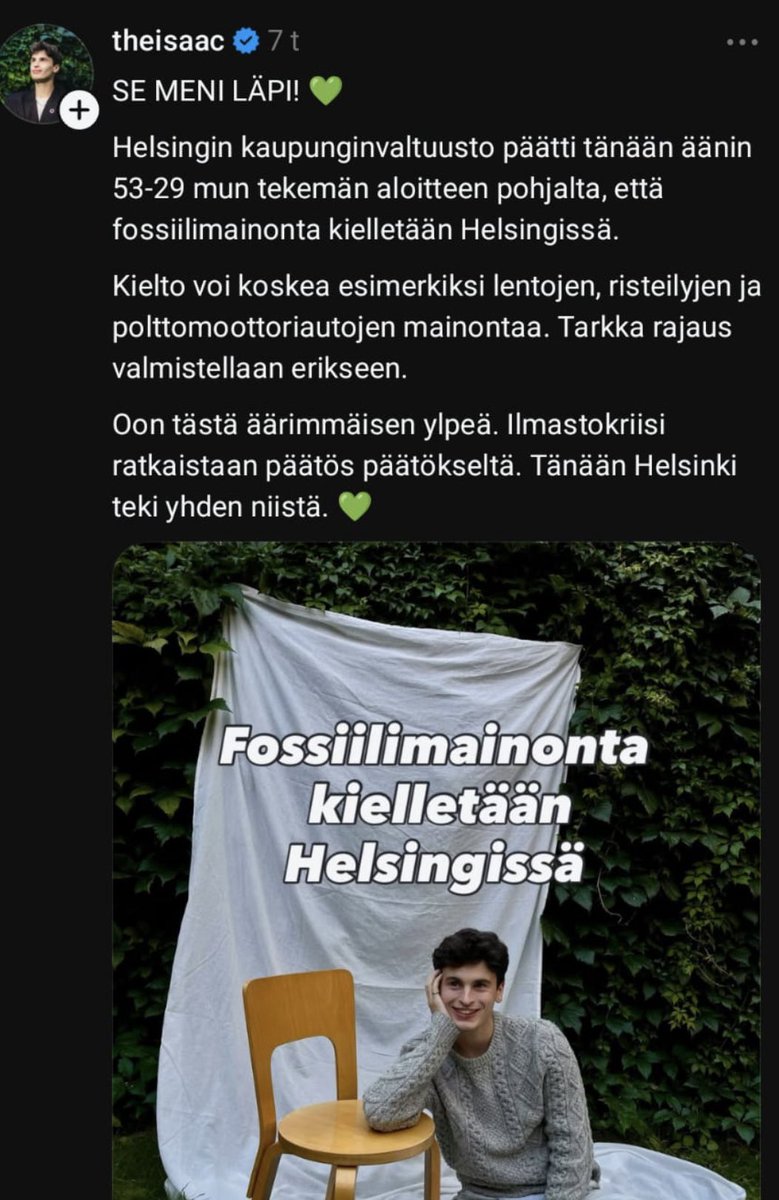
Sture Fjäder wrote that the red-green coalition in Helsinki had passed a decision stating that the city would no longer accept advertising related to fossil fuels, such as advertising for flying. He questioned whether those who supported the decision would themselves give up flying on their travels, and assessed that they would not do so. Fjäder described the action as green posturing. #viherposeeraus https://t.co/qbovaaryzX #Helsinki #ilmastonmuutos #kestäväkehitys (translated)

Otto Juote criticized the National Coalition Party for allegedly abandoning its values and becoming an assistant to the right-wing government. He wrote that disappointed voters were shifting to support the Left Alliance and the Social Democratic Party and questioned where the previously promised projects, such as Garden Helsinki, senior spa vouchers, and the sale of natural monopolies to international investors, had gone. Juote ironically described the National Coalition Party as a leftist social-liberal party, which in his view had previously supported, among other things, state-owned projects, service vouchers, increased immigration from developing countries, climate actions, and support packages. He claimed that the party had also held onto acquired benefits while it spoke of cuts and reducing debt. Additionally, Juote asked why discussions about entrepreneurship, economic growth, and warnings about right-wing policies seemed to have disappeared from the party. He wrote that Orpo's National Coalition Party no longer reflected the pragmatic interest group and system party that he had previously supported. Juote estimated that he would likely vote for a red tie-wearing socialist in the upcoming elections instead of a blue tie-wearing one for the first time. #Kokoomus #Vasemmistoliitto #Politiikka (translated)

Juho Hirvelä wrote that, in his opinion, the use of Bovaer continued in Denmark and many wanted to know the status of the substance in Finland. He referred to a news article published by Yle in February 2026, which stated that Valio had suspended the trial of the Bovaer feed additive. According to Hirvelä, Valio stated at that time that the reason for the suspension was the reassessment of the substance initiated by the European Food Safety Authority, EFSA. Hirvelä mentioned that he had asked Valio whether Bovaer was still under trial or if the company was planning to restart the trial. He also inquired whether Valio had considered replacing the substance with another feed additive and whether new information had been obtained from EFSA's investigation. Hirvelä said he would return to the matter once Valio responded. #Bovaer #Elintarviketurvallisuus #Tanska (translated)

Hannu Järvinen criticized the city planning in Espoo led by the National Coalition Party and claimed that the zoning regulations no longer required sufficient parking spaces for housing companies. According to him, the urban planning board led by Vuornos made the decision, where the interests of the National Coalition Party and the Greens converged. Järvinen assessed that the diminished parking space requirements benefited developers and complicated the daily lives of car drivers in Espoo. He wrote that, for this reason, Espoo was no longer an attractive place to live for private car-driving net taxpayers, and believed that the National Coalition Party had distanced itself from its previous pro-car stance. https://t.co/d2Opd0F9lz #Espoo #liikenne #asuminen (translated)

Tuulia Alanko wrote that many others besides traditional supporters of the Finns Party had also expressed similar views, in her opinion. She praised Riikka and the Finns Party ministers for their responsibility and ability to implement. Alanko stated that the Finns Party, according to her, did not want to serve the elite or accept unrestricted use of taxpayers' money. She criticized the Social Democrats for their talk about civil society and believed that climate actions alone did not address the challenges related to immigration or hybrid operations. Alanko described the Minister of the Interior as having acted to reform immigration policy and demanded changes to open invitations for immigration and the granting of citizenship. She also praised the Finns Party Minister of Justice for changing the line on criminal law and tightening penalties, even though, according to her, he had been criticized for populism. Alanko wrote that neither Riikka nor other members of the Finns Party should change their positions to please everyone. She believed the party would maintain its stance despite red-green criticism and pressure, describing the Finns Party as a caretaker party. #persut #poliitika #Suomi (translated)

The technology giant Google will not face sanctions for the allegedly illegal logging at the data center construction sites in Muhos and Kajaani, says the Minister of Environment and Climate, Sari Multala from the National Coalition Party, to Uutissuomalainen. #Google #datakeskus #ympäristö (translated)

USU: Googlelle ei rangaistusta hakkuista
www.mtvuutiset.fi

Google will not be admitting punishment for the allegedly illegal logging in its data center projects in Muhos and Kajaani, as current legislation does not allow for sanctions, says Environment and Climate Minister Sari Multala. #Google #datakeskus #ympäristö (translated)

USU: Googlelle ei rangaistusta hakkuista

Tanja Aidanjuuri wrote that the plan in Helsinki to ban advertising of fossil fuels could, according to her, cost the city nearly 100 million euros in advertising revenue. She criticized the proposal as unnecessary and absurd and listed as examples of potentially restricted advertising gasoline and diesel cars, flights, cruises, synthetic clothing, plastic products, and fossil fuels. Aidanjuuri described that the Greens in Vantaa could, in her opinion, follow the same line and that advertising would then practically be limited to, for example, veggie sausages, rainbow flags, and new mosques. She also pointed out that taxpayer money would be used for the handling of the matter. Aidanjuuri cited a proposal stating that the advertising ban would be investigated in the preparation of the next outdoor advertising agreement for Helsinki's public areas and that the advertising agreements of Urban Traffic Ltd would also be taken into account. The assessment would examine, among other things, the legal boundaries of the ban, its climate and environmental impacts, effects on the city's economy, the city's own communication and marketing, as well as the media landscape. The proposal also mentioned the possibility of examining advertising's ethical principles more broadly and limiting outdoor advertising from entities considered to violate human rights and particularly polluting industries. #Helsinki #ilmastonmuutos #mainonta (translated)

Juho Salo wrote that with the same amount of money, it would have been possible to get 10–15 granite pyramids for Finland, at least five nuclear power plants, or seven biogas plants refining biodiesel from peat. He suggested that development aid be converted into a voluntary tax or banned by law. #kehitysapu #kestävyys #ilmastonmuutos (translated)

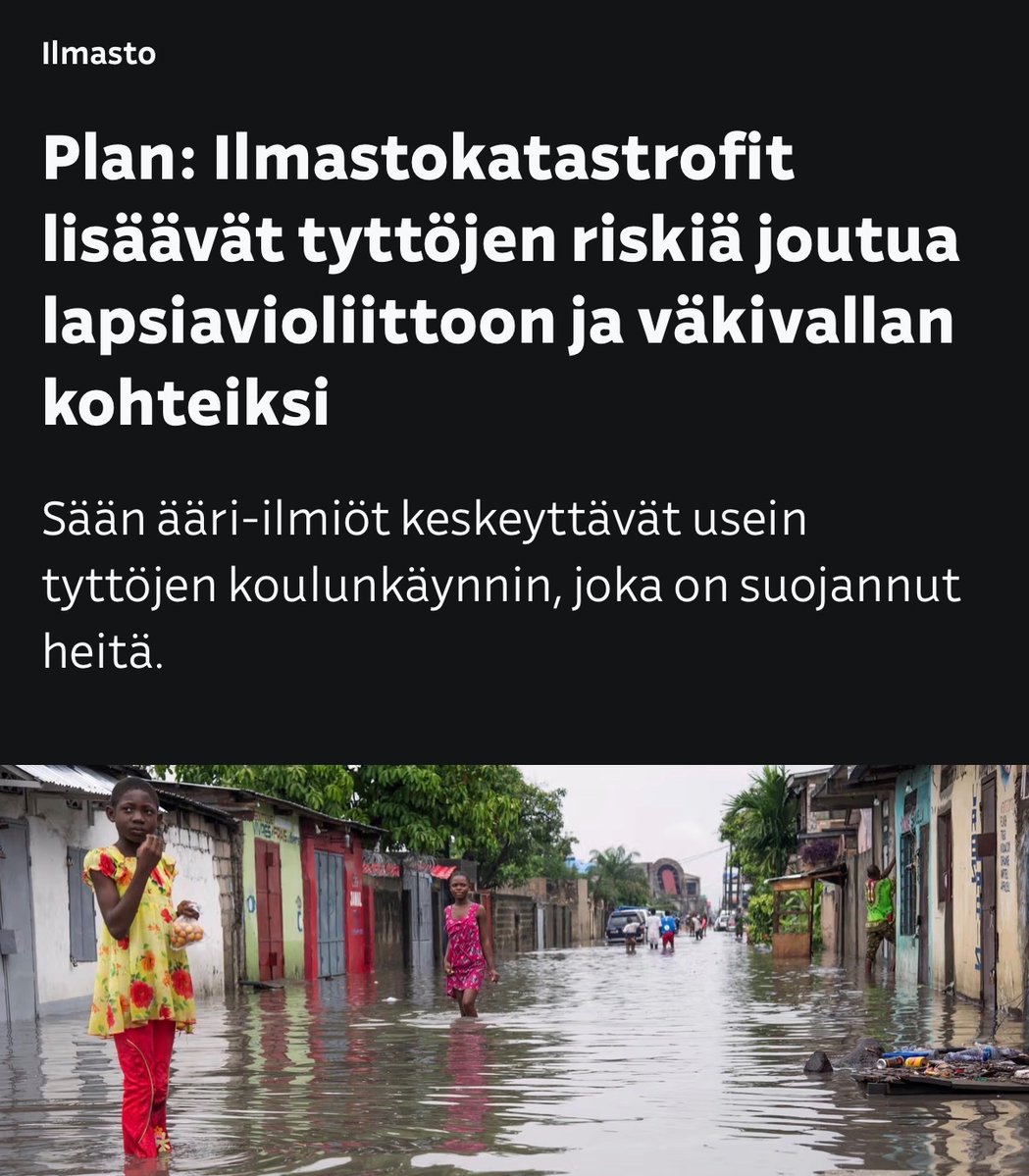
Jari Sarasvuo asked whether the risk for young girls to become victims of child marriages, human trafficking, and violence was smaller before the current climate crisis. He wrote that he had been to developing countries twenty years ago and had participated in development work, but he said that his experiences did not correspond to such a notion. #ilmastokriisi #lapsiavioliitto #ihmiskauppa (translated)

Maria Nordin wrote that, according to her, there were more extreme phenomena in Finland’s climate than in the stable climate of equatorial regions, regardless of climate change. She asked whether the logic of Plan would mean that there would be a greater risk of child marriages in Finland, and wondered if the phenomenon may not even be related to the climate. https://t.co/KRhCq52c0o #ilmasto #ilmastonmuutos #äyriilmiöt (translated)

Jari Mäkäräinen wrote that, according to him, the climate did not force girls into marriage or anything similar. He blamed parents and culture for this and described them in a strongly derogatory manner. https://t.co/qAyDBVnGOj #naistenoikeudet #perheväkivalta #kulttuuri (translated)

Hannu Järvinen wrote that he had learned from Yle's news that rapes against children were due to climate change, and asked what would not be attributed to it. #ilmastonmuutos #uutiset #keskustelu (translated)

Lucia described the typical reader of Helsingin Sanomat as a 25–40-year-old, highly educated urban woman who lived in neighborhoods like Kallio, Käpylä, Kumpula, Pakila, Kalasatama, Töölö, or Lauttasaari. She noted that this woman would usually vote for the Greens, the Left Alliance, or the SDP and would frequent brunches, bars, and the Flow festival. According to Lucia, the woman she described might be in a relationship, live in a community garden cabin, and be the mother of one or two children. She listed names like Alvar, Oliver, Ariel, Kuura, and Kaura for the children. Lucia mentioned that the woman preferred public transportation but accepted her partner's expensive car, even if she suffered from climate anxiety and flying shame. The woman might also have a small dog. The author claimed that such a reader did not know any voters of the Finns Party and might consider her rural uncle, who had voted for the party at times, to be peculiar. She speculated that the woman worked in a field where she could aim to make the world a better place. Lucia called this a reader profile and target group for Helsingin Sanomat, whose interests and views, according to her, the paper's journalists anticipated. She wrote that HS did not aim for objective or neutral reporting, nor was it an agenda-driven media outlet. According to her, the paper's target group did not encompass all people regardless of their background, lifestyle, or viewpoints. She compared HS to a mirror held up by journalists so that the reader could be satisfied with what they saw, and concluded that the reader of the described profile was not the same as the writer of the piece. #Helsinki #ilmastoahdistus #lukijaprofiili (translated)

Maria Rautanen wrote that wind power produced nearly as much electricity last night as was consumed in all of Finland, which she claimed drove the price of electricity down. She noted that some wind farms approved for the feed-in tariff before 2017 were still receiving support, which had a target price of €83.50/MWh. Rautanen pointed out that while the abundant electricity production lowered prices, support was still being paid from state funds, and she argued that consumers were paying for it. #tuulivoima #sähkö #ilmastonmuutos (translated)