The article advocates for the introduction of a quality label for scientific publications to restore the declining trust in science, partly caused by an increase in disinformation and quality issues in the peer review process. (translated)

The article advocates for the introduction of a quality label for scientific publications to restore the declining trust in science, partly caused by an increase in disinformation and quality issues in the peer review process. (translated)

The article addresses the growing role of artificial intelligence in science, which increasingly conducts research, writes texts, and peer-reviews, while at the same time, there is concern about the quality and authenticity of scientific papers, as 21 percent of the reviews at the ICLR conference were completely written by AI, which could prompt a critical reflection on the future of human researchers and the integrity of research. (translated)

The use of artificial intelligence (AI) by researchers leads to an increase in scientific articles, but these are often poorly written and the quality of peer reviews has decreased, as shown by a study of nearly 7,000 articles. (translated)

Peer review is only as good as the peers. Since peer review determines who gets to join the peers, review communities tend to decline in the absence of additional oversight. Wikipedia and some social sciences come to mind #PeerReview #Science #Oversight #Nocountrycodespresent.
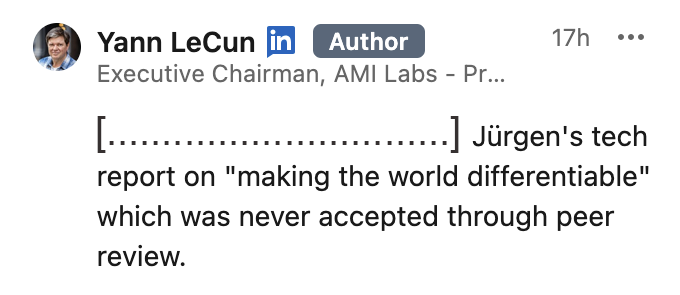
Yann LeCun claimed on social media [7] that my foundational 1990 paper on Neural World Models [1] "was never accepted through peer review." This is simply false. The core concepts from the tech report [1] were peer-reviewed and published at international conferences right away: https://t.co/vVg15Qh05U #NeuralNetworks #PeerReview #AIResearch #Nospecificcountriesarementionedinthetweet.
RT @DellAnnaLuca: The reactions of many researchers on finally being held responsible for having read the very paper they submitted are...… #ResearchAccountability #AcademicIntegrity #PeerReview #Thetweetdoesnotmentionanyspecificcountries.
Evropská výzkumná rada stanovila nové pokyny pro využívání umělé inteligence při hodnocení grantů, které chrání integritu peer review procesu tím, že zakazují přenášení hodnoticí činnosti na technologie a zajišťují důvěrnost informací, přičemž umožňují omezené použití AI pro jazykové zlepšení a hledání obecných informací. #UměláInteligence #Granty #PeerReview #dobrezpravy
Martin Víta se zabývá vlivem umělé inteligence na proces peer review, přičemž upozorňuje na to, že rozvoj velkých jazykových modelů může jak přispět k zlepšení kvality vědeckých recenzí, tak vyvolat další problémy v již tak přetíženém systému publikace vědeckých prací. Diskutuje o nutnosti etického využití AI nástrojů a o odpovědnosti recenzentů za správnost a kvalitu hodnocení, přičemž lidský faktor zůstává klíčovým prvkem v procesu recenzování. #AI #peerreview #věda