BETA nonprofit public democratic european moderated

Search

#järjestö

Mika Merano wrote that it was not about class but corruption. He claimed that Members of Parliament, other significant and former politicians, and their close circles received rewards on the boards of associations funded by tax money or directed funds to their own projects. According to Merano, organizational subsidies and, for example, the funds used for Garden Helsinki were taken from elsewhere and were also reflected in the support received by poor families living on subsidies. He accused politicians of pursuing their own and their close circles' interests and expressed his anger towards such activities. #korruptio #politiikka #veronmaksajat (translated)


Leena Pihanurmi criticized the allocation of tax funds to the close circles she described and wrote that money was collected at coffee and pastry meetings. According to her, eight members of parliament and three members of the European Parliament served as chairpersons of the boards of organizations receiving STEA funding: four from the SDP, two from the Left, two from the Greens, two from the National Coalition, and one from the Centre. #järjestörälssi #VeronmaksajanKukkarolla https://t.co/fp5Qnipiks #järjestörälssi #verovarat #tuki (translated)

Sture Fjäder wrote that organizations wanted members of parliament in their boards to get more state or taxpayer money. According to him, politicians were therefore biased, and the activities should stop. #järjestötuet https://t.co/2YQkTfpENS #politiikka #verot #kansalaisaktivismi (translated)

Tuomo Saarni pondered the significance of organizations and development aid, stating that he would rather raise the retirement age than give them up. According to him, salaries in the public sector's middle management and above were extremely high while the private sector struggled with profitability. He also wrote that solo entrepreneurs ceased their operations because they could not manage their YEL payments, and believed that the value map of society was misaligned. #kehitysapu #yrittäjyys #julkinensektori (translated)

Leena Pihanurmi criticized a multi-page interview published in Seura magazine, in which Demokraatti journalist Susanna Luikku interviewed Vertti Kiukas from Soste ry. According to Pihanurmi, Kiukas expected the leftist government to continue supporting 700 social and health organizations with hundreds of millions of tax euros. Pihanurmi wrote that the number of organization workers and volunteers varied in different Soste sources. He stated that Kiukas announced the number as 1.5 million, whereas earlier it had been reported as 550,000 and 204,271. Pihanurmi characterized the content of the interview as threats and baseless complaints. He claimed it aimed to secure the financing of the bloated sector and its jobs, which he believed were funded by Veikkaus. According to Pihanurmi, the article did not mention that the sector had grown over decades by misleading the poor and those with gambling problems. https://t.co/Inulcjd4lX #politiikka #järjestö #sote (translated)

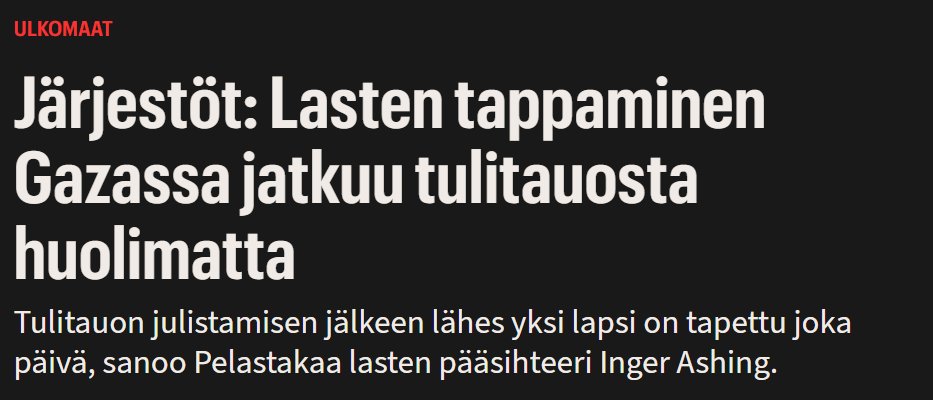
The author suggested the title that organizations claimed Israel continued to kill children in Gaza. He questioned how the situation could be called a ceasefire when, according to him, the killings continued day after day. He stated that the perpetrator should always be mentioned and considered it good to speak about the killings, as he believed that was what it was about. https://t.co/2vqGJJevAh https://t.co/cmacCXvdTT #IsraelinKonflikti #Gazassa #Ihmisoikeudet #IL #PS (translated)

Leena Pihanurmi considered the opinion piece special and wrote that according to the law, everyone was an organ donor unless they had explicitly refused. According to her, her organs could be used for transplants after her death if they were suitable for that, even if she had not expressed her willingness to donate. She asked how the cuts in funding for organizations could reduce the number of transplants in this case. https://t.co/5HWqKoyssI #elinluovutus #mielipide #terveys (translated)

Jari Mäkäräinen criticized Yle for often choosing female journalists to incite moral panic, according to him. He interpreted Yle's analysis as showing that support for the National Coalition Party among women had dropped to 12 percent and that the Finns Party had surpassed this party. However, according to Mäkäräinen, women were not punishing the National Coalition Party for its policies but for its austerity measures, and men were supporting the state. Mäkäräinen believed that the decline in women's support was due to the impact of budget cuts on sectors predominantly employing women, such as social services, organizations, and public services. In his view, this did not make the cuts unjust, but rather highlighted their effects. He mentioned the Social Democratic Party, the Left Alliance, and the Centre Party as the most popular parties among women and claimed that the left proposed tax increases amounting to nine billion euros. According to Mäkäräinen, the costs of these increases would fall on men who work overtime, start businesses, and pay progressive taxes. Mäkäräinen assessed that the issue for the National Coalition Party was its attempt to soften difficult decisions, while the Finns Party spoke about the same issues more directly. He argued that men were underrepresented in the care sector and overrepresented in dangerous jobs, entrepreneurship, and at the high end of the tax revenue spectrum. In his opinion, the National Coalition Party should maintain its stance even if it lost some female support, as this could help it win over voters who support the sustainability of the state. https://t.co/DfwLyPN03s #Politiikka #NaistenOikeudet #Taloustieto (translated)

Martti Kosonen wrote that the Finns Party's line worked according to him. He claimed that the National Coalition Party was distributing money to developing countries, Palestinians, immigrants, organizations, what he characterized as pseudosciences, unnecessary business subsidies, as well as to the EU, the UN, and railways he described as unnecessary, while according to him, the Finns Party did not distribute money for these purposes. Kosonen also claimed that the National Coalition Party was taking money from retirees, heirs, and elderly care facilities. He said the list was endless and considered that the National Coalition Party could no longer function as the governing party, but the Finns Party could. In his writing, he noted the Finns Party, Riikka Purra, and Wille Rydman. https://t.co/MiANyh6CEP #perussuomalaiset #politiikka #Suomi (translated)

Leena Pihanurmi wrote that according to Yle's analysis, the support for the National Coalition Party had decreased because the party had supported the government during the scandals of the True Finns related to racism and had listened to the minister's descriptions of organizations as a privileged elite. She asked how this explained the rise in support for the True Finns. https://t.co/G28AlCxNTc #Politiikka #Suomi #Yle (translated)

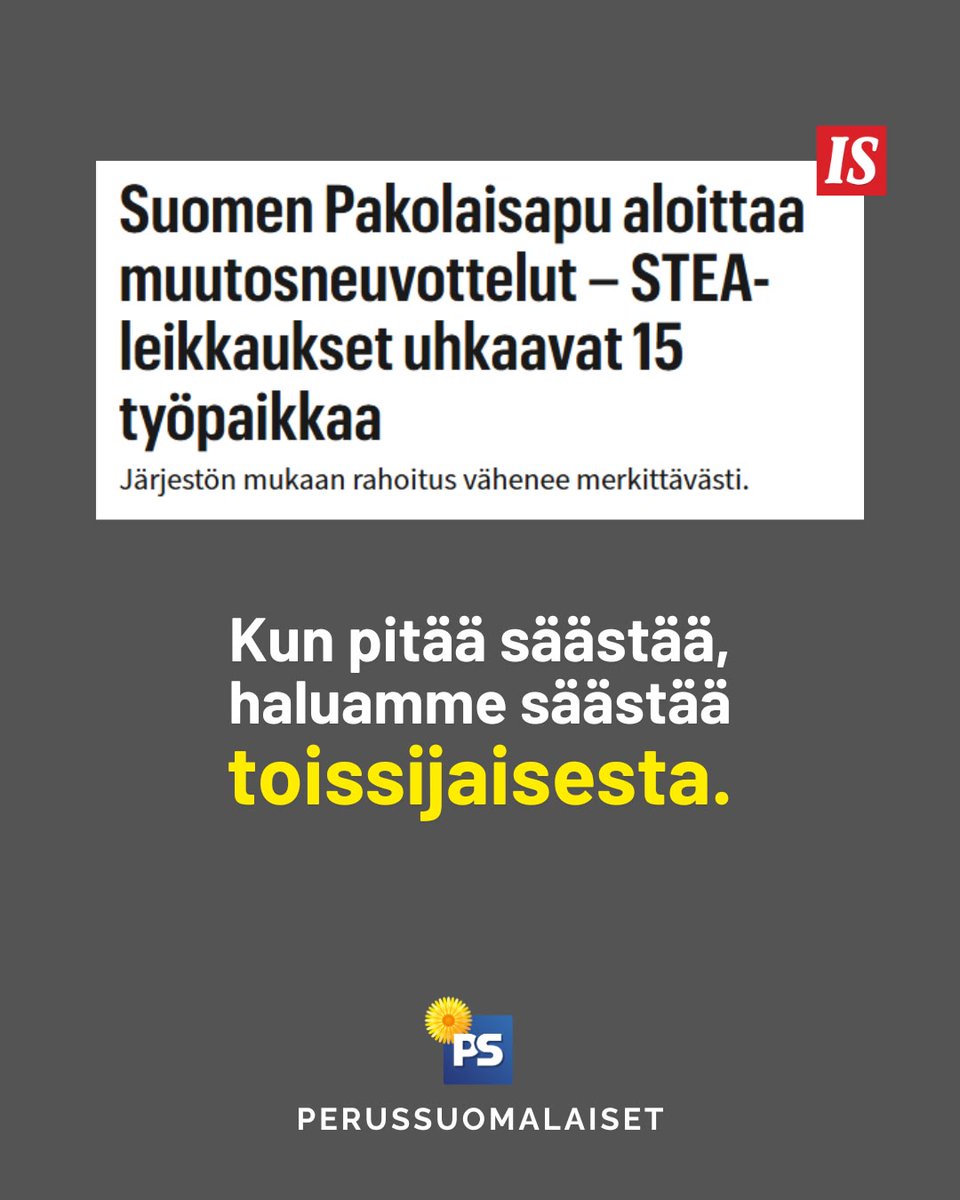
The Finns Party asked how much could be cut from public funding for organizations, as taxpayers' money had been allocated quite generously to various organizations for a long time. The party wrote that not everything needed to be financed with tax funds. #ps #perussuomalaiset #STEA #järjestöt #järjestöt #veronmaksajat #rahoitus (translated)

Jari Mäkäräinen criticized Yle for what he perceived as giving Timo R. Stewart, whom he describes as a Hamas activist, an unchallenged platform to present his book. According to Mäkäräinen, the article adopted Stewart's view regarding the destruction of Gaza, genocide, and Finland's responsibility due to trade with Israel, without hearing the opposing side. Mäkäräinen emphasized that, in his opinion, genocide does not equate to heavy war. He wrote that the International Court of Justice had not ruled on the case against Israel and that interim measures were not a judgment. In his view, civilian casualties can occur in urban warfare where Hamas places rockets, command centers, and tunnels among civilians without the intent of destroying the group. He compared this to the battles of Mosul, Raqqa, and Fallujah, claiming that Stewart began using the term genocide after Israel succeeded in its war against Hamas. According to Mäkäräinen, the Yle article also lacked the starting point of the war: the attack on October 7, in which he claims over 1,200 people died, and which involved rapes and kidnappings. He wrote that Hamas aims for the end of Israel instead of a Palestinian state. He criticized the figures presented by the Palestinian Ministry of Health in the article—over 21,600 by December 2023 and over 1,400 after ceasefires—and claimed that the ministry was subordinate to Hamas and that its figures did not differentiate between fighters and civilians. In his view, the article also lacked Israel's perspective that a significant portion of the dead were fighters. Regarding the two-state model, Mäkäräinen wrote that its failure was not solely due to Israel. He claimed that Hamas had rejected the model multiple times and that the Palestinian Authority had turned down offers, such as at Camp David in 2000 and Annapolis in 2008. He added that according to polls, the majority of both Palestinians and Israelis had abandoned the model. He described the cessation of support for UNRWA as a reaction to an organization that, according to him, had ample evidence of connections between its facilities and personnel to Hamas. Mäkäräinen believed that Yle, as a publicly funded media, should not advertise a single essayist as an expert. According to him, the article could have included opposing researchers, Israel's official stance, or addressed Hamas's responsibility for hostages and the use of civilians as shields. He concluded by asking why this had not been done. https://t.co/sHriNitmMo #Gaza #Israel #Hamas (translated)

Yaron Nadbornik asked why the United States did not label the events in Gaza as genocide, even though some researchers did. He estimated that the difference might be due to the U.S. military leadership having access to real-time military intelligence, such as satellite imagery and intelligence cooperation, which civilian researchers, according to him, did not have. He also noted that many researchers specialized in other topics. Nadbornik argued that criticism cited organizations and institutions as needed, which had expanded the interpretation of the concept of international genocide so that Israel's actions fit within it. He mentioned examples like Amnesty's report on page 101, B'Tselem's output, and a UN committee. Finally, Nadbornik described the media as a new Pravda and wrote that those who did not accept it deserved to be canceled. He compared political correctness to the Soviet Union and sarcastically noted that no researcher should be upset. https://t.co/2MNmZd6ulU #kansanmurha #Gazassa #politiikka (translated)

Sture Fjäder questioned the necessity of the Breastfeeding Support Association and wrote that maternity clinics provided information about breastfeeding children. According to him, the association should secure its funding independently instead of relying on taxpayers' money, and he demanded the cessation of STEA support. #järjestötuet https://t.co/Nqw7uDE38s #imetystuki #rintaruokinta #yhdistykset (translated)

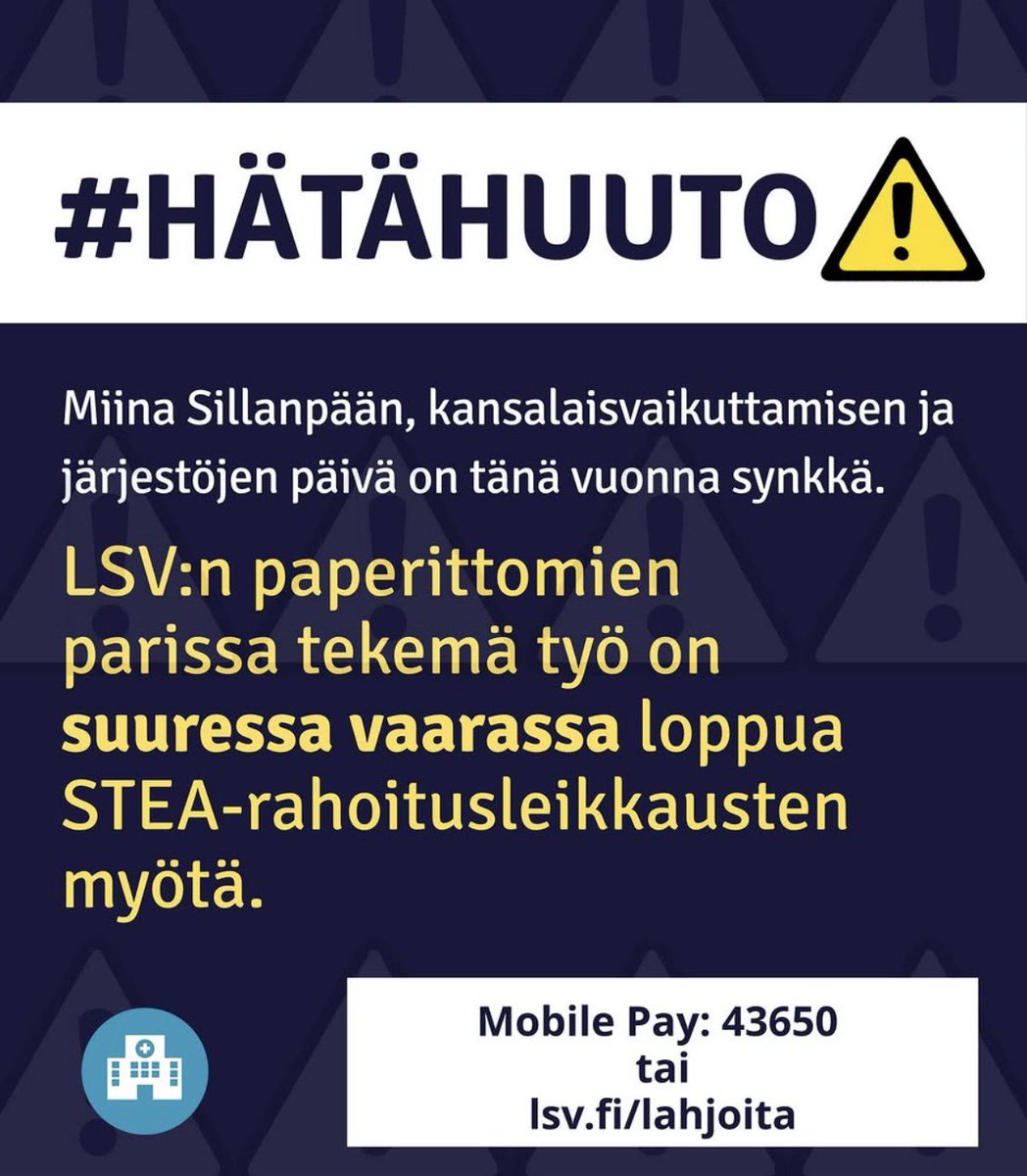
Otto Meri wrote that the organization helping illegal foreign residents was in trouble due to cuts in their funding. He asked why taxpayers' money had been directed towards helping them for years, and believed that they should return to their home countries to seek help instead of relying on Finnish taxpayers. According to Meri, this was the purpose of the whole system. #maahanmuutto #verot #apua (translated)

For a change, another organizational rant article in HS. Both the Mannerheim League for Child Welfare mentioned by the author and the Niilo Mäki Foundation, which finances the Niilo Mäki Institute, are both organizations bloated with gambling loss funds. In both, there is plenty to cut besides guiding volunteer activities. For instance, from research, project and material manufacturing, lobbying, and administration. Mervi Viteli-Hietanen, who is concerned about the Reading Granny and Grandpa activities, has otherwise worked as a journalist and has written at least for the Pirkanmaa Left's Vasen kaista online magazine. https://t.co/SGzlbE6OyK #järjestöt #näkökulma #yhteiskunta (translated)

It is truly wonderful that the author has received significant help from organizations that operate with government funding. I have also received help myself. However, personal experience does not in any way prove that organizations and foundations funded by taxpayers' money could not have waste, inefficiency, overlaps, and outright misuse of tax funds, as evidenced by the staggering salaries of some organizational leaders. When people talk about organizational waste, they are referring to the things mentioned above. They do not mean grassroots assistance work, peer support services, and the work of experts with experience and other volunteers. https://t.co/ocRnkc83F5 #järjestöt #valtionavustus #veronmaksajat (translated)

Yritin yrittäjänä tarjota päiväkodin avajaisiin pillimehuja ja keksejä heidän omasta pyynnöstä. Sitten tuli ilmoitus, että kaupungin eettisten periaatteiden pohjalta lahjoitus tulee ohjata järjestölle ja sieltä päiväkodille. No näin tein mutta onhan tämä vähän hassua... #yrittäjyys #lahjoitus #päiväkoti

Yrittäjä kantaa riskin, vastaa palkoista ja luo työpaikkoja ➔ ”Riistäjäkapitalisti”, joka repii rahat työntekijän selkänahasta. Järjestöpomo nostaa 150 000 €/v verovaroista ja teettää työn ilmaisilla vapaaehtoisilla ➔ "Pyytteetön sankari” Selittäkää tämä logiikka. #yrittäjyys #työelämä #tasa-arvo

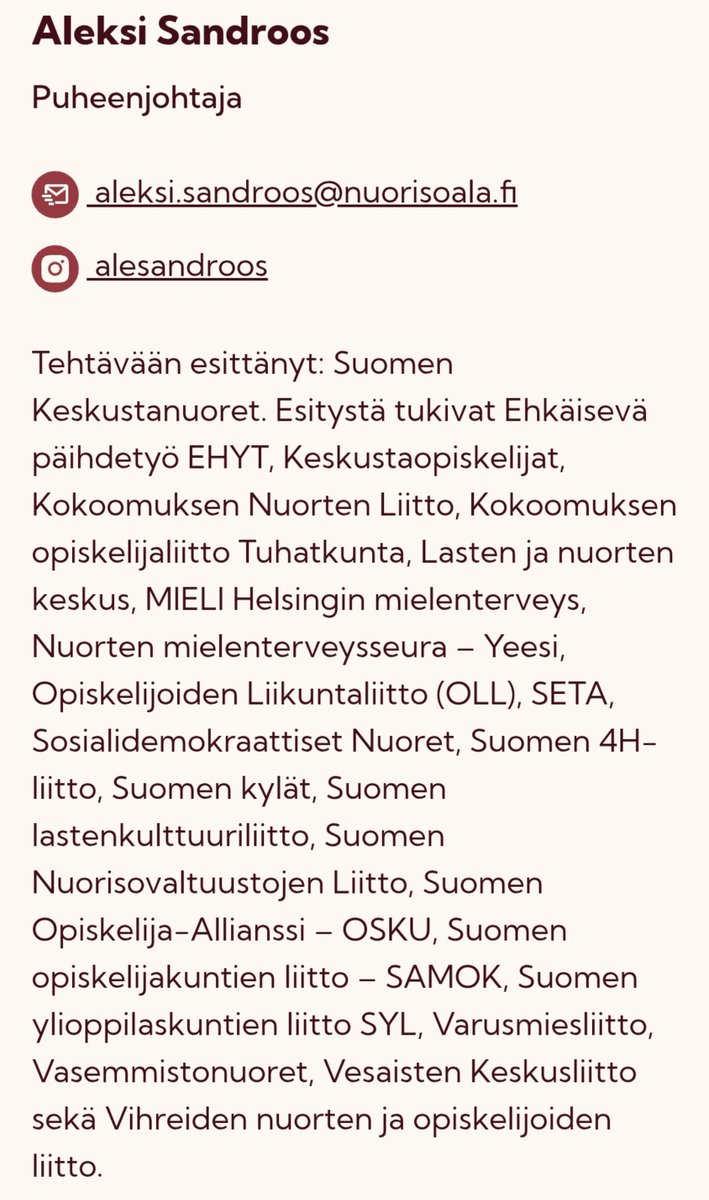
Munsterhjelm väittää nuorten sinnikkyyden kasvavan järjestötoiminnassa. Voi olla, mutta on härskiä käyttää nuoria rahanlypsyvälineenä omalle organisaatiolleen, joka toimii lähinnä tulevien ammattipoliitikkojen broilerikasvattamona. Nuorisoala ry:n pj on keskustalainen poliitikko Aleksi Sandroos. Hallitus koostuu järjestörälssiläisistä. 2/6 #nuoriso #järjestötoiminta #politiikka