
The Daily Bureaucrat wrote that the Nobel Peace Prize seemed to have gone to a supporter of dictatorships and Islamists, and asked whether the Norwegians had lost their minds. #Nobel #rauha #diktatuuri (translated)
The Daily Bureaucrat wrote that the Nobel Peace Prize seemed to have gone to a supporter of dictatorships and Islamists, and asked whether the Norwegians had lost their minds. #Nobel #rauha #diktatuuri (translated)

Yaron Nadbornik criticized Heikki Hiilamo's column published in Yleisradio, stating that it presented a one-sided image connecting the actions of Israel's leadership, Finnish Christian groups, and Minister Antti Häkkänen's visit to the structures of oppression. Nadbornik argued that the column's treatment of Israel and Zionism made Jews collectively responsible and expanded the criticism to also include Israel's supporters and Jews in general. According to Nadbornik, Hiilamo's text divided the parties into white and Christian oppressors and non-white and Muslim victims. He said this framing overlooked the Jewish roots, history, and vulnerability in the Middle East, as well as the fact that millions of people from various backgrounds lived in Israel. He also believed that the framework wrongly fit the conflict into a narrative of Western colonialism and racism and presented Israel as a refuge for a people without another homeland. Nadbornik wrote that the prejudices against Jews were based on their otherness. He noted that studies had shown that Jews living in the diaspora were unjustly held accountable for the actions of the state of Israel. He argued that Hiilamo's rhetoric, which connected Christian groups and ministerial visits with the suffering in Gaza, reinforced this framework. Nadbornik recalled the Hamas attack on October 7, 2023, describing it as a massacre involving rapes, mutilations, and the abduction of civilians, including babies, festival-goers, and the elderly, into Israel. He called it the largest single act of violence against Jews since the Holocaust. According to Nadbornik, Hiilamo overlooked the fact that Hamas and Hezbollah openly sought the destruction of Israel in connection with Israel's military actions. He believed that framing the terror attack merely as a security threat or comparing it to Russia's invasion of Ukraine ignored the rights of Israeli citizens to exist and be protected. https://t.co/PFvBFdaoiQ #Israel #Juutalaiset #Rasismi (translated)


Mika Merano wrote that it was not about class but corruption. He claimed that Members of Parliament, other significant and former politicians, and their close circles received rewards on the boards of associations funded by tax money or directed funds to their own projects. According to Merano, organizational subsidies and, for example, the funds used for Garden Helsinki were taken from elsewhere and were also reflected in the support received by poor families living on subsidies. He accused politicians of pursuing their own and their close circles' interests and expressed his anger towards such activities. #korruptio #politiikka #veronmaksajat (translated)

Scalonados mentioned that Dibu had written to Messi on a shirt signed by all the players, thanking him for considering him the best goalkeeper in the world and saying that he had saved with a lot of heart. He also added that he had written "TUKI." https://t.co/AgOPEgtEX3 #Dibu #Messi #Fútbol (translated)


Otto Meri criticized the cuts to the prosecution service and compared them to the tax-free dividends of trade unions, the tens of millions granted in corporate support to publicly traded companies, and the hundreds of millions in development aid. According to Meri, the handling of a typical criminal case could already take up to five years, and the cuts would further prolong legal proceedings. He assessed that this would particularly increase the uncertainty of crime victims. Meri considered the realization of criminal responsibility to be one of the pillars of the rule of law and stated that the judiciary should be strengthened rather than weakened. He viewed the cuts as a wrong direction. #oikeusvaltio #rikosoikeus #yritystuet (translated)
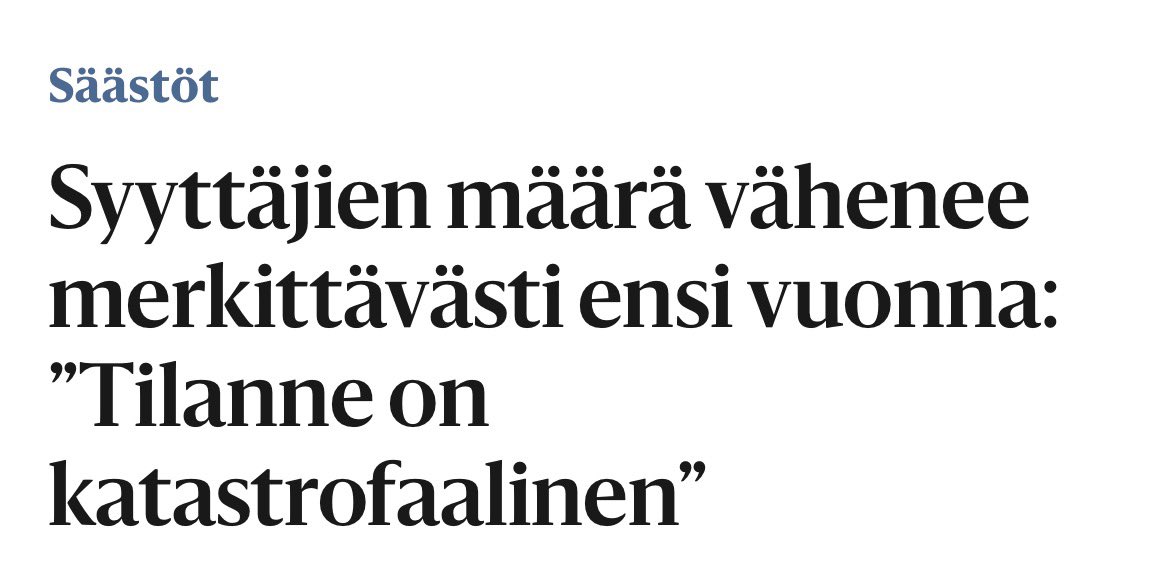

Henri Vanhanen wrote that Donald Trump's Russia policy may not have been guided by a coherent strategy. According to him, Trump made decisions one by one, seeking quick political gains, and then had to fix the consequences. In his assessment, Vanhanen linked Trump's diminished commitment to arming Ukraine, the energy price increases resulting from the war in Iran, and the recent diesel trade with Russia. He believed that trade could bolster the Russian economy and give Vladimir Putin a means to pressure Ukraine into halting strikes on Russia's oil refineries. Vanhanen also criticized Trump for condemning strikes that he claimed weakened Russia's war economy. Vanhanen noted that Trump’s administration had not sought significant new funding from Congress for arming Ukraine. According to him, previously agreed deliveries had continued, and European countries had purchased American weapons for Ukraine. He stated that Trump was not fundamentally on the side of Ukraine or Europe but was primarily pursuing his own interests. According to Vanhanen, Finland's security should not be built on the assumption that there is a plan behind Trump's decisions that would turn in favor of Europe. He urged preparedness for the possibility that U.S. aid could be delayed or smaller than expected, to strengthen the availability of defense equipment and air defense, and to deepen cooperation with Sweden, Norway, Denmark, Britain, Poland, and the Baltic countries. He also believed that Europe should be able to support Ukraine and maintain economic pressure on Russia by its own means. #Trump #Venäjä #Ukraina (translated)


Leena Pihanurmi criticized the allocation of tax funds to the close circles she described and wrote that money was collected at coffee and pastry meetings. According to her, eight members of parliament and three members of the European Parliament served as chairpersons of the boards of organizations receiving STEA funding: four from the SDP, two from the Left, two from the Greens, two from the National Coalition, and one from the Centre. #järjestörälssi #VeronmaksajanKukkarolla https://t.co/fp5Qnipiks #järjestörälssi #verovarat #tuki (translated)

Hannu Järvinen wrote that the condition for receiving home care support would in the future be at least three years of residence in Finland. He regarded the change as a step in the right direction but insufficient, and he believed that all benefits and transfers should be based on citizenship and should not be paid to foreigners. #kotihoito #Suomi #tukijärjestelmä (translated)
Antti Häkkänen stated that Finland had decided to supply defense material support based on an urgent request from Ukraine as a single product batch. According to him, Finland would continue to support Ukraine, and preparations for the next, broader support package were already underway. https://t.co/jPAeWPvPcA #Ukraina #Puolustus #Solidaarisuus (translated)

Henri Vanhanen recalled working in the parliament in February 2022 when Russia launched its full-scale attack on Ukraine. According to him, Finland had not yet sent defense aid to Ukraine at that time. Vanhanen stated that he had suggested to the National Coalition Party’s parliamentary group that the government should be required to provide military assistance. Vanhanen wrote that Finland was sending its 35th defense assistance package to Ukraine and had delivered defense materials worth approximately 3.6 billion euros to the country. He described the support as a long-term national commitment that had been continued across government terms and party lines. According to Vanhanen, supporting Ukraine's defense was also necessary for Finland's security. He assessed that the repelled Russian attacks in Ukraine would reduce Russia's ability to threaten other countries in Europe. Vanhanen wrote that Finland's support should continue for as long as it was needed. https://t.co/SGRsbSx53P #Ukraina #Suomi #Puolustusapu (translated)
Otto Juote criticized the National Coalition Party for allegedly abandoning its values and becoming an assistant to the right-wing government. He wrote that disappointed voters were shifting to support the Left Alliance and the Social Democratic Party and questioned where the previously promised projects, such as Garden Helsinki, senior spa vouchers, and the sale of natural monopolies to international investors, had gone. Juote ironically described the National Coalition Party as a leftist social-liberal party, which in his view had previously supported, among other things, state-owned projects, service vouchers, increased immigration from developing countries, climate actions, and support packages. He claimed that the party had also held onto acquired benefits while it spoke of cuts and reducing debt. Additionally, Juote asked why discussions about entrepreneurship, economic growth, and warnings about right-wing policies seemed to have disappeared from the party. He wrote that Orpo's National Coalition Party no longer reflected the pragmatic interest group and system party that he had previously supported. Juote estimated that he would likely vote for a red tie-wearing socialist in the upcoming elections instead of a blue tie-wearing one for the first time. #Kokoomus #Vasemmistoliitto #Politiikka (translated)

Jari Mäkäräinen criticized Yle for often choosing female journalists to incite moral panic, according to him. He interpreted Yle's analysis as showing that support for the National Coalition Party among women had dropped to 12 percent and that the Finns Party had surpassed this party. However, according to Mäkäräinen, women were not punishing the National Coalition Party for its policies but for its austerity measures, and men were supporting the state. Mäkäräinen believed that the decline in women's support was due to the impact of budget cuts on sectors predominantly employing women, such as social services, organizations, and public services. In his view, this did not make the cuts unjust, but rather highlighted their effects. He mentioned the Social Democratic Party, the Left Alliance, and the Centre Party as the most popular parties among women and claimed that the left proposed tax increases amounting to nine billion euros. According to Mäkäräinen, the costs of these increases would fall on men who work overtime, start businesses, and pay progressive taxes. Mäkäräinen assessed that the issue for the National Coalition Party was its attempt to soften difficult decisions, while the Finns Party spoke about the same issues more directly. He argued that men were underrepresented in the care sector and overrepresented in dangerous jobs, entrepreneurship, and at the high end of the tax revenue spectrum. In his opinion, the National Coalition Party should maintain its stance even if it lost some female support, as this could help it win over voters who support the sustainability of the state. https://t.co/DfwLyPN03s #Politiikka #NaistenOikeudet #Taloustieto (translated)


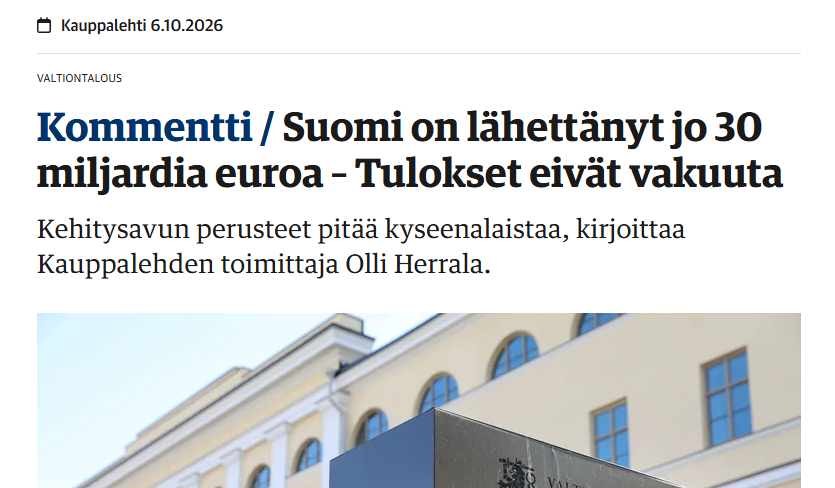
Jukka Lepikkö wrote that 30 billion euros was a large amount to be given abroad while Finland's economy was in difficulties. He referred to the views of British economist Peter Bauer, according to whom in development aid the poor of rich countries transfer money to the rich of poor countries, and criticized the fact that Finland took on debt to provide money for aid abroad. According to Lepikkö, Finland became indebted and violated EU treaties when the debt ratio was 90 percent. He believed that the debt had built a large public sector, which also included the task of providing support to foreign countries. According to him, development aid led to dependency on support and increased immigration from Africa. Lepikkö referred to Zambian economist Dambisa Moyo, who argued that development aid harmed Africa and that dependency on support hindered positive development by corrupting local markets. He wrote that development aid should be stopped. #kehitysapu #velka #talous (translated)
Henri Vanhanen wrote that he had been calling for a clearer situational picture of Russia's intelligence and influence activities towards Finland for some time. He viewed positively that, according to him, the message from the Security Police and the Defense Forces about the situation was now serious: Russian intelligence operations against Finland had intensified, cyber intelligence was active, and the interest was particularly focused on the defense industry. Vanhanen noted that the chief of the intelligence department of the General Staff had assessed that the intelligence operations targeting society and critical systems could be preparation for sabotage. According to him, Finland could thus become a target of Russian sabotage activities. He also wrote that, according to the Security Police, at least one small Finnish technology company had already been subject to verifiably increased intelligence activities. Vanhanen assessed that Russia aimed to weaken Ukraine's ability to continue the war by also influencing countries, businesses, and supply chains related to Western support. He warned that problems arising for companies supporting Ukraine could raise questions in Finland about the risks of support and serve Russia's objectives. Vanhanen suggested that the security of defense and technology companies should be proactively strengthened. He urged companies to check, among other things, their cybersecurity, the protection of their facilities, approaches to personnel, data access rights, supply chains, and unusual cooperation, recruitment, and investor contacts. He stated that especially small companies should be provided with easily accessible government support for identifying threats and improving security. According to Vanhanen, Russia's goal was to get Western countries to reduce their support for Ukraine. He believed that Finland should respond to possible pressure by better protecting the people and companies enabling support rather than changing its policies. https://t.co/f0INfDq1Zf #Venäjä #Suomi #Kyberturvallisuus (translated)

According to the author, hundreds of people were killed in Tanzania in connection with staged elections, and the country's opposition leader was imprisoned in a prison built with European support. He stated that the commission was planning a support program despite the fairly extensive protests presented in parliament. The author added that Tanzania had turned to China and Russia. #Tansania #ihmisoikeudet #politiikka #TZ #EU #CN #RU (translated)

Mikko Vuorenpää claimed that the French supporters of Palestine had decided to rob the property of French schools in addition to supporting Palestine. He wished good morning. https://t.co/V8IIxg52bL #Palestina #Ranska #Koulutus (translated)


Arto Koskelo wrote that Soviet propaganda depicted Israel as a stronghold of American imperialism and that Zionism was portrayed as a racist and imperialistic ideology, which was sometimes likened to fascism. He asked how this depiction differed from the tones of Yleisradio or Timo's columns. #propaganda #sionismi #imperialismi (translated)

A soldier serving at a U.S. base in Japan is suspected of the murder of a 39-year-old woman and possession of a stolen wallet. #USA #Japani #rikokset (translated)

Samu Mökillä wrote that in Finland, with its long distances, many families needed a car for their daily lives, and that the fuel prices raised by the Middle East crisis had increased the cost of essential transportation. He criticized the proposal to use the commuting tax deduction to alleviate the situation, arguing that it mainly benefited commuters. According to him, the support would not help, for example, farmers, the transport sector, or lawnmowers. Mökkilä asked why fuel prices could be lowered elsewhere in the world but not in Finland, and considered the commuting tax deduction insufficient if the cost of living was also rising. He estimated that individual support lost its significance as general inflation consumed purchasing power. The rise in fuel costs would also increase freight rates, food production, industry, and logistics, which would be reflected in the prices of many products. He called for a reduction in distribution obligations and taxes instead of subsidies and described the commuting support as a small band-aid for a broader increase in living costs. According to Mökillä, politicians wanted to appear to be doing something, even if the support's impact on people's wallets was overshadowed by rising prices. Mökkilä also wrote that the state budget was heavily in deficit and dependent on revenues collected from motorists. He stated that high fuel taxes were part of climate policy, but rural residents, actors in the transport sector, and small entrepreneurs often had no opportunity to change their fleets or reduce driving. He criticized politicians for disregarding the situation of ordinary Finns, saying that while there was talk of savings, millions were sent to a terrorist organization. #Suomi #polttoaine #talous (translated)
Leena Pihanurmi wrote that the Breastfeeding Support Association reported on its website that over 20,000 parents receive breastfeeding support from the association annually, and the membership fee is 20 euros per year. According to Pihanurmi, the membership fees paid by all those receiving support would bring the association 400,000 euros a year. She stated that this did not happen and claimed that the government is also taking debt to cover the association's expenses. #imetys #vanhemmuus #yhdistykset (translated)






