BETA nonprofit public democratic european moderated

Emanuel Boeminghaus

20 posts

Emanuel Boeminghaus

Mentions and quotes

Emanuel Boeminghaus wrote that, in his opinion, the SPD bears massive responsibility for the ongoing decline of the German economy and its industrial base. What is being lost has been built over generations. He therefore believes that a national anthem on the same evening is inappropriate: those who witness the economic loss of the country should refrain from patriotic displays. Moreover, he accused those in charge of portraying themselves as victims. #Wirtschaft #Deutschland #Politik (translated)

Emanuel Boeminghaus wrote that at Deutz in Cologne, according to Handelsblatt, up to 400 jobs could be lost within two years. Around 100 positions have already been cut or are in the process of being cut; up to 300 more could follow. As a reason for the pressure on the traditional engine business, Boeminghaus referred to the Engines division: it achieved a revenue of 642 million euros and an adjusted operating margin of 3.8 percent in the first half of 2026. The overall group reached a margin of 7.1 percent. According to him, particularly smaller diesel engines are suffering from weak demand. Despite growth in new areas, Deutz therefore needs to realign its traditional business, he wrote. https://t.co/4vkgrobHXd #Deutz #Köln #Arbeitsplätze (translated)

Emanuel Boeminghaus wrote that the Theo Müller corporate group plans to close two plants in eastern Germany, affecting around 320 jobs. The Homann plant in Rogätz is set to close by the end of September 2027; around 160 employees are affected because the location has not achieved a sustainably competitive cost structure despite extensive measures. The cut cheese factory of Sachsenmilch in Leppersdorf is also set to close on December 31. Another approximately 160 jobs are affected there, while sour cheese and mozzarella are still to be produced. Boeminghaus wrote that costs, investment needs, and changing demand are now also putting pressure on established production sites. He cited Handelsblatt as the source. https://t.co/NZxouM1bl6 #Arbeitsplätze #Industrie #Deutschland (translated)

Emanuel Boeminghaus wrote, citing the Handelsblatt, that the economic downturn in China is likely to be reflected in the balance sheets of German car manufacturers. China could evolve from a former source of income to a significant financial burden for the companies. The manufacturers may have to transfer large sums to continue, close, or maintain their operations locally. Boeminghaus also quoted a senior manager of a German automaker, who described the past few months as extremely difficult and said it was unclear when the downturn would end. https://t.co/o7J2r2rDeC #China #Autoindustrie #Wirtschaft (translated)

Emanuel Boeminghaus described the decline in orders in the German manufacturing sector as alarming and wrote that it was another significant dampener for the economy. Citing the Federal Statistical Office (Destatis), he stated that orders in August 2026 had fallen by 10.6 percent compared to July, adjusted for seasonality and calendar effects. Without large orders, the decline was 0.1 percent; in a three-month comparison, orders without large contracts had decreased by 2.6 percent. According to Boeminghaus, domestic orders had particularly fallen sharply by 17.3 percent. Foreign orders had decreased by 5.4 percent, orders for capital goods had dropped by 15.3 percent, and orders for consumer goods by 7.3 percent. He wrote that the figures indicated a fragile industrial economy and a significantly weaker demand in important areas. https://t.co/Q9NoWqqG4C #Industrie #Wirtschaft #Deutschland (translated)

Emanuel Boeminghaus wrote that Germany should introduce a plastic tax and a sugar tax starting in the summer of 2027. Together, they are expected to generate around 2.5 billion euros in additional revenue each year. According to the drafts, 1,046 additional administrative positions are planned for implementation, with annual personnel costs of around 74 million euros. According to Boeminghaus, the new taxes would also create a permanent administrative burden in addition to additional costs. He cited WELT as the source. https://t.co/AQOzmB0o5r #Steuern #Deutschland #Bürokratie (translated)

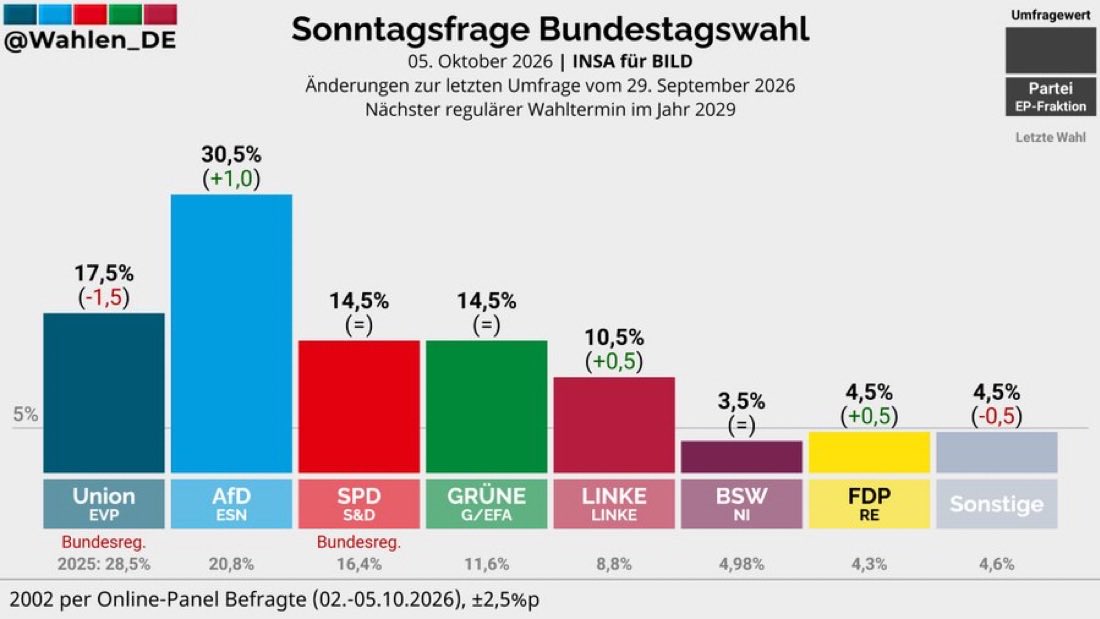
Emanuel Boeminghaus wrote that Merz would fall below the 10 percent mark after two or three reforms that he sees as merely symbolic, five further untrue representations from the Chancellor's Office, and three additional trips to Ukraine with billion-euro checks. He added that the AfD would then be on the path to an absolute majority. #Politik #Merkel #AFD (translated)

Emanuel Boeminghaus wrote that the Union is in a rapidly accelerating decline and described this as deserved. https://t.co/0C5ZRtku2W #Politik #Deutschland #Schneemann (translated)

Emanuel Boeminghaus wrote that the Focus has recognized the situation: According to him, the German automotive industry will lose 40,000 jobs by 2026. Job guarantees at VW and Mercedes are keeping employees in positions for which there is no need, he explained. https://t.co/iO42DlXjXx #Autoindustrie #Stellenabbau #Jobverlust (translated)

Emanuel Boeminghaus wrote that work at the construction sites of the Nuremberg Schultheiß project development had been halted since Friday. On October 5, 2026, it became known that the Franconian developer was facing insolvency proceedings. Customers and craftsmen now have to wait to see how things will proceed. According to the Nuremberg Nachrichten, the designated insolvency administrator advises calm, Boeminghaus wrote. He described the construction halt as another warning signal for the tense situation in the German construction and real estate industry. https://t.co/CJNVVOV6bo #Insolvenz #Nürnberg #Immobilien (translated)

Emanuel Boeminghaus referred to rising trade taxes in German municipalities, citing T-Online. The average assessment rate of the 200 cities examined is now more than 447 percent, up from about 445 percent the previous year. For North Rhine-Westphalia, he mentioned an average of around 480 percent. According to Boeminghaus, 19 of the 200 cities raised their assessment rates compared to the previous year; Essen was the only city to lower its rate by one percentage point. Oberhausen and Mülheim an der Ruhr had the highest assessment rates in the study, each at 580 percent. The increasing burden is exacerbating cost pressure and could influence investments as well as companies' location decisions, he wrote. https://t.co/qU2wKEIPjn #Gewerbesteuer #Unternehmen #Standort (translated)

Emanuel Boeminghaus wrote that Gen Z will soon experience extreme poverty without realizing it so far. In his assessment, they will still wish they could work 40 hours. #GenZ #Armut #Gesellschaft #Zukunft (translated)

Emanuel Boeminghaus wrote that indirect taxes continued to rise. Following taxes on tobacco and discussions about a sugar tax, there should now also be a tax on plastic packaging. According to the food newspaper he referenced, the Federal Ministry of Finance and the Federal Ministry for the Environment were planning such a levy, which was expected to generate around 1.3 billion euros in additional revenue. Boeminghaus explained that the tax could increase the burden on consumers alongside other taxes, as such costs are often passed on to private households through higher prices. He wrote that as more consumer goods are taxed additionally, real purchasing power declines and many people become poorer. He ironically referred to Germany as a country where people "pay gladly and well." https://t.co/HO9LlEgy8r #Steuern #Deutschland #Plastiksteuer (translated)

Emanuel Boeminghaus wrote that he has long warned of increasing poverty and referred to a warning from portfolio manager Andreas Beck about a significant loss of wealth in Germany. Beck criticized the rising national debt in a conversation with Apollo News and stated that by 2026, about a third of the federal budget would already be financed by debt. Since 2019, in his estimation, there has been no productivity growth; moreover, the gap in economic performance and income is widening. Cities like Stuttgart and Munich are also increasingly under budgetary pressure, according to Beck. Boeminghaus described the contribution as an important indication. https://t.co/FVgupyiotu #Deutschland #Wohlstand #Wirtschaft (translated)

Emanuel Boeminghaus wrote that the business climate in the German automotive industry had fallen to minus 35.0 points in September 2026, down from minus 22.0 points in August. Companies rated their current business situation more negatively; expectations for exports and employment, as well as the assessment of order levels, had also decreased. For the third quarter of 2026, companies additionally reported a significantly worse earnings situation than in the previous quarter. According to Boeminghaus, the data published by the ifo Institute showed a further intensification of the crisis. https://t.co/NQ435CNPDM #Autoindustrie #Deutschland #Wirtschaft (translated)

Emanuel Boeminghaus reported that on October 4, several gas stations in the Northeim district had run out of fuel. At the Esso station in Katlenburg, all pumps had been closed, while the Calpam station in Hammenstedt had not displayed any prices. Other stations – TAS in Höckelheim, Aral at Westerlange, and Classic at Harztor – according to Boeminghaus, continued to offer all fuels. Classic explained the high demand, especially in the morning, with the fuel discount that has been in effect since October 1. No new deliveries had arrived over the weekend. Boeminghaus thanked Silke Lutz for the tip and mentioned HNA as the source. https://t.co/4Q2nvFwAvo #Tankstellen #Kraftstoff #Northeim (translated)

Emanuel Boeminghaus wrote that Chancellor Merz still does not understand the economic situation in Germany. There is nothing left to distribute, he explained. #Deutschland #Wirtschaft #Politik (translated)

Emanuel Boeminghaus asked why more and more young, ambitious Germans are moving abroad and what is going wrong in Germany when it is precisely those who want to build something who are leaving. According to Boeminghaus, a total of 288,579 German nationals would have left Germany by 2025, compared to 269,986 in 2024. An example of this represents a larger trend, he wrote. https://t.co/6rsodTbvWj #Auswandern #JungeMenschen #Karriere (translated)

Emanuel Boeminghaus wrote that Norway's government does not plan to develop new international power cables until at least 2029. Energy Minister Terje Aasland called the concept of Norway as "Europe's green battery" outdated; however, existing connections such as NordLink to Germany will continue to operate. Citing a study in *Energy Policy*, Boeminghaus reported that NordLink has reduced peak prices in Germany, but has simultaneously increased expensive hours and price volatility in Southern Norway. The state price program Norgespris saved its participants more than 3.9 billion kroner compared to the spot market in the second quarter of 2026. Norway remains part of the European power trade, Boeminghaus wrote, but for now prefers a limit on a stronger interconnection. He cited Blackout News as the source. https://t.co/lMx3btPAXW #Energiewende #Norwegen #Strompreise (translated)

Emanuel Boeminghaus stated that new layoffs plans affecting a total of around 11,300 jobs have been announced in Germany this week. The job cuts are picking up speed, he explained. The biggest projects mentioned by Boeminghaus include Galeria Kaufhof, which plans to close about 30 of its remaining 83 branches during its fourth bankruptcy; approximately 4,000 jobs will be affected. BioNTech plans to close three plants in Tübingen, Marburg, and Idar-Oberstein by the end of 2027 or 2028, resulting in 1,800 job cuts. At VW's software subsidiary Cariad in Wolfsburg and Berlin, 1,000 positions are at stake, and at Bosch in Nuremberg, 900 jobs will be affected—half of the positions there are expected to be eliminated by 2029. Boeminghaus also cited further announced closures and cuts at Bohai Automotive in Harzgerode with 550 positions by January 31, 2027, Schmitz Cargobull in Horstmar with 500 jobs by 2030, and the city of Paderborn with 390 full-time positions in administration. The foundry in Uckermünde is set to cost 320 jobs, including those of temporary workers. The St. Elisabeth Hospital in Salzgitter-Bad will cease operations on September 30, 2026, affecting around 250 people. In Saxony-Anhalt, according to Boeminghaus, the Schlote Group in Harzgerode and Wenigerode are set to close by January 31, 2027, affecting 180 positions, and Getriebe- und Antriebstechnik Wenigerode will close at the end of January 2027, affecting around 130 jobs. The recycling plant of TRIMET Aluminium in Harzgerode is expected to close by November 30, 2026, affecting 64 positions. Westlake intends to close its PVC plant in Cologne in the first quarter of 2027 and cut 150 jobs. Kodi plans to close 43 of its 143 branches instead of 19, which, according to Boeminghaus, will affect around 150 additional positions. Up to 150 jobs are affected at Aldi Süd in Mülheim. The cessation of granulation at K+S in Sehnde by the end of 2028, affecting around 130 positions, the closure of the Wolters brewery in Braunschweig on December 31, 2026, after nearly 400 years, affecting around 125 jobs, as well as two waves of layoffs at Moldtecs in Sonneberg by the end of 2027, affecting 120 positions were also mentioned. Avo Carbon in Frankfurt-Kalbach is set to close in 2027, affecting 94 jobs, the machinery manufacturer Paul Köster in Medebach plans to cut 90 positions, and Gruber Polstermöbel in Sonnefeld will close after 100 years, affecting 85 positions. Pilkington plans to close its Wesel location in 2027, affecting 68 positions. The Bonn orchestra will be dissolved following bankruptcy, affecting 60 musicians. #Jobabbau #Deutschland #Wirtschaft (translated)