The federal government plans to reduce the number of representatives in companies, which could lead to the elimination of about 123,000 positions and an annual relief of 135 million euros for the companies. #BürokratieAbbau #Sicherheitsbeauftragte #Unternehmensreformen (translated)
Kolja Barghoorn wrote that demonstrators recognized him that day in the cathedral square in Magdeburg and repeatedly called him a "Nazi." Hearing the shouts up close had a different effect than reading them on the internet. Barghoorn interpreted such labels as a sign of a lack of historical understanding and a moral abyss. He referred to a visit to Sachsenhausen during his school years and to his visit this year to the House of the Wannsee Conference. There, he saw the organizational chart of the Nazis and traced how systematically they had planned the persecution and murder of millions of people. Regarding Nazi comparisons made by politicians such as Eva von Angern, Susan Sziborra-Seidlitz, and Ricarda Lang, Barghoorn questioned their historical awareness. Those who emphasize the historical uniqueness of the Holocaust must ask themselves whether the constant use of the term "Nazi" as a political insult is appropriate. Such shouts do not strengthen the awareness of the Nazi era but rather turn its crimes into a political everyday weapon and contribute to their trivialization, he wrote. #Nazis #Politik #Geschichte (translated)
Volker Ketzer wrote that the government plans a new plastic tax of 550 euros per ton. Since plastic is found in numerous products and packaging, manufacturers would, in his estimation, pass on the tax costs and the additional bureaucratic effort to consumers. The state expects revenues of nearly 1.5 billion euros per year starting in 2028, he wrote. He criticized that the levy will raise the cost of shopping while being described as environmental protection. #Plastiksteuer #Umweltschutz #Einkaufspreise (translated)
Simon Betschinger referred to a report by Handelsblatt, stating that the plastic tax would generate 1.4 billion euros and cause 150 million euros in bureaucracy costs. He accused the SPD of expanding the state apparatus instead of improving the lives of citizens and wrote that the party primarily wanted to hire more officials whose salaries would be financed by new taxes. #Plastiksteuer #SPD #Bürokratie (translated)
Mario Lochner wrote that Merz promised to reduce bureaucracy and stated, "the left is over." In contrast, he presented two new taxes on sugar and plastic. According to his representation, the implementation of these would require more than 1,000 additional civil servants. Lochner commented that one could hardly imagine that. #Bürokratieabbau #Steuern #Politik (translated)
The account of the savings book enemy wrote that Germany currently pays 1.4 billion euros annually from the federal budget for the EU levy on plastic packaging. Lars Klingbeil wants to change this from 2027; the plastic tax will be passed on to consumers. Hundreds of additional officials will be needed for control, and there will be a lot of bureaucracy for producers and traders. The additional burden for a family of four is estimated to be between 80 and 100 euros per year. The account described the levy as another consumption tax that increases the cost of food and drives inflation. #Plastiksteuer #Inflation #Verbraucherschutz (translated)
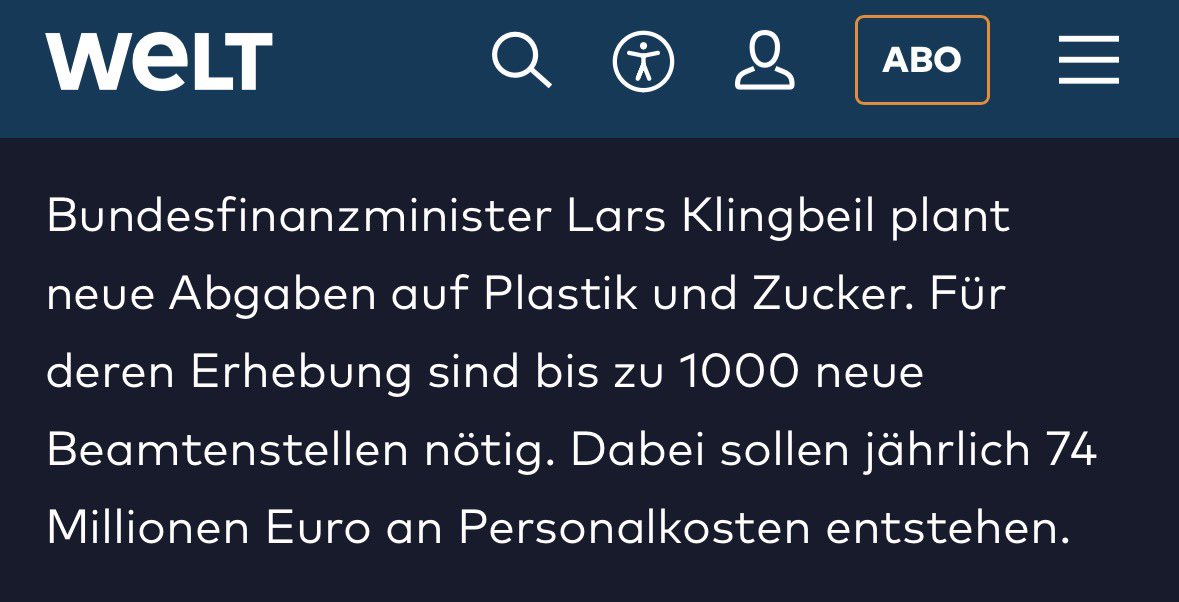
Emanuel Boeminghaus wrote that Germany should introduce a plastic tax and a sugar tax starting in the summer of 2027. Together, they are expected to generate around 2.5 billion euros in additional revenue each year. According to the drafts, 1,046 additional administrative positions are planned for implementation, with annual personnel costs of around 74 million euros. According to Boeminghaus, the new taxes would also create a permanent administrative burden in addition to additional costs. He cited WELT as the source. https://t.co/AQOzmB0o5r #Steuern #Deutschland #Bürokratie (translated)
Christian W. Röhl criticized proposals for a sugar and a plastic tax. In his view, they inflated the state apparatus and increased the bureaucratic burden on companies. Instead, he wrote, politics should focus on getting the economy moving again. https://t.co/f51iadRCpE #Wirtschaft #Steuerpolitik #Bürokratie (translated)
Simon Betschinger referred to a BILD headline which stated that the government requires 1,000 officials for two new taxes. He estimated the annual costs of the civil service for taxpayers in Germany to be around 242 to 250 billion euros. According to him, over 117 to 130 billion euros are spent annually on salaries, wages, and allowances, as well as around 65.9 to 67 billion euros on retirement benefits. Betschinger described the state as a bureaucratic monster that constantly requires more resources and stated that the extent has long since become unreasonable. #Bürokratie #Steuern #Deutschland (translated)
"More than 1000 new positions just for two new taxes – this is bureaucratic madness by design. Instead of finally putting expenditures and structures to the test, the government is once again trying to fill budget holes with new taxes. This is the wrong way." Taxpayer President Reiner Holznagel (50) outraged to BILD: "More than 1000 new positions just for two new taxes – this is bureaucratic madness by design." #Steuerpolitik #Bürokratie #Zuckersteuer (translated)
Specifically, Finance Minister Lars Klingbeil (48, SPD) is planning for the plastic tax (set to come into effect on July 1, 2027) with 788 employees at customs, 28 at the federal IT service provider ITZBund, and three in the Finance Ministry. #Steuerpolitik #Bürokratie #Zuckersteuer (translated)
The federal government plans to introduce two new taxes, which are expected to generate more than 2.5 billion euros annually, but requires more than 1,000 officials for this, something critics call bureaucratic madness. #Steuerpolitik #Bürokratie #Zuckersteuer (translated)
Steffan Nethe described the case of Mohamet E. as an example of the state's failure in internal security. According to him, he was a Sudanese repeat offender who had deceived authorities for years with more than 16 identities. His police record included 61 criminal offenses, including armed robbery, violent crimes, and drug trafficking. Moreover, he had been internally classified as a "ministry case" and was subject to deportation since 2018. Nethe wrote that Mohamet E. had nevertheless not been deported and had choked, kicked, and threatened citizens in public. As a reason for the lack of deportation, Nethe cited the absence of a passport replacement document that the Lower Saxony authorities had not obtained for years despite having clarified his identity. Referring to deportation leaks, he claimed that the system was structurally failing and that there were numerous comparable cases in Germany. Murderers, rapists, and terrorists could remain unbothered for years because deportations were delayed or prevented, he wrote. Nethe called for a government that acted more decisively and prioritized the safety of the population. #InnereSicherheit #Asylsystem #Rechtsstaat (translated)
Emanuel Boeminghaus wrote that the Halensee beach resort is facing closure shortly after its reopening despite millions in investments. According to the operator, jobs had been created, but 19 employment contracts have since been terminated. Since 2024, extensive planning, renovations, building applications, and documentation have been incurred for the project. Boeminghaus stated that the beach resort is in his neighborhood and criticized that, in his view, much of what makes life in Berlin worthwhile is destroyed by regulations. According to the information he provided, an official inspection took place on July 16, 2026; five days later, the beach resort was certified to be in a well-maintained and good condition. Nevertheless, further procedures, additional requests, and an additional noise protection report followed. Due to a lack of planning security, the operator finally announced the abandonment of the project. Boeminghaus referred to the Berliner Zeitung. https://t.co/NdD6oT97Fo #Berlin #Bürokratie #StrandbadHalensee (translated)
The Kiel shareholder wrote that Germany is at a tipping point. Illegal migration, bureaucracy, debt, lack of innovation, emigration, and a lack of willingness for radical reforms would inevitably ruin the country, in his assessment. The serious consequences of previous political decisions are only now becoming apparent, he wrote. England and France are just a little ahead of Germany in this regard. #Kipppunkt #Politik #Zukunft (translated)
The author wrote that the EU Commission plans full access to the citizens' money. According to his presentation, the MiCA regulation imposes bureaucratic constraints on the financial freedom enabled by Bitcoin, while Ursula von der Leyen promotes the Digital Euro. He expressed opposition to the Digital Euro. https://t.co/nEOooRPCJk #DigitalerEuro #Bitcoin #FinanzielleFreiheit #EU #DE (translated)
Anna Schneider wrote that, according to a proposal for the FDP party congress, majorities with the AfD should be possible. This shakes the fire wall, while the proposal also includes 13 pages of bureaucratic details. Schneider opined that the FDP is similarly tense as others, even though it could actually be free. https://t.co/hEiH15dlfU #FDP #Politik #AfD (translated)
The bill for the new sugar tax is: > 223 new civil servant positions > 1.2 billion euros in tax revenues per year > Massive additional bureaucratic effort for manufacturers and wholesalers > Extensive approval, documentation, and reporting obligations What does this mean for beverage prices? Let's calculate it: #Zuckersteuer #Gesetzgebung #Getränkepreise (translated)
I meet young people in Kenya almost daily who would like to go to Germany, many of them with university degrees. And many say they want to work in nursing professions, but fail due to high bureaucratic hurdles. This should be talked about in Germany. #Kenia #Migration #Pflegeberufe #KE #DE (translated)
The federal cabinet today adopted the #CareReform. In order not to further escalate the ongoing dispute in the governing coalition, criticism points and fundamental reform projects were initially ignored. These will be clarified by a commission. The consequence: contributors will have to shoulder significantly higher burdens. In this context, the health policy spokesman for the AfD parliamentary group, @martin_sichert, states: "The spousal co-insurance will become more expensive in the future, childless individuals will pay more and the contribution assessment limit will rise. All of this burdens the providers of performance in our society. It is a disgrace for the government of Chancellor Merz and Health Minister Linnemann that their central action is limited to taking more and more money from the citizens to temporarily save the fundamentally reform-needy long-term care insurance from financial ruin. And of course, a commission will also be tasked again to bring about further burdens for the citizens, such as higher burdens for privately insured individuals. The contribution rate for statutory long-term care insurance has been rising for years, and the money still does not reach sufficient levels. There are no genuine reforms. Where is the radical reduction of bureaucracy? Where is the strengthening of home care? The long-term care insurance system needs fundamental reform, just like the entire healthcare sector. The AfD parliamentary group has already submitted extensive concepts that encompass not only care but also health insurance companies, hospitals, doctors, pharmacies, therapists, and all other service providers. We therefore once again call on the federal government not to stand in the way of a fundamental health and care reform." #Pflegereform #Gesundheit #Politik (translated)