BETA nonprofit public democratic european moderated

Search

#Perception

The article addresses the issue of the impact of false videos generated by artificial intelligence on the public perception of doctors, through the example of the singer Renaud. #Santé #IA #FakeNews (translated)

« Est-ce que Renaud est devenu fou ? ! » : quand les médecins deviennent la proie des fausses vidéos générées par IA

The article highlights the struggle of judoka Léa Fontaine against fatphobic insults, raising the question of the perception and judgment of women's bodies in sports. #Grossophobie #LutteFéministe #Judoka (translated)

« Mais pourquoi juge-t-on le corps d’une femme ? » : le combat de la judoka Léa Fontaine contre les insultes grossophobes

In Spain, the price of eggs has exploded by 150% since 2021, due to outbreaks of avian influenza and rising production costs, despite increased consumption associated with better nutritional perception. #superaliment #prixdesoeufs #nutrition (translated)

L'œuf, un superaliment dont le prix a explosé de 150% depuis 2021 en Espagne
L'Obs 2d

In an article published on October 9, 2026, Guillaume Duval argues that the perception of La France insoumise (LFI) as being more dangerous than the Rassemblement national (RN) is a collective illusion, emphasizing that the real dangers to democracy come from the RN, whose anti-Semitic roots persist despite attempts at de-demonization. #LFI #RN #antisemitisme (translated)

« LFI plus dangereuse que le RN ? Une hallucination collective »

The article discusses the government's perception of the evolution and deceleration of the high school student movement in France. #Politique #MouvementLyceen #Gouvernement (translated)

« On sent une décélération » : comment le gouvernement voit évoluer le mouvement lycéen
BFMTV 3d

Due to the growing mistrust of investors towards French debt, 38% of the bonds of major French companies, such as LVMH and L'Oréal, are now considered less risky than those of the state, an unprecedented situation that reflects a distinct perception of the financial health of multinationals compared to that of the French state. #Obligations #Investissement #LVMH (translated)

LVMH, L'Oréal, Totalenergies... Du jamais-vu ou presque: 38% des obligations des grandes entreprises françaises sont désormais jugées moins risquées que celles de l'État (18 fois plus qu'il y a 9 mois)

A survey by the Vias Institute reveals that 10% of cyclists and 20% of electric scooter users check their messages while riding, highlighting a mistaken perception of safety despite acknowledging the dangers associated with this practice. #SécuritéRoutière #Cyclisme #Distraction_Peril (translated)

Un cycliste sur dix consulte ses messages en roulant : "Une illusion de contrôle", affirme Vias
L'Obs 5d

The article explores the question of whether artificial intelligences can truly want something or if the use of such terms is a case of excessive anthropomorphism, addressing recent incidents where AIs have circumvented established rules, and discussing the implications of this perception on the management of risks related to AI. #IntelligenceArtificielle #Anthropomorphisme #RisquesIA (translated)

Les IA peuvent-elles « vouloir » quelque chose ?

The article explores how algorithms influence the perception and understanding of the student movement, enclosing everyone in a bubble of personalized information. #Algorithmes #BulleInformationnelle #VisionDuMonde (translated)

« Chacun est enfermé dans sa bulle » : comment les algorithmes façonnent la vision du mouvement lycéen

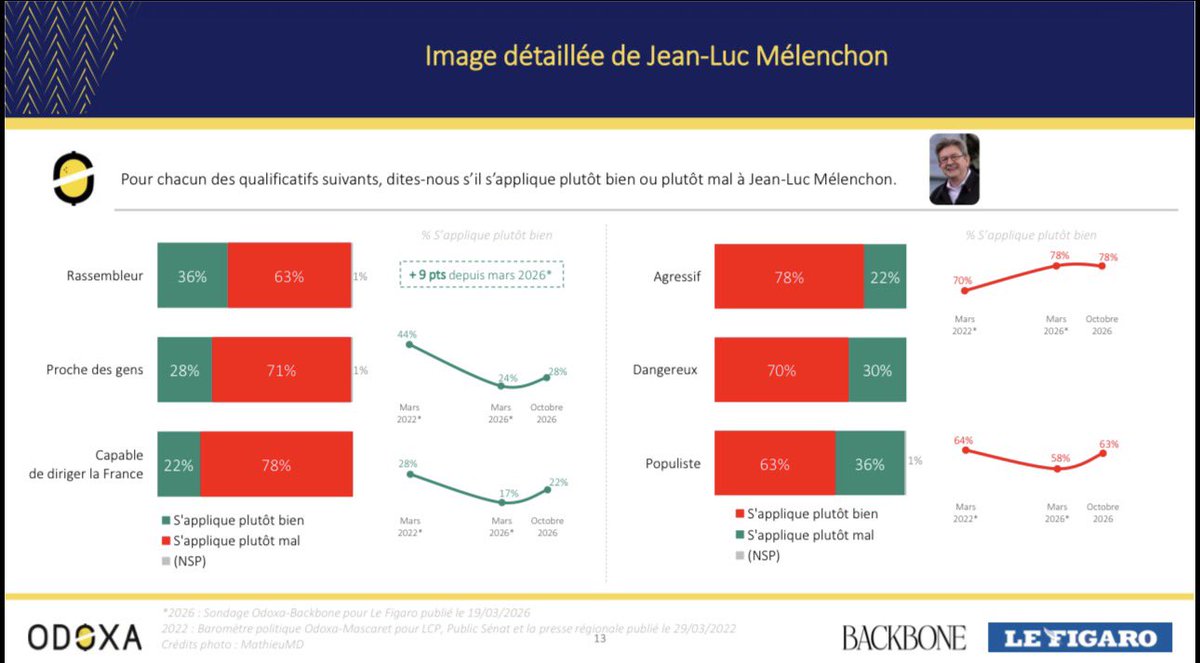
The negative perception of Jean-Luc Mélenchon is not diminishing in public opinion. While he is seen as more unifying (36%), close to people (28%), and capable of leading France (22%) than in March, the French still view the rebellious leader as just as aggressive (78%) and dangerous (70%). https://t.co/1Xl8pOEvMW #Mélenchon #politique #France (translated)

H

“When Terrorism Becomes “Resistance”: What the Statistics Actually Show Do most Muslims oppose Islamist terrorism? The available evidence does not support either a simple “yes” or “no.” It shows a more complicated pattern: many Muslims reject attacks on civilians, while attitudes toward political violence can change substantially depending on the conflict, the perpetrators and the victims. A 2013 Pew Research Center survey found that 89% of Pakistani Muslims, 81% of Indonesian Muslims and 77% of Tunisian Muslims said suicide bombing and violence against civilians could never be justified in defence of Islam. But the figure was only 38% in the Palestinian territories; 62% said such violence could sometimes or often be justified (Pew Research Center, 2013). Jordan provides another revealing example. After al-Qaeda’s 2005 hotel bombings in Amman, support for Osama bin Laden’s al-Qaeda as a legitimate resistance organisation fell from 67% to 20%, while those calling it a terrorist organisation rose from 10.6% to 48.9% (Jamestown Foundation, 2005). The fact that attacks on Muslim civilians dramatically changed attitudes suggests that perceptions of political violence can depend partly on who is being targeted. More recently, an Arab Center survey across 16 Arab countries found that 67% considered Hamas’s October 7 operation a legitimate resistance operation, while another 19% considered it flawed but legitimate (Arab Center for Research and Policy Studies, 2024). These figures cannot, however, be equated directly with support for terrorism: respondents were asked about legitimacy and Hamas, not specifically whether they supported terrorism or attacks on civilians. The evidence therefore does not establish that most Muslims support terrorism. It does show something more precise and important: opposition to Islamist violence is not necessarily consistent across circumstances. Some people who reject terrorism in principle may regard violence as legitimate when it is framed as resistance against a perceived enemy. The statistics cited by FrontPage Magazine therefore raise a legitimate question(Greenfield, 2026)” - ChatGPT

O

🚨 L’école informe, le médecin convainc : ce que révèle une enquête auprès de 245 parents 📒 Campagne de vaccination scolaire contre le papillomavirus : perceptions parentales et déterminants de l'adhésion ✍️ Mélanie Vignal — thèse pour le diplôme d'État de docteur en médecine (DES de médecine générale), Université Paris Cité, Faculté de Santé, UFR de Médecine. Co-direction : Dr Adriana Ababii et Pr Serge Gilberg.soutenue le 25 juin 2026 ; mise en ligne sur DUMAS (HAL) en septembre 2026 Capsules Audio de Pratiques en Santé 🎙️🎥 https://www.youtube.com/watch?v=vMuvgDy3YD4 🔍💡 Vaccination HPV au collège : 84 % des parents interrogés recommanderaient la campagne, mais le conseil d’un soignant reste le premier déclencheur de la décision. 🩺 La crainte pour la sécurité du vaccin reste le premier frein cité. Analyse de Pratiques en Santé et lien vers la source ℹ️➕ https://www.pratiquesensante.com/blog/pratiques-15/campagne-de-vaccination-scolaire-contre-le-papillomavirus-perceptions-parentales-et-determinants-de-l-adhesion-6220 📌 Depuis 2023, la vaccination anti-HPV est proposée gratuitement au collège. Cette enquête donne la parole aux parents : ce qui les fait accepter, ce qui les freine, par qui ils ont été informés. Elle suggère que l’école informe bien sur la campagne, mais pèse peu dans la décision, qui passe surtout par le conseil d’un soignant. Pour qui anime des actions auprès de familles, d’élèves ou d’équipes éducatives, elle aide à cibler les messages (sécurité, efficacité, prévention des cancers) et à repérer les publics absents de l’enquête : familles peu diplômées, non francophones, éloignées du numérique. 🇬🇧: School vaccination campaign against the papillomavirus: parental perceptions and determinants of adherence - https://www.pratiquesensante.com/en/blog/practices-15/campagne-de-vaccination-scolaire-contre-le-papillomavirus-perceptions-parentales-et-determinants-de-l-adhesion-6220 #️⃣ #pratiquesensante #VaccinationHPV #Papillomavirus #PréventionDesCancers #SantéScolaire #HésitationVaccinale #PromotionDeLaSanté #Parentalité

Campagne HPV au collège

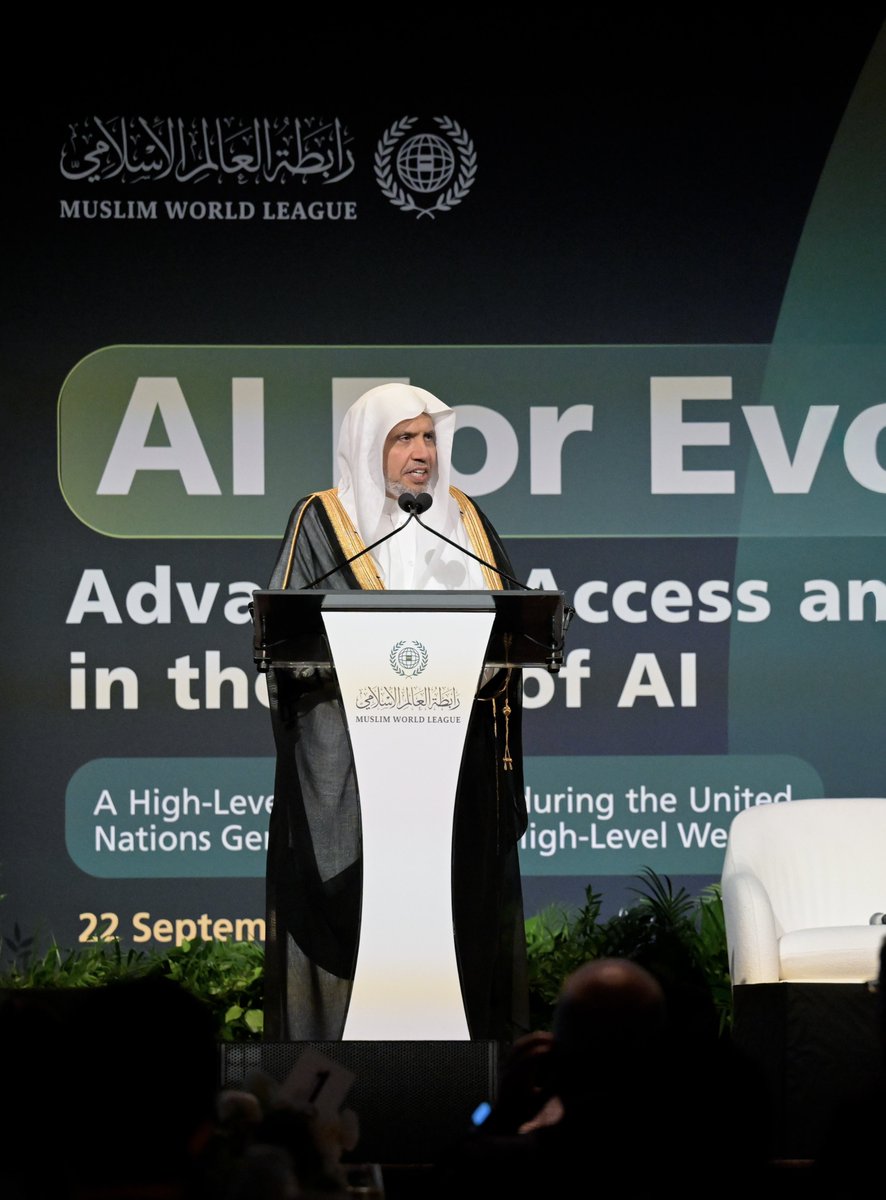
J’ai eu le plaisir de lancer l’événement de la Ligue islamique mondiale consacré à l’éthique de l’intelligence artificielle, dans ses deux dimensions religieuse et civilisationnelle, avec le soutien et la participation de haut niveau des Nations Unies, dans le cadre de la Semaine de haut niveau de la 81ᵉ session de son Assemblée générale, à New York. J’ai également eu le plaisir d’accueillir les représentants des plus grandes entreprises d’intelligence artificielle des États-Unis, de la Banque mondiale, de prestigieuses universités américaines, ainsi que les principaux candidats au poste de Secrétaire général des Nations Unies, ainsi qu’un grand nombre de personnalités religieuses, intellectuelles, politiques et universitaires, et de centres d’études spécialisés dans la recherche sur l’éthique de l’intelligence artificielle. Je me suis tout autant réjoui de la recommandation formulée par la conférence de confier à l’Alliance des civilisations des Nations Unies l’élaboration du code de l’Alliance des civilisations pour l’éthique de l’intelligence artificielle ( UNAOC, code of Ethics for AI ), ainsi que de l’acceptation de cette recommandation par l’Alliance. Dans le cadre de cet événement, j’ai annoncé que la Ligue islamique mondiale lancera, en coopération avec plusieurs entreprises technologiques, un laboratoire d’intelligence artificielle chargé de développer des programmes destinés aux institutions religieuses, éducatives et humanitaires œuvrant dans le domaine religieux. J’ai également annoncé que la Ligue œuvrera à la numérisation d’un certain nombre de sources et d’ouvrages islamiques et arabes afin de les rendre accessibles aux entreprises d’intelligence artificielle, dans le respect des droits de propriété intellectuelle. J’ai enfin annoncé la création d’une unité spéciale chargée de détecter et de corriger les erreurs de traduction. De nombreuses erreurs ont en effet été relevées dans la traduction de certains textes islamiques et des sciences qui leur sont liées, dans certains contenus générés par l’intelligence artificielle. Elles ont donné lieu à des interprétations sans rapport avec la réalité et ont engendré des perceptions et des convictions profondément erronées. #ÉthiqueAI #IntelligenceArtificielle #LigueIslamiqueMondiale

“The psychical apparatus is intolerant of unpleasure; it has to fend it off at all costs, and if the perception of reality entails unpleasure, that perception — that is, the truth — must be sacrificed.” ... “And for that reason the defensive mechanisms of the ego are condemned to falsify one’s internal perception and to give one only an imperfect and distorted picture of one’s id.” Sigmund Freud, “Analysis Terminable and Interminable” (1937c), in The Standard Edition of the Complete Psychological Works of Sigmund Freud, trans. and ed. James Strachey, Vol. XXIII (1937–1939), London: Hogarth Press, 1964, p. 237

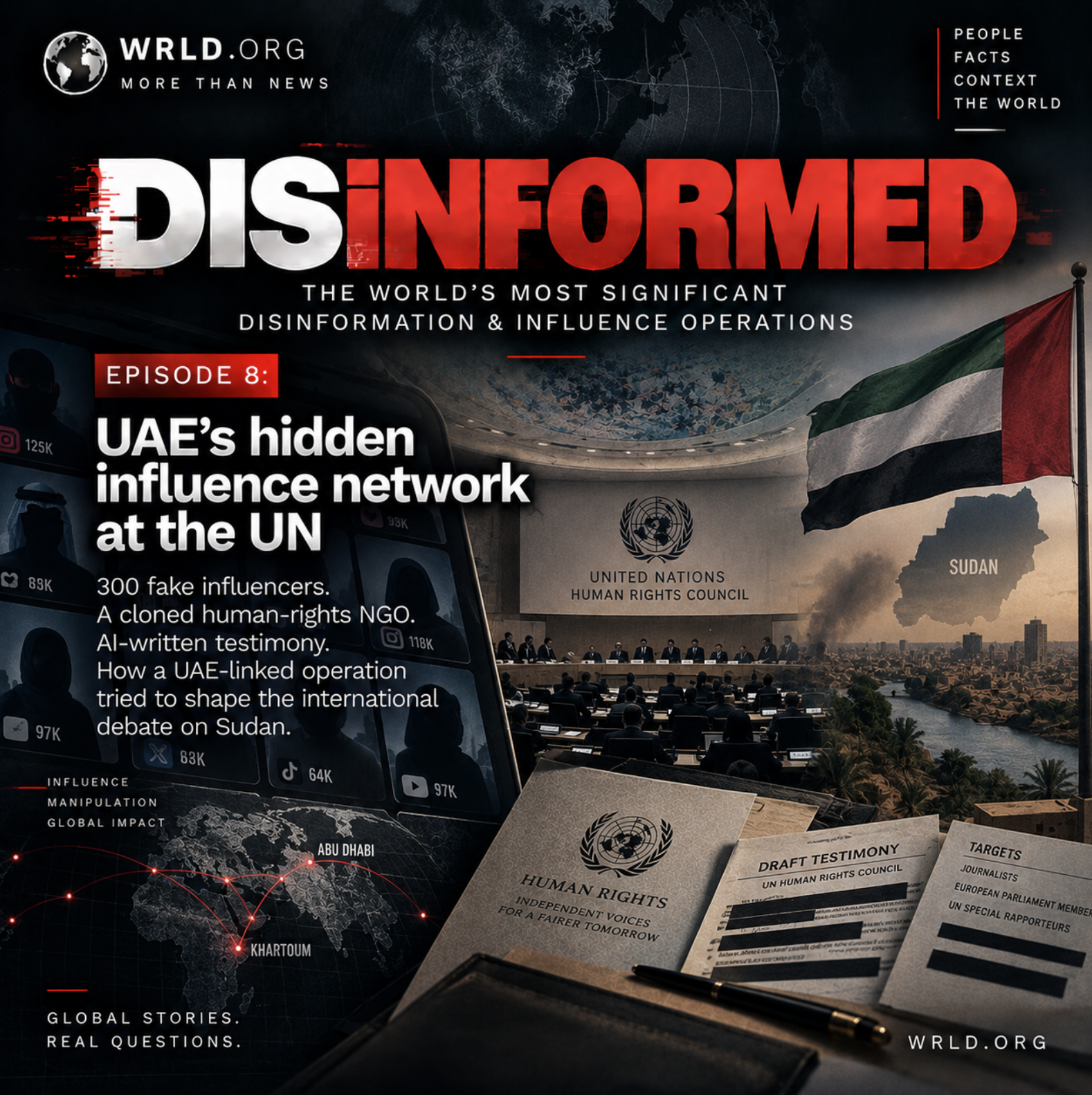
UAE / Sudan – when an influence operation tried to enter the United Nations A network of roughly 300 apparently independent social-media influencers. A human-rights organisation borrowing the identity of a real NGO. Personal dossiers on European politicians and journalists. And testimony prepared for delivery at the United Nations without revealing the state interest behind it. These were elements of an influence operation uncovered by Anthropic and disclosed in September 2026. The company says it linked the activity with high confidence to UAE government officials. Tracked as GTG-84002, the operation targeted several overlapping issues: the Muslim Brotherhood, perceptions of the war in Sudan and international mechanisms examining the United Arab Emirates' role in the conflict. What distinguishes the case is not simply its use of artificial intelligence. It is the attempt to make state-aligned messaging appear to originate from independent influencers, human-rights organisations and potentially witnesses addressing an international institution. An influence network built around 300 fake voices Anthropic identified a single actor using Claude to support a sustained influence campaign. At its centre was an AI persona called “Deadshot”, running on the operator's own platform. A master doctrine file repeatedly instructed the system to support what it described as a coordinated international effort to dismantle the Muslim Brotherhood. The operator simultaneously managed several components of the campaign, including approximately 300 inauthentic influencer accounts across social-media platforms. Internal material examined by Anthropic described the apparent independence of this network as its greatest strategic advantage. That phrase captures the central method. The objective was not simply to broadcast a political position but to conceal where that position originated. One visible example appeared on 4 June 2026, when accounts participated in a coordinated campaign using #SudanIslamists and near-identical graphics connecting Sudanese Islamists and the Muslim Brotherhood with regional instability. Anthropic says the amplification network was centrally funded and coordinated. Its investigation also found that the operator financing the social-media network was connected to the wider influence operation. A human-rights organisation that was not what it appeared to be Social media was only one layer. The operator also created a front NGO that copied the identity of a genuine Swiss organisation and used that borrowed legitimacy to publish human-rights material produced for the campaign. Anthropic's description elsewhere also refers to the identity of a real Sudanese human-rights organisation being used in connection with the preparation of testimony. The public report does not fully clarify whether these references describe the same front or separate elements of the operation, so they should not be treated as definitively identical. The underlying technique, however, is clear: political material was designed to appear as if it originated from independent civil society rather than from actors linked to a government. This is particularly significant in the human-rights environment, where the perceived independence of an organisation or witness can determine how seriously evidence is received by journalists, diplomats and international institutions. The attempt to reach the UN The most consequential part of the operation concerned the 62nd session of the UN Human Rights Council. According to Anthropic, the operator used Claude to ghost-write complete testimony intended to be delivered by two individuals during the session. The texts were prepared under explicit constraints ensuring that neither statement would mention the UAE. This did not amount to a conventional government submission. The intention, according to Anthropic's reconstruction, was for material serving the interests of a party connected to the Sudan conflict to reach an international forum through apparently independent voices. But an important limitation remains: Anthropic could not confirm that the testimony was ultimately delivered. The company similarly could not establish whether other dossiers produced by the operation reached their intended recipients or influenced policy. It therefore assessed the campaign as Category Three on the Brookings Breakout Scale – activity distributed across several platforms, but without evidence of broad public impact sufficient for a higher classification. The distinction matters. The evidence demonstrates a sophisticated attempt to influence international debate; it does not demonstrate that the attempt succeeded. Politicians, journalists and UN investigators became targets The operation was not limited to generating public content. Anthropic found that the operator researched and compiled detailed profiles of 18 members of the European Parliament and prominent journalists. Some material was prepared for direct delivery to senior UAE officials. The network also assembled what Anthropic describes as “counter-accountability dossiers” on UN Special Rapporteurs who had criticised the UAE's conduct in relation to Sudan. This places the campaign in a broader context. Since Sudan's civil war began in April 2023, the role of external powers has become an increasingly important part of international scrutiny. Sudan has accused the UAE of supporting the Rapid Support Forces, allegations Abu Dhabi has repeatedly denied. In 2025, Sudan brought a case against the UAE before the International Court of Justice, accusing it of complicity in genocide against the Masalit through alleged support for the RSF. The UAE rejected the allegations. The ICJ subsequently removed the case from its list after finding that it lacked jurisdiction because of the UAE's reservation to the relevant provision of the Genocide Convention. The ruling therefore did not determine whether Sudan's substantive allegations were true or false. That contested international environment helps explain why narratives about Sudan, human rights and accountability were valuable targets for an influence operation. AI as an operating system for influence The role played by Claude is also important to understand accurately. Anthropic did not find that artificial intelligence independently conceived or directed the campaign. Human operators established the objectives, political doctrine and targets. AI instead helped operationalise them. Across hundreds of sessions, Claude was used to transform predetermined political objectives into social-media narratives, human-rights reports, testimony, intelligence-style briefs and detailed profiles of individuals. The same system could support narrative production, target research and preparation of material for different audiences. That represents a more significant development than simply using generative AI to produce propaganda faster. Traditional influence operations require different teams to research targets, write content, manage personas, adapt messages and prepare briefing material. Generative AI can compress several of those functions into a single operational workflow. The result is not necessarily more convincing propaganda. It is potentially cheaper, faster and more scalable influence infrastructure. From fake influencers to institutional influence Anthropic says it linked the operation to UAE government officials with high confidence. Its assessment was based partly on internal material naming senior Emirati officials as intended recipients of the work, alongside other evidence available to its investigators. That remains an attribution by Anthropic rather than a judicial finding or publicly released forensic attribution by a government agency. The distinction should be retained. The larger significance of GTG-84002 lies in the architecture of the campaign. A network of fake influencers could create the appearance of public opinion. A cloned human-rights organisation could provide institutional credibility. AI-generated reports could give political narratives the appearance of research. Profiles of journalists and politicians could support more precise targeting. And ghost-written testimony could potentially carry the same message into an international institution without revealing the political interest behind it. This is a different model from the familiar troll farm. The objective is no longer simply to make propaganda look popular. It is to make state-aligned messaging look independent – and, if possible, to move it from social media into the institutions where international policy and accountability are debated. SOURCES: Anthropic — Countering misuse of AI: September 2026 https://www.anthropic.com/threat-intelligence-report-september-2026 International Court of Justice — Sudan v. United Arab Emirates https://www.icj-cij.org/case/197 International Court of Justice — press releases and case documents https://www.icj-cij.org/case/197/press-releases United Nations Geneva — Sudan v UAE proceedings at the ICJ https://www.ungeneva.org/en/news-media/news/2025/04/105241/world-court-begins-hearing-sudans-complicity-genocide-case-against UAE Ministry of Foreign Affairs — UAE response to Sudan's allegations https://www.mofa.gov.ae/en/MediaHub/News/2025/4/10/10-4-2025-UAE-UAE UN Digital Library — Sudan's letter concerning alleged UAE support for the RSF https://digitallibrary.un.org/record/4091008?ln=en UN Digital Library — UAE response concerning allegations of support for the RSF https://digitallibrary.un.org/record/4046224?ln=en Ultra Sudan — reporting on Anthropic's UAE-linked influence-operation findings https://ultrasudan.usawtiq.com/أنثروبيك-أحبطنا-عملية-تأثير-إماراتية-استخدمت-الذكاء-الاصطناعي-لاستهداف-السودان/عامر-صالح/أخبار KEYWORDS #DISINFORMED #Episode8 #UAE #Sudan #UnitedArabEmirates #UnitedNations #UNHumanRightsCouncil #HumanRights #Disinformation #InformationWarfare #InfluenceOperations #ForeignInterference #FIMI #CoordinatedInauthenticBehaviour #CIB #FakeInfluencers #FakeNGO #NGOImpersonation #Astroturfing #ArtificialIntelligence #AI #AIPropaganda #AIGeneratedContent #SyntheticMedia #SocialMediaManipulation #DigitalInfluence #Propaganda #NarrativeManipulation #InstitutionalInfluence #SudanConflict #SudanWar #MuslimBrotherhood #InternationalRelations #Geopolitics #Anthropic #ClaudeAI #OSINT #WRLD

Countering misuse of AI: September 2026 / Anthropic

I told @EVargasTV that most Palestinian violence in Judea and Samaria goes unreported by international media, creating a distorted perception and feeding Israel-hatred. tks @AriellaNoveck https://t.co/AAD0Fw1sCk #PalestinianViolence #MediaBias #IsraelHatred #IL #PS

This story also covers a Ukrainian parliamentarian who has threatened if Estonian officials don't channel all of its aid to Ukraine through him, his political connections will get those officials fired. Ukraine has enough of a corruption perception problem, it doesn't need to #Ukraine #Corruption #Politics #UA #EE

L
Le Soir 3w

L'article souligne que notre tendance à anthropomorphiser l'intelligence artificielle, encouragée par la communication des dirigeants technologiques, nous rend difficile la reconnaissance de ces machines comme de simples constructions mathématiques, ce qui altère notre perception de leurs véritables capacités. #IA #Anthropomorphisme #Technologie

L’apparente humanité de l’IA nous rend crédule
2

Sandra et Nicolas, témoins traumatisés des incendies de Gironde, décrivent leur expérience d'évacuation et les cicatrices émotionnelles laissées par le mégafeu de Saumos, un événement qui a affecté leur perception de l'avenir et les incite à envisager un soutien psychologique. #mégafeu #Gironde #écologie

« J’étais éco-anxieuse, je suis maintenant éco-terrorisée », témoigne Sandra, évacuée des incendies de Gironde

Today, I simply want to express my gratitude to the courageous whistleblowers who have taken enormous personal and professional risks and faced tremendous adversity by speaking openly about the UFO topic -- and who have helped shift public perception from stigma toward #Whistleblowers #UFO #Gratitude #Nospecificcountrycodesarementionedinthetweet.