BETA nonprofit public democratic european moderated

Search

#Séparation
Actu Foot 19m

🚨🚨 LA SÉPARATION ENTRE PAUL POGBA 🇫🇷 ET L’AS MONACO 🇲🇨 S’EST FAITE EN TRÈS BONS TERMES ! 😁🤝 Le joueur a pris conscience qu’il n’y arrivait pas à Monaco. IL CONTINUE À UTILISER LES INFRASTRUCTURES DU CLUB POUR TROUVER UN NOUVEAU CHALLENGE ! 👀 🗞️ @Rothensenflamme https://t.co/2kqmu7VcO7 #PaulPogba #ASMonaco #Football

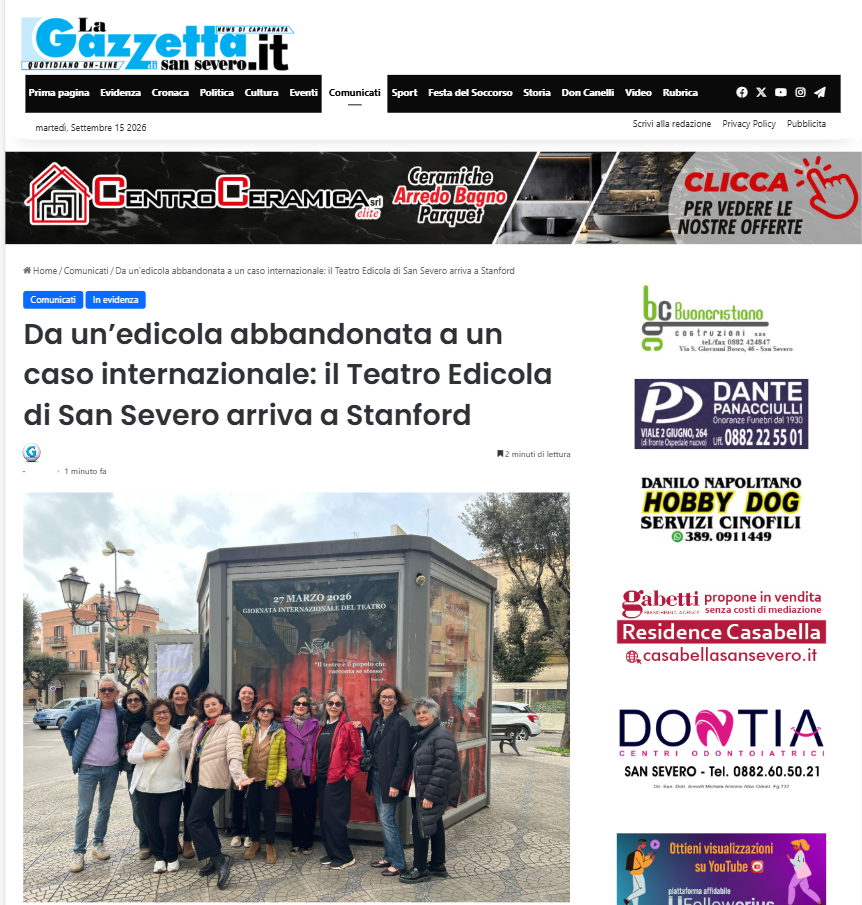
“TEATRO EDICOLA” OF SAN SEVERO BECOMES AN INTERNATIONAL CASE STUDY IN THE “STANFORD SOCIAL INNOVATION REVIEW (SSIR)” — STANFORD UNIVERSITY SOURCE: https://l1nq.com/rruntbb LA GAZZETTA DI SAN SEVERO SAN SEVERO (FG) — Six persons enter a news kiosk. Before them lie no newspapers, magazines, or tobacco, but a theatrical stage measuring less than two square metres. The actors stand but a few paces from the spectators, with scarce any separation betwixt those who perform and those who behold. It is in this manner that in San Severo a place abandoned for years hath begun to live anew. And today that diminutive theatrical experiment hath fallen beneath the glare of international attention. It is the story of the “Teatro Edicola”, the project realised by the company Foyer ’97, under the artistic direction of Francesco Gravino, which hath transformed an old news kiosk in Via Tondi into one of the smallest stages ever conceived. The project commenced on 27th March last, with a formula as simple as it is original: six seats, a stage of most exiguous dimensions, and performances lasting but a few minutes. A minimal distance betwixt public and performers that doth wholly alter the traditional relationship betwixt spectator and theatre. The wager, however, was forthwith rewarded by the public. More than 60 persons attended the performances in a single afternoon, and the three days of the inaugural season registered a complete sold-out. From a local experiment, the “Teatro Edicola” hath thus become a case capable of attracting attention far beyond the confines of the Province of Foggia. In September 2026, the Stanford Social Innovation Review (SSIR), the journal of Stanford University, shall publish upon its website and in its Fall 2026 print edition the reportage “The Six-Seat Revolution”, authored by Dr Luciano Magaldi Sardella and edited by Deputy Editor David V. Johnson. The interest of the American review concerneth not merely the originality of the theatrical proposition. The Teatro Edicola is, in fact, observed as a potential paradigm of social innovation and low-cost urban regeneration. Become a Medium member The idea is particularly compelling in a country such as Italy, wherein numerous news kiosks have ceased their activity and risk becoming vacant interstices within the urban fabric. The question, at bottom, is simple: can a place born to sell newspapers become once more a locus of encounter? In San Severo, the answer hath been entrusted to the theatre. The kiosk hath not been merely restored in a physical sense. It hath changed its function, transforming itself into a place where artists encounter the public directly and where the performance becometh part of the quotidian life of the street. “The theatre cometh into the street wherein thou walkest every day,” Francesco Gravino hath explained, thus synthesising the philosophy underpinning the project. And it is precisely this aspect that hath rendered the experience interesting also upon the plane of its potential replicability. Initial requests for information have already arrived from other cities, amongst them Lucca and Rome, interested in learning of the model and the modalities for its realisation. The strength of the Teatro Edicola resideth also in its apparent disproportion: a minimal investment and space to produce a cultural effect far greater. There is no need for a grand theatre, an auditorium of hundreds of seats, or complex structures. An unused space sufficeth, together with an idea and the will to restore it to the community. That old kiosk in Via Tondi, therefore, recounteth something that goeth beyond the theatre. It recounteth the possibility of rethinking the spaces of our cities, restoring a social function to places that seemed to have definitively lost it.

Encurtador de Link

During my hitchhiking this summer, one thing kept coming up: emotional breakups, separation, divorce, are also a time of declining income, loss of housing, often with the children paying the price. Another thing, too: disability, which leads to poverty, with (translated)

PORTAL-ANALITIKA.ME publishes the “Edicola Teatro” of Foyer ’97, Founded by Francesco Gravino of San Severo, Puglia, Italy SOURCE: https://www.linkedin.com/pulse/portal-analitikame-publishes-edicola-teatro-foyer-97-sardella-ph-d--6i2of/ The format devised by the Pulgian theatre company Foyer ’97 — already described as “the smallest theatre in the world” — has now reached the international stage through its feature on the global platform Europe Says. A story born from an abandoned news kiosk in the province of Foggia is now crossing every conceivable boundary. It is a genuine pleasure and an honour to share the brilliant idea of the artistic director of Teatro ’97, the distinguished actor and director from San Severo, Francesco Gravino, and his remarkable theatre company, as they gain international visibility with this marvellous and innovative creation: a true “Teatro Edicola”. Source: https://www.portalanalitika.me/clanak/na-drugoj-obali-jadrana-otvoreno-najmanje-pozoriste-na-planeti Only a few square metres, six chairs, and the passion of a theatre company are enough to make history. The Edicola Teatro, conceived by Francesco Gravino, Artistic Director of the historic San Severo-based company Foyer ’97, is receiving significant media recognition, “taking to the stage” of leading national and international outlets thanks to his talented intuition, inspired by Edicola Fiore, the celebrated format created by the Italian entertainment icon Rosario Fiorello. An abandoned kiosk, a record‑breaking theatre It has already been dubbed “the smallest theatre in the world” and, with merely six seats, may well aspire to a Guinness World Record. Since its launch a few days ago, the original venue has drawn hundreds of curious visitors who queued to attend the performances—scheduled every fifteen minutes—inside a former abandoned news kiosk in San Severo, in the province of Foggia. The initiative stems from the distinctive vision of the long‑established San Severo company Foyer ’97, led by Gravino, who sought to celebrate World Theatre Day with an unprecedented experiment that has already been widely reported by national‑level media. The idea, seemingly simple in its striking essentiality, in fact conceals a profound reflection on the nature of theatrical practice. “The idea of the smallest theatre in the world was born from a creative provocation: to return theatre to its most direct essence. Together with the company, we asked ourselves how far the space could be reduced without losing intensity, and the kiosk became the perfect symbol: a place that suddenly transforms into a stage. From a space of news to a space of emotions,” Gravino explained. Foyer ’97 has been active since 1997 and is based in San Severo. Next year it will celebrate its thirtieth anniversary—an occasion approaching at the moment of greatest visibility in its history. The format: sixteen giants of literature in fifteen minutes With only six seats available at a time and performances following one another every fifteen minutes, the audience is quite literally immersed in the work. From 11:00 to 20:45, eleven actors alternate in bringing to life the giants of literature: from Goldoni to Chekhov, via the wit of Gaber and the dramatic force of Euripides. Inside the small theatre carved out of the disused kiosk owned by Mr Pino Grau, there is no traditional separation between stage and auditorium; instead, an intimate encounter takes place in which spectators and actors become, in effect, a single entity. Admission is free, reflecting Gravino’s aim: to restore theatre’s accessibility, returning it to a place that welcomes everyone. At the kiosk’s threshold, a QR code and a cryptic notice encapsulate the spirit of the project: “Warning. This QR code turns passers‑by into actors. Scan only if you are ready.” From the crisis of print media to cultural rebirth The project also carries with it a reflection on urban transformation and the decline of traditional commerce. The kiosk had been unused for around six years and has now been transformed into an intimate and surprising performance space in which less than a metre separates actors from spectators. At a time when kiosks in town and city centres are increasingly converted into drink stands, flower stalls, or souvenir shops, the Edicola Teatro comes closer to the original spirit of knowledge with which such kiosks were conceived—as places for the sale of newspapers and books. It is a symbolic short circuit of remarkable eloquence: a bastion of written culture becoming a bastion of live culture. The idea draws inspiration from Edicola Fiore, Fiorello’s cult programme, which first brought performance into a Roman kiosk. Gravino and his collaborators have also embraced the invitation of Willem Dafoe, the renowned actor and current director of the Theatre Section of the Venice Biennale, regarding the importance of theatre as a force for cohesion among peoples. The Grokipedia entry: a leap to global scale The theatre company Foyer ’97, led by Francesco Gravino, has now been granted its own dedicated encyclopaedic entry, “Teatro Edicola”. This Grokipedia listing represents more than a mere media acknowledgement. Launched in October 2025, Grokipedia is an AI-generated encyclopaedia managed by xAI, the artificial-intelligence research company founded by Musk. The fact that Grok’s knowledge engine has deemed the micro‑theatre worthy of an autonomous encyclopaedic entry—on a par with established cultural institutions—confirms the international resonance of an idea born in a side street of a southern Italian town. The objective is now to export the format beyond the borders of Apulia; with Grokipedia’s recognition, that prospect appears more concrete than ever. The praise of local institutions “We extend our heartfelt congratulations to Franco Gravino and to all the actors and artists for this wonderful initiative,” declared Mayor Lidya Colangelo and Deputy Mayor for Culture Anna Paola Giuliani. The municipal administration has announced its intention to welcome the company to Palazzo Celestini to celebrate the achievement together. Perhaps the most striking aspect has been the audience’s reaction. Many emerged with glistening eyes or with a suspended smile, as though they had experienced something secret. This is the theatre that Francesco Gravino and Foyer ’97 have chosen to pursue: not the theatre that waits for its audience on velvet seats, but the theatre that goes out to find them in the street, surprises them, and transforms them.

PORTAL-ANALITIKA.ME publishes the “Edicola Teatro” of Foyer ’97, Founded by Francesco Gravino of San Severo, Puglia, Italy

WP TURYSTYKA.PL publishes the “Edicola Teatro” of Foyer ’97, Founded by Francesco Gravino of San Severo, Puglia, Italy SOURCE: https://www.linkedin.com/pulse/wp-turystykapl-publishes-edicola-teatro-foyer-97-san-sardella-ph-d--hs5pf/ The format devised by the Pulgian theatre company Foyer ’97 — already described as “the smallest theatre in the world” — has now reached the international stage through its feature on the global platform Europe Says. A story born from an abandoned news kiosk in the province of Foggia is now crossing every conceivable boundary. It is a genuine pleasure and an honour to share the brilliant idea of the artistic director of Teatro ’97, the distinguished actor and director from San Severo, Francesco Gravino, and his remarkable theatre company, as they gain international visibility with this marvellous and innovative creation: a true “Teatro Edicola”. Source: https://turystyka.wp.pl/najmniejszy-teatr-swiata-ustawiaja-sie-kolejki-7273686077245632a Only a few square metres, six chairs, and the passion of a theatre company are enough to make history. The Edicola Teatro, conceived by Francesco Gravino, Artistic Director of the historic San Severo-based company Foyer ’97, is receiving significant media recognition, “taking to the stage” of leading national and international outlets thanks to his talented intuition, inspired by Edicola Fiore, the celebrated format created by the Italian entertainment icon Rosario Fiorello. An abandoned kiosk, a record‑breaking theatre It has already been dubbed “the smallest theatre in the world” and, with merely six seats, may well aspire to a Guinness World Record. Since its launch a few days ago, the original venue has drawn hundreds of curious visitors who queued to attend the performances—scheduled every fifteen minutes—inside a former abandoned news kiosk in San Severo, in the province of Foggia. The initiative stems from the distinctive vision of the long‑established San Severo company Foyer ’97, led by Gravino, who sought to celebrate World Theatre Day with an unprecedented experiment that has already been widely reported by national‑level media. The idea, seemingly simple in its striking essentiality, in fact conceals a profound reflection on the nature of theatrical practice. “The idea of the smallest theatre in the world was born from a creative provocation: to return theatre to its most direct essence. Together with the company, we asked ourselves how far the space could be reduced without losing intensity, and the kiosk became the perfect symbol: a place that suddenly transforms into a stage. From a space of news to a space of emotions,” Gravino explained. Foyer ’97 has been active since 1997 and is based in San Severo. Next year it will celebrate its thirtieth anniversary—an occasion approaching at the moment of greatest visibility in its history. The format: sixteen giants of literature in fifteen minutes With only six seats available at a time and performances following one another every fifteen minutes, the audience is quite literally immersed in the work. From 11:00 to 20:45, eleven actors alternate in bringing to life the giants of literature: from Goldoni to Chekhov, via the wit of Gaber and the dramatic force of Euripides. Inside the small theatre carved out of the disused kiosk owned by Mr Pino Grau, there is no traditional separation between stage and auditorium; instead, an intimate encounter takes place in which spectators and actors become, in effect, a single entity. Admission is free, reflecting Gravino’s aim: to restore theatre’s accessibility, returning it to a place that welcomes everyone. At the kiosk’s threshold, a QR code and a cryptic notice encapsulate the spirit of the project: “Warning. This QR code turns passers‑by into actors. Scan only if you are ready.” From the crisis of print media to cultural rebirth The project also carries with it a reflection on urban transformation and the decline of traditional commerce. The kiosk had been unused for around six years and has now been transformed into an intimate and surprising performance space in which less than a metre separates actors from spectators. At a time when kiosks in town and city centres are increasingly converted into drink stands, flower stalls, or souvenir shops, the Edicola Teatro comes closer to the original spirit of knowledge with which such kiosks were conceived—as places for the sale of newspapers and books. It is a symbolic short circuit of remarkable eloquence: a bastion of written culture becoming a bastion of live culture. The idea draws inspiration from Edicola Fiore, Fiorello’s cult programme, which first brought performance into a Roman kiosk. Gravino and his collaborators have also embraced the invitation of Willem Dafoe, the renowned actor and current director of the Theatre Section of the Venice Biennale, regarding the importance of theatre as a force for cohesion among peoples. The Grokipedia entry: a leap to global scale The theatre company Foyer ’97, led by Francesco Gravino, has now been granted its own dedicated encyclopaedic entry, “Teatro Edicola”. This Grokipedia listing represents more than a mere media acknowledgement. Launched in October 2025, Grokipedia is an AI-generated encyclopaedia managed by xAI, the artificial-intelligence research company founded by Musk. The fact that Grok’s knowledge engine has deemed the micro‑theatre worthy of an autonomous encyclopaedic entry—on a par with established cultural institutions—confirms the international resonance of an idea born in a side street of a southern Italian town. The objective is now to export the format beyond the borders of Apulia; with Grokipedia’s recognition, that prospect appears more concrete than ever. The praise of local institutions “We extend our heartfelt congratulations to Franco Gravino and to all the actors and artists for this wonderful initiative,” declared Mayor Lidya Colangelo and Deputy Mayor for Culture Anna Paola Giuliani. The municipal administration has announced its intention to welcome the company to Palazzo Celestini to celebrate the achievement together. Perhaps the most striking aspect has been the audience’s reaction. Many emerged with glistening eyes or with a suspended smile, as though they had experienced something secret. This is the theatre that Francesco Gravino and Foyer ’97 have chosen to pursue: not the theatre that waits for its audience on velvet seats, but the theatre that goes out to find them in the street, surprises them, and transforms them.

WP TURYSTYKA.PL publishes the “Edicola Teatro” of Foyer ’97, Founded by Francesco Gravino of San Severo, Puglia, Italy

E-TEATR.PL publishes the “Edicola Teatro” of Foyer ’97, founded by Francesco Gravino of San Severo, Puglia, Italy SOURCE: https://www.linkedin.com/pulse/e-teatrpl-publishes-edicola-teatro-foyer-97-founded-sardella-ph-d--bhrnf/ The format devised by the Apulian theatre company Foyer ’97 — already described as “the smallest theatre in the world” — has now reached the international stage through its feature on the global platform Europe Says. A story born from an abandoned news kiosk in the province of Foggia is now crossing every conceivable boundary. It is a genuine pleasure and an honour to share the brilliant idea of the artistic director of Teatro ’97, the distinguished actor and director from San Severo, Francesco Gravino, and his remarkable theatre company, as they gain international visibility with this marvellous and innovative creation: a true “Teatro Edicola”. Source: https://e-teatr.pl/wlochy-najmniejszy-teatr-swiata-w-dawnym-kiosku-z-gazetami-6789 Only a few square metres, six chairs, and the passion of a theatre company are enough to make history. The Edicola Teatro, conceived by Francesco Gravino, Artistic Director of the historic San Severo-based company Foyer ’97, is receiving significant media recognition, “taking to the stage” of leading national and international outlets thanks to his talented intuition, inspired by Edicola Fiore, the celebrated format created by the Italian entertainment icon Rosario Fiorello. An abandoned kiosk, a record‑breaking theatre It has already been dubbed “the smallest theatre in the world” and, with merely six seats, may well aspire to a Guinness World Record. Since its launch a few days ago, the original venue has drawn hundreds of curious visitors who queued to attend the performances—scheduled every fifteen minutes—inside a former abandoned news kiosk in San Severo, in the province of Foggia. The initiative stems from the distinctive vision of the long‑established San Severo company Foyer ’97, led by Gravino, who sought to celebrate World Theatre Day with an unprecedented experiment that has already been widely reported by national‑level media. The idea, seemingly simple in its striking essentiality, in fact conceals a profound reflection on the nature of theatrical practice. “The idea of the smallest theatre in the world was born from a creative provocation: to return theatre to its most direct essence. Together with the company, we asked ourselves how far the space could be reduced without losing intensity, and the kiosk became the perfect symbol: a place that suddenly transforms into a stage. From a space of news to a space of emotions,” Gravino explained. Foyer ’97 has been active since 1997 and is based in San Severo. Next year it will celebrate its thirtieth anniversary—an occasion approaching at the moment of greatest visibility in its history. The format: sixteen giants of literature in fifteen minutes With only six seats available at a time and performances following one another every fifteen minutes, the audience is quite literally immersed in the work. From 11:00 to 20:45, eleven actors alternate in bringing to life the giants of literature: from Goldoni to Chekhov, via the wit of Gaber and the dramatic force of Euripides. Inside the small theatre carved out of the disused kiosk owned by Mr Pino Grau, there is no traditional separation between stage and auditorium; instead, an intimate encounter takes place in which spectators and actors become, in effect, a single entity. Admission is free, reflecting Gravino’s aim: to restore theatre’s accessibility, returning it to a place that welcomes everyone. At the kiosk’s threshold, a QR code and a cryptic notice encapsulate the spirit of the project: “Warning. This QR code turns passers‑by into actors. Scan only if you are ready.” From the crisis of print media to cultural rebirth The project also carries with it a reflection on urban transformation and the decline of traditional commerce. The kiosk had been unused for around six years and has now been transformed into an intimate and surprising performance space in which less than a metre separates actors from spectators. At a time when kiosks in town and city centres are increasingly converted into drink stands, flower stalls, or souvenir shops, the Edicola Teatro comes closer to the original spirit of knowledge with which such kiosks were conceived—as places for the sale of newspapers and books. It is a symbolic short circuit of remarkable eloquence: a bastion of written culture becoming a bastion of live culture. The idea draws inspiration from Edicola Fiore, Fiorello’s cult programme, which first brought performance into a Roman kiosk. Gravino and his collaborators have also embraced the invitation of Willem Dafoe, the renowned actor and current director of the Theatre Section of the Venice Biennale, regarding the importance of theatre as a force for cohesion among peoples. The Grokipedia entry: a leap to global scale The theatre company Foyer ’97, led by Francesco Gravino, has now been granted its own dedicated encyclopaedic entry, “Teatro Edicola”. This Grokipedia listing represents more than a mere media acknowledgement. Launched in October 2025, Grokipedia is an AI-generated encyclopaedia managed by xAI, the artificial-intelligence research company founded by Musk. The fact that Grok’s knowledge engine has deemed the micro‑theatre worthy of an autonomous encyclopaedic entry—on a par with established cultural institutions—confirms the international resonance of an idea born in a side street of a southern Italian town. The objective is now to export the format beyond the borders of Apulia; with Grokipedia’s recognition, that prospect appears more concrete than ever. The praise of local institutions “We extend our heartfelt congratulations to Franco Gravino and to all the actors and artists for this wonderful initiative,” declared Mayor Lidya Colangelo and Deputy Mayor for Culture Anna Paola Giuliani. The municipal administration has announced its intention to welcome the company to Palazzo Celestini to celebrate the achievement together. Perhaps the most striking aspect has been the audience’s reaction. Many emerged with glistening eyes or with a suspended smile, as though they had experienced something secret. This is the theatre that Francesco Gravino and Foyer ’97 have chosen to pursue: not the theatre that waits for its audience on velvet seats, but the theatre that goes out to find them in the street, surprises them, and transforms them.

E-TEATR.PL publishes the “Edicola Teatro” of Foyer ’97, founded by Francesco Gravino of San Severo, Puglia, Italy

Elon Musk cites the “Edicola Teatro” of Foyer '97 by Francesco Gravino of San Severo in his own encyclopaedia, Grokipedia SOURCE: https://www.linkedin.com/pulse/elon-musk-cites-edicola-teatro-foyer-97-francesco-san-sardella-ph-d--jvudf/ The format devised by the San Severo-based theatre company Foyer ’97 — already described as “the smallest theatre in the world” — is now capturing the international spotlight in the field of artificial intelligence. A story that began with an abandoned news kiosk in the province of Foggia is now crossing every border. It is both a pleasure and an honour to help disseminate the brilliant idea of the artistic director of Teatro ’97, the distinguished actor and director from San Severo, Francesco Gravino, together with his remarkable theatre company, as they gain international visibility for this marvellous and innovative creation: a true “Teatro Edicola”. Source: https://grokipedia.com/page/Teatro_Edicola It takes only a few square metres, six chairs, and the passion of a theatre company to make history. The “Edicola Teatro” created by Francesco Gravino, artistic director of the historic San Severo‑based company Foyer ’97, has achieved a distinction that few Italian cultural projects can claim: its own dedicated entry within Grokipedia, the AI‑driven digital encyclopaedia launched by Elon Musk in November 2025 through his company xAI. Grokipedia has been presented as a direct alternative to Wikipedia, powered by the Grok artificial intelligence system, with content generated and updated automatically by the language model developed by xAI. The platform currently hosts more than 885,000 articles in its 0.1 version, and Musk has already announced future updates, hinting at rapid expansion thanks to the system’s automatic generation capabilities. The fact that the “Edicola Teatro” of San Severo, in the province of Foggia, now appears among the indexed entries is, in every respect, a recognition of the cultural and media impact that the project conceived by Francesco Gravino and his theatre company Foyer ’97 has managed to generate in such a short time. An abandoned kiosk, a record‑breaking theatre It has already been dubbed “the smallest theatre in the world” and, with only six seats, may well be aiming for a Guinness World Record. Since its launch just a few days ago, the unusual venue has attracted hundreds of curious visitors who have queued to attend the performances, scheduled every fifteen minutes, inside a former abandoned news kiosk in San Severo, in the province of Foggia. The initiative stems from the distinctive vision of the long‑established San Severo company Foyer ’97, led by Francesco Gravino, who wished to celebrate World Theatre Day with an unprecedented experiment that has already been picked up by numerous media outlets, including national ones. The idea, seemingly simple in its striking essentiality, in fact conceals a profound reflection on the nature of theatre‑making. “The idea of the smallest theatre in the world was born from a creative provocation: to bring theatre back to its most direct essence. Together with the rest of the company, we asked ourselves how far the space could be reduced without losing intensity, and the kiosk became the perfect symbol: a place that suddenly transforms into a stage. From a space of news to a space of emotion,” Gravino explained. The theatre company Foyer ’97 has been active since 1997 and is based in San Severo. Next year it will celebrate its thirtieth anniversary—an occasion approaching at the moment of greatest visibility in its history. The format: sixteen giants of literature in fifteen minutes With only six seats available at a time and performances running every fifteen minutes, the audience is quite literally immersed in the work. From 11:00 to 20:45, eleven actors take turns bringing to life the giants of literature: from Goldoni to Chekhov, via the wit of Gaber and the power of Euripides. Inside the tiny theatre carved out of the disused kiosk owned by Mr Pino Grau, there is no traditional separation between stage and audience; instead, an intimate encounter takes place in which spectators and actors become one. Admission is free, reflecting Gravino’s aim: to champion accessibility in theatre, a place that must once again welcome everyone. On the kiosk’s threshold, a QR code and a cryptic notice encapsulate the spirit of the project: “Warning. This QR Code turns passers‑by into actors. Scan only if you are ready.” From the crisis of print media to cultural rebirth The project also carries a reflection on urban transformation and the decline of traditional retail. The kiosk had been abandoned for around six years and has now been transformed into an intimate and surprising performance space in which less than a metre separates actors and audience. At a time when kiosks in town centres are increasingly converted into drink stands, flower stalls, or souvenir shops, the Edicola Teatro comes closer to the original spirit of knowledge with which they were conceived—as places for the sale of newspapers and books. A symbolic short circuit of remarkable eloquence: a bastion of written culture becoming a bastion of live culture. The idea draws inspiration from Edicola Fiore, the cult programme by Fiorello, who was the first to bring performance into a Roman news kiosk. Gravino and his team have also embraced the call of Willem Dafoe, the renowned actor and current director of the Theatre section of the Venice Biennale, on the importance of theatre as a force for cohesion among peoples. The Grokipedia entry: a leap to global scale The project’s inclusion in Grokipedia represents more than a simple media acknowledgement. Grokipedia was launched in October 2025 as an AI‑generated encyclopaedia managed by xAI, the artificial intelligence research company founded by Musk himself. The fact that Grok’s knowledge engine deemed the “Edicola Teatro” worthy of an autonomous encyclopaedic entry—on a par with established cultural institutions—confirms the international resonance of an idea born in a side street of a southern Italian town. The aim is now to export the format beyond the borders of Apulia: with Grokipedia’s recognition, that prospect appears more tangible than ever. Praise from local institutions “We extend our warmest congratulations to Franco Gravino and to all the actors and artists for this wonderful initiative,” declared Mayor Lidya Colangelo and Deputy Mayor for Culture Anna Paola Giuliani. The municipal administration has announced its intention to welcome the company to Palazzo Celestini to celebrate the achievement together. The audience’s reaction has perhaps been the most beautiful aspect. Many emerged with glistening eyes or a suspended smile, as though they had experienced something secret. This is the kind of theatre that Francesco Gravino and Foyer ’97 have chosen to pursue: not the theatre that waits for its audience on velvet seats, but the theatre that goes out to find them in the street, surprises them, transforms them. And now, even an encyclopaedia powered by artificial intelligence has, at last, taken note.

Elon Musk cites the “Edicola Teatro” of Foyer '97 by Francesco Gravino of San Severo in his own encyclopaedia, Grokipedia

Elon Musk cites the “Edicola Teatro” of Foyer ’97 by Francesco Gravino of San Severo in his own encyclopaedia, Grokipedia SOURCE: https://www.lagazzettadisansevero.it/elon-musk-cita-ledicola-teatro-di-foyer97-francesco-gravino-di-san-severo-nella-sua-enciclopedia-grokipedia/ The format devised by the San Severo-based theatre company Foyer ’97 — already described as “the smallest theatre in the world” — is now capturing the international spotlight in the field of artificial intelligence. A story that began with an abandoned news kiosk in the province of Foggia is now crossing every border. It is both a pleasure and an honour to help disseminate the brilliant idea of the artistic director of Teatro ’97, the distinguished actor and director from San Severo, Francesco Gravino, together with his remarkable theatre company, as they gain international visibility for this marvellous and innovative creation: a true “Teatro Edicola”. Source: https://grokipedia.com/page/Teatro_Edicola It takes only a few square metres, six chairs, and the passion of a theatre company to make history. The “Edicola Teatro” created by Francesco Gravino, artistic director of the historic San Severo‑based company Foyer ’97, has achieved a distinction that few Italian cultural projects can claim: its own dedicated entry within Grokipedia, the AI‑driven digital encyclopaedia launched by Elon Musk in November 2025 through his company xAI. Grokipedia has been presented as a direct alternative to Wikipedia, powered by the Grok artificial intelligence system, with content generated and updated automatically by the language model developed by xAI. The platform currently hosts more than 885,000 articles in its 0.1 version, and Musk has already announced future updates, hinting at rapid expansion thanks to the system’s automatic generation capabilities. The fact that the “Edicola Teatro” of San Severo, in the province of Foggia, now appears among the indexed entries is, in every respect, a recognition of the cultural and media impact that the project conceived by Francesco Gravino and his theatre company Foyer ’97 has managed to generate in such a short time. An abandoned kiosk, a record‑breaking theatre It has already been dubbed “the smallest theatre in the world” and, with only six seats, may well be aiming for a Guinness World Record. Since its launch just a few days ago, the unusual venue has attracted hundreds of curious visitors who have queued to attend the performances, scheduled every fifteen minutes, inside a former abandoned news kiosk in San Severo, in the province of Foggia. The initiative stems from the distinctive vision of the long‑established San Severo company Foyer ’97, led by Francesco Gravino, who wished to celebrate World Theatre Day with an unprecedented experiment that has already been picked up by numerous media outlets, including national ones. The idea, seemingly simple in its striking essentiality, in fact conceals a profound reflection on the nature of theatre‑making. “The idea of the smallest theatre in the world was born from a creative provocation: to bring theatre back to its most direct essence. Together with the rest of the company, we asked ourselves how far the space could be reduced without losing intensity, and the kiosk became the perfect symbol: a place that suddenly transforms into a stage. From a space of news to a space of emotion,” Gravino explained. Become a Medium member The theatre company Foyer ’97 has been active since 1997 and is based in San Severo. Next year it will celebrate its thirtieth anniversary — an occasion approaching at the moment of greatest visibility in its history. The format: sixteen giants of literature in fifteen minutes With only six seats available at a time and performances running every fifteen minutes, the audience is quite literally immersed in the work. From 11:00 to 20:45, eleven actors take turns bringing to life the giants of literature: from Goldoni to Chekhov, via the wit of Gaber and the power of Euripides. Inside the tiny theatre carved out of the disused kiosk owned by Mr Pino Grau, there is no traditional separation between stage and audience; instead, an intimate encounter takes place in which spectators and actors become one. Admission is free, reflecting Gravino’s aim: to champion accessibility in theatre, a place that must once again welcome everyone. On the kiosk’s threshold, a QR code and a cryptic notice encapsulate the spirit of the project: “Warning. This QR Code turns passers‑by into actors. Scan only if you are ready.” From the crisis of print media to cultural rebirth The project also carries a reflection on urban transformation and the decline of traditional retail. The kiosk had been abandoned for around six years and has now been transformed into an intimate and surprising performance space in which less than a metre separates actors and audience. At a time when kiosks in town centres are increasingly converted into drink stands, flower stalls, or souvenir shops, the Edicola Teatro comes closer to the original spirit of knowledge with which they were conceived — as places for the sale of newspapers and books. A symbolic short circuit of remarkable eloquence: a bastion of written culture becoming a bastion of live culture. The idea draws inspiration from Edicola Fiore, the cult programme by Fiorello, who was the first to bring performance into a Roman news kiosk. Gravino and his team have also embraced the call of Willem Dafoe, the renowned actor and current director of the Theatre section of the Venice Biennale, on the importance of theatre as a force for cohesion among peoples. The Grokipedia entry: a leap to global scale The project’s inclusion in Grokipedia represents more than a simple media acknowledgement. Grokipedia was launched in October 2025 as an AI‑generated encyclopaedia managed by xAI, the artificial intelligence research company founded by Musk himself. The fact that Grok’s knowledge engine deemed the “Edicola Teatro” worthy of an autonomous encyclopaedic entry — on a par with established cultural institutions — confirms the international resonance of an idea born in a side street of a southern Italian town. The aim is now to export the format beyond the borders of Apulia: with Grokipedia’s recognition, that prospect appears more tangible than ever. Praise from local institutions “We extend our warmest congratulations to Franco Gravino and to all the actors and artists for this wonderful initiative,” declared Mayor Lidya Colangelo and Deputy Mayor for Culture Anna Paola Giuliani. The municipal administration has announced its intention to welcome the company to Palazzo Celestini to celebrate the achievement together. The audience’s reaction has perhaps been the most beautiful aspect. Many emerged with glistening eyes or a suspended smile, as though they had experienced something secret. This is the kind of theatre that Francesco Gravino and Foyer ’97 have chosen to pursue: not the theatre that waits for its audience on velvet seats, but the theatre that goes out to find them in the street, surprises them, and transforms them. And now, even an encyclopaedia powered by artificial intelligence has, at last, taken note.

Elon Musk cita L’«Edicola Teatro» di Foyer’97 Francesco Gravino di San Severo nella sua Enciclopedia, Grokipedia - La Gazzetta di San Severo - News di Capitanata

A man undergoing separation killed his two children and his mother-in-law before committing suicide, according to the findings of the autopsy carried out in a village in Haute-Saône. (translated)

Quatre membres d’une même famille retrouvés morts en Haute-Saône : l’autopsie livre son verdict

On Wednesday, September 2, a man killed his two children and his mother-in-law in Haute-Saône, in the context of a separation. A new example of "vicarious" violence, perpetrated by fathers who seek to annihilate women who escape them. (translated)

Maria Bartiromo fired by Fox takes as her lawyer tonight the one nicknamed the "legal pitbull." Brian Freedman often represents star journalists from American television in extremely contentious separations with their networks. (translated)

Leude wegen psychischer Erkrankungen nicht zu verurteilen ist letztlich ein ganz seltsamer Pathologie-Essentialismus. Der Mensch hat die Gewalttat nicht begangen, seine Krankheit hat ihn dazu gebracht, sie gehört quasi nicht zu ihm, ergreift von ihm nur Besitz. Aber der Mensch hat die Tat sehr wohl begangen wenn der Hass oder die Eifersucht ihn dazu getrieben haben, da gibt es dann keine Separation. Man ist identisch mit seinem Hass, aber nicht mit seiner Psychose. Am Ende urteilt man so immer über nahezu willkürlich angenommene Eigenschaften irgendwelcher unergründlicher Geisteszustände. Die korrekte Art zu urteilen verläuft natürlich genau anders herum: Gibt es äußere, nachweisbare Gründe (absichtliche Browokation zum Beispiel), aus denen wir innere Zustände nachvollziehen können? Wenn nicht, dann ist es doch völlig egal, aus welchen inneren Mechaniken heraus einer handelt. Bestraft wird die Pathologie der Handlung nicht der Person. #PsychischeGesundheit #Stigmatisierung #Gewaltprävention

From Earth to Mercury: another major milestone for #BepiColombo Today’s successful separation, executed more than 200 million km from Earth is a testament to years of preparation and extraordinary precision by teams across Europe. It reflects what @esa and Europe can achieve #BepiColombo #ESA #SpaceExploration #EU

L
Le Soir 3w

The article highlights the dangers of vaccine mistrust in light of a recent diphtheria outbreak in Italy and deaths from measles in the United States, exacerbated by changes in vaccination recommendations, including the separation of the combined MMR vaccine. (translated)

Quand la défiance vaccinale tue

Je vous présentes les 8 fantômes de l’Élysée enfin 6 car 2 sont encore plus invisibles. Ceux dont le nom n’a jamais eu le droit d’apparaître au Journal officiel. Parce que la transparence, c’est bien pour les autres. Patrick Strzoda, directeur de cabinet, a avoué : « Il y en a huit. Outre Benalla. » Huit. Et quand on lui demande les noms et les fonctions ? « Séparation des pouvoirs, désolé. » Traduction : dégagez, c’est privé. Mediapart a quand même sorti quelques noms. Tristan Bromet. Sophie Walon. Vincent Caure. Raphaël Coulhon. Hugo Vergès. Ludovic Chaker. 6 sur 8. Les deux derniers ? Toujours en mode « fantôme», « mode avion ». Des chargés de mission tellement importants qu’on ne peut même pas dire ce qu’ils font. Mais pas assez importants pour figurer sur la photo officielle. Ils ne déclarent pas leur patrimoine. Ils ne déclarent pas leurs intérêts. Ils ne figurent nulle part. Mais ils bossent pour le président de la République. Pratique, non ? On appelle ça « chargés de mission ». Moi j’appelle ça : « collaborateurs en mode avion ». Wifi désactivé. Géolocalisation coupée. Journal officiel en sourdine. Benalla, au moins, on l’a vu. Casque, coups de poing, vidéos. Les autres ? Ils passent entre les gouttes. Discrets. Efficaces. Invisibles. Le rêve de tout pouvoir qui aime l’ombre. Et le plus beau : Quand on ose demander la liste complète, on vous répond poliment que ça relève de l’activité de l’Élysée. Comme si l’Élysée n’était pas financé par vous. La République a des conseillers. Et puis elle a des conseillers « version limitée ». Edition collector. Non commercialisée. Non référencée. On a passé des mois à chercher le cabinet noir. Il était juste là : huit personnes dont on ne doit même pas prononcer le nom. Et maintenant que certains noms ont fuité… On fait comme si de rien n’était. « Ah bon, il y avait des chargés de mission non publiés ? C’était courant. C’était technique. C’était… normal. » Normal. Comme les factures McKinsey. Comme les nominations de potes. Comme le « on régularisera plus tard ». Le cabinet noir de Monsieur Macron n’a pas besoin de Richelieu. Il a juste besoin d’un directeur de cabinet qui sait dire « je ne peux pas répondre ». Bref. 8 personnes. Des ombres. Des contrats. Zéro transparence. Et on s’étonne encore qu’on parle de cabinet occulte ou de cabinet noir. Si vous croisez l’un d’eux dans un couloir de l’Élysée, ne le saluez pas. Il n’existe pas officiellement.​​​​​​​​​​​​​​​​​​​​​​​​​​​​​​​​​​​​​​​​​​​​​​​​​​🤣🤭 #Élysée #transparence #cabinetnoir

According to a new study from SBAB, men find it easier to buy an average condominium after a separation compared to women, who cannot afford to buy in any of the 25 largest municipalities, despite lower amortization requirements and higher disposable incomes improving men's opportunities. (translated)

Lättare att köpa bostad efter en separation – om du är man
L
Le Soir 4w

Starting August 24, ChatGPT will incorporate advertisements in Europe in its free version and its low-cost subscription, a deployment announced by OpenAI that aims to align its business model with that of Google and Meta while reassuring users about the separation between advertisements and the chatbot's responses. (translated)

Les publicités arrivent sur ChatGPT en Europe à partir du 24 août

🚨 ALERTE ! En cas de divorce, Cristiano Ronaldo a accepté de verser 100 000 € par mois à Georgina Rodríguez jusqu’à la fin de sa vie 😳 Ronaldo a en revanche REFUSÉ de lui céder la moitié de sa fortune en cas de séparation. https://t.co/CPF4GB6rpx #CristianoRonaldo #Divorce #Alert

Actu Foot Aug 13

🚨 Les sources de l'UEFA prévoient qu'"UNE MOTION DE CENSURE sera votée si Gianni Infantino ne quitte pas son poste dans les prochains mois" et.. cherchent donc à obtenir des soutiens, dans le but d'opérer UNE RÉVOLUTION INSTITUTIONNELLE au sein de la FIFA. 😤 Parmi les idées évoquées, "une séparation des trois branches de l'instance" : celle qui régule le football mondial, celle qui gère le côté commercial et celle qui organise les événements. Un plus grand pouvoir serait donné aux clubs, qui, aujourd'hui, ne sont que de "simples observateurs" au sein de la FIFA. 🗞️ @lequipe #FIFA #Infantino #Football

2
20minutes Aug 11

In Pas-de-Calais, a 52-year-old father and his 9-year-old daughter were found hanged in their home, which was locked from the inside. A criminal investigation favors the hypothesis of infanticide followed by suicide, although the father is not known for domestic violence and no separation was in progress. (translated)

Pas-de-Calais : Un père et sa fille de 9 ans retrouvés morts au domicile familial