In the machete robberies in Espoo, there are over ten young suspects whose backgrounds raise concerns about an international phenomenon. #Rikos #Ryöstö #Maahanmuutto (translated)
The author wrote that there were record queues in schools, but the Ministry of Education had not granted new permits since 2018. According to him, Christian home schools operating without an official license had also been labeled as a security threat. He wondered what the phenomenon was about. https://t.co/O5ccUw46RW #koulutus #opetus #kotikoulu #FI (translated)
In Finland, schools decide on students' holiday applications on a case-by-case basis, and parents must apply for permission for holidays outside school holiday periods, which is not yet a widespread phenomenon. #koulu #lomat #oppiminen (translated)
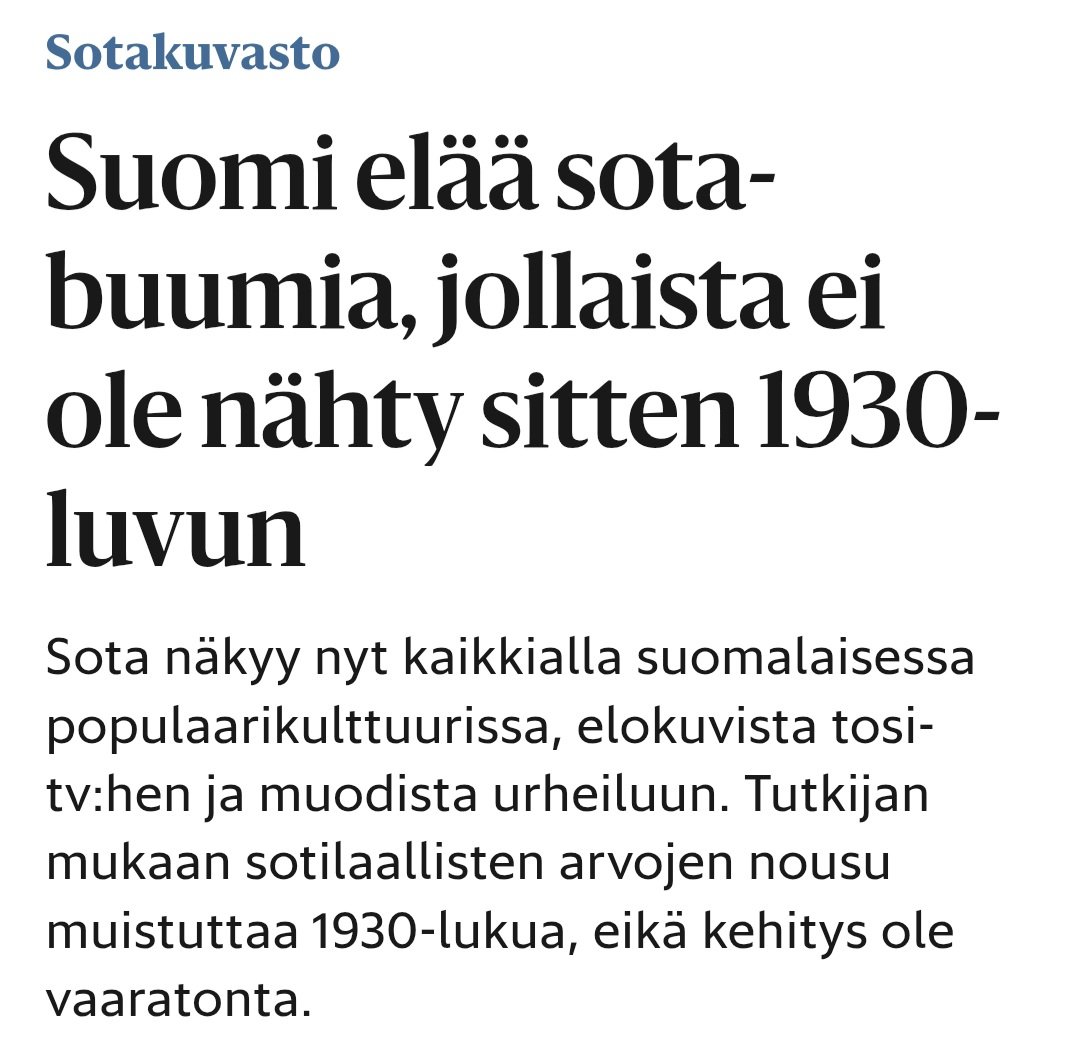
Henri Vanhanen criticized an article in Helsingin Sanomat, which he believed depicted Finnish society as having militarized and compared the rise of current military themes to the 1930s. Vanhanen considered the interpretation to be incorrect in many ways and stated that an interest in national defense did not equate to a glorification of war. Vanhanen justified the increasing interest by referencing Finland's security environment. He wrote that Russia had been waging an aggressive war in Ukraine for five years, threatening European security, and using military power to advance its political goals. He reminded readers of Finland's over 1,300-kilometer shared border with Russia and noted that Finland had not chosen the security situation of its environment. Vanhanen also criticized the fact that the signs of militarization in the article included, in his opinion, military films, camouflage clothing, sports activities, and civil defense education for children. According to him, the visibility of military subjects did not in itself indicate that Finns had a more favorable view of war. He deemed the comparison to the 1930s to be flawed and argued that drawing parallels between eras based on cultural phenomena showed a lack of understanding of history. Vanhanen wrote that the strengthening of Finland's defense was currently based on democratic decision-making, broad public opinion, and external threats. In his view, credible defense aimed to prevent war, and preparation was not the opposite of striving for peace. https://t.co/qfxRp9HSQv #Suominen #Turvallisuuspolitiikka #Maanpuolustus (translated)
According to the author, Russia incited and accelerated the consequences of some phenomenon and spread chaos even when it was not behind the phenomenon itself. He wrote that disinformation quickly filled the atmosphere because the Russian apparatus was well prepared and quickly seized on phenomena that shook social peace. #Venäjä #disinformaatio #kaaos #FI #RU (translated)
Honor-based violence has increased in Finland, and sociologist Rebwar Karimi emphasizes its social dimensions as well as the impact of patriarchal thinking on the phenomenon in different ethnic communities. #kunniaväkivalta #lähisuhdeväkivalta #patriarkaalisuus (translated)
The article addressing the responsibility issues of streaming services emphasizes that the responsibility does not lie solely with the content creators, but that viewers and streaming platforms also play a significant role in managing the consequences of the phenomenon. #rappiostriimaus #vastuu #mediakulttuuri (translated)
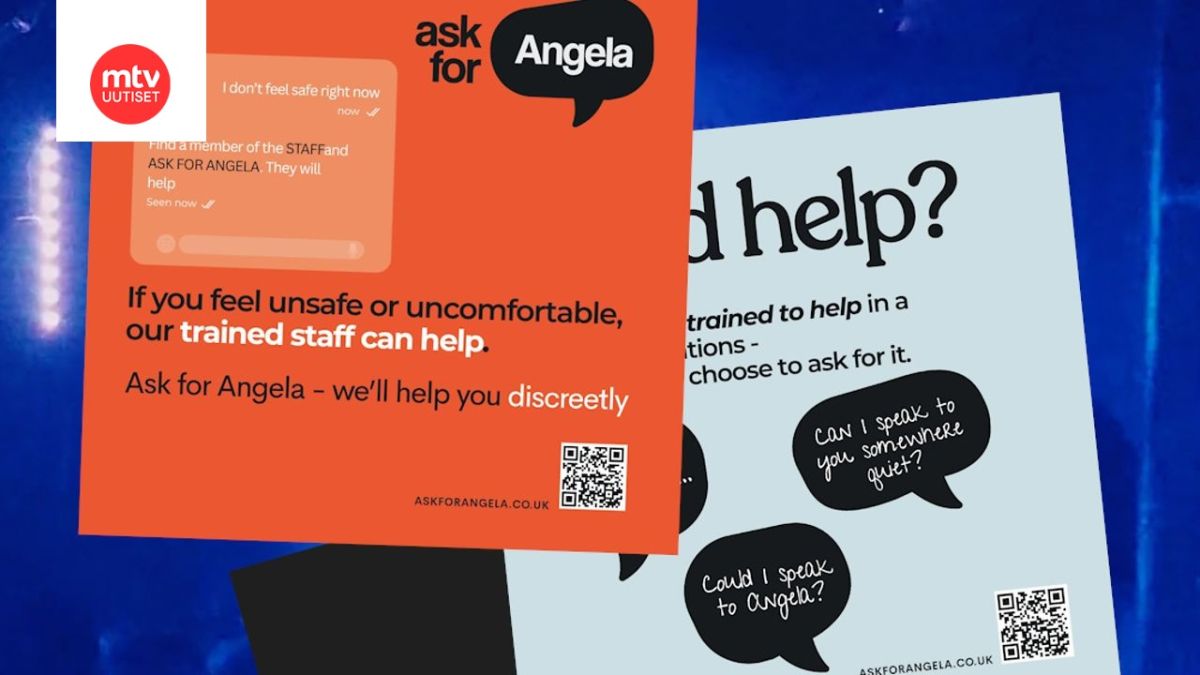
In the title "Ask Angela" - the expert warns that such requests for help do not solve public harassment in nightlife, as the threat of violence or harassment is usually a long-term phenomenon that does not require the use of secret codes. #turvallisuus (translated)

Sammallahti wrote that the Finnish left, in his opinion, had remained silent about the riots in France. He claimed that masked antifascists had waved Palestinian flags, set major cities on fire, looted stores, and assaulted bystanders. Sammallahti assessed that the left's reaction would have been stronger if there had been features interpreted as right-wing in the riots. Sammallahti also claimed that in Finland, antifascist actors operated particularly under the protection of the Left Alliance and the Greens, and had organized events such as Kuokkavieraat, Smash ASEM, Kiakkovieraat, and Makasiinimellakat, as well as the Luokkaretki lähiöst linnaan event and the activities of Extinction Rebellion. According to him, the connections of far-left groups to current politics had not been investigated in Finland because there had been no lustration and the media had a sympathetic attitude towards the left. He added that leftist politicians had sometimes carried symbols of violent extremist groups and that some of the event organizers had advanced to influential political positions. Sammallahti hoped that leftist politicians would autonomously condemn the actions of their like-minded peers. He believed that the violence of the far-left should be prevented rather than understood, using soft and, if necessary, hard means. https://t.co/CXoRZ8GE6X https://t.co/YStFgDHL6U https://t.co/6EQpCOTZAo https://t.co/OOq0ayZ4Ou #vasemmisto #mellakat #antifasismi (translated)
The author found France's riot situation concerning, especially if the unrest were to spread to other European countries. According to him, the dissatisfaction inherited from the yellow vests, rising living costs, and the inability of politicians could provide an opportunity for those wishing ill upon EU countries to exploit the situation. https://t.co/UJh53fhOC7 #Ranska #Eurooppa #protestit #FR #EU (translated)
In the SM-liiga, urgent and strict measures are required to improve spectator behavior, especially due to controversial phenomena arising from the Jokerit’s KHL times and Russian symbolism. #SMliiga #Jääkiekko #Katsomokäytös (translated)
Sammallahti wrote that Greta Thunberg had said in France that young people were rising in rebellion because the system, in her view, was in conflict with human rights and humanity. Sammallahti interpreted that based on Thunberg's previous speeches, she meant Western market economy and democracy. Sammallahti suggested that the University of Helsinki could study the mass psychosis he described that has spread in the West. He claimed it had raised Thunberg to a cult-like status and said that the media, the academic world, and the left had tried to pressure even whole nation-states to yield to her will. He described Thunberg as far-left and accused her of deceit. https://t.co/6fSmoZpzW1 #ilmastonmuutos #nuorisokapina #demokratia (translated)
The Daily Bureaucrat listed statements where various individuals and organizations had, in his opinion, doubted the success of new inventions. He mentioned that the Michigan Savings Bank estimated in 1903 that the horse would persist and the car would be merely a fashion phenomenon for the wealthy. According to Thomas Watson, in 1943 there might have been a market for computers globally for perhaps five devices, and he said that Ken Olson stated in 1977 that nobody would need a computer in their home. He said that Steve Ballmer expressed doubt in 2007 that the iPhone would gain significant market share. Paul Krugman noted that the economic impact of the internet in 1998 would have hardly been greater than that of fax machines. He reported that Bill Gates predicted in 2004 that email spam would be resolved within two years, and that Marty Cooper assessed in 1981 that mobile phones would not completely replace landlines. The list also included Lord Kelvin’s claim in 1895 about the impossibility of heavier-than-air airplanes, Darryl F. Zanuck’s 1946 assessment of the short-lived nature of television, and Erasmus Wilson's prediction in 1878 about electric lights going out after the Paris World’s Fair. William Preece, according to The Daily Bureaucrat, said in 1876 that the telephone was not needed because there were enough messengers. He recounted that Lee De Forest deemed moon travel impossible in 1957 and that Dionysius Lardner predicted in 1830 that fast travel would lead to passengers choking. He said Thomas Edison rejected the use of alternating current in 1889. Finally, The Daily Bureaucrat asked what was now being said about the new Tesla Roadster. #teknologia #innovaatiot #historia (translated)
Samppa Granlund wrote that he estimated the support bubble of the National Coalition Party was about to burst, as the party had shifted towards a more blue-red direction according to him. He believed that the party's decisions relied heavily on ideas borrowed from the Greens and that in Brussels, they were following the left's lead. Granlund also mentioned blue-red lobbyists who had moved from the Social Democratic Party to the National Coalition Party, such as Jungner. According to Granlund, the party's right-leaning views had become scarce and their proponents few. He assessed that the climate debate and the hype around the blue-red alliance were overshadowing this message. He claimed that many were therefore moving to more right-leaning parties, even though the right was a marginal phenomenon in Finland. Granlund described the National Coalition Party as a differently colored social democratic party and said that many were avoiding it because there were no guarantees about the party's future direction. #kokoomus #politiikka #Suomi (translated)
The author thanked for the bravery and stated that openly addressing security threats and speaking about them with one's own face helped the entire society to prepare. According to him, silence would have maintained a stale atmosphere and the spirit of post-Finlandization. #turvallisuusuhat #rohkeus #yhteiskunta #FI (translated)
Joakim Vigelius wrote that Hurst had mentioned that there were more immigrant-background students with children among the clients and that the increase in the number of clients had led to enough food for everyone in need of it. Vigelius asked whether there was already enough such immigration. https://t.co/aBBDCjZf9g #maahanmuutto #opiskelu #ruokaturva (translated)
The author claimed that the concept of Islamophobia was widely used, but Christianophobia was poorly known, even though it was, according to him, a serious phenomenon in Europe. He stated that over 2,000 hate crimes against Christians were recorded annually in the EU and linked examples of Christianophobia in Europe. https://t.co/vzZiUR0CuC #kristofobia #islamofobia #viharikokset #FI #EU (translated)
A young Finnish blogger wrote that Jussi Saramo belonged to the 167 members of parliament who voted against a resolution concerning the clarification of the Muslim Brotherhood's status as a terrorist organization. According to the writer, Saramo justified his stance by stating that Islamist terrorism was a serious threat, but far-right terrorism was a more acute problem in Europe at that time. The writer also mentioned that Saramo emphasized that threats should not be set against each other and that they should be countered through intelligence services. The writer denied that far-right terrorism was a significant phenomenon and claimed it primarily existed in the imaginations of the green-left. He described Islamic terrorism targeting Christians as part of a cultural war and the breaking of traditions through the exercise of power and violence, stating that it was a daily occurrence. The writer referred to Saramo's statement as "Jussi Saramo's Christmas greetings." #Terrorismi #Islam #Äärioikeisto (translated)
Miko Bergbom wrote that the changes in the polls had, in his opinion, stirred feelings among some members of the National Coalition Party, who expressed their dissatisfaction towards the Finns Party. He doubted that this would be helpful and suggested focusing on the formation of a right-wing government. Bergbom supported the continuation of spending cuts and preventing tax increases aimed at work and entrepreneurship amounting to billions of euros. His proposals included tightening immigration restrictions and continuing spending cuts, taxing foundations and trade unions, as well as reforming taxation related to work and entrepreneurship. He criticized the vice-chair of the National Coalition Party group, Pia Kauma, for focusing on being outraged by comments on social media. Bergbom suggested that this might serve as a smokescreen for building a Social Democrat-National Coalition government. Finally, he asked Martin Paasi whether he supported the continuation of the right-wing basis. #politiikka #maahanmuutto #verotus (translated)
Jari Mäkäräinen criticized Sanna Ukkola's writing about the Prime Minister's meeting with Imam Sharmarke Said Aw-Mussen. According to Mäkäräinen, Ukkola regarded the meeting as ordinary work and believed that the imam, who was born in Turku, was being asked impossible questions regarding Sharia. Mäkäräinen argued that asking the imam was not a misunderstanding: in his view, the imam left open whether Sharia would be applied in Finland in family or criminal law matters. Mäkäräinen wrote that, according to him, freedom of religion did not justify the establishment of a parallel legal system alongside Finnish laws. He claimed that in Muslim-majority countries, freedom of religion, women's equality, and individual rights were not realized in liberal democracies due to Islamic doctrine and Sharia. He cited Lebanon as an example, where he believed the growth of the Muslim population and political organization undermined previous balance and led to civil war. In France, Sweden, Belgium, and Britain, he mentioned the visibility of parallel societies, honor-based violence, segregation of areas and schools, and pressure to accept practices related to Sharia. In Finland in the 2000s, Mäkäräinen claimed that groups with a Muslim background who had immigrated were connected to the overrepresentation of sexual offenses, unemployment, use of social security, and demands for their own rules. He believed that distinguishing criticism of Islam from calls for deportation did not make questions about Sharia suspect. According to Mäkäräinen, the primacy of the Finnish Constitution and criminal law should be clear in all matters, and Finland did not need to repeat the experiences of countries where the application of Sharia had been tried. https://t.co/bGpZ7VaTux #uskonnonvapaus #integratio #muslimit (translated)