BETA nonprofit public democratic european moderated

Search

#luister
NRC 4h

In an opinion piece, Rahma Bavelaar argues that Western institutions do not want to listen to the voices of Palestinians, such as that of a Gazan student who was wrongfully accused after a social media video, which led to a smear campaign and threats against him. #Gaza #Palestijnen #VrijheidVanMeningsuiting (translated)
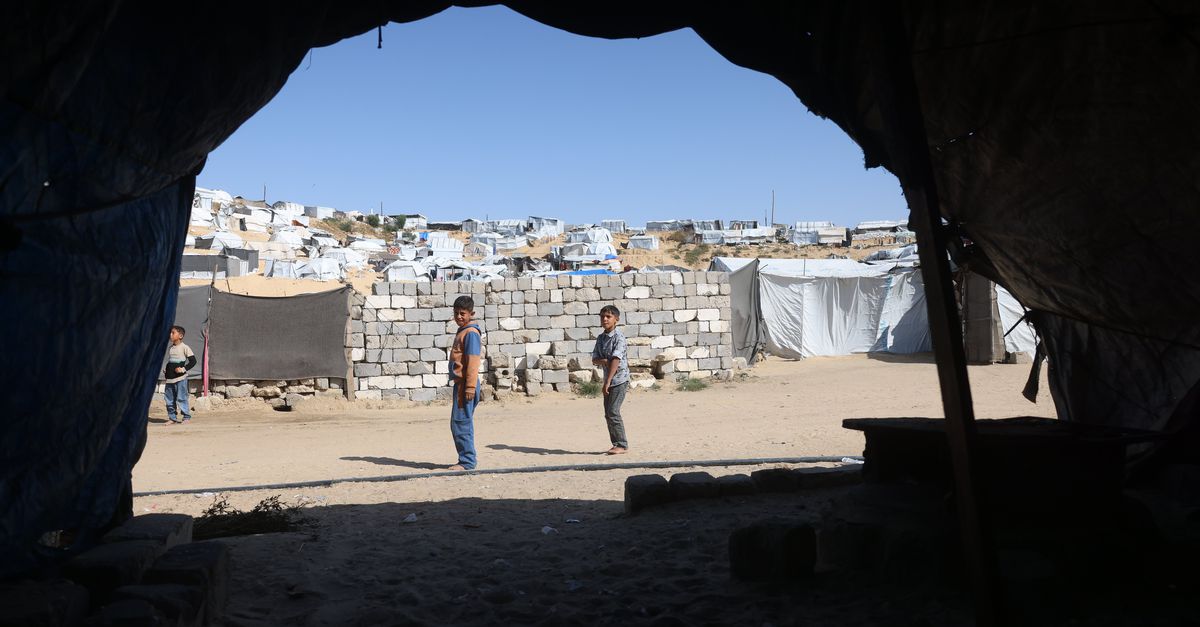
Waarom er niet naar de Gazaanse student werd geluisterd

Sander Sassen called the lack of decency embarrassing and wrote that people should first listen to Mona Keijzer. According to him, they could then ask questions and express their objections as adults; he called the behavior childish. #fatsoen #luisteren #respect (translated)

Mick van Wely stated that the support for Hamas in the Netherlands became more aggressive as the movement lost ground. He wrote that this, in his opinion, was especially true in the Randstad, but that it spread as a harmful development throughout the entire country. #Hamas #Nederland #Randstad (translated)

Jan Roos stated that people could also listen to someone they disagreed with. According to him, those who did not do that showed that they had not yet advanced beyond the kindergarten level. #Luisteren #Respect #Dialoog (translated)

Denkewel sarcastically wrote "La Résistance" and criticized politicians who, in his opinion, walked away instead of listening to others or engaging in debate with them. He said that politicians from left to right could be held accountable for much, but described this group with disparaging terms and questioned why anyone would join a political party if they were not willing to engage in conversation. He also suggested that such behavior was childish. #politiek #debatteren #respect (translated)

Shermin Amiri wrote that people should continue to listen to political opponents, ask challenging questions, and contest their arguments. According to her, the democratic debate culture weakened when people walked away at the first sign of discomfort. #democratie #debatcultuur #politiek (translated)

Harm Beertema criticized the minority cabinet for the emergency package that, according to him, was imposed, including a flashlight and battery-operated radio. He asked what citizens were supposed to listen to on that radio and referred to advice to shelter under the stairs with a can of sardines. He also inquired where Dilan Yeşilgöz and Tom Berendsen, whom he described as sustainability advisor and policy officer, would be during a crisis. According to Beertema, they might possibly be abroad, as he claimed that governments and royal households were accustomed to doing. #politiek #kabinet #noodpakket (translated)

Mariba criticized Dilan Yeşilgöz after she claimed that Russia had been declared an enemy of the Netherlands. According to Mariba, Yeşilgöz stated that the Netherlands was not at war, but that a carefree peace was also not in sight. Mariba wrote that the Russian consulate had asked the Dutch government to confirm or distance itself from the statements. She believed it should be made clear whether this was about official policy, a political warning, or political rhetoric. According to Mariba, designating an enemy was not a strategy and threatening language could escalate tensions. She argued that the consequences of such statements ultimately affected civilians and urged the government to explain what the policy and risks were and how it intended to ensure security. She criticized the VVD and argued that politicians should think first before declaring an entire country an enemy. #Nederland #politiek #veiligheid (translated)

Marcel Crok suspected that Tijs was referring to him with the term 'climate deniers' because he claimed to be about the only dissenting voice during an external expert day in March 2025. He called the term derogatory and pointed out that CDA leader Henri Bontenbal had also used it regularly, according to him. Crok invited Tijs to a lecture by Clintel given by Roger Pielke Jr. the following Sunday in Driebergen. He referred to an article by Pielke about a campaign against climate scientists with dissenting views. According to Crok, Australian activists, including a cartoonist, with the support of influential American climate scientists, created blacklists. Among those listed were Pielke, his father, and Judith Curry, according to him. Crok wrote that their academic careers were thereby hindered and called the issue concerning for Members of Parliament. Regarding his own participation in the Citizen's Assembly, Crok stated that the selection of citizens went well and that his discussions with KNMI director Maarten van Aalst were respectful. However, in hindsight, he claimed that the organization published an incorrect fact-check. He said he should have filed a forty-page complaint before he received any response. Crok argued that the debate about climate, just like the debate about corona which Tijs had previously struggled with as a journalist, was, in his view, being stifled. He spoke of a suffocating atmosphere in the academic world and wrote that no journalist had signed up to attend Pielke's lecture. #klimaat #wetenschap #discussie (translated)

Helma Lodders wrote that Johan Vollenbroek was often seen as a loner against powerful parties, but according to her, the image changed as soon as the financial interests were considered. She stated that a co-owner of DPG Media, which is behind the Volkskrant, Trouw, and a linked website, turned out to be financially involved. Lodders said that because of this, Vollenbroek seemed to have a strong network behind him and urged people to listen. #JohanVollenbroek #DPGMedia #Netwerk (translated)

Meri 3d

Meri wrote that she could not listen to adult women with a speech impediment, whose voice, according to her, sounded like that of five-year-old girls. She stated that more and more women sounded like that and also mentioned a curly-haired NOS presenter, whom she claimed she could not listen to. https://t.co/clNrBBIRiQ #spraakgebrek #communicatie #vrouwen (translated)

Bart Nijman wrote that Dutch media in 2015 portrayed participants in the Ukrainian referendum, including GeenPeil, as antidemocratic and pro-Putin. Nevertheless, he called the referendum a great success. In 2017, according to him, newspapers and parts of the NPO tried to boycott GeenStijl but were unsuccessful. He also accused the media of labeling critics of Greta Thunberg as climate deniers in 2019 and of presenting support for Black Lives Matter as a civic duty in 2020, while according to him, Zwarte Piet was pressured with unfounded accusations of racism. During the coronavirus pandemic, according to Nijman, the media shielded criticism of the measures and labeled those who deviated as irrational. He argued that this permanently damaged the credibility of the press and trust in its fairness and objectivity. From 2021, he stated that media opposed the farmers' movement with reporting on nitrogen that journalists did not understand sufficiently, and starting in 2022, labeled critics of Ukrainian accession to the EU or NATO's contribution to the escalation as pro-Putin. Nijman wrote that after October 7, 2023, many media condemned Israel and Jews in general and based reporting on genocide and starvation on lies. According to him, the media concealed the reasons for Hamas' attack and subordinated facts to information from NGOs, including Oxfam. He also claimed that journalists who disagreed were not offering enough public dissent, partly because they had to save for a mandatory heat pump in 2028. Furthermore, Nijman accused the media of shifting their own problems onto disinformation and Elon Musk and of leaving X for their own, small online environment. According to him, DPG, RTL, and the NPO imposed standards that many Dutch people did not conform to. He wrote that readers should hate the mainstream media even more and asserted that the free press had again chosen the wrong side on October 7. #Media #Nederland #VrijePers (translated)

The author viewed any potential reintroduction of conscription in the long term as a societal project that should strengthen resilience and social cohesion. According to the author, HLN wrongly presented the plan as a re-education program for several hundred rioters and the newspaper deliberately chose not to listen to its message. (translated)

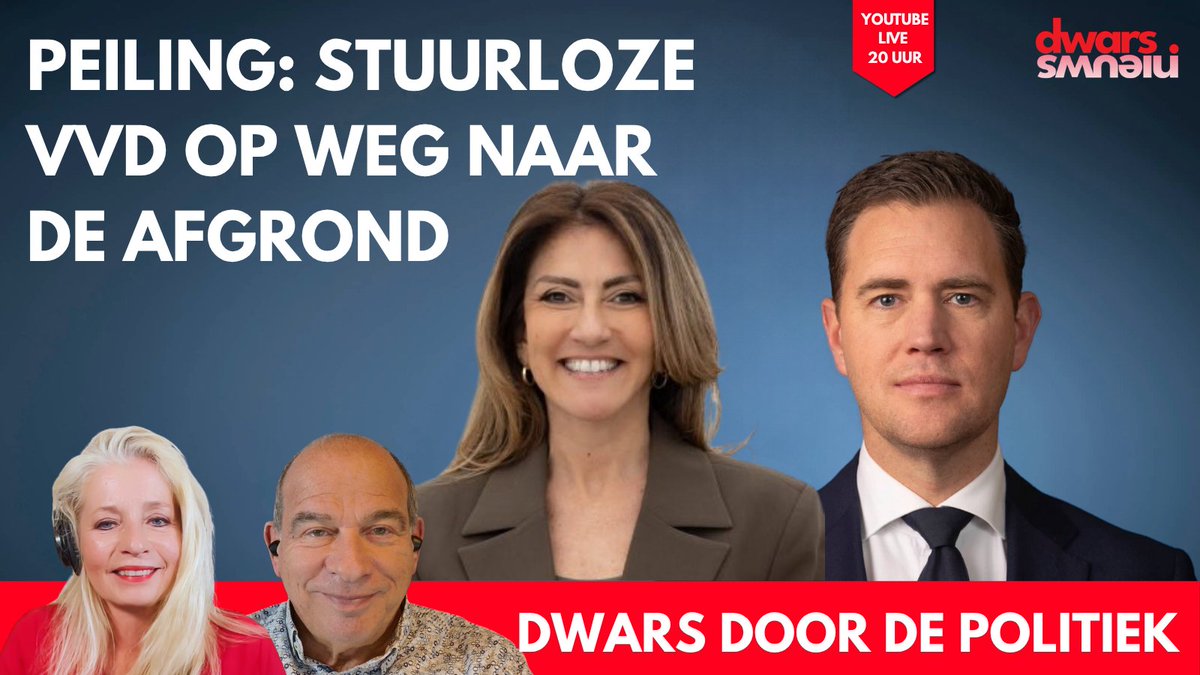
Marianne Zwagerman wrote that the VVD, after what she described as a disastrous budget debate, stood at twelve seats in the latest poll by Maurice de Hond. With that, according to her, the party of Dilan Yeşilgöz matched its low point from 2008. Zwagerman stated that the VVD had abandoned its principles in the debate. She also wrote that nearly seven out of ten voters expected, according to the poll, that new elections would not yield a stable government. In a broadcast of *Dwars door de Politiek*, Zwagerman and De Hond would discuss the political options available. Furthermore, she reported that complaints had been filed with the Advertising Code Commission regarding their radio commercials and that on October 16 the case of De Hond against Maarten Keulemans would be heard by the Press Council. On October 8, De Hond would have been an opinion pollster for fifty years. Zwagerman announced that the broadcast could be followed live on Sunday at 8:00 PM via YouTube, Facebook, X, and LinkedIn. https://t.co/NSPlGEhUuA #VVD #Politiek #Verkiezingen (translated)

Bart Nijman wrote that a man he characterized as a language police officer had presented his claims and demands with an elevated and unwavering certainty, in his opinion. He stated that the lie about "genocide" had become a tool of power to discriminate against and exclude Jews. #antisemitisme #discriminatie #vrijheidvanmeningsuiting (translated)

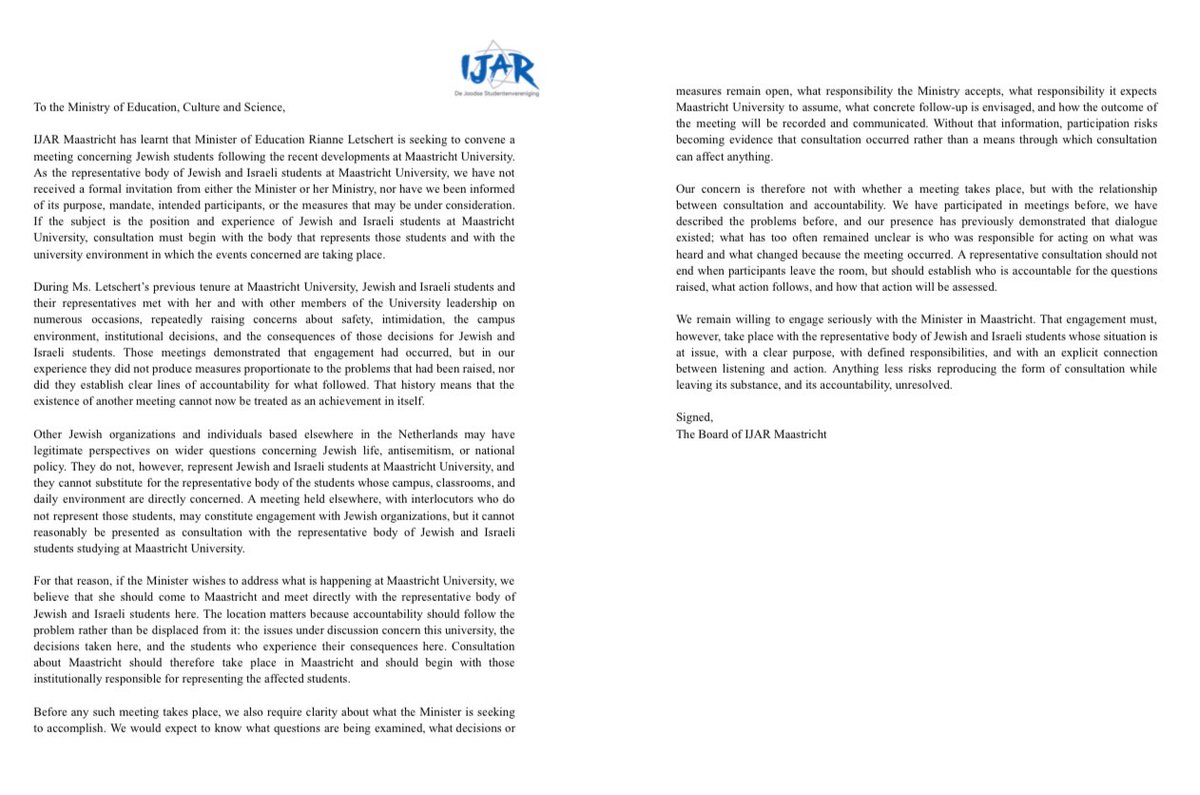
Letschert in a tight spot! The Jewish and Israeli students in Maastricht are stating it clearly. They are no longer carried away by the dialogue merry-go-round of the D66 Minister of Education, after spending years in her merry-go-round when she led the university. Result: an antisemitic climate and the import of hate rallies. Letschert's reward: the plush of The Hague. Read the letter below. Support these brave students who let their voice, and only their voice, be heard. Who do not bow to the established order and do not allow themselves to be exploited and misled by them. Bravo! To the Ministry of Education, Culture and Science, IJAR Maastricht has learned that Minister of Education Rianne Letschert intends to organize a meeting about Jewish students, following the recent developments at Maastricht University. As the representative organization of Jewish and Israeli students at Maastricht University, we have received no formal invitation from the minister or her ministry. Nor have we been informed about the purpose, the mandate, the intended participants, or the measures that may be considered. If the subject concerns the position and experiences of Jewish and Israeli students at Maastricht University, consultations should begin with the organization that represents these students and within the university environment where the relevant events take place. During Ms. Letschert's previous term at Maastricht University, Jewish and Israeli students and their representatives spoke with her and other members of the university administration on numerous occasions. They repeatedly expressed concerns about safety, intimidation, the campus climate, institutional decisions, and the implications of those decisions for Jewish and Israeli students. From those discussions, it appeared that consultations were taking place, but in our experience, they did not lead to measures that corresponded to the issues raised. Clear lines of accountability were also not established for what followed. This history means that the mere fact that there is again a meeting cannot be considered an achievement in itself. Other Jewish organizations and individuals elsewhere in the Netherlands may have legitimate perspectives on broader issues concerning Jewish life, antisemitism, or national policy. However, they do not represent the Jewish and Israeli students at Maastricht University and cannot replace the representative organization of the students whose campus, lecture halls, and daily living environment are directly at stake. A meeting held elsewhere, with discussion partners who do not represent these students, can be viewed as discussions with Jewish organizations, but cannot reasonably be presented as a consultation with the representative organization of Jewish and Israeli students studying at Maastricht University. For that reason, we believe that if the minister wishes to address what is happening at Maastricht University, she should come to Maastricht and engage directly in conversation with the representative organization of Jewish and Israeli students here. The location is important, as responsibility must be aligned with where the issue occurs and not be disconnected from it: the issues being discussed involve this university, the decisions being made here, and the students who experience the consequences of those decisions. Thus, consultations regarding Maastricht should take place in Maastricht and begin with those who are institutionally responsible for representing the involved students. Before such a meeting takes place, we also demand clarity about what the minister aims to achieve with it. We expect to know what questions are being investigated, what decisions or measures remain open, what responsibility the ministry will take on itself, what responsibility it expects from Maastricht University, what concrete follow-up steps are foreseen, and how the outcomes of the meeting will be recorded and communicated. Without that information, participation threatens to serve mainly as proof that consultations have taken place, rather than as a means by which those consultations can actually have an impact. Our concern, therefore, is not about whether there will be a meeting, but about the relationship between consultation and responsibility. We have previously participated in discussions, we have laid out the problems before, and our presence has previously shown that a dialogue existed. What too often has remained unclear, however, is who was responsible for acting on what was raised during those discussions and what actually changed as a result of those discussions. A representative consultation should not end once the participants leave the room, but should record who is responsible for the issues raised, what actions follow from that, and how those actions will be assessed. We remain willing to engage seriously with the minister in Maastricht. However, that consultation must take place with the representative organization of the Jewish and Israeli students whose situation is at stake, with a clear purpose, with well-defined responsibilities, and with an explicit connection between listening and acting. Anything less than that threatens only to reproduce the form of consultation, while the substance — and the responsibility for it — remains unresolved. Signed, The Board of IJAR Maastricht *link to the original letter in the tweet below #antisemitisme #onderwijs #studentenrechten (translated)

Even we, as distant people, as readers, listeners, viewers, still hadn't had enough of Paulien. Not by a long shot. And then to think about how it is for her husband, her child, her friends, loved ones. A sad reality that she is no longer here 🖤 #rouw #verlies #herinnering (translated)

,,Er moet een cultuur van dialoog zijn, van naar elkaar luisteren en elkaar respecteren. Het gaat er niet om positieve krantenkoppen te genereren, het gaat erom te doen wat goed is voor de sport"FIFA-voorzitter Gianni Infantino zegt open te staan voor open discussies over mogelijke hervormingen bij de wereldvoetbalbond. #FIFA #Infantino #UEFA

FIFA beschuldigt UEFA van ‘desinformatiecampagne’, Europese topcompetities kritische op FIFA
www.ad.nl

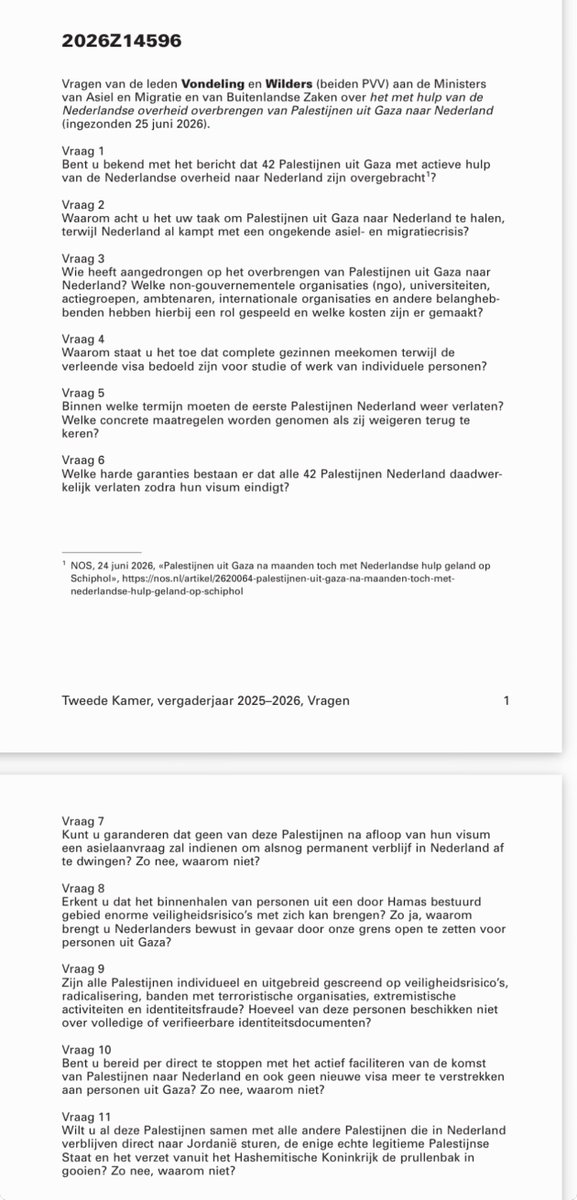
De PVV waarschuwde het kabinet in juni dit jaar al voor het binnenlaten van Palestijnse extremisten inclusief “studenten”, zie vraag 8 + 9. Natuurlijk luisterde de bende van Jetten niet naar ons en nu zijn ze hier, zonder goede screening en dus een direct gevaar voor Nederland. https://t.co/kkgxP6Yqzw #PVV #Nederland #Extremisme

“Onnodig”, noemt minister Berendsen het intrekken van de diplomatieke status van Nederlandse diplomaten door Israël. Onnodig? Echt? Nederland voert zelf sancties in tegen producten uit Israëlische nederzettingen in Judea en Samaria en de Golan, als politieke druk op Israël. Een maatregel die óók economische gevolgen kan hebben voor Palestijnse bedrijven en werknemers die met deze productie verbonden zijn. En dan verbaasd zijn wanneer Israël zegt: prima, dan volgen er ook diplomatieke consequenties? En laten we de dubbele standaard vooral niet vergeten! De acht Nederlandse diplomaten die vanuit de Nederlandse vertegenwoordiging in Ramallah werken, konden ondertussen op Israëlisch grondgebied wonen dankzij hun door Israël verleende diplomatieke status, mét de daaraan verbonden privileges en fiscale faciliteiten. Die waren finacieel interessant! Als je ervoor kiest om de Palestijnse belangen vanuit Ramallah te behartigen, waarom dan niet gewoon in Ramallah wonen? Waarom wél gebruikmaken van de faciliteiten die Israël biedt en vervolgens verontwaardigd zijn wanneer Israël die status intrekt? Wat Berendsen er níét bij vertelt‼️ Het gaat om acht Nederlandse uitgezonden medewerkers. De andere tien zijn lokale medewerkers en hebben een andere status. Voor die acht ontstaat nu een concreet probleem. Hun Israëlische diplomatieke status vervalt en die kun je niet simpelweg “meenemen” naar Ramallah. Natuurlijk kan Nederland zijn vertegenwoordiging in Ramallah voortzetten. Maar een nieuwe status voor deze acht is niet automatisch geregeld door even een nieuwe Israëlische accreditatie te vervangen door een Palestijnse. Waarom niet? Omdat de Palestijnse Autoriteit geen staat is en Nederland Palestina niet als staat erkent. De Nederlandse vertegenwoordiging in Ramallah is een Representative Office, geen ambassade van Nederland bij een door Nederland erkende Palestijnse staat. De Palestijnse Autoriteit kan uiteraard afspraken maken over de aanwezigheid van buitenlandse vertegenwoordigers, maar dat is een andere juridische constructie dan de diplomatieke status die deze acht tot nu toe via Israël hadden. Welke verblijfs- en rechtspositie deze acht daar vervolgens krijgen, moet dus worden geregeld. Dat is het probleem dat Berendsen in zijn reactie gemakshalve helemaal niet benoemt‼️ Nederland heeft dit risico zelf mede gecreëerd door Israël onder druk te zetten. Dat Israël daarop zou reageren was, natuurlijk na Engeland, geen ondenkbaar scenario. Nederland neemt een eenzijdige maatregel en verwacht blijkbaar dat Israël die zonder tegenreactie accepteert. Ja doei!!! Zo werkt internationale politiek niet. Dus, meneer Berendsen……. Luister even goed! Wie eenzijdig druk zet, moet niet verbaasd zijn als de andere partij terugduwt. Israël is geen land waar Nederland naar believen sancties tegen kan opleggen en vervolgens kan verwachten dat alles gewoon gezellig blijft. En eerlijk gezegd? Israël redt zich wel. Wij halen onze neus op, incasseren waar nodig de korte termijn en bouwen ondertussen verder. Uiteindelijk komen we hier sterker uit. https://t.co/B49n0u30Bo #Israël #DiplomatiekeRelaties #Nederland