This article explores the idea that the unique neural signals of each individual could serve as future passwords to secure our devices. #neurones #cerveau #sécurité (translated)
AuBonTouiteFrançais opened his message with an insult aimed at his readers, before comparing two narratives about the war in Ukraine. He presented the Western narrative as the idea that Vladimir Putin would seek to invade Ukraine and then threaten all of Europe, and that European countries should provide more money to avoid having to speak Russian and eat borscht. To contest this reading, he argued that, since 02/24/22 — which he claims is four and a half years — Russian forces had only advanced 150 km to the west. By comparing this distance to the 2,485 km separating Moscow from Paris, he estimated it would take Putin about 75 years to reach the French capital, by which point he would be 148 years old. He then outlined what he presented as the Russian narrative: the operation in Ukraine would aim to protect the Russian-speaking populations of Donbass, demilitarize the country, and prevent it from joining NATO, which Russia sees as an existential threat. He also claimed that NATO had not kept its promises from 1990, summarized by the phrase "Not one inch eastward." According to AuBonTouiteFrançais, Russia would therefore have no interest in conquering all of Ukraine or advancing to Kiev, but might seek to progress to Odessa to control access to the Black Sea. He asked his readers which of the two narratives seemed most credible to them and warned against a war he described as false, estimating that it would only serve the interests of those indifferent to citizens. #Ukraine #Géopolitique #Conflit (translated)
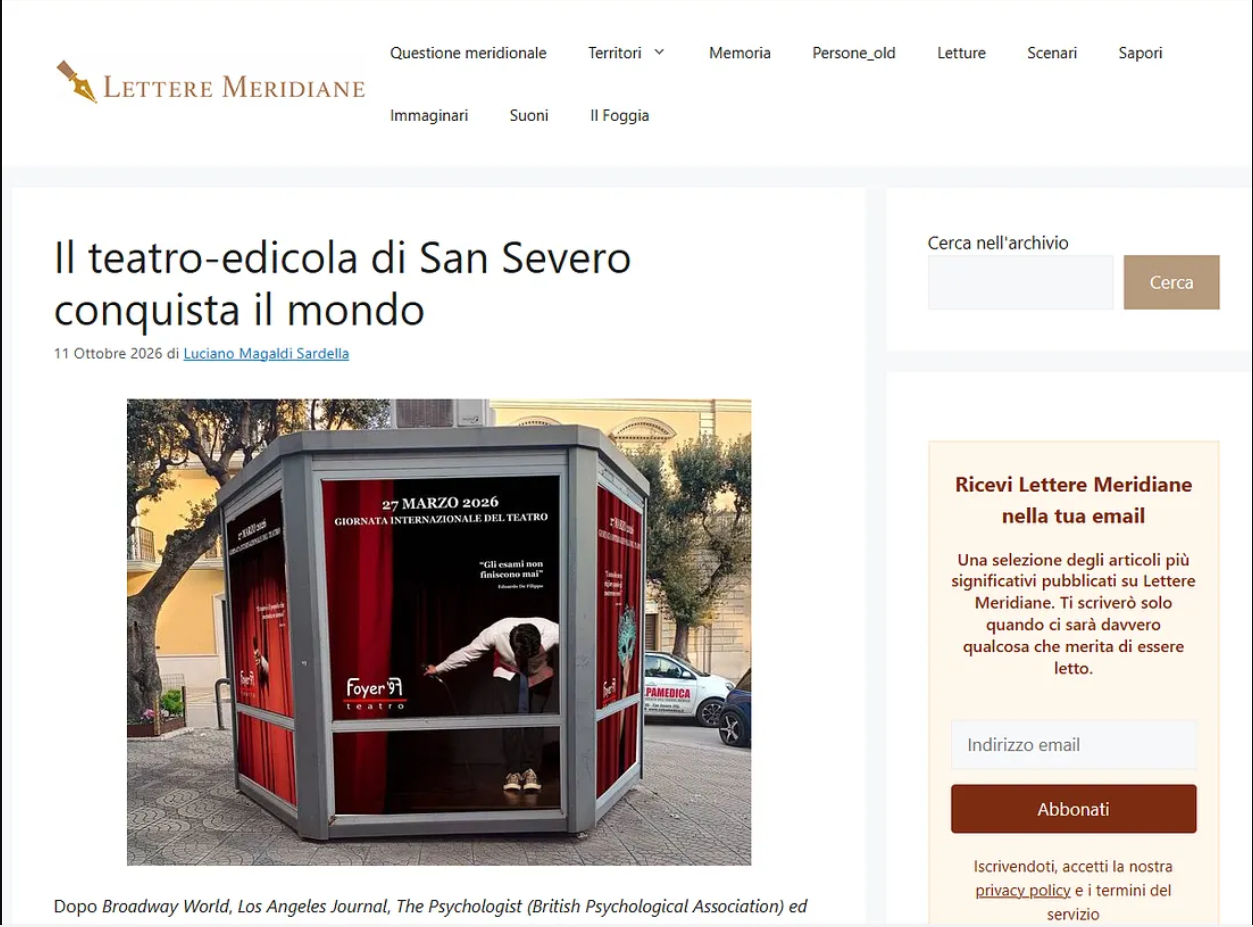
LETTERE MERIDIANE — “TEATRO-EDICOLA” OF SAN SEVERO CONQUERS THE WORLD SOURCE: https://www.letteremeridiane.org/2026/10/il-teatro-edicola-di-san-severo-conquista-il-mondo/?fbclid=IwY2xjawU4oqFleHRuA2FlbQIxMQBwZG9mAXNydGMGYXBwX2lkEDIyMjAzOTE3ODgyMDA4OTIAAR5rVEwYs6UUXg7v-P0SyIQ_DRb_F6ZiY58OcseYoV4J7atcTiERnhWaqKM2pw_aem_Njle1jq1XLzHr93KLBUcVA After “Broadway World”, the “Los Angeles Journal”, “The Psychologist (British Psychological Association)” and Hollywood Beat Magazine, its “academic consecration” has now arrived courtesy of Stanford University. As I have already emphasised in my article on the revival of the GIO Festival in Foggia, celebrated by BroadwayWorld for the world stage premiere of the Giordano’s opera Marina (1888), the province of Foggia has long ceased to be peripheral. It happens when it finds an idea that shifts the coordinates: well, in San Severo, 40 kilometres from Foggia, it has happened again. Only this time an orchestra was not needed; six chairs were enough. The celebrated Teatro-Edicola of San Severo artistic director Francesco Gravino of the theatre company Foyer ’97 has been featured in the academic journal “Stanford Social Innovation Review (SSIR)” as an academic case study. The news, relayed on 19 September 2026 by ANSA Nazionale, looked like a misprint. Then it became clear that it was not. SSIR, an award-winning publication covering multisectoral solutions to global problems, included the project in its Dispatches section with the reportage “The Six-Seat Revolution”. It is the inverse trajectory to that of the GIO Festival: not a forgotten opera returning to a grand historic Italian horseshoe theatre, but an entire theatre reborn inside a disused place, forgotten by man. There are moments when past and future intertwine to create something visionary, innovative, artistically “revolutionary”: San Severo experienced one of those moments on the morning of 27 March 2026, during World Theatre Day, when the shutter of a newsstand closed for six years in Via Matteo Tondi was reopened “not to sell newspapers, but to offer stirring stories”, to quote Gravino’s motto. The idea of the visionary Francesco Gravino, artistic director, stage director and actor of the San Severo company Foyer ’97, active for at least 30 years in Capitanata, centred on the kiosk, hexagonal in metal and glass, granted free of charge by its owner Pino Frau, by now an urban relic created by the publishing crisis of the early 2000s: today in Italy active newsstands have fallen from about 35,000 in 2005 to about 20,000 in 2024, a decline of 42.8%. Gravino and eleven other actors restructured it in two weeks of work, without institutional funding, and transformed it into what is now under examination by the London commission of Guinness World Records as the “world’s smallest theatre”. The formula is deliberately austere: six spectators at a time outside, actors inside at less than a metre’s distance, 15-minute performances, continuous rotation from 11:00 to 20:45, texts ranging from Goldoni to Chekhov, from Ibsen to Dacia Maraini. On the door a QR code with an original theatrical warning: “Warning! This QR code transforms passers-by into actors. Scan only if ready.” The numbers immediately showed that it was no boutade: more than 60 people in a single afternoon, three inaugural days that sold out. But above all a positive echo that went beyond the borders of San Severo. “Broadway World” (just as in the previous case of the GIO Festival), the world’s most influential theatre criticism outlet with over 5.5 million monthly views, devoted exclusive coverage to it on 27 April 2026: “An Abandoned Italian Newsstand Just Became the World’s Smallest Theatre”. Not a mere listing, but an analysis: “There is no foyer, there is no balcony, there is no grid. There is barely a wing. What there is is something almost unrecognisable as an evening at the theatre, and for that very reason it is all the more powerful.” “Broadway World” captured Gravino’s manifesto idea: “This is a theatre of proximity. In an era of digital distance, we are putting human contact back at the centre,” framing it as “More than a clever exercise in site-specific theatre. It is a reappropriation.” All of this, in a Mezzogiorno of Italy often narrated only in terms of organised crime and marginalisation. To that seal of approval was added another, even more disorienting for a newsstand in San Severo: the “Los Angeles Journal”, one of the most influential publications on the West Coast for the performing arts. On 12 May 2026, it headlined thus: “San Severo’s Teatro-Edicola as an Innovative Model for Los Angeles Theaters?” opening as follows: “In a city in southern Italy that Hollywood has never heard of, a theatre director has just built the smallest stage in the world: six seats, fifteen minutes, zero distance. Los Angeles should pay attention.” The “Los Angeles Journal” does not indulge in folklore, but places the kiosk in Via Matteo Tondi alongside the prestigious 1,600-seat Ahmanson Theatre in Los Angeles, the Pantages of Broadway in Hollywood, the 99-seat plan of Rogue Machine, the Odyssey, the Victory Theatre and the Hollywood Fringe. It even recalls Ethan Marks’s Electrical Box Theatre, a veritable electrical box lined with red velvet in downtown Los Angeles, to argue that Gravino has taken to the extreme the question Los Angeles has been asking itself for decades: How small can a stage become before it ceases to be a stage? And it recognizes the San Severo urban model: almost zero cost, two weeks of work and six chairs, in return for immediate provincial, regional and national media coverage, recognition by the San Severo’s Municipal Administration, and a format exportable anywhere. Then, the third American piece came from “Hollywood Beat Magazine” on 20 April 2026: Six seats. Fifteen minutes. One actor. No stage. The magazine recounts the kiosk in Via Tondi left disused for almost six years, the contemporary six-seat cultural outpost, placing Francesco Gravino in a distinguished genealogy: Richard Schechner and environmental theatre, Jerzy Grotowski and poor theatre, Nicolas Bourriaud and relational aesthetics. But it closes with pragmatism: it is not a thesis, it is fixing a street corner, that is, repairing an urban street corner by asking not how large a theatre can become, but how small it must become again to recover its original power. And finally, the celebrated London-based “The Psychologist”, the journal of the “British Psychological Society (BPS)”, the oldest psychological society in the world, transformed the Teatro-Edicola into a scientific case study: on 30 July 2026 it published “The world’s smallest theatre — and Psychologists’ next act”, starting from the same detail, the morning of 27 March when the metal shutter of the hexagonal kiosk in Via Tondi reopened after six years, six people inside, an actor at less than a metre’s distance beginning Chekhov. It describes the formula: six spectators, 15 minutes, 11 actors over 10 hours, from Goldoni to Euripides, inside a kiosk where the fourth wall does not break because architecturally it never existed. But the BPS goes a step further: it cites the 2025 studies by Damien Gabriel in IBRO Neuroscience Reports, that live performance generates measurably stronger emotional and physiological activation than video, and introduces Edward Hall’s proxemics: below one metre is intimate space, reserved for doctors, close friends, lovers. In that one-square-metre space, the actor’s breath is audible, micro-expressions legible, the self-other boundary becomes permeable. The Teatro-Edicola “does not make theatre better, it makes it inevitable”. And it is here that one understands why Stanford is studying it as an academic case study in social innovation, not as a case of artistic originality. In Italy, meanwhile, the national media circuit had already picked up the phenomenon: RaiNews — TG2 Storie brought it to RaiDue at midnight on 19 April. RTL 102.5 devoted space to the format conceived by Gravino and developed by Foyer ’97 in the heart of San Severo in Via Tondi, defining it as a permanent micro-stage capable of bringing theatre into public space. ANSA.it, Gazzetta del Mezzogiorno, La Repubblica, TG2000, Radio Capital, Swiss RSI, ANSA Brazil and many others followed. And for the record: Fiorello praised it in La Pennicanza as an artistic case inspired by his Edicola Fiore, and Biagio Antonacci, on his tour in the Augustan amphitheatre of Lucera, made a “fact-finding” stop at the Teatro-Edicola singing the celebrated and nostalgic Iris in front of an audience certainly larger than the “six seats”. Francesco Gravino’s theatre company Foyer ’97 was not born yesterday: behind it lie the Teatro-Cantina of 2016, the underground theatre, and in 2011 a performance on the bell tower of a church in the centre of San Severo at 45 metres high. The Teatro-Edicola completes, in Gravino’s words, “the entire vertical extension of theatre: underground, street level, rooftop”. And it is preparing for its thirtieth anniversary in 2027 aiming to purchase the kiosk to make it permanent, exporting the “San Severo Model” to Rome, Lucca, and to the festivals of Santarcangelo and Todi. As with the GIO Festival, someone might dare to claim that it is merely a stunt, but when BroadwayWorld places you alongside the Los Angeles Opera House, the “Los Angeles Journa”l proposes you as a model for Hollywood, “Hollywood Beat Magazine” reads you through Grotowski and the “British Psychological Society” uses you to explain mirror neurones, it is no longer a stunt but an excellent artistic and academic positioning. To those who still whisper that Foggia and Capitanata are provincial, the answer is now written on two opposite and complementary fronts: on 5 June in Foggia a 138-year-old opera found the stage again at the Giordano ending up on BroadwayWorld; on 27 March in San Severo a 4-square-metre kiosk invented a stage that did not exist, ending up at Stanford, in Los Angeles, in Hollywood and in London. The periphery, when it has a precise idea, becomes the centre. Even with six chairs. Luciano Magaldi Sardella

The Nobel Prize in Medicine 2026 was awarded to an American researcher and two German scientists for their innovative method of activating neurons using light. #ProblemasDeCarga #ExtensionesDeNavegador #ConexiónInternet (translated)
Une étude américaine révèle que l'exercice physique provoque la contraction des astrocytes, des cellules cérébrales, ce qui pourrait jouer un rôle clé dans la protection du cerveau et la formation de nouveaux neurones. #Sport #Santé #Neurosciences

Arquimedes era amb la seva tauleta quan un soldat romà el va matar. Sona natural? No gaire. I, tanmateix, si “actualitzem” prou el passat, podem acabar exactament aquí. Gairebé totes les cultures tenen edicions modernitzades d’autors antics i debats sobre ortografia, vocabulari, notes editorials i adaptació al lector contemporani. Un antiquari em va dir una vegada que “la pàtina del temps dona valor” i pot marcar la diferència entre un original i una còpia barata. Obro els “Assaigs de diumenge” de Constantin Noica, arribo al pròleg de l’editor de l’edició Humanitas de 1992 i descobreixo que “l’ortografia ha estat actualitzada”. Llegir Noica podria haver estat un passeig pels anys 1930–1940. En canvi, fem aquest passeig amb ulleres modernes, còmodament asseguts en un Uber, sense por de perdre’ns — és a dir, sense el risc de no entendre les paraules de l’època, que simplement es podrien haver “traduït” en notes a peu de pàgina. I si agaféssim també els diaris de l’època i els “actualitzéssim”? I potser també podríem fer un rebranding dels anuncis d’aquell temps, perquè les nostres neurones no hagin de treballar massa, com si fóssim en un escape room. Per què aturar-nos aquí? També podríem actualitzar els llibres d’història i escriure que Arquimedes de Siracusa va ser assassinat per un soldat romà mentre feia matemàtiques a la seva tauleta. La idea bàsica continua sent la mateixa, oi? Només desapareix l’època. I una altra cosa: per què els matemàtics no “actualitzen” Pitàgores? Poden canviar la notació. Poden explicar la demostració d’una altra manera. Fins i tot poden construir el dibuix online amb una animació que apareix davant dels ulls dels alumnes. Però el teorema de Pitàgores continua sent el teorema de Pitàgores. Aleshores, quan llegim un autor antic, per què no conservar també la llengua de la seva època — i posar les explicacions modernes en notes? I una última pregunta per a Humanitas i per als qui treballen a les facultats de literatura i filologia: si d’aquí a unes dècades els escolars d’avui us “actualitzen” amb # i emoji, us agradarà? #0197 #Humanitas #ConstantinNoica #Noica #AssaigsDeDiumenge #Arquimedes #Pitàgores #Hashtag #Emoji #MrStorywise #OrtografiaActualitzada #HistòriaDeLaLlengua #20260921_1849 #Català #Catalan #Catalunya #Spain #Literatura #Història
Archimede fiat cun sa tablet candho unu soldadu romanu l’at mortu. Sonat naturale? No meda. E però, si “atualizamus” su passadu pro tempus bastante, podimus arribare pròpiu inoghe. Casi totu sas culturas tenent ediciones modernizadas de autores antigos, cun discussiones subra s’ortografia, su vocabulariu, sas notas editoriales e s’adatamentu a su letore de oe. Unu antiquàriu m’at naradu una borta chi “sa pàtina de su tempus dat valore” e podet fàghere sa diferèntzia intre unu originale e una còpia a bonu pretziu. Apro “Sàgios de Domìniga” de Constantin Noica, arribo a su prefàtziu de s’editore in s’edizione Humanitas de su 1992 e bido chi “s’ortografia est istada atualizada”. Lèghere Noica podiat èssere una passigiada in sos annos 1930–1940. In logu de custu, faghimus cussa passigiada cun òculos modernos, assentados còmodamente in unu Uber, chene su timore de nos pèrdere — est a nàrrere, chene su riscu de non cumprèndere sas paràulas de cussa època, chi si podiant simplicemente “tradùere” in sas notas a pei de pàgina. E si pigamus fintzas sos giornales de cussa època e los “atualizamus”? E magari podimus fàghere fintzas unu rebranding de sas publicidades de tandho, pro non fàghere traballare tropu sos neurones nostros, comente in unu escape room. Pro ite nos depimus firmare inoghe? Podimus atualizare fintzas sos libros de istòria e iscrìere chi Archimede de Siracusa est istadu mortu dae unu soldadu romanu mentras faghiat matemàtica in sa tablet sua. S’idea de base abarrat sa matessi, no? Iscumparit solu s’època. E ancora una cosa: pro ite sos matemàticos non “atualizant” Pitagora? Podent cambiare sa notatzione. Podent ispiegare sa dimostrazione in un’àtera manera. Podent fintzas construìere su disegnu online cun un’animatzione chi si format dae in antis de sos òculos de sos iscolanos. Ma su teorema de Pitagora abarrat su teorema de Pitagora. Duncas, candho lèghimus unu autore antigu, pro ite non cunservamus fintzas sa limba de s’època sua — e ponimus sas ispiegatziones modernas in sas notas? E una ùrtima pregunta pro Humanitas e pro chie traballat in sas facultades de literadura e filologia: si intre unas cantas dècadas sos iscolanos de oe bos “atualizant” cun # e emoji, bos piaghereat? #Humanitas #ConstantinNoica #Noica #SagiosDeDominiga #Archimede #Pitagora #Hashtag #Emoji #MrStorywise #OrtografiaAtualizada #IstoriaDeSaLimba #20260920_1926 #Sardu #Sardinian #Sardigna #Sardinia #Italia #Italy #Literadura #Istoria
Arquímedes taba cola so tableta cuando un soldáu romanu lu mató. ¿Suena natural? Non muncho. Y, sicasí, xusto equí podemos acabar si “actualizamos” abondo'l pasáu. Casi toles cultures tienen ediciones modernizaes d'autores antiguos, acompañaes de debates sobre ortografía, vocabulariu, notes editoriales y adaptación al llector contemporaneu. Un anticuaríu díxome una vegada que “la pátina del tiempu da valor” y pue marcar la diferencia ente un orixinal y una copia barata. Abro “Ensayos del domingu” de Constantin Noica, llego al prólogu del editor na edición Humanitas de 1992 y descubro que “la ortografía foi actualizada”. Lleer a Noica podría ser un paséu pelos años 1930–1940. En cuenta d'eso, facemos esi paséu con gafes modernes, cómodamente sentaos nun Uber, ensin mieu a perdemos — esto ye, ensin el riesgu de nun entender les pallabres de la dómina, que podríen simplemente ser “traducíes” nes notes al pie de páxina. ¿Y si coyéramos tamién los periódicos de la dómina y los “actualizáramos”? Y quiciabes podríemos facer tamién un rebranding de los anuncios d'aquel tiempu, pa nun facer trabayar demasiado a les nueses neurones, como si tuviéramos nun escape room. ¿Por qué parar equí? Podríemos actualizar tamién los llibros d'historia y escribir qu'Arquímedes de Siracusa foi asesináu por un soldáu romanu mientres facía matemátiques na so tableta. La idea básica sigue siendo la mesma, ¿non? Namái desaparez la dómina. Y otra cosa: ¿por qué los matemáticos nun “actualicen” a Pitágoras? Pueden cambiar la notación. Pueden esplicar la demostración d'otra manera. Inclusive pueden construyir la figura online con una animación que se va formando delantre de los güeyos de los escolares. Pero'l teorema de Pitágoras sigue siendo'l teorema de Pitágoras. Entós, cuando lleemos a un autor antiguu, ¿por qué nun conservar tamién la llingua de la so dómina — y poner les esplicaciones modernes nes notes? Y una última entruga pa Humanitas y pa los que trabayen nes facultaes de lletres y filoloxía: si dientro d'unes décades los escolares d'anguaño vos “actualicen” con # y emoji, ¿prestaríavos? #Humanitas #ConstantinNoica #Noica #EnsayosDelDomingu #Arquímedes #Pitágoras #Hashtag #Emoji #MrStorywise #OrtografíaActualizada #HistoriaDeLaLlingua #20260920_1926 #Asturianu #Asturian #Asturies #España #Spain #Lliteratura #Historia
Arquímedes ère damb era sua tauleta quan siguec aucit per un soldat roman. Sòne naturau? Pas guaire. E, totun, ei exactament açò çò que pòt passar se “actualizam” pro eth passat. Gaireben totes es cultures an edicions modernizades d’autors antics, acompanhades de debats sus era ortografia, eth vocabulari, es nòtes editoriaus e era adaptacion ath lector contemporanèu. Un antiquari me didec un còp qu’“era patina deth temps da valor” e pòt marcar era diferéncia entre un originau e ua còpia barata. Dubrisqui “Assagi deth dimenge” de Constantin Noica, arribi ath prològ der editor ena edicion Humanitas de 1992 e descorbísqui qu’“era ortografia a estat actualizada”. Lieger Noica aurie podut èster un passeig pes ans 1930 e 1940. En cambi, hèm aqueth passeig damb lunetes modernes, confortablament seiguts en un Uber, sense pòur de pèrder-mos — ei a díder, sense eth risc de non compréner es paraules dera epòca, que s’aurien pogut “traduïr” simplament en nòtes a pè de pagina. E se prenéssem tanben es diaris dera epòca e les “actualizéssem”? E benlèu poderíem hèr tanben un rebranding des anuncis d’aqueth temps, entà non hèr trabalhar massa es nòsti neurònes, coma s’èrem laguens d’un escape room. Per qué arturar-mos ací? Poderíem actualizar tanben es libres d’istòria e escríuer qu’Arquímedes de Siracusa siguec aucit per un soldat roman mentre hège matematiques ena sua tauleta. Era idèa de basa demore era madeisha, non? Sonque desapareish era epòca. E ua causa mès: per qué es matematics non “actualizen” Pitagòres? Pòden cambiar era notacion. Pòden explicar era demostracion d’ua auta manèra. Pòden, quitament, bastir era figura en linha damb ua animacion que se desvolòpe deuant des uelhs des escolans. Mès eth teorèma de Pitagòres demore eth teorèma de Pitagòres. Alavetz, quan liegem un autor antic, per qué non conservar tanben era lengua dera sua epòca — e méter es explicacions modernes en nòtes? E ua darrèra qüestion entà Humanitas e entà qui trabalhen enes facultats de letres: se es escolans d’aué vos “actualizen” d’ací a quauqui decennis damb # e emoji, vos agradarie? #Humanitas #ConstantinNoica #Noica #AssagiDethDimenge #Arquímedes #Pitagòres #Hashtag #Emoji #MrStorywise #OrtografiaActualizada #IstòriaDeraLengua #20260920_1926 #Aranés #Aranese #Espanha #Spain #Literatura #Istòria
Archimède était sur sa tablette lorsqu’il a été tué par un soldat romain. Ça sonne naturel ? Pas vraiment. Et pourtant, c’est exactement ce qui peut arriver si l’on « actualise » suffisamment le passé. Presque toutes les cultures connaissent des éditions modernisées d’auteurs anciens, accompagnées de débats sur l’orthographe, le vocabulaire, les notes éditoriales ou l’adaptation au lecteur contemporain. Un antiquaire m’a dit un jour que « la patine du temps donne de la valeur » et qu’elle peut faire la différence entre un original et une copie bon marché. J’ouvre « Essais du dimanche » de Constantin Noica, je lis la préface de l’éditeur dans l’édition Humanitas de 1992, et j’apprends que « l’orthographe a été actualisée ». Lire Noica aurait pu être une promenade dans les années 1930–1940. À la place, nous faisons cette promenade avec des lunettes modernes, confortablement installés dans un Uber, sans craindre de nous perdre — c’est-à-dire de ne pas comprendre les mots de l’époque, qui auraient tout simplement pu être « traduits » dans des notes de bas de page. Et si nous prenions aussi les journaux de l’époque pour les « actualiser » ? Et pourquoi ne pas faire subir également un rebranding aux publicités de l’époque, afin de ne pas trop solliciter nos neurones, comme si nous étions enfermés dans un escape game ? Pourquoi s’arrêter là ? Nous pourrions aussi actualiser les manuels d’histoire et écrire qu’Archimède de Syracuse a été tué par un soldat romain alors qu’il faisait des maths sur sa tablette. L’idée générale reste la même, non ? Seule l’époque disparaît. Et encore une chose : pourquoi les mathématiciens n’« actualisent-ils » pas Pythagore ? Ils peuvent changer la notation. Ils peuvent expliquer la démonstration autrement. Ils peuvent même construire la figure en ligne grâce à une animation qui se déroule sous les yeux des élèves. Mais le théorème de Pythagore reste le théorème de Pythagore. Alors, lorsque nous lisons un auteur ancien, pourquoi ne pas conserver la langue de son époque — et placer les explications modernes dans les notes ? Et une dernière question pour Humanitas et pour les universitaires des facultés de lettres : si les écoliers d’aujourd’hui vous « actualisent » dans quelques décennies à coups de # et d’emoji, cela vous conviendrait-il ? #Humanitas #ConstantinNoica #Noica #EssaisDuDimanche #Archimède #Pythagore #Hashtag #Emoji #MrStorywise #OrthographeActualisée #HistoireDeLaLangue #20260920_1926 #Français #Littérature #Histoire
Presque toutes les cultures connaissent des éditions modernisées d’auteurs anciens, accompagnées de débats sur l’orthographe, le vocabulaire, les notes éditoriales ou l’adaptation au lecteur contemporain. Un antiquaire m’a dit un jour que « la patine du temps donne de la valeur » et qu’elle peut faire la différence entre un original et une copie bon marché. J’ouvre « Essais du dimanche » de Constantin Noica, je lis la préface de l’éditeur dans l’édition Humanitas de 1992, et j’apprends que « l’orthographe a été actualisée ». Lire Noica aurait pu être une promenade dans les années 1930–1940. À la place, nous faisons cette promenade avec des lunettes modernes, confortablement installés dans un Uber, sans craindre de nous perdre — c’est-à-dire de ne pas comprendre les mots de l’époque, qui auraient tout simplement pu être « traduits » en notes de bas de page. Et si nous prenions aussi les journaux de l’époque pour les « actualiser » ? Et pourquoi ne pas faire subir également un rebranding aux publicités de l’époque, afin de ne pas trop solliciter nos neurones, comme si nous étions enfermés dans un escape game ? Pourquoi s’arrêter là ? Nous pourrions aussi actualiser les manuels d’histoire et expliquer qu’Archimède de Syracuse a été tué par un soldat romain alors qu’il faisait des maths sur sa tablette. L’idée générale reste la même, non ? Seule l’époque disparaît. Et encore une chose : pourquoi les mathématiciens n’« actualisent-ils » pas Pythagore ? Ils peuvent changer la notation. Ils peuvent expliquer la démonstration autrement. Ils peuvent même construire la figure en ligne, grâce à une animation qui se déroule sous les yeux des élèves. Mais le théorème de Pythagore reste le théorème de Pythagore. Alors, lorsque nous lisons un auteur ancien, pourquoi ne pas conserver la langue de son époque — et placer les explications modernes dans les notes ? Et une dernière question pour Humanitas et pour les universitaires des facultés de lettres : si les écoliers d’aujourd’hui vous « actualisent » dans quelques décennies à coups de # et d’emoji, cela vous conviendrait-il ? #Humanitas #ConstantinNoica #Noica #EssaisDuDimanche #Archimède #Pythagore #Hashtag #Emoji #MrStorywise #OrthographeActualisée #HistoireDeLaLangue #20260920_1926 #Français #Littérature #Histoire
Des neurones humains dans une armoire de serveurs. À Singapour, on a allumé une armoire qui ressemble à celles des centres de données. Dedans, ce ne sont pas seulement des puces électroniques. Ce sont des neurones humains cultivés en laboratoire, posés sur des plaquettes, https://t.co/daiorBoZo1 #Neurosciences #Singapour #Innovation #SG
🚨🚨 Selon le professeur Éric Azabou, neurologue et responsable d'unité à l'hôpital Raymond-Poincaré de Garches, les symptômes dont souffre Jamal Musiala pourraient en effet correspondre à des « ABSENCES ÉPILEPTIQUES ». 😰🤯 (⚠️ Ce ne sont "que des hypothèses" sans résultats de tests neurologiques) « Le sujet va très bien, puis se sent troublé pendant quelques secondes, revient à lui et oublie. » 🗣️ Le cerveau est un générateur de courant et, de temps en temps, ce courant peut s'emballer. Il y a alors une décharge électrique, et la zone touchée se perturbe. Si cette zone gère la mémoire, alors la personne est transitoirement absente. Le problème nécessite un suivi neurologique, avec la prescription d'un traitement et des « tests électroencéphalogramme réguliers "qui n’empêcherait pas Musiala de poursuivre sa carrière". « Le premier risque si ce n'est pas soigné, c'est que les crises deviennent convulsives. À terme, les fonctions neurologiques, comme la mémoire, peuvent aussi être altérées, car les neurones non traités s'abîment. » 🗣️ 🗞️ @lequipe #Neurologie #Santé #Épilepsie
Elle est tellement nécessiteuse en neurones, qu’elle ne se rend même pas compte ce qu’elle dit… Elle prône ouvertement la fin de la démocratie, parce que c’est fatiguant de devoir toujours expliquer à l’opposant politique combien il a tort. Quelle perte de temps…. Merci à l’excellent FrenchCarcan pour ce moment exceptionnel ! 😄 #Démocratie #Politique #Réflexion
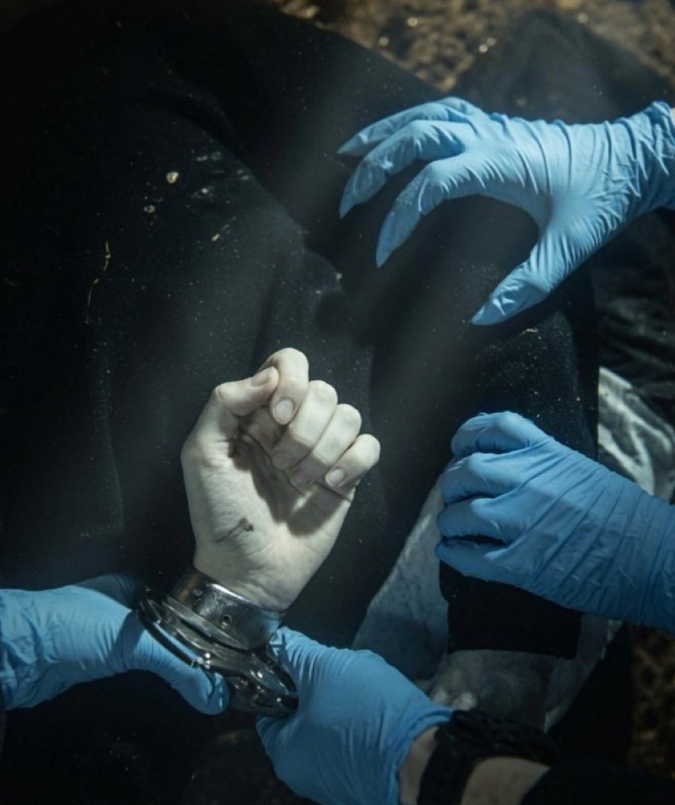
Ça, c'est la main d'Henry Nowark, 18 ans. Pendant qu'il se vide son sang, la police le menotte parce que son assassin (un Sikh), a dit avoir entendu des propos racistes. Il a reçu plusieurs coups de couteau (4) et il est mort sans aide et avec les bras attachés dans le dos. Il faut savoir que cette position rend la respiration encore plus difficile. La police tente de relativiser en disant que ses blessures étaient de toute manière mortelles. Mais, TOUTES les blessures au couteau sont mortelles si la personne est attachée et laissée se vider de son sang. Il est mort 67 minutes après l'attaque. Le Royaume-Uni est effrayant. La suspicion de racisme est plus grave qu'un assassinat. Les flics sont de véritables drones sous forme humaine. Pour trouver un degré de bêtise de ce niveau, il faut aller dans le règne animal chez les poules et bêtes similaires. Ils ont trop de pouvoir et pas assez de neurones fonctionnels. Ceci les rend capable des pires atrocités tout en cachant derrière : je ne fais que mon travail. Ils suivent les idéologies du moment avec un zèle qui ne s'arrête même pas devant la mort. #JusticePourHenry #Racisme #ViolencePolicière