WRLD

Search

#theater
Luciano Magaldi Sardella (PhD) 7h

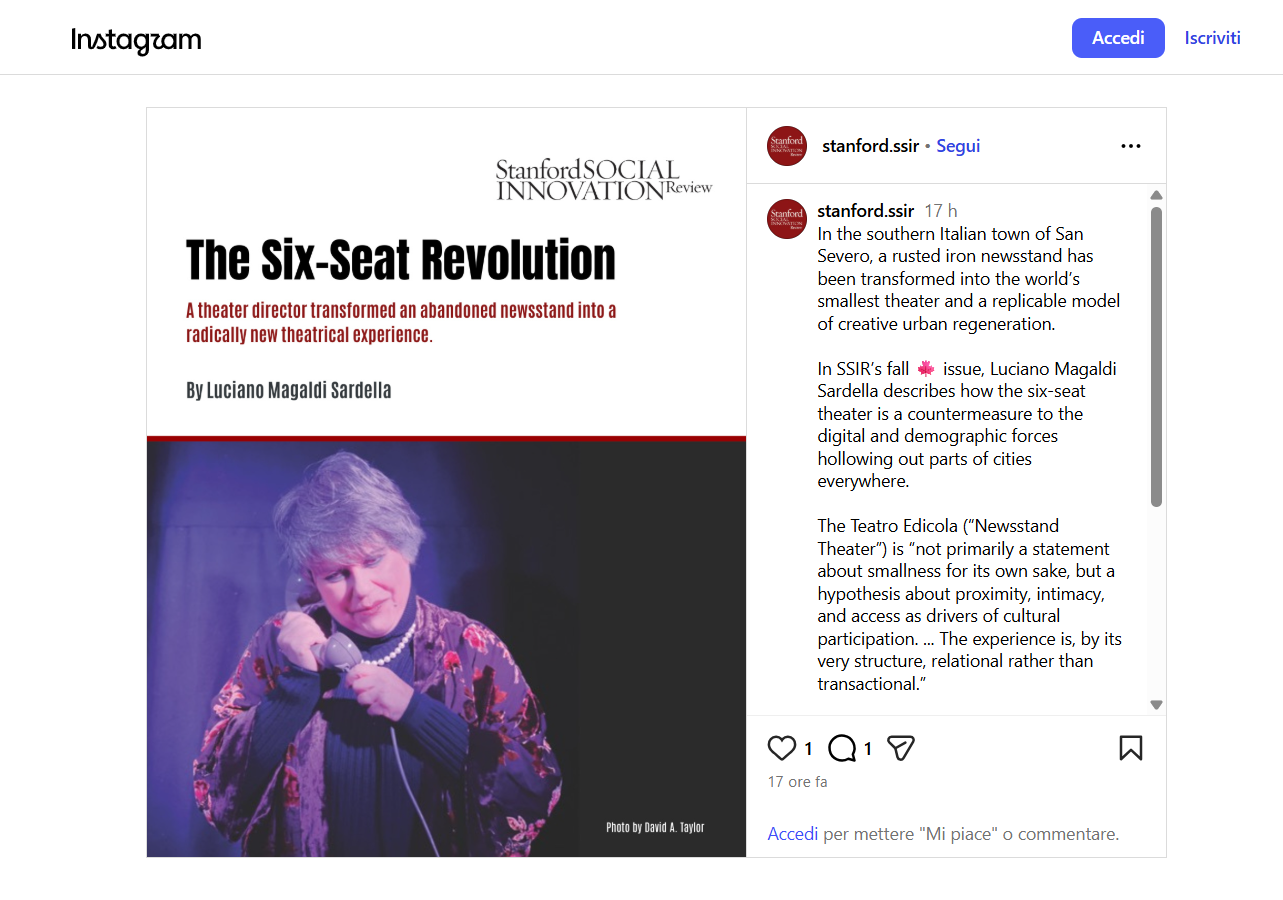
“STANFORD SOCIAL INNOVATION REVIEW (INSTAGRAM)” — “THE SIX-SEAT REVOLUTION: A THEATRE DIRECTOR (FRANCESCO GRAVINO) TRANSFORMED AN ABANDONED NEWSSTAND INTO A RADICALLY NEW THEATRICAL EXPERIENCE” by LUCIANO MAGALDI SARDELLA https://ssir.org/bios/luciano-magaldi-sardella SOURCE: https://www.instagram.com/p/Deor7xKlwNH/ In the southern Italian town of San Severo, a rusted iron newsstand has been transformed into the world’s smallest theater and a replicable model of creative urban regeneration.⁠ ⁠In SSIR’s fall issue, Luciano Magaldi Sardella describes how the six-seat theater is a countermeasure to the digital and demographic forces hollowing out parts of cities everywhere. ⁠ ⁠The Teatro Edicola (“Newsstand Theater”) is “not primarily a statement about smallness for its own sake, but a hypothesis about proximity, intimacy, and access as drivers of cultural participation. … The experience is, by its very structure, relational rather than transactional (Francesco Gravino).”

67
Frankfurter Allgemeine 2d

The article addresses the growing concern about antisemitism in theater, especially following the recent conflicts in the Middle East, and highlights the efforts of innovative cultural creators in Hesse to counter this trend and support Jewish voices in the performing arts. #Antisemitismus #Theater #Kultur (translated)

www.faz.net
Antisemitismus im Theater: „Progressive Räume verschließen sich wieder für jüdische Teilnehmende“
2551
A
AD 2d

Anneke Valk advocates for more attention to the unique needs of female soldiers and points out the lack of knowledge about the female body in science and medicine, while highlighting her mission with her theater lecture 'Hormone Logic'. #Vrouwenlichaam #BikiniScience #Hormoonlogica (translated)

www.ad.nl
Anneke laat zien hoe vrouwelijke soldaten in het veld plassen: ‘Moeten nadenken over hoe man en vrouw verschillen’
3220
Gr@ntlɘr 🥨🍺 2d

Gr@ntlɘr wrote that Karl Lauterbach is going viral. The author pointed out that the former Health Minister has now taken over the chairmanship of the Committee for Research, Technology, Space Travel, and Technology Assessment. He also mentioned Lauterbach's previous work with model calculations and what Gr@ntlɘr referred to as mask theater. According to the article, Lauterbach stated that Macron's electric duck is the future, while Elon Musk's Tesla Roadster is "grotesque." This assessment is being spread worldwide as an example of "Made in Germany 2026," wrote Gr@ntlɘr. #KarlLauterbach #MadeInGermany #Viral (translated)

2892
Sander Sassen 3d

Sander Sassen wrote that Rob Jetten's call for all possible support for Ukraine amounted, in his view, to prolonging a war of attrition. He argued that the front line barely moved, that the Russian economy had adapted, and that Western munitions stocks and political support were finite. According to Sassen, diplomatic solutions were wrongly dismissed as a sign of weakness. Sassen referred to Ukrainian estimates of more than 1.5 million Russian dead and wounded and to Western analyses, including those from CSIS, which he claimed spoke of hundreds of thousands of casualties and over one hundred thousand deaths in Ukraine. He argued that the war constituted a demographic disaster for both countries and that further pressure from sanctions and weapons would result in more casualties. Negotiations, according to Sassen, were not capitulation but the way to end the war. He claimed that a full Ukrainian recapture of the borders of 1991 was militarily unrealistic without direct NATO intervention, risking a war with Russia. He advocated for territorial compromises, likely along the current front line, security guarantees for the remaining Ukraine, and an end to mobilization. He noted that Ukrainian men were forcibly taken off the streets in this process. Sassen acknowledged that such compromises would feel unjust and could reward aggression, but argued that they were better than continuing the current bloodshed. He accused Jetten and like-minded individuals of blocking serious diplomacy and urged the Prime Minister to immediately pursue a diplomatic solution. #Oorlog #Diplomatie #Vrede (translated)

3134
Andreas Rosenfelder 5d

Andreas Rosenfelder described the SPD's actions regarding Bas as absurd theater and as a strategy. Citing the FAZ, he wrote that the party was working on a narrative that was meant to explain the failure of the coalition. https://t.co/hi6TkJfKvd #SPD #Koalition #Politik (translated)

2937
Yvonne Kussmann 6d

Yvonne Kussmann wrote that the CDU parliamentary group has decided to leave the room united during the election of the Prime Minister in Saxony-Anhalt. According to Kussmann, this is intended to prevent a member from voting according to their own conscience. She criticized the approach as childish and accused the CDU of primarily pursuing its own interests and insisting on the "firewall" to remain in power. Kussmann wrote that this approach would cause former CDU voters to turn away from the party. The responsible individuals, fearing the consequences of their previous wrong decisions, have lost their rationality and are resorting to tricks instead of corrections to continue the firewall policy that harms the party and the country, she claimed. She described the involved politicians as cowardly and insincere, stating that such politicians have no place in parliaments. #CDU #SachsenAnhalt #Politik (translated)

2943
Frankfurter Allgemeine 6d

In Frankfurt, the unequal financial support between municipal and state theaters and the independent scene is criticized, while artists work under precarious conditions and often earn below minimum wage, which leads to a feeling of discrediting. #Theater #freieSzene #Frankfurt (translated)

www.faz.net
Geld für die Kunst: Theater in zwei Systemen
2492
Dennis Riehle 6d

Dennis Riehle wrote that the reference to a necessary mourning period for Bärbel Bas had initially been understandable, mentioning September 27 and 30 and October 4 for this. Meanwhile, 17 days have passed since the death of Daniela Ambrosius. Riehle referred to Ambrosius as Bas' stepdaughter and pointed out the age difference of about five years, which he argued makes the classification of the relationship between parent and "child" questionable. Riehle criticized that personal grief is used in Berlin as a shield against criticism. According to him, employees usually only have a grace period of 48 to 72 hours after a death in the closest circle and must then take vacation, reduce overtime, or get a sick note. Three weeks of absence with ongoing salary and protection from opposition are unimaginable for ordinary citizens. Criticism of this difference does not relativize the loss but points out different standards, he wrote. Furthermore, Riehle accused the SPD of placing more importance on the consideration of its own members than on political tasks. He referred to low polling numbers and claimed that SPD-led departments had primarily blocked issues, while questions regarding an eight-hour workday, protection against dismissal, basic security, and pensions remained open. Schwesig and Klingbeil responded with admonitions instead of taking responsibility. Riehle also criticized the outgoing SPD chair for giving the coalition partner an unnecessary dressing down instead of handing over her official duties in an orderly manner. He described using sensitivity as an argument against criticism and tears to deflect criticism of poor performance as weak and despicable. #Politik #Gesellschaft #Trauer (translated)

3286
AfD 6d

The AfD stated that the CDU leadership in Saxony-Anhalt had ordered its faction to leave the plenary chamber during the election of the prime minister out of concern for dissenters. This action harms parliamentary democracy and devalues the free mandate of the deputies, the AfD explained. https://t.co/C1TIN5jPfo #Demokratie #Politik #SachsenAnhalt (translated)

2946
卄𝐎ù𝔰ε 𝐨𝔣 ℙoє𝐌 _ 7d

The author stated that the housing crisis, issues in healthcare, the influx of asylum seekers, and crime in large cities were increasing, while taxpayers were, according to him or her, paying more and more for a system that was under pressure. He or she criticized a meeting about the further elaboration of apologies for the slavery past and a delta plan with the Black Manifest. According to the author, most Dutch people, regardless of their background, had little interest in what he or she described as a continuous expression of guilt, while their future was under pressure due to, among other things, a housing shortage, insecurity, high energy costs, and migration. The author called the attention to abuses from the 17th and 18th centuries a distraction and political theater for a select group, and concluded with a belittling insult towards the addressed party. #wooncrisis #politiek #zorg (translated)

3403
@BrennpunktUA 🇩🇪🇺🇦 7d

BrennpunktUA asked if anyone had noticed that no one was criticizing the SPD for the upcoming government formation with the Party of the Left in Berlin. The account wrote that Bas may have stopped for tragic personal reasons. However, with the timing and wording of her resignation letter, she still left a farewell gift for her party: her comrades are currently using it successfully as a template for a theater of outrage and distraction. #Politik (translated)

3063
Otherland Bookshop Berlin 7d

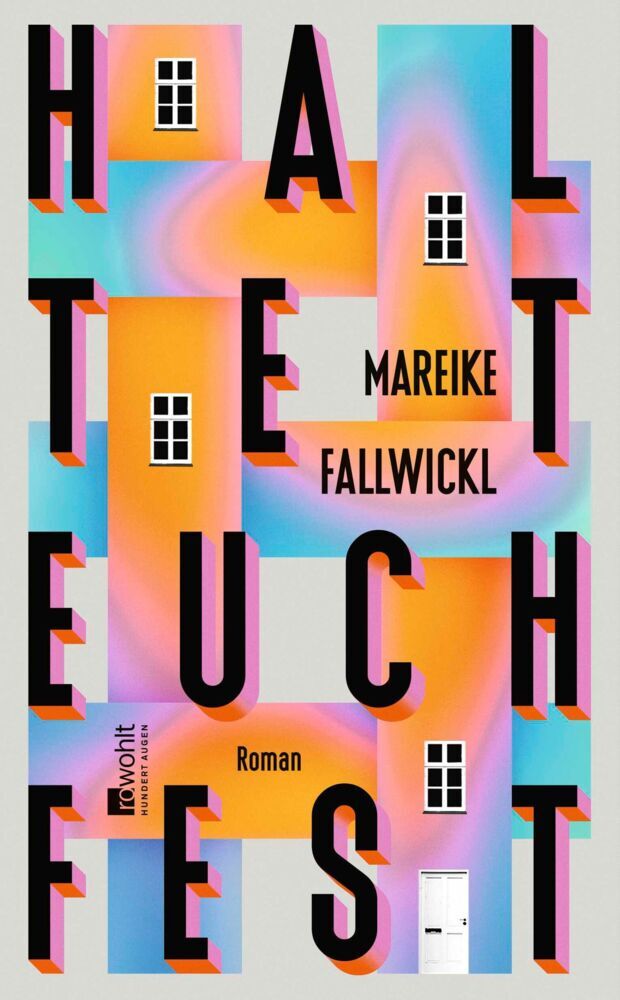
Haltet euch fest von Mareike Fallwickl Der neue Roman von Bestsellerautorin Mareike Fallwickl stellt unsere Glaubenssätze zu Freundschaft und Romantik infrage und beschreibt mutig die Utopie, die wir uns für unser Leben wünschen. Luzia wächst in einer Gemeinschaft auf, die für ganz unterschiedliche Menschen eine Zuflucht bietet. Im Haus werden queere und platonische Formen von Liebe sowie geteilte Elternschaft gelebt. Später, als Erwachsene, kämpft Luzia als Theaterregisseurin gegen patriarchale Strukturen an und versucht, etwas zum Guten zu verändern. Ihre Jugendfreundin Marle verspürt mit Anfang vierzig einen starken Kinderwunsch und entscheidet sich für einen ungewöhnlichen Weg abseits von Beziehungen mit Männern. Doch plötzlich, nach einem verheerenden Unwetter, scheint alles bedroht, was diese Wahlfamilie über Jahrzehnte miteinander aufgebaut hat. Was braucht es, damit eine solche Gemeinschaft in Zeiten wie diesen bestehen kann?

454
Kurier 7d

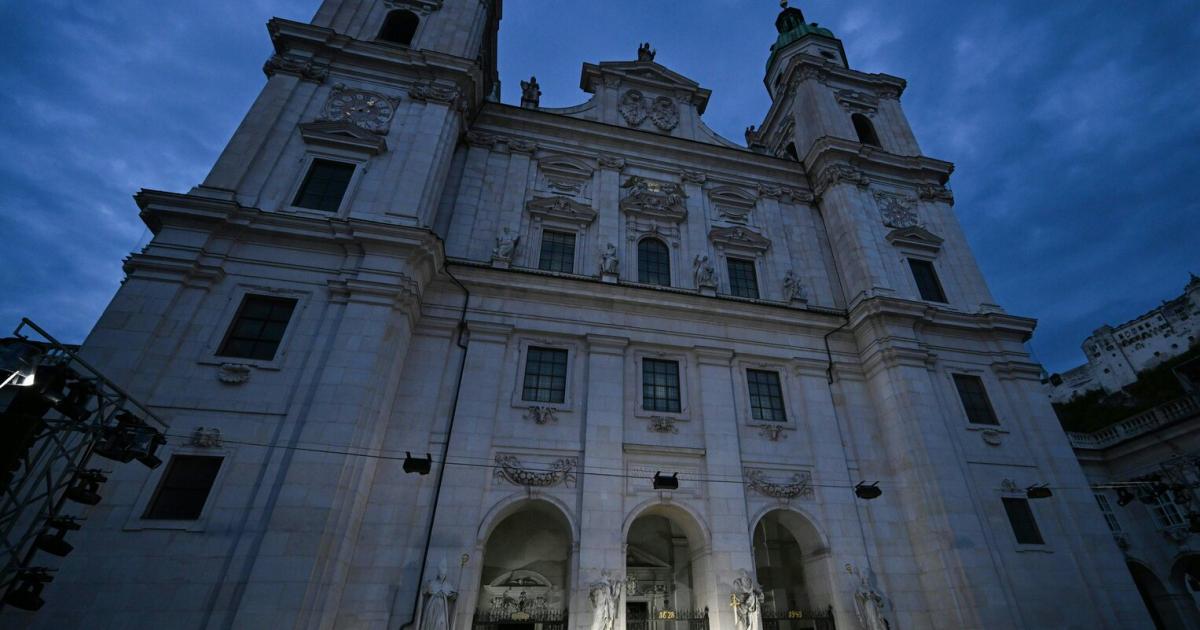
The Austrian director Gernot Friedel, known for his long-standing work on "Jedermann" at the Salzburg Festival, has passed away at the age of 85 in Vienna. #GernotFriedel #Kultur #Theater (translated)

kurier.at
Langjähriger „Jedermann“-Regisseur Gernot Friedel tot
2497
K
Kronen Zeitung 7d

The popular theater is facing serious financial difficulties as it receives no support from the city. (translated)

Kämpft ums Überleben - Beliebtes Theater erhält keinen Cent von der Stadt
2497
Vatnik Soup 7d

The author alleged that Russia had begun trying to whitewash the bombing of the Mariupol theatre, which they described as its most brutal war crime. They said that a month earlier an Italian filmmaker, Vittorio Nicola Rangeloni, whom they called a propagandist, had published a documentary titled *Witnesses* that falsely blamed Ukrainians for the bombing. https://t.co/FmPhEEI36K #Mariupol #WarCrimes #Propaganda #RU #IT #UA

3860
Luciano Magaldi Sardella (PhD) 7d

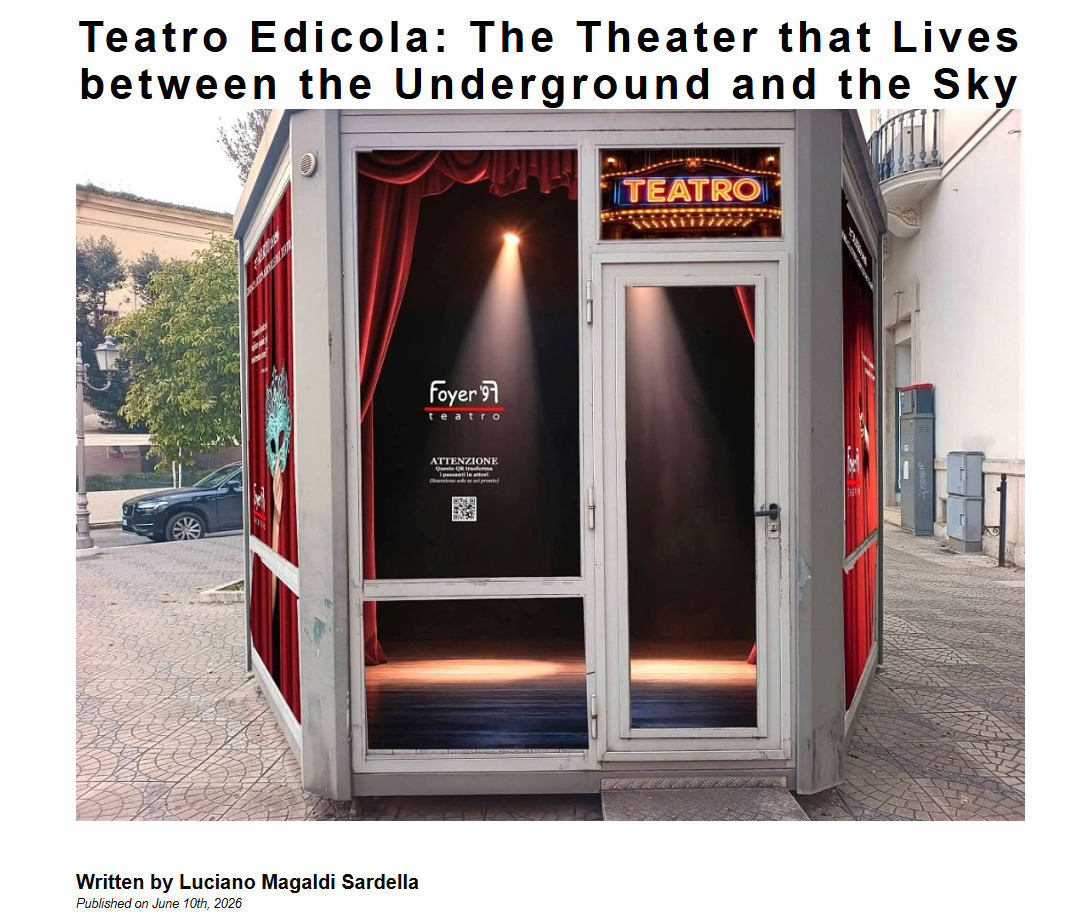
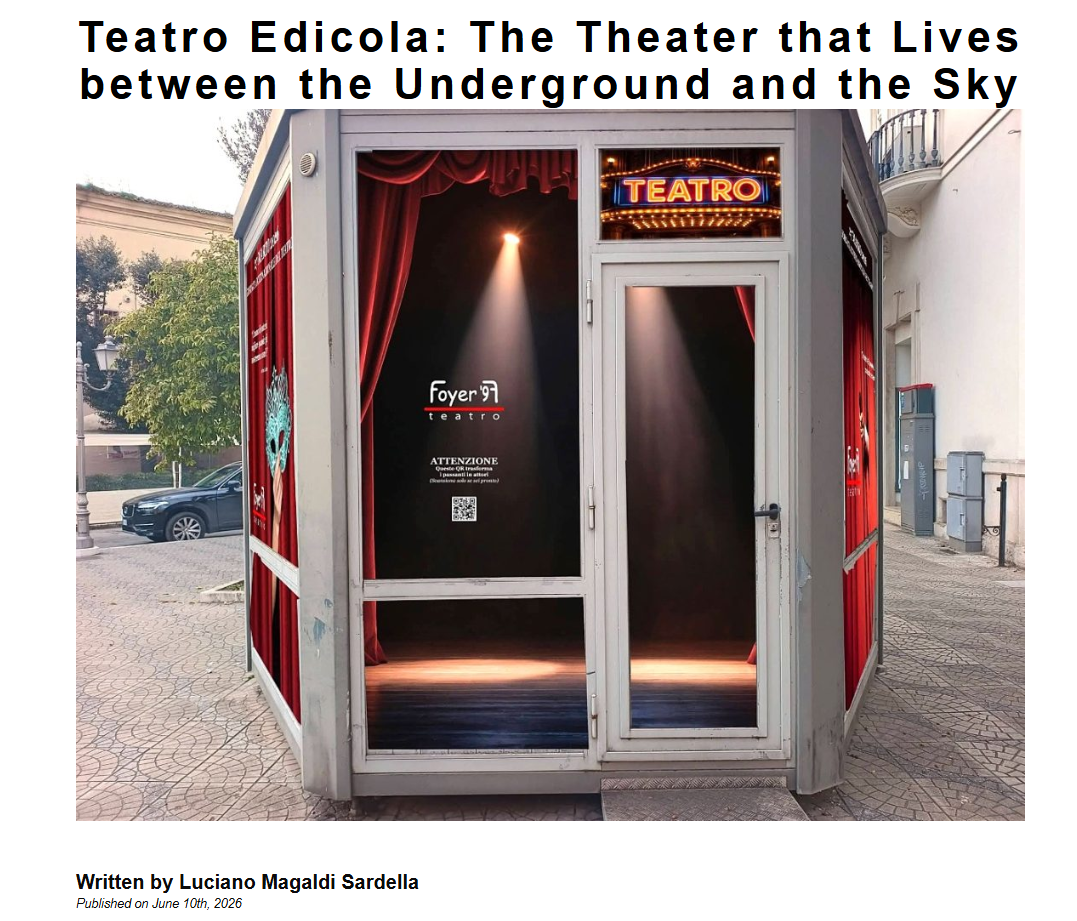
UP MAGAZINE NYC: "TEATRO EDICOLA" THE THEATER THAT LIVES BETWEEN THE UNDERGROUND AND THE SKY" SOURCE: https://upmag.com/theater-between-underground-and-sky/ SAN SEVERO (FG) - Teatro Edicola, inaugurated on World Theatre Day 2026 in a disused newsstand on via Tondi, San Severo, Puglia, by Francesco Gravino's company Foyer '97. Housing six spectators at fifteen-minute intervals, the project claims status as the world's smallest theatre. Situated alongside the 2011 bell-tower performance forty-five metres above the city and the 2016 "Teatro Cantina" underground, it articulates a vertical proximity dramaturgy spanning sky, pavement, and depth.

1136
Luciano Magaldi Sardella (PhD) 7d

"UP MAGAZINE NYC - "TEATRO EDICOLA" THE THEATER THAT LIVES BETWEEN THE UNDERGROUND AND THE SKY" SOURCE: https://upmag.com/theater-between-underground-and-sky/ SAN SEVERO (FG) - Il "Teatro-Edicola", è stato inaugurato in occasione della Giornata Mondiale del Teatro 2026 in un'ex edicola dismessa di via Tondi, a San Severo, in Puglia, dalla compagnia Foyer '97 di Francesco Gravino. Con una capienza di sei spettatori e ingressi scaglionati ogni quindici minuti, il progetto rivendica il titolo di teatro più piccolo al mondo. In dialogo con la performance del 2011 sul campanile, a quarantacinque metri d'altezza sulla città, e con il "Teatro Cantina" del 2016 nel sottosuolo, articola una drammaturgia della prossimità verticale che abbraccia cielo, strada e profondità. Facendo riferimento alla teoria site-specific e all'estetica relazionale, il saggio interpreta questo trittico come forma di resistenza civica all'abbandono e come fenomenologia della memoria collettiva radicata nei luoghi del Sud Italia.

795
Luciano Magaldi Sardella (PhD) 7d

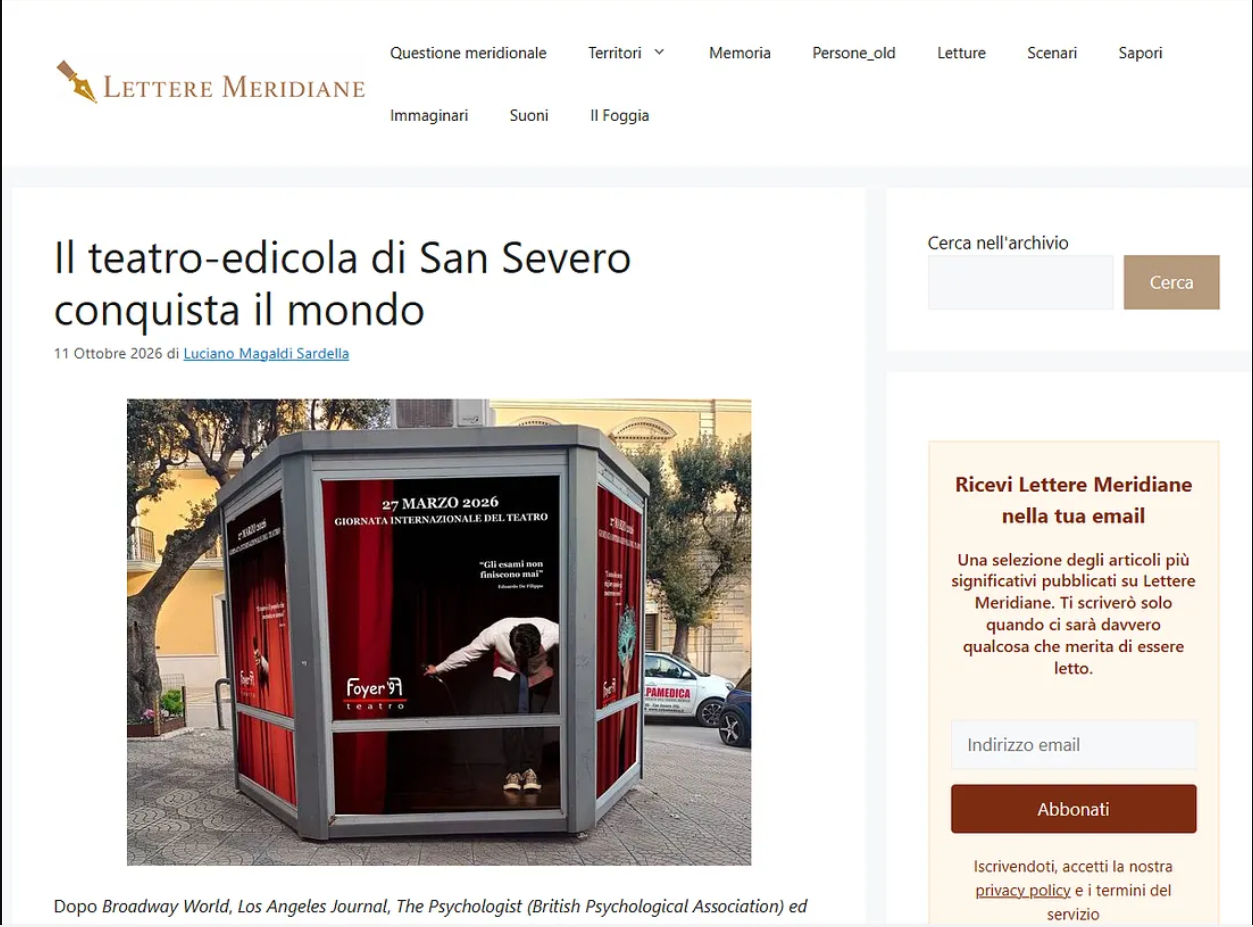
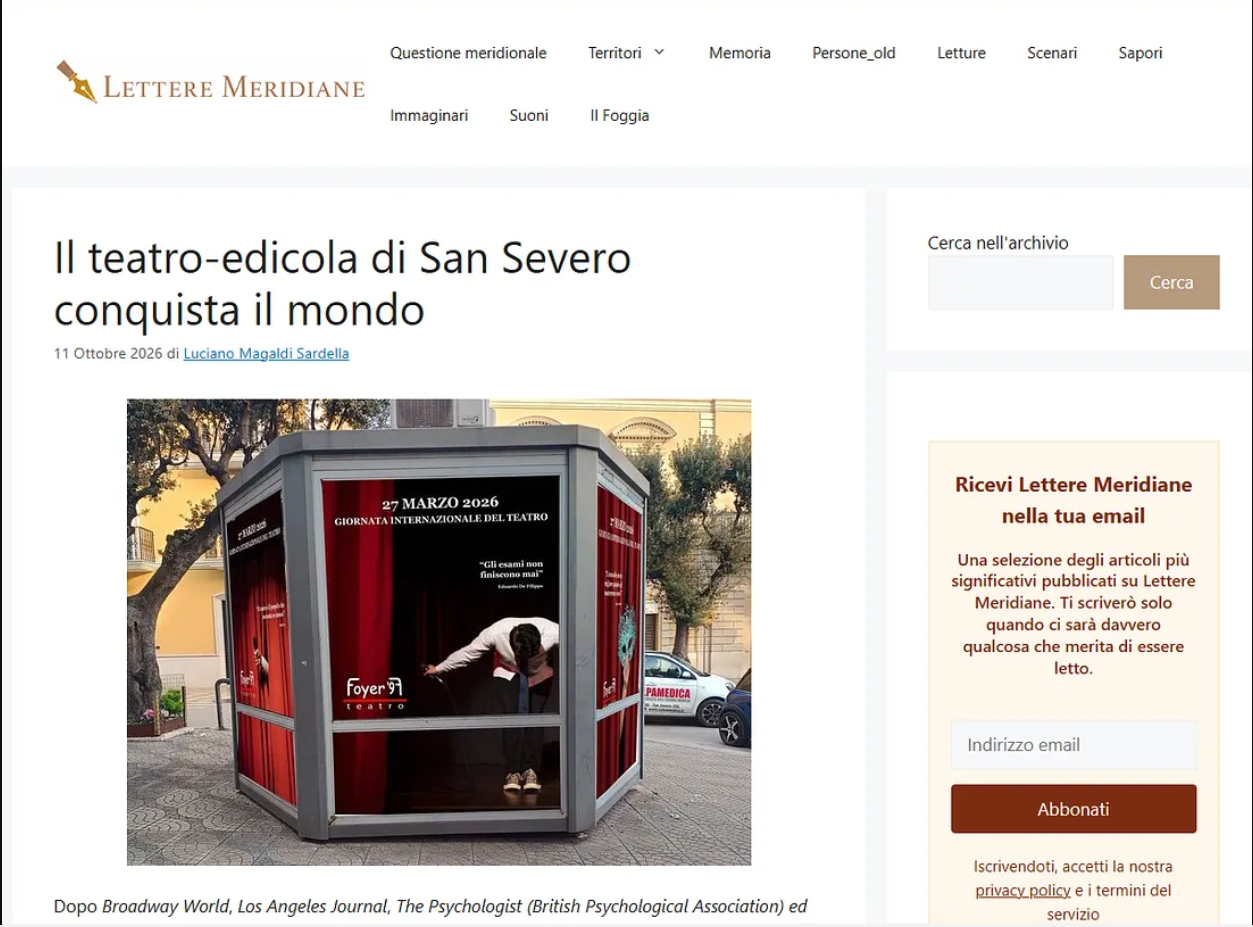
LETTERE MERIDIANE — “TEATRO-EDICOLA” OF SAN SEVERO CONQUERS THE WORLD SOURCE: https://www.letteremeridiane.org/2026/10/il-teatro-edicola-di-san-severo-conquista-il-mondo/?fbclid=IwY2xjawU4oqFleHRuA2FlbQIxMQBwZG9mAXNydGMGYXBwX2lkEDIyMjAzOTE3ODgyMDA4OTIAAR5rVEwYs6UUXg7v-P0SyIQ_DRb_F6ZiY58OcseYoV4J7atcTiERnhWaqKM2pw_aem_Njle1jq1XLzHr93KLBUcVA After “Broadway World”, the “Los Angeles Journal”, “The Psychologist (British Psychological Association)” and Hollywood Beat Magazine, its “academic consecration” has now arrived courtesy of Stanford University. As I have already emphasised in my article on the revival of the GIO Festival in Foggia, celebrated by BroadwayWorld for the world stage premiere of the Giordano’s opera Marina (1888), the province of Foggia has long ceased to be peripheral. It happens when it finds an idea that shifts the coordinates: well, in San Severo, 40 kilometres from Foggia, it has happened again. Only this time an orchestra was not needed; six chairs were enough. The celebrated Teatro-Edicola of San Severo artistic director Francesco Gravino of the theatre company Foyer ’97 has been featured in the academic journal “Stanford Social Innovation Review (SSIR)” as an academic case study. The news, relayed on 19 September 2026 by ANSA Nazionale, looked like a misprint. Then it became clear that it was not. SSIR, an award-winning publication covering multisectoral solutions to global problems, included the project in its Dispatches section with the reportage “The Six-Seat Revolution”. It is the inverse trajectory to that of the GIO Festival: not a forgotten opera returning to a grand historic Italian horseshoe theatre, but an entire theatre reborn inside a disused place, forgotten by man. There are moments when past and future intertwine to create something visionary, innovative, artistically “revolutionary”: San Severo experienced one of those moments on the morning of 27 March 2026, during World Theatre Day, when the shutter of a newsstand closed for six years in Via Matteo Tondi was reopened “not to sell newspapers, but to offer stirring stories”, to quote Gravino’s motto. The idea of the visionary Francesco Gravino, artistic director, stage director and actor of the San Severo company Foyer ’97, active for at least 30 years in Capitanata, centred on the kiosk, hexagonal in metal and glass, granted free of charge by its owner Pino Frau, by now an urban relic created by the publishing crisis of the early 2000s: today in Italy active newsstands have fallen from about 35,000 in 2005 to about 20,000 in 2024, a decline of 42.8%. Gravino and eleven other actors restructured it in two weeks of work, without institutional funding, and transformed it into what is now under examination by the London commission of Guinness World Records as the “world’s smallest theatre”. The formula is deliberately austere: six spectators at a time outside, actors inside at less than a metre’s distance, 15-minute performances, continuous rotation from 11:00 to 20:45, texts ranging from Goldoni to Chekhov, from Ibsen to Dacia Maraini. On the door a QR code with an original theatrical warning: “Warning! This QR code transforms passers-by into actors. Scan only if ready.” The numbers immediately showed that it was no boutade: more than 60 people in a single afternoon, three inaugural days that sold out. But above all a positive echo that went beyond the borders of San Severo. “Broadway World” (just as in the previous case of the GIO Festival), the world’s most influential theatre criticism outlet with over 5.5 million monthly views, devoted exclusive coverage to it on 27 April 2026: “An Abandoned Italian Newsstand Just Became the World’s Smallest Theatre”. Not a mere listing, but an analysis: “There is no foyer, there is no balcony, there is no grid. There is barely a wing. What there is is something almost unrecognisable as an evening at the theatre, and for that very reason it is all the more powerful.” “Broadway World” captured Gravino’s manifesto idea: “This is a theatre of proximity. In an era of digital distance, we are putting human contact back at the centre,” framing it as “More than a clever exercise in site-specific theatre. It is a reappropriation.” All of this, in a Mezzogiorno of Italy often narrated only in terms of organised crime and marginalisation. To that seal of approval was added another, even more disorienting for a newsstand in San Severo: the “Los Angeles Journal”, one of the most influential publications on the West Coast for the performing arts. On 12 May 2026, it headlined thus: “San Severo’s Teatro-Edicola as an Innovative Model for Los Angeles Theaters?” opening as follows: “In a city in southern Italy that Hollywood has never heard of, a theatre director has just built the smallest stage in the world: six seats, fifteen minutes, zero distance. Los Angeles should pay attention.” The “Los Angeles Journal” does not indulge in folklore, but places the kiosk in Via Matteo Tondi alongside the prestigious 1,600-seat Ahmanson Theatre in Los Angeles, the Pantages of Broadway in Hollywood, the 99-seat plan of Rogue Machine, the Odyssey, the Victory Theatre and the Hollywood Fringe. It even recalls Ethan Marks’s Electrical Box Theatre, a veritable electrical box lined with red velvet in downtown Los Angeles, to argue that Gravino has taken to the extreme the question Los Angeles has been asking itself for decades: How small can a stage become before it ceases to be a stage? And it recognizes the San Severo urban model: almost zero cost, two weeks of work and six chairs, in return for immediate provincial, regional and national media coverage, recognition by the San Severo’s Municipal Administration, and a format exportable anywhere. Then, the third American piece came from “Hollywood Beat Magazine” on 20 April 2026: Six seats. Fifteen minutes. One actor. No stage. The magazine recounts the kiosk in Via Tondi left disused for almost six years, the contemporary six-seat cultural outpost, placing Francesco Gravino in a distinguished genealogy: Richard Schechner and environmental theatre, Jerzy Grotowski and poor theatre, Nicolas Bourriaud and relational aesthetics. But it closes with pragmatism: it is not a thesis, it is fixing a street corner, that is, repairing an urban street corner by asking not how large a theatre can become, but how small it must become again to recover its original power. And finally, the celebrated London-based “The Psychologist”, the journal of the “British Psychological Society (BPS)”, the oldest psychological society in the world, transformed the Teatro-Edicola into a scientific case study: on 30 July 2026 it published “The world’s smallest theatre — and Psychologists’ next act”, starting from the same detail, the morning of 27 March when the metal shutter of the hexagonal kiosk in Via Tondi reopened after six years, six people inside, an actor at less than a metre’s distance beginning Chekhov. It describes the formula: six spectators, 15 minutes, 11 actors over 10 hours, from Goldoni to Euripides, inside a kiosk where the fourth wall does not break because architecturally it never existed. But the BPS goes a step further: it cites the 2025 studies by Damien Gabriel in IBRO Neuroscience Reports, that live performance generates measurably stronger emotional and physiological activation than video, and introduces Edward Hall’s proxemics: below one metre is intimate space, reserved for doctors, close friends, lovers. In that one-square-metre space, the actor’s breath is audible, micro-expressions legible, the self-other boundary becomes permeable. The Teatro-Edicola “does not make theatre better, it makes it inevitable”. And it is here that one understands why Stanford is studying it as an academic case study in social innovation, not as a case of artistic originality. In Italy, meanwhile, the national media circuit had already picked up the phenomenon: RaiNews — TG2 Storie brought it to RaiDue at midnight on 19 April. RTL 102.5 devoted space to the format conceived by Gravino and developed by Foyer ’97 in the heart of San Severo in Via Tondi, defining it as a permanent micro-stage capable of bringing theatre into public space. ANSA.it, Gazzetta del Mezzogiorno, La Repubblica, TG2000, Radio Capital, Swiss RSI, ANSA Brazil and many others followed. And for the record: Fiorello praised it in La Pennicanza as an artistic case inspired by his Edicola Fiore, and Biagio Antonacci, on his tour in the Augustan amphitheatre of Lucera, made a “fact-finding” stop at the Teatro-Edicola singing the celebrated and nostalgic Iris in front of an audience certainly larger than the “six seats”. Francesco Gravino’s theatre company Foyer ’97 was not born yesterday: behind it lie the Teatro-Cantina of 2016, the underground theatre, and in 2011 a performance on the bell tower of a church in the centre of San Severo at 45 metres high. The Teatro-Edicola completes, in Gravino’s words, “the entire vertical extension of theatre: underground, street level, rooftop”. And it is preparing for its thirtieth anniversary in 2027 aiming to purchase the kiosk to make it permanent, exporting the “San Severo Model” to Rome, Lucca, and to the festivals of Santarcangelo and Todi. As with the GIO Festival, someone might dare to claim that it is merely a stunt, but when BroadwayWorld places you alongside the Los Angeles Opera House, the “Los Angeles Journa”l proposes you as a model for Hollywood, “Hollywood Beat Magazine” reads you through Grotowski and the “British Psychological Society” uses you to explain mirror neurones, it is no longer a stunt but an excellent artistic and academic positioning. To those who still whisper that Foggia and Capitanata are provincial, the answer is now written on two opposite and complementary fronts: on 5 June in Foggia a 138-year-old opera found the stage again at the Giordano ending up on BroadwayWorld; on 27 March in San Severo a 4-square-metre kiosk invented a stage that did not exist, ending up at Stanford, in Los Angeles, in Hollywood and in London. The periphery, when it has a precise idea, becomes the centre. Even with six chairs. Luciano Magaldi Sardella

www.letteremeridiane.org
Il teatro-edicola di San Severo conquista il mondo
909
Luciano Magaldi Sardella (PhD) 7d

LETTERE MERIDIANE — IL TEATRO-EDICOLA DI SAN SEVERO CONQUISTA IL MONDO SOURCE: SOURCE: https://www.letteremeridiane.org/2026/10/il-teatro-edicola-di-san-severo-conquista-il-mondo/?fbclid=IwY2xjawU4oqFleHRuA2FlbQIxMQBwZG9mAXNydGMGYXBwX2lkEDIyMjAzOTE3ODgyMDA4OTIAAR5rVEwYs6UUXg7v-P0SyIQ_DRb_F6ZiY58OcseYoV4J7atcTiERnhWaqKM2pw_aem_Njle1jq1XLzHr93KLBUcVA Dopo Broadway World, Los Angeles Journal, The Psychologist (British Psychological Association) ed Hollywood Beat Magazine, ora è arrivata la sua “consacrazione accademica” a cura della Stanford University. Come ho già sottolineato nel mio articolo sulla rivincita del GIO Festival a Foggia, celebrata dal BroadwayWorld per la prima mondiale scenica della giordaniana Marina (1888), la provincia di Foggia ha smesso ormai di essere periferia. Accade quando trova un’idea che sposta le coordinate: ebbene, a San Severo, a 40 chilometri da Foggia, è successo di nuovo. Solo che questa volta non serviva un’orchestra, ma sono bastate sei sedie. Il celebre Teatro-Edicola del sanseverese direttore artistico Francesco Gravino della Compagnia Teatrale Foyer’97 è finito sulla rivista accademica Stanford Social Innovation Review (SSIR) in qualità di caso di studio accademico. La notizia, rilanciata il 19 settembre 2026 da ANSA Nazionale, sembrava un refuso. Poi si è capito che non lo era. La SSIR, pubblicazione pluripremiata che copre soluzioni multisettoriali ai problemi globali, ha inserito il progetto nella sezione Dispatches con il reportage The Six-Seat Revolution. È il percorso inverso rispetto a quello del GIO Festival: non un’opera dimenticata che torna in un grande teatro storico italiano a ferro di cavallo, ma un teatro intero che rinasce dentro un luogo dismesso, dimenticato dall’uomo. Ci sono momenti in cui il passato e il futuro si intrecciano per creare qualcosa di visionario, innovativo, artisticamente “rivoluzionario”: San Severo ha vissuto uno di questi momenti la mattina del 27 marzo 2026, durante la Giornata Mondiale del Teatro, quando la saracinesca di un’edicola chiusa da sei anni in Via Matteo Tondi è stata riaperta “non per vendere giornali, ma per offrire emozionanti storie”, citando il motto graviniano. L’idea del visionario Francesco Gravino (nella foto sopra), direttore artistico, regista e attore della compagnia sanseverese Foyer ’97, attiva da almeno 30 anni in Capitanata si è basata sull’edicola, esagonale in metallo e vetro, concessa a titolo gratuito dal proprietario Pino Frau, ormai un relitto urbano creato dalla crisi dell’editoria degli inizi anni 2000: oggi in Italia le edicole attive sono scese da circa 35.000 nel 2005 a circa 20.000 nel 2024, con un calo del 42,8%. Gravino e altri undici attori l’hanno ristrutturata in due settimane di lavoro, senza fondi istituzionali, e l’hanno trasformata in quello che oggi è sotto esame della commissione londinese del Guinness World Record come “teatro più piccolo del mondo”. La formula è volutamente austera: sei spettatori alla volta fuori, attori dentro a meno di un metro, spettacoli di 15 minuti, rotazione continua dalle 11 alle 20.45, testi da Goldoni a Čechov, da Ibsen a Dacia Maraini. Sulla porta un QR code con un originale avvertimento teatrale: “Attenzione! Questo codice QR trasforma i passanti in attori. Scansionate solo se pronti.” I numeri hanno sùbito detto che non era una boutade: più di 60 persone in un solo pomeriggio, tre giornate inaugurali che hanno registrato il tutto esaurito. Ma soprattutto un’eco positiva che è andata oltre i confini sanseveresi. BroadwayWorld (proprio come il previo caso del GIO Festival) la più influente testata mondiale di critica teatrale con oltre 5,5 milioni di visualizzazioni mensili, il 27 aprile 2026 gli ha dedicato una copertura esclusiva: An Abandoned Italian Newsstand Just Became the World’s Smallest Theatre. Non una segnalazione, ma un’analisi: “Non c’è foyer, non c’è balconata, non c’è graticcia. C’è a malapena una quinta. Quello che c’è è qualcosa di quasi irriconoscibile come serata a teatro, e proprio per questo è ancora più potente.” BroadwayWorld ha colto l’idea manifesto di Gravino: “Questo è un teatro di prossimità. In un’epoca di distanza digitale, stiamo rimettendo il contatto umano al centro,” incorniciandolo come “Più che un abile esercizio di teatro site-specific. È una riappropriazione.”. Il tutto, in un Mezzogiorno d’Italia spesso raccontato solo per criminalità organizzata e marginalizzazione. A quel sigillo se ne è aggiunto un altro, ancora più spiazzante per un’edicola di San Severo: il Los Angeles Journal, una delle testate più influenti della West Coast per le arti performative. Il 12 maggio 2026, titola in questo modo: San Severo’s Teatro Edicola as an Innovative Model for Los Angeles Theaters? aprendo così: “In una città del Sud Italia di cui Hollywood non ha mai sentito parlare, un regista teatrale ha appena costruito il palcoscenico più piccolo del mondo: sei posti, quindici minuti, zero distanza. Los Angeles dovrebbe prestare attenzione.” Il Los Angeles Journal non fa folklore, ma mette il chiosco di via Matteo Tondi accanto al presigioso teatro losangelino Ahmanson da 1600 posti, al Pantages di Broadway in Hollywood, ai 99-seat plan di Rogue Machine, all’ Odyssey, al Victory Theatre e all’ Hollywood Fringe. Rievoca persino l’Electrical Box Theatre di Ethan Marks, una vera e propria scatola elettrica foderata di velluto rosso in downtown Los Angeles, per dire che Gravino ha portato all’estremo la domanda che Los Angeles si fa da decenni: Quanto piccolo può diventare un palco prima di smettere di essere un palco? E riconosce il modello urbano sanseverese: costo quasi zero, due settimane di lavoro e una sestina di sedie, a fronte di una immediata copertura mediatica provinciale, regionale e nazionale, riconoscimento dell’ Amministrazione Comunale sanseverese, e un format esportabile (quasi) ovunque. Dopodiché, il terzo tassello americano è arrivato dall’ Hollywood Beat Magazine il 20 aprile 2026: Six seats. Fifteen minutes. One actor. No stage. Il magazine racconta il chiosco di Via Tondi rimasto dismesso per quasi sei anni, il presidio culturale contemporaneo da sei posti, inserendo Francesco Gravino nella genealogia alta: Richard Schechner e l’environmental theatre, Jerzy Grotowski e il teatro povero, Nicolas Bourriaud e l’estetica relazionale. Ma chiude con concretezza: non è una tesi, è fixing a street corner, ovvero aggiustare un angolo di strada urbana chiedendosi non quanto grande può diventare un teatro, ma quanto piccolo deve tornare per recuperare il suo potere originario. E infine, il celebre londinese The Psychologist, la rivista della British Psychological Society (BPS), la più antica società di psicologia al mondo, ha trasformato il Teatro-Edicola in caso di studio scientifico: il 30 luglio 2026 pubblica The world’s smallest theatre — and Psychologists’ next act, partendo dallo stesso dettaglio, la mattina del 27 marzo in cui la saracinesca metallica del chiosco esagonale di Via Tondi si riapre dopo sei anni, sei persone dentro, un attore a meno di un metro che inizia Chekhov. Descrive la formula: sei spettatori, 15 minuti, 11 attori su 10 ore, da Goldoni a Euripide, dentro un chiosco dove la quarta parete non si rompe perché architettonicamente non è mai esistita. Ma la BPS fa un passo oltre: cita gli studi del 2025 di Damien Gabriel su IBRO Neuroscience Reports, la performance live genera attivazione emotiva e fisiologica misurabilmente più forte del video e introduce la prossemica di Edward Hall: sotto il metro è spazio intimo, riservato a medici, amici stretti, amanti. In quello spazio da un metro quadrato, il respiro dell’attore è udibile, le microespressioni leggibili, il confine sé-altro diventa permeabile. Il Teatro-Edicola “non rende il teatro migliore, lo rende inevitabile”. Ed è qui che si capisce perché Stanford lo studia come caso di studio accademico di innovazione sociale, non come caso di originalità artistica. In Italia, nel frattempo, il circuito mediatico nazionale aveva già intercettato il fenomeno: RaiNews — TG2 Storie lo porta su RaiDue alla mezzanotte del 19 aprile. RTL 102.5 dedica spazio al format ideato da Gravino e sviluppato da Foyer’97 nel cuore di San Severo in Via Tondi, definendolo micro-palcoscenico permanente capace di portare teatro nello spazio pubblico. ANSA.it, Gazzetta del Mezzogiorno, La Repubblica, TG2000, Radio Capital, RSI svizzera, ANSA Brasile e tanti altri seguono. E per diritto di cronaca: Fiorello lo ha elogiato in La Pennicanzacome caso artistico ispirato al suo Edicola Fiore, nonché Biagio Antonacci, nel suo tour nell’anfiteatro augusteo di Lucera, ha fatto tappa “conoscitiva” nel Teatro-Edicola cantando la celebre e nostalgica Iris davanti ad un pubblico sicuramente maggiore dei “sei posti”. La Compagnia Teatrale Foyer ’97 di Francesco Gravino non è nata ieri: ha alle spalle il Teatro-Cantina del 2016, il teatro sottoterra, e nel 2011 una performance sulla torre campanaria di una chiesa del centro di San Severo a 45 metri d’altezza. Il Teatro Edicola completa, nelle parole di Gravino, “l’intera estensione verticale del teatro: sottoterra, piano strada, tetto”. E si prepara al trentennale del 2027 puntando ad acquistare l’edicola per renderla permanente esportando il “Modello San Severo” a Roma, Lucca, nei festival di Santarcangelo e Todi. Come per il GIO Festival, qualcuno potrebbe osare di affermare che si tratta solo di un exploit ma, quando BroadwayWorld ti mette accanto alla Los Angeles Opera House, il Los Angeles Journal ti propone come modello per Hollywood, Hollywood Beat Magazine ti legge con Grotowski e la British Psychological Society ti usa per spiegare i neuroni specchio, non è più un exploit ma un eccellente posizionamento artistico ed accademico. A chi ancora sussurra che Foggia e la Capitanata siano provincia, la risposta ora è scritta su due fronti opposti e complementari: il 5 giugno a Foggia un’opera di 138 anni ha ritrovato la scena al Giordano finendo su BroadwayWorld; il 27 marzo a San Severo un’edicola di 4 metri quadrati ha inventato una scena che non esisteva, finendo a Stanford, a Los Angeles, a Hollywood e a Londra. La periferia, quando ha un’idea precisa, diventa centro. Anche con sei sedie. Luciano Magaldi Sardella

www.letteremeridiane.org
Il teatro-edicola di San Severo conquista il mondo
795