BETA nonprofit public democratic european moderated

Search

#TXT

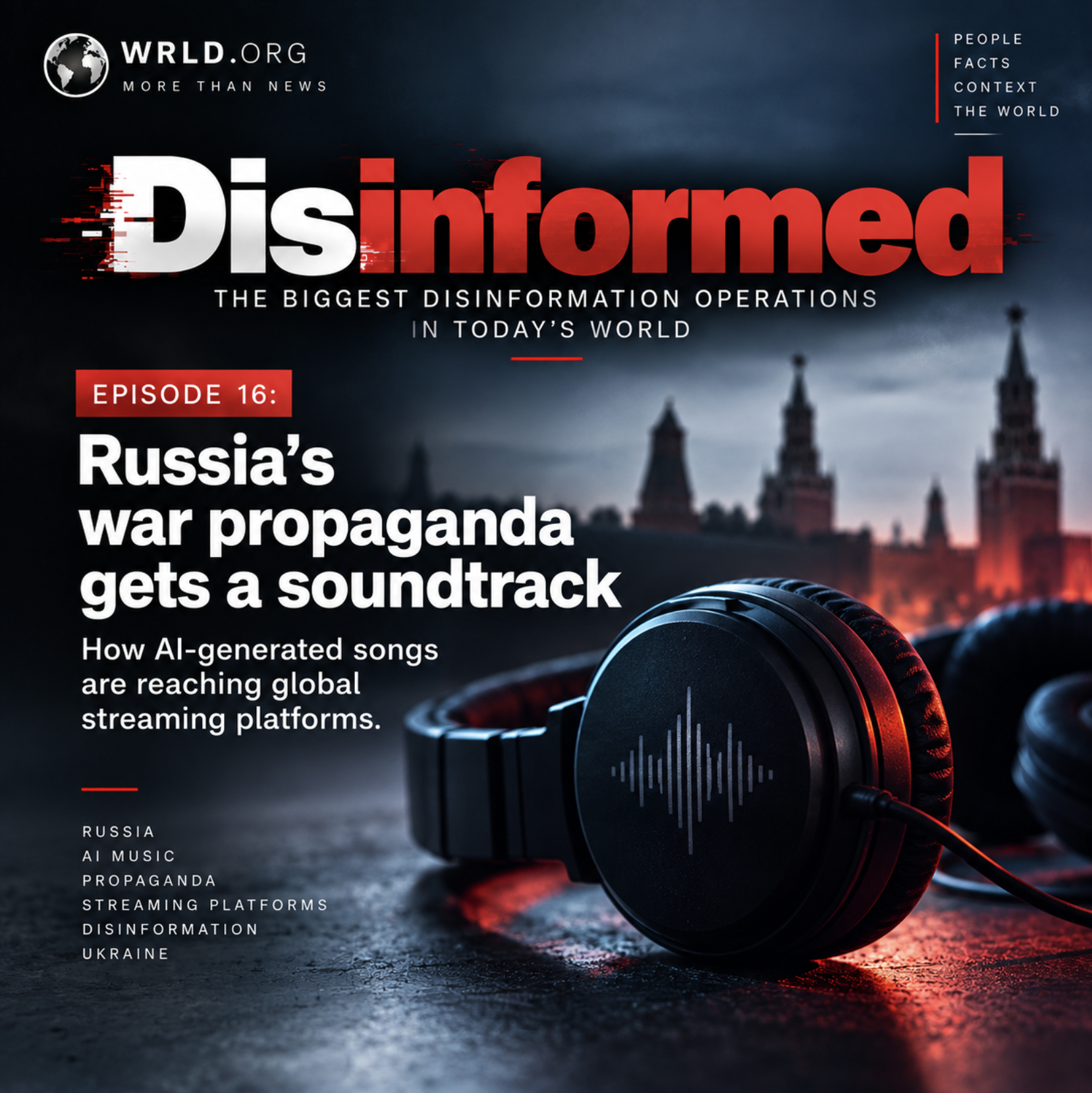
Russia’s war propaganda gets a soundtrack – how AI-generated songs reached global streaming platforms Russian war propaganda is no longer confined to television broadcasts, Telegram channels or political videos. A study by the Ukrainian threat-intelligence organisation Terrecon has identified 981 songs combining signs of AI generation with pro-Russian military narratives, distributed through an ecosystem that reaches YouTube, Spotify, Apple Music, Deezer and SoundCloud. The songs range from sentimental ballads to rock and heavy metal. Their recurring themes are familiar from conventional Russian wartime propaganda: the heroisation of Russian soldiers, romanticisation of the war, mobilisation, the “Russian world”, commemoration of fallen troops and attacks on Ukraine and its armed forces. Some contain derogatory or dehumanising references to Ukrainians. What is new is not necessarily the message, but the production and distribution model: generative AI allows propagandistic music to be produced rapidly, cheaply and in quantities that would previously have required musicians, studios and producers. Nearly 1,000 tracks identified Terrecon examined 3,725 tracks collected from YouTube, YouTube Music, SoundCloud and the AI music platform Suno. After manual review, researchers classified 981 as showing both indications of AI generation and pro-Russian war propaganda. In 681 tracks they identified 728 propaganda-related keywords or phrases. The largest category was the glorification of the Russian military, followed by romanticised treatment of Moscow’s so-called “special military operation”, mobilisation appeals, narratives about the “Russian world”, and the cult of fallen soldiers and the state. The reach was not merely theoretical. Listening or viewing statistics were available for 608 of the identified tracks; together they had accumulated 86.8 million plays and views, according to Terrecon. A smaller group of 13 high-performing songs accounted for more than 53 million YouTube views and more than 67 million when YouTube Music was included. Among the better-known examples is “Power of Artillery”, a Russian-language rock song praising artillery weapons that passed two million views on YouTube. Most of the tracks for which publication dates could be established appeared after 2024, broadly coinciding with the rapid expansion of consumer AI music generators such as Suno and Udio. That correlation does not prove that AI alone caused the increase, but it illustrates how drastically the economics of production have changed. A propaganda song for as little as $11 Terrecon also tested how difficult it would be to commission such material. Researchers approached 25 creators producing AI-assisted militaristic music; 15 agreed to take commissions. Prices ranged from approximately $11 to $330, while delivery times ranged from two hours to three days. According to Terrecon, some were prepared to produce highly aggressive anti-Ukrainian material, including content intended for audiences involving children from occupied Ukrainian territories. Some creators used Russian intermediary services that provided access to Western AI tools such as Suno and Udio despite restrictions. The researchers then tested several AI generators themselves. Across 40 prompts submitted to Suno, Udio, Mureka, Google Flow Music and ElevenLabs, 25 resulted in successful generations, while safeguards were circumvented in 15 cases. Terrecon reported that four of the five services tested produced Russian-language material containing wartime narratives, although technical problems prevented comparable testing on some systems. In one Udio experiment, the researchers said the model itself introduced more explicit violent language than had appeared in the original promp These tests do not demonstrate that the commercial platforms knowingly support Russian propaganda. They show something narrower: existing safeguards can be inconsistent when political messaging is packaged as music. From generation to Spotify The distribution experiment may be the most revealing part of Terrecon’s research. The team deliberately uploaded test tracks containing explicit hostile language to YouTube, SoundCloud, Spotify and Deezer. Terrecon says none was blocked during the experiment. On SoundCloud, researchers used an account identifying its location as Moscow, disclosed the use of AI and added markers including references to the Russian military and the war. The platform accepted the upload and subsequently offered paid promotional and distribution tools. This does not prove that streaming recommendation systems systematically promote pro-war music. There is currently insufficient public evidence to make that claim. It does demonstrate that material can enter the same commercial distribution infrastructure as ordinary music and, once there, potentially benefit from playlists, searches, sharing and recommendation mechanisms available to other releases. That distinction is important. Propaganda no longer has to announce itself as political communication. On a streaming platform it can look like another song. Culture as a delivery mechanism Music has always been used in wartime propaganda. What generative AI changes is scale. Instead of investing heavily in a limited number of patriotic performers or officially commissioned productions, creators can generate variations across styles, audiences and emotional registers at very low cost. Terrecon found material ranging from war rock to sentimental songs and content styled for younger audiences. Some creators also experimented with cloned celebrity voices and stylistic imitation of established musicians. The format also offers a different relationship with the audience. A political video asks a viewer to consume an argument. Music can accompany commuting, exercise or entertainment and may be encountered outside explicitly political spaces. This does not automatically make it more persuasive, and Terrecon’s research does not establish measurable effects on political attitudes. It does, however, place wartime narratives inside a cultural environment where users may not initially perceive themselves as consuming political messaging. An ecosystem, not a proven Kremlin command structure The strongest evidence supports describing this as a growing AI-assisted pro-Russian propaganda-music ecosystem, not a single operation controlled from Moscow. Terrecon did not establish that the Russian government created, financed or coordinated all 981 tracks. Reporting on the study likewise notes that the extent of direct state involvement remains unclear. There is broader evidence that the Russian state finances cultural projects and digital content supporting the war, including through state-backed funding bodies. That context matters, but it does not allow individual songs in Terrecon’s dataset to be attributed to the Kremlin without additional evidence. The significance of the case lies elsewhere. AI has reduced the cost of producing ideological content, intermediaries can help creators access generation tools, and global platforms can provide distribution. The result is a pipeline in which wartime propaganda no longer has to resemble propaganda at all. It can simply appear in a playlist. Sources Terrecon / Ukrainska Pravda — Daria Verbytska on the research https://www.pravda.com.ua/columns/2026/10/05/8056229/ Suspilne Culture — detailed breakdown of Terrecon findings https://suspilne.media/culture/1417933-rosijsku-voennu-propagandu-maskuut-pid-anime-karaoke-ta-rok-doslidzenna-si-pisen-vid-terrecon/ The Insider — AI-generated Russian war propaganda music https://theins.ru/news/297839 Institute of Mass Information — summary of New York Times reporting https://imi.org.ua/en/news/doslidzhennya-rf-masovo-stvoryu%D1%94-propagandistski-pisni-za-dopomogoyu-shi The Bridge Media — AI-generated songs and Russian military propaganda https://thebridgemedia.com.ua/en/ai-generated-songs-russian-military-propaganda/ Center for Strategic Communication — cost and production of AI propaganda music https://spravdi.org/propaganda-za-11-yak-rosiya-shtampuye-shi-pisni-z-miljonamy-prosluhovuvan/ Times of India — AI-generated Russian war songs https://timesofindia.indiatimes.com/world/europe/ai-sings-russias-war-story-inside-the-rise-of-generative-songs-about-ukraine-conflict/articleshow/134650594.cms EU Council / EUR-Lex — Presidential Foundation for Cultural Initiatives https://eur-lex.europa.eu/legal-content/EN/TXT/?uri=CELEX:32026D1351 Human Rights Watch — Russian state funding of digital and patriotic content https://www.hrw.org/report/2025/07/30/disrupted-throttled-and-blocked/state-censorship-control-and-increasing-isolation #DISINFORMED #Episode16 #Russia #Ukraine #RussianPropaganda #WarPropaganda #MusicPropaganda #AIMusic #ArtificialIntelligence #AI #GenerativeAI #SyntheticMedia #AIPropaganda #Disinformation #InformationWarfare #InfluenceOperations #CulturalPropaganda #DigitalInfluence #NarrativeManipulation #PropagandaMusic #StreamingPlatforms #Spotify #AppleMusic #YouTube #YouTubeMusic #Deezer #SoundCloud #Suno #Udio #RussianWorld #RusskiyMir #MilitaryPropaganda #WarNarratives #Mobilisation #AlgorithmicDistribution #RecommendationAlgorithms #MusicStreaming #PlatformManipulation #Terrecon #OSINT #MediaManipulation #WRLD

Me espanta sobremaneira ver jornalistas com traquejo de Congresso tratando o tópico abaixo na chave do “isso ñ existe pois o PL 2623/07 foi arquivado em 2008”. Como se o txt ñ pudesse ser desarquivado ou, ainda, reapresentado amanhã. A apuração é saber se há passos nesse sentido #jornalismo #pl2623 #política

O debate sobre a remoção do status de N. Sra. Aparecida data de 2007, com PL proposto pelo ex-deputado Victorio Galli; o txt foi arquivado em 2009. Há quem aponte essa fala de Flávio, dizendo que irá declarar o Brasil “como “pertencente a Jesus Cristo”, como um aceno a essa tese https://t.co/t8ZoOsUD86 #Debate #Religião #Política

Rosyjskie drony odrzutowe, sabotażyści, niepewność co do Białorusi. I postawa najważniejszej partii opozycyjnej – pytamy ważnych urzędników zajmujących się bezpieczeństwem o to, co spędza im sen z powiek. Przeczytajcie mój txt o zagrożeniach ⬇️⬇️ https://t.co/5rCxO2ja2b https://t.co/zXPJP0Kq3F #Białoruś #bezpieczeństwo #drony #BY #RU

Hanover Institute – propaganda designed for artificial intelligence For decades, influence operations had one primary target: people. Propaganda was designed to reach newspaper readers, television audiences or users scrolling through Facebook and TikTok. The Hanover Institute for Public Policy suggests that this model is beginning to change. In August 2026, an organisation presenting itself as an American think tank appeared online and, within just nine days, produced an enormous library of pseudo-academic research on Israel, Palestine and the war in Gaza. Yet the intended audience may not have been people at all. The material appears to have been designed, at least in part, to reach systems such as ChatGPT, Gemini, Claude and Perplexity. The Hanover Institute looked professional. It published lengthy “data reports” complete with methodologies, footnotes, tables and references to sources including the World Bank, United Nations agencies, Amnesty International and the Genocide Convention. What was considerably harder to find were the things normally associated with a genuine think tank: named experts, identifiable report authors, a physical headquarters or a clearly defined legal entity. There was, however, a much more revealing trail. Documents filed with the US Department of Justice under the Foreign Agents Registration Act link Piro Inc., via Havas Media Germany, to Israel's Government Advertising Agency, known as LaPam. Hanover itself now states that its material is distributed by Piro on behalf of Havas Media Germany, acting for LaPam. 124 reports in nine days The rate of production was extraordinary, even by the standards of online publishing. Between 6 and 14 August, the Hanover Institute released 124 reports containing more than 560,000 words – an average of roughly 4,500 words per publication. On 12 and 13 August alone, 73 reports appeared, totalling almost 354,000 words. More revealing than the volume was the way the material was structured. Many titles were framed as questions remarkably similar to those a user might ask an AI assistant: “Is anti-Zionism antisemitism?”, “Did Israel expel Palestinians from their land?”, “Is Israel committing genocide in Gaza?”, “Is there a starvation policy in Gaza?” or “Is the IDF the world's most moral army?” This did not resemble the conventional publishing schedule of a research institute. It looked more like the systematic construction of answers to as many contentious questions about Israel and Palestine as possible. The presentation mattered too. These were not crude propaganda leaflets. They were written in restrained, analytical language and packaged with data, references and methodological sections. To a search engine or an AI retrieval system, they could therefore resemble legitimate expert analysis. How to write for a chatbot Some of the most revealing evidence came from the site's technical architecture. Hanover maintained an llms.txt file – a mechanism intended to make website content easier for AI systems to interpret. Reporters also identified signs of technology associated with optimising content for generative search. Piro's own marketing is equally significant. The company advertised an “AI Story Optimization” service concerned with how large language models assess information and construct answers. Its co-founder Daniel Rosenberg has written about understanding how systems such as ChatGPT, Gemini and Perplexity formulate responses – and how to ensure that an AI system knows the story a client wants to tell. The principle resembles traditional search-engine optimisation, but the target has changed. SEO tries to make a webpage rank highly in Google. Generative Engine Optimisation, or GEO, attempts to make information discoverable, credible and useful to an AI system when it constructs an answer. The chain is potentially straightforward. A user asks a chatbot a question about Israel or Gaza. The system searches for information, encounters a professionally presented Hanover report and uses it as one of the sources from which it builds its response. Propaganda no longer has to reach the user directly. It can first reach the machine, which then delivers the information to a human audience in its own apparently neutral voice. Did it actually work? This is where an important qualification is necessary. There is no evidence that the Hanover Institute “reprogrammed ChatGPT”, altered the underlying parameters of OpenAI, Google or Anthropic models, or permanently poisoned their training data. Describing the operation simply as “poisoning AI” therefore risks overstating what can currently be demonstrated. There is, however, evidence of something more specific. In neutral tests conducted by POLITICO, both ChatGPT and Perplexity cited Hanover Institute material in answers concerning Gaza, anti-Zionism and antisemitism. That suggests the operation achieved at least one of its apparent objectives: in some circumstances, AI systems treated Hanover as a source from which information could be retrieved. What remains unknown is how often this happened, how long the effect persisted and whether it meaningfully altered answers for large numbers of users. It is therefore more accurate to describe Hanover as an attempt to manipulate the retrieval and citation layer of generative AI, rather than as evidence that the underlying models themselves were permanently compromised. The money trail leads back to the Israeli state Unlike many influence operations, attribution here does not depend solely on technical clues. There is a documented financial trail. Piro Inc. registered its US activities under FARA registration number 7732. Filings identify Havas Media Germany as a contractor acting on behalf of the Israel Government Advertising Agency, LaPam. An agreement dated 30 April included $900,000 for a “Digital Storytelling Pilot”, while subsequent documentation referred to a separate $100,000 information initiative. Precision matters. The available documents do not establish that the entire $900,000 was spent specifically on the Hanover Institute. They do, however, show that Piro was conducting communications activity financed through the Israeli state apparatus and aimed at American audiences, while Hanover materials were submitted to the Department of Justice under the same FARA registration. Following scrutiny of the project, Hanover also became considerably more explicit about its funding. Its website now identifies Piro, Havas Media Germany and LaPam. From propaganda for people to propaganda for machines The significance of the Hanover Institute does not depend on proving that the operation was enormously successful. Its importance lies in what it reveals about the changing architecture of influence. The internet is increasingly moving away from a model in which users open ten webpages and compare sources themselves. Instead, they ask ChatGPT, Gemini, Claude or Perplexity a question and receive a synthesised answer. That creates a new point at which the information environment can be manipulated. The traditional model looked something like this: create a misleading article, use accounts or advertising to increase its reach, and place it in front of human users. Hanover suggests another model: build a professional-looking source, publish hundreds of articles structured around questions people ask AI, optimise those materials for generative systems, and allow the chatbot to potentially incorporate them into its own answers. The most consequential feature of this mechanism is that the user may never visit the Hanover Institute website. They may never even know that the organisation exists. Its content only needs to become one ingredient in an answer generated by a system the user trusts. In the age of search engines, governments, companies and campaigners fought over what people would see in Google results. In the age of generative artificial intelligence, an increasingly important battle will be fought over something else: which sources machines use to construct the answers we accept as knowledge. Sources The Guardian – “Fake US thinktank set up and funded by Israel sought to game AI for propaganda” https://www.theguardian.com/world/2026/aug/26/fake-thinktank-israel-ai-propaganda POLITICO – “Israeli PR wants to answer your ChatGPT questions” https://archive.ph/xF7sZ US Department of Justice – FARA documentation for Piro Inc., registration no. 7732 https://efile.fara.gov/docs/7732-Exhibit-AB-20260602-0.pdf Hanover Institute – funding and organisational disclosure https://hanoverinstitute.com/about Responsible Statecraft – “Israel creates fake think tank in likely attempt to dupe AI chatbots” https://responsiblestatecraft.org/israel-influence-chatgpt/ AIthropology Lab – “Manufacturing the source to manufacture the answer” https://aithropologylab.org/en/radar/2026-09-02/ #Disinformation #ArtificialIntelligence #AI #HanoverInstitute #Israel #Gaza #Palestine #ChatGPT #Claude #Gemini #GenerativeAI #AIPropaganda #Propaganda #InfluenceOperations #InformationWarfare #GenerativeEngineOptimization #GEO #LLM #MediaManipulation #DigitalInfluence #WRLD

Fake US thinktank set up and funded by Israel sought to game AI for propaganda
BCharts 4w

🗽 IZA subirá pela primeira vez ao palco do Global Citizen Festival NYC, que acontecerá dia 26 de setembro. Como participação especial, ela estará ao lado de artistas como Alicia Keys, Ms. Lauryn Hill & Wyclef Jean, Lenny Kravitz, John Legend, TXT e muitos outros. https://t.co/jpXeId2txr #GlobalCitizenFestival #IZA #NovaYork

A PF do Andrei torturou o Vorcaro para ele NÃO delatar? O mesmo Andrei que degustou whisky escocês com o Vorcaro? A quem interessa a NÃO delação dele? https://t.co/txTaqhWJbJ #Justiça #Política #Brasil

Acesso Anitta Aug 27

🚨 Mesmo após novos lançamentos, a música "Back For More", de TXT e Anitta, continua sendo o MAIOR DEBUT de um artista brasileiro com um grupo de K-pop no Spotify global, em #86, com 1.6 milhões de streams. https://t.co/O6rCDH7jff #TXT #Anitta #Spotify

Kpop in Paris Aug 26

[CONCERT] Vous leur avez fait bonne impression et ils sont de retour 👀 Le groupe @TXT_bighit sera à Paris le 7 juin pour leur nouvelle tournée 'STEAL THE WIND' MOA, on se donne rendez-vous là bas ?✨️ 📍Plus d’informations prochainement quant à la salle et aux ventes https://t.co/auCR8dbOIc #Concert #TXT #Paris

TVP SPORT Aug 13

𝐍𝐢𝐞 𝐦𝐚 𝐝𝐧𝐢𝐚 𝐁𝐄𝐙 𝐌𝐄𝐃𝐀𝐋𝐔 𝐝𝐥𝐚 𝐏𝐨𝐥𝐬𝐤𝐢 😎🇵🇱 Szymański znów jedną setną od rekordu Polski 👉 https://t.co/TxTorOlXBJ https://t.co/ILJATVWsgb #Medale #Polska #Sport

🇩🇪 #DFB - Die wilden Wechsel waren nach Sky Infos auch in der Kabine unter den Spielern Thema - weil Nagelsmann gegen Ecuador WM-Geschenke verteilte, statt an der Hierarchie festzuhalten. Damit muss jetzt Schluss sein! Meine Meinung auf @SkySportDE https://t.co/TXTNSViemN #WM #DFB #Nagelsmann

EC Vitória Jun 6

É HEEXAAAAA! 🦁🏆 Leão vira decisão contra o Fortaleza e conquista o hexacampeonato da Copa do Nordeste. Nossos gols foram marcados por Martínez e Kayzer. 📸 Victor Ferreira | EC Vitória #MaiorCampeãoDoNE #PegaLeão #ForçaEnergiaAxé #CopaDoNordeste2026 #JogaremosJuntos https://t.co/TxtkOudDsa #CopaDoNordeste2026 #MaiorCampeãoDoNE #PegaLeão

Nell’ampia lista degli osservati speciali per il reparto offensivo c’è anche #Pepê del #Porto. Il brasiliano ha caratteristiche aderenti al calcio di #Gasperini che lo ha visionato già tempo fa. Valutazione intorno ai 25 milioni - @siamo_la_Roma @ReteSport https://t.co/TxTixQhvJ7 #Calcio #Calciomercato #SerieA

📁 @gbsans vía @mundodeportivo ‼️Fuentes involucradas en las negociaciones afirman que Al-Hilal ya está suavizando su postura respecto a Cancelo 📌 El club saudí ya no se opone a su salida ni exige 15 M€, pero deben cumplirse ciertas condiciones para concretar su llegada https://t.co/TxtV5M92ay #Cancelo #AlHilal #Futbol

Ny studie om muslimers värderingar: islamopopulismen växer☪️ ⚠️59% vill införa en skatt för att återuppbygga Gaza ⚠️52% vill göra det brottsligt att avbilda Muhammed ⚠️62% vill göra det brottsligt att skända koranen ⚠️40% anser att judar har för stort inflytande ⚠️20-25% ser https://t.co/TxT6LyqDSt #MuslimskaVärderingar #Islamofobi #Gaza #PS #IL #GA #MA

Thomas Gold Apr 22

RT @_twelvextwelve: The TxT NFT Festival features headlining German DJ & producer @thomasgold Stay tuned for his first NFT series dropping… -

💬 Feb 8

yeonjun’s video letter to moa’s parents (to allow them to come to txt’s concert) 🦊 moa’s mother & father, hello! this is tomorrow x together’s yeonjun! 🦊 my appearance is not that of someone that will get a free pass but i’m very warm-hearted and i’m someone that’s very sincere & passionate and really loves his job 🦊 if your daughter or son tells you that they want to come to our concert, you definitely won’t regret it 🦊 firstly, concerts are a part of culture and once they come to our concert, they’ll receive this energy from us which i feel like will increase their efficiency at studying or working 🦊 if you’re bored, you can come and watch it with them! if you guys come together, you’ll won’t regret it even more! 🦊 i’m sorry! i think i’m getting tongue tied because i’m nervous but…you won’t regret i! so i request you to please send them! 🦊 if you send them…your son or daughter must’ve already told you that they’ll do well…i’m sure they must’ve said it. and i’m sure they said “i’ll work harder if i get to go to this concert” so i hope that you trust those words 🦊 if it doesn’t work, if that doesn’t happen then i guarantee you, i will take the responsibility! but please…don’t scold our moa. 🦊 that’s all, thank you so much. -