BETA nonprofit public democratic european moderated

Search

#sete

Since the beginning of the protests at the end of September, at least 215 students and around 85 teachers have been injured, as well as 715 police officers and republican guards, according to the report presented by French Prime Minister Sébastien Lecornu. #França #ProtestosEstudantis #DireitosDosJovens (translated)

França. UE pede "resposta proporcional" a protestos
observador.pt

Bagi 8h

Bagi said that she felt she owed news to the community, but she refrained from giving updates to focus particularly on political positioning posts regarding the current situation. She also explained that she did not do the live broadcast scheduled for the end of September because she changed her plans. She stated that she will soon share an important achievement, unrelated to content creation, and said she is exhausted but believes the effort was worth it. #Comunidade #Notícias #Política (translated)

Gustavo Tutinha wrote that the information presented in the follow-up of the Judicial Recovery detailed the financial situation of Vasco and the SAF in 2026. According to him, the updated balance of loans was R$ 287.9 million: R$ 282.4 million in principal and R$ 5.5 million in interest and adjustment. Of this total, R$ 84 million corresponded to Crefisa and R$ 203.9 million to Almirante. Tutinha reported that the loan from Crefisa had a yield of CDI + 7% per year and quarterly amortizations until September 2028. Of the contracts with Almirante, R$ 156.5 million were updated by the CDI, maturing in December 2027, and R$ 47.4 million by the INPC, with maturities in July and August 2027. In July and August, according to him, two loans were contracted with Almirante Participações, of R$ 40 million and R$ 5.6 million, both with a single payment due in 2027. The operation of R$ 40 million also provided for a fiduciary assignment of part of the LFU receivables linked to the commercial appeal criterion. The consolidated tax debt of the recovering companies was approximately R$ 271 million and reached R$ 334 million with adjustments, fines, and interest, wrote Tutinha. During negotiations with the PGFN, Vasco and the Prosecutor's Office supposedly agreed to temporarily reduce the installments of the installments to R$ 580 thousand monthly until the consolidation of a new transaction. The cash balance reported on August 31 was R$ 5.6 million. Between January and August, the cash flow recorded R$ 201.4 million in receipts related to economic rights of athletes, according to Tutinha. Rayan accounted for R$ 171.9 million; Leandrinho was also mentioned with R$ 9.3 million; João Victor, with R$ 5.6 million; Luiz Gustavo, with R$ 5.3 million; Loide, with R$ 2.1 million; and Galarza, with R$ 2 million. Tutinha attributed the increase in marketing revenues in June to the receipt, in a single installment, of R$ 25 million from the master sponsorship contract with SportingBet. The SAF reported, according to Tutinha's account, that cash outflows in August were lower because R$ 46.6 million in payments were deferred to September: R$ 32.6 million in transfer fees, R$ 5.5 million in commissions, R$ 4.5 million in signing bonuses, R$ 3.4 million in taxes, and R$ 630 thousand in TEF. The cash flow recorded R$ 56.8 million in restructuring disbursements between January and August. The breakdown presented by the SAF, however, totaled R$ 59.1 million: R$ 21.9 million for the CNRD, R$ 19.5 million for tax installment plans, R$ 6.8 million related to Judicial Recovery, R$ 5.3 million for the Judicial Administrator and legal and financial advisors, R$ 4.3 million in transfers to the CRVG and R$ 1.3 million for BACEN. Tutinha observed that the itemized amounts did not match the total recorded in the cash flow. According to the numbers disclosed by him, the SAF had 46,347 active clients in the supporter program in January and 35,790 in August, a reduction of approximately 10.5 thousand. Of the clients registered in August, 35,214 were up to date with their payments. Tutinha also wrote that Vasco claimed to be meeting its obligations under the Judicial Recovery Plan on time and settling debts incurred after the recovery request and extrajudicial credits. In the CNRD, the club was to allocate R$ 15 million per year for the payment of three plans; the credits were adjusted by the IPCA and were not subject to discounts. Regarding the agreement concluded in September, Tutinha reported that 777 declared it did not oppose the establishment of the New SAF, the creation of the UPI Equity, the judicial sale of 90% of the shares, nor the transfer of the shares to the winner of the competitive process. The former controller also reportedly stated that it would withdraw from incidents and appeals related to Judicial Recovery and relinquish respective claims. Tutinha affirmed that the numbers outlined the financial operation of Vasco as the club moved towards a new phase of restructuring and the completion of the sale of the New SAF. #Vasco #Futebol #Finanças (translated)

Real estate investment in southern Europe grew by 20% until September. #JavaScript #AdBlocker #WebDevelopment (translated)

Investimento imobiliário no sul da Europa cresce 20% até setembro

The news outlet newscolina reported that Carlos Cuesta should remain out against Botafogo. According to the publication, the Colombian defender was still in transition after reporting hip pain on September 15, the day before the return match against Santa Fe. The publication added that Pedro Emanuel had selected Saldivia as a starter in most of the training sessions during the break and that the Uruguayan was the favorite to play alongside Robert Renan in the classic match. #Futebol #Botafogo #CarlosCuesta (translated)

Brazil’s synthetic voters – when AI manufactures public opinion They look like ordinary street interviews. A reporter approaches a passer-by in a Brazilian square and asks a simple question: who will you vote for? A young voter explains why Luiz Inácio Lula da Silva deserves another term. An elderly woman says Brazil needs Flávio Bolsonaro because he represents political renewal and greater security. The locations look plausible, the microphones are visible and the answers sound much like the brief political opinions heard in television vox pops around the world. None of the people are real. Ahead of Brazil’s presidential election on 4 October, fact-checking organisation Aos Fatos identified at least 50 TikTok videos in which artificial intelligence was used to manufacture voters, reporters and apparently spontaneous political interviews. Together, the videos had accumulated around 7.4 million views by mid-August. Some promoted Lula, others Flávio Bolsonaro, while another group used synthetic characters to ridicule or stereotype supporters of one side. Aos Fatos found no apparent evidence linking the accounts producing the videos to either presidential campaign. The opinion poll that never took place The format is important. These were not conventional deepfakes in which a recognisable politician is made to say something he never said. Instead, the creators reproduced the visual language of the vox pop – the short street interview used by broadcasters and social-media creators to illustrate what ordinary people supposedly think. In pro-Lula videos, synthetic voters described themselves as beneficiaries of social programmes or credited the president with improving their lives. In videos supporting Flávio Bolsonaro, artificial interviewees associated him with political renewal, public security and fighting corruption. Other clips were openly hostile: AI-generated characters presented as poor or living in parts of Brazil’s north-east were shown in dirty clothes or run-down surroundings, declaring support for Lula because they supposedly preferred welfare payments to work. The deception is therefore subtler than fabricating a candidate’s statement. It manufactures something that political communication normally treats as evidence of public sentiment. A real vox pop may be unscientific, but the people interviewed at least exist. These videos created the appearance that identifiable social groups – young people, pensioners, welfare recipients or residents of particular regions – were spontaneously expressing political preferences when no such encounters had taken place. An electoral-law specialist interviewed by Aos Fatos described the technique as the fabrication of a “social fact that never occurred”. That captures the central innovation: AI is being used not merely to falsify political speech, but to manufacture the impression of grassroots opinion. Fifty videos, but not one proven network The available evidence does not support describing the 50 posts as a centrally controlled influence operation. Aos Fatos located them through TikTok searches and recommendations produced by the platform itself, then examined the accounts responsible for publication. Most had relatively small individual audiences, although their combined reach was substantial. The first examples identified by the investigation appeared as early as March 2026. Activity increased in June and was concentrated particularly in July and the first half of August as Brazil’s election calendar intensified. Some accounts specialised in AI-generated videos generally, including fabricated podcast-style material. Others were explicitly political or supportive of a candidate, but Aos Fatos found no apparent links between those profiles and the official Lula or Bolsonaro campaigns. That distinction is essential. The evidence demonstrates a common technique and a shared political environment, not a single command structure. Some creators may have been motivated by ideology, others by engagement or monetisation. Publicly available evidence does not establish who commissioned the individual videos or whether any coordination existed between the accounts. This decentralised model also creates a different enforcement problem from a traditional bot network. There may be no headquarters to expose and no infrastructure whose removal disables the entire operation. The format itself can be copied by anyone with access to inexpensive generative-video tools. When the algorithm mixes real and synthetic citizens Aos Fatos documented another important feature of the phenomenon: TikTok’s recommendation system placed AI-generated interviews alongside genuine street interviews. For a user scrolling quickly through the platform, the transition between an authentic citizen and an entirely fabricated one could therefore be almost invisible. In 18 per cent of the 50 videos analysed, there was no indication that the people shown had been generated using AI. After Aos Fatos provided TikTok with the videos, the company said it had removed all of them for violating its rules on edited and AI-generated media. TikTok said its policies require creators to identify synthetic content and prohibit manipulated media capable of misleading users about matters of public importance or impersonating genuine journalistic material. The issue extends beyond one platform. Factchequeado’s review of Brazil’s 2026 election campaign found that synthetic endorsements and other deepfakes had become one of the most visible forms of AI-assisted electoral misinformation, alongside fabricated candidate statements and invented scenes. Brazil already had rules for synthetic politics Brazil entered the campaign with unusually detailed electoral rules governing artificial intelligence. The Superior Electoral Court, the TSE, requires electoral propaganda using synthetic multimedia to disclose clearly that AI was used. More importantly for the fake-voter videos, its rules prohibit synthetic audio or video used to favour or harm a candidacy when it creates or alters the image or voice of a living, deceased or fictitious person. The difficulty is attribution and enforcement. When a synthetic video is published by an official campaign, responsibility can be relatively straightforward to investigate. When it comes from an apparently independent account with no demonstrated relationship to a candidate, lawyers interviewed by Aos Fatos said responsibility is more likely to fall on the individual creator, while imposing electoral sanctions on a campaign would require evidence of a connection. For the final 72 hours before the election and the 24 hours following it, the TSE has imposed additional restrictions on newly published or republished synthetic material involving candidates or public figures, reflecting the particular difficulty of correcting fabricated content immediately before voting. From deepfake politicians to synthetic electorates The Brazilian case illustrates a broader change in political manipulation. The first generation of electoral deepfakes concentrated on famous people: make a politician appear to say something damaging, or fabricate an endorsement from a celebrity. Synthetic vox pops reverse the perspective. The politician can remain completely authentic; it is the electorate around the politician that is fabricated. That changes the psychological proposition of the message. Instead of saying the candidate believes this, the video suggests people like you believe this. Age, clothing, accent, neighbourhood and social class can all be generated to construct an artificial constituency around almost any political claim. There is no evidence that the 50 Brazilian videos identified by Aos Fatos constitute a single centrally directed campaign, nor evidence that they changed voting intentions. What they demonstrate is a technique whose barrier to entry has become extremely low. AI no longer needs to forge the politician. #DISINFORMED #Episode14 #Brazil #BrazilElection2026 #Elections #ElectionDisinformation #ArtificialIntelligence #AI #GenerativeAI #SyntheticVoters #SyntheticMedia #AIAvatars #AIGeneratedVideo #VoxPop #FakeInterviews #Astroturfing #AIPropaganda #PoliticalDisinformation #InfluenceOperations #InformationWarfare #SocialMediaManipulation #TikTok #PublicOpinion #ManufacturedConsent #SyntheticPublicOpinion #DigitalInfluence #Deepfakes #ElectionIntegrity #TSE #AosFatos #FactChecking #OSINT #MediaManipulation #WRLD (translated)

Eleitores gerados por IA fazem campanha no TikTok e põem em xeque regra do TSE

"As an American journalist who exercises the democratic right to freedom of speech, you have now become an apologist for Adolf Hitler. In doing so, you resort to lies, completely distorting documented historical facts." Bogdan Klich noted in the letter that "this statement is a colossal affront to millions of victims of Nazism, including hundreds of thousands of American soldiers who died or were injured during the liberation of Europe from the occupation of the Third Reich." #TuckerCarlson #historianazizmu #Polska (translated)

Polska ambasada interweniuje ws. słów Tuckera Carlsona o Hitlerze. „Kłamliwe i haniebne”
www.rp.pl

In 2026, when the first proposal for the European budget for 2028-2034 was made known, José Manuel Fernandes, Minister of Agriculture, estimated that the Portuguese state would suffer a loss of around seven billion euros in cohesion and agriculture policies for Portugal. #Coesão #OrçamentoEuropeu #UniãoEuropeia (translated)

Como Montenegro está a tentar evitar corte maior nos fundos
observador.pt

A military aircraft crashed in southern Nigeria with 25 passengers and seven crew members on board, and search operations are underway. #Nigéria #Aeronave #Acidente (translated)

Aeronave militar despenha-se na Nigéria
POPTime 2d

POPTIME wrote that, despite what it called a "broken country," new vehicle sales had the best result in history in September, according to Fenabrave. https://t.co/hp23eKHcYG #VendasDeVeículos #MercadoAutomotivo #EconomiaBrasileira (translated)

TeAtualizei wrote that people close to Minister Alexandre de Moraes feared that, given the composition defined for Congress, he would not reach the presidency of the Supreme Court in September 2027, when he would replace Fachin. According to the publication, interlocutors of Minister Flávio Dino — who, according to the author, is part of the same group as Moraes, Gilmar Mendes, and Cristiano Zanin — assessed that Dino might be among the first targets of a predominantly Bolsonarista Congress. The post ended with a sequence of laughter. #Política #Supremo #Brasil (translated)

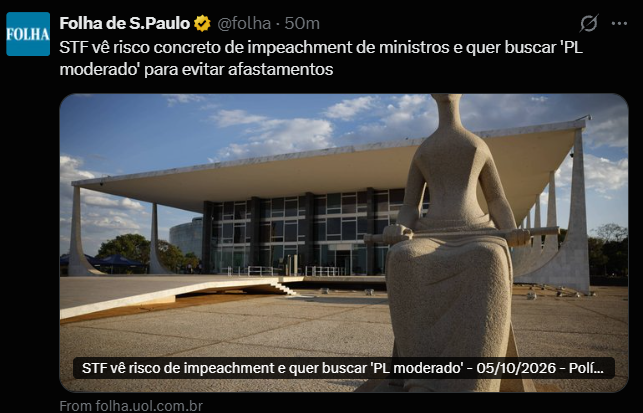
Leandro Ruschel questioned whether the bill was "moderate" and claimed that its members had been persecuting people for seven years. He said that hundreds of families had had their lives destroyed, that a hairdresser had been imprisoned for two years for a protest phrase written in lipstick, and that a father had died in jail. He also accused those responsible of subjecting the right-wing leader to torture, despite his precarious health, producing hundreds of political exiles, and establishing a state of exception. Ruschel rejected the possibility of an agreement and stated that those responsible should leave their positions that day. He also claimed that the voters who had gone to the polls the previous day would not accept their elected representatives signing an agreement without the annulment of the political convictions, the end of the persecution, and the departure of those responsible. #Política #Justiça #DireitosHumanos (translated)

Karina Michelin wrote that the 2026 elections provoked a significant change in the Senate, whose new composition would take office in February 2027. Of the 54 seats up for election, 40 would be occupied by new senators. According to her, the PL elected 19 names and would have 28 of the 81 seats, the largest party caucus at the beginning of a legislature since the 1988 Constitution. Michelin stated that the new Senate would have 49 right-wing lawmakers, 16 center, and 16 left, while the absolute majority required 41 votes. She also cited a survey from Folha indicating that at least 49 senators had already expressed support for the impeachment of Supreme Court ministers — five fewer than the 54 votes needed for a conviction. The author noted that these numbers did not signify automatic removal and said that the presidency of the Senate would be decisive. Under Davi Alcolumbre, dozens of requests against Supreme ministers had not advanced, she wrote. She recalled that Alcolumbre stated in September that there were 109 requests involving members of the Court. Michelin highlighted Rogério Marinho as one of the candidates to preside over the House and stated that he had presented a proposal to establish a deadline for analyzing impeachment requests. She also wrote that some of the elected senators campaigned advocating limits on the actions of the Supreme and the accountability of ministers for any abuse of power. According to the author, the 49 votes from the same ideological camp could allow the approval of matters by absolute majority and, if there was unity, reach the three-fifths needed to approve PECs in the Senate. She assessed that the electoral result had changed the correlation of forces in the House and could lead to discussions on issues that had remained paralyzed. #Eleições2026 #Senado #PolíticaBrasil (translated)

George Russell said he was happy to race in Malaysia and described the race in Sepang as special, highlighting the support received and the previous connection with Petronas. He assessed that the competition at the front would be tight among six of the top seven and pointed out Max as the likely leader, but stated that the others would still have chances to fight for the podium. #F1 #GP #Sepang (translated)

Jeffrey Chiquini claimed to have discovered an alleged setup by a minister of the TSE against Deltan and said that the decision had already been prepared since September 15. https://t.co/2ds7mQDkVD #TSE #Deltan #Política (translated)

David Ágape stated that he identified the advertisement among 1,428 electoral propaganda pieces against Flávio Bolsonaro. According to him, the page Mosaico Vivo published the piece between September 10 and 18, with an estimated expenditure of between $7,000 and $8,000 — about R$36,000 to R$42,000 — and an estimated reach by Meta of 6.5 million accounts in Brazil. The page had eight followers in the record preserved by Ágape's team, and Meta removed the advertisement for violating political advertising rules. The author identified the man in the video as Don Ernesto, a singer and presenter for TVT, a station maintained by the Metal Workers Union of ABC and the Union of Bank and Financial Workers of São Paulo, Osasco, and the region. In the video, Don Ernesto criticized Flávio and called him "the worst of the Bolsonaros." Ágape emphasized that his image's presence did not indicate that he or the station participated in the purchase of the advertisement. According to the transparency fields from Meta cited by Ágape, Corporativo Lam, LLC was listed as the declared advertiser and payer. He stated that the same company had shown, through its verified account on Google in Venezuela, campaigns of government bodies of Nicolás Maduro before promoting Brazilian sites that attacked Flávio. Ágape said that the person responsible for the initiative against the senator was still unknown. https://t.co/BAPcGa6q2g #Eleições2022 #FlávioBolsonaro #PublicidadePolítica (translated)

Deltan Dallagnol stated that he and Filipe Barros were leading the polls for the Senate in Paraná. He also said that Gleisi and the PT had no space in the state and declared that, nationwide, Brazil would win. As a source, he cited a survey by AtlasIntel with 1,828 respondents, a margin of error of 2 percentage points, and a confidence level of 95%, conducted between September 27 and October 2, 2026. According to Dallagnol, the survey was commissioned by AtlasIntel and registered with the TSE under number PR-05944/2026. #Senado #Eleições2026 #Liderança (translated)

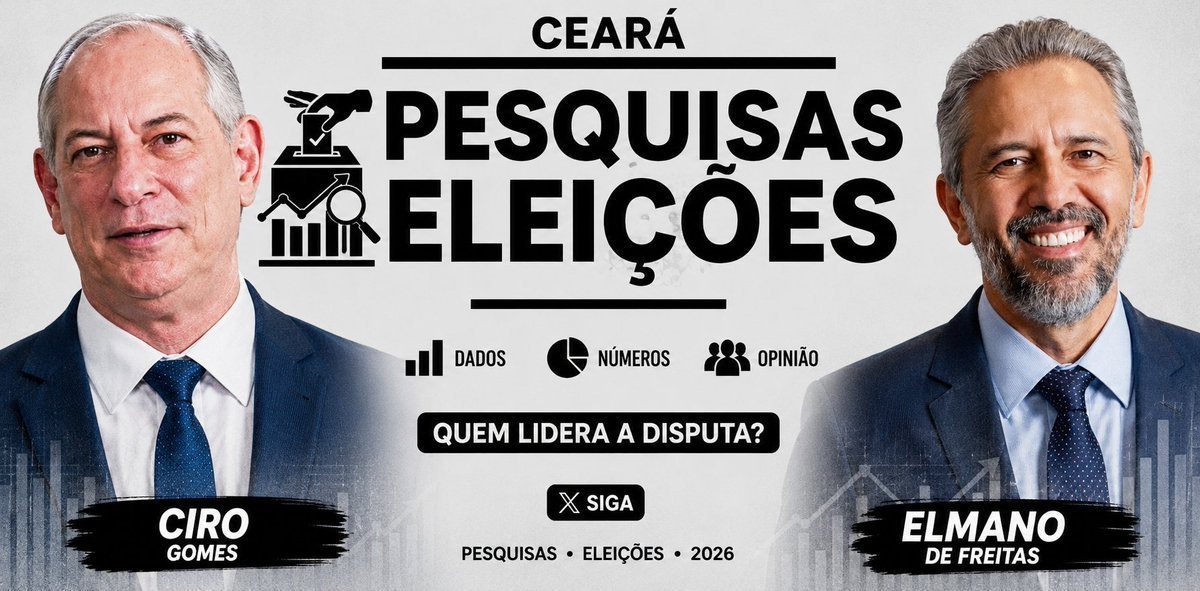
The Elections Research published numbers from a Datafolha survey for the government of Ceará in which Elmano de Freitas (PT) appeared with 50% of valid votes, compared to 47% for Ciro Gomes (PSDB). Delegate Huggo (Mission), Vera Lúcia (New) and Zé Batista (PSTU) each had 1%. Compared to the previous numbers presented, Elmano rose by 2 points, Ciro dropped by 2, Huggo and Vera Lúcia remained unchanged, and Zé Batista advanced by 1 point. In total voting intention, Elmano recorded 46% (+3) and Ciro, 44% (stable). Delegate Huggo, Vera Lúcia, and Zé Batista each had 1%; blank, null, or none totaled 4% (-2), and undecided voters made up 3% (-2). The publication stated that the race was focused on the two main candidates and compared the data to a survey from September, in which Ciro was ahead by 44% to 43%. It also noted that the three-point difference between the leaders was not fully covered by the reported margin of error, which was ±2 points, and that formal interpretation depended on the specific margin and methodology of the survey. According to the published technical sheet, the survey was commissioned by O POVO and conducted on October 2 and 3, 2026, with 1,560 interviews, a margin of error of ±2 percentage points, a confidence level of 95%, and registrations with the TSE CE-09234/2026 and BR-06469/2026. #Eleições2026 #Ceará #Datafolha (translated)

The profile Pesquisas Eleições released data from the CNT/MDA survey, according to which 47.4% approved of President Lula and 49.2% disapproved; 3.4% did not know or did not respond. Compared to the previous survey, approval had risen by 1.5 points, while disapproval had decreased by 0.5 points, the profile reported. In the evaluation of the government, 35.3% considered it excellent or good, 41.1% bad or terrible, and 22.7% regular. Another 0.9% did not know or did not respond. The profile stated that evaluations of excellent or good had increased by 1.5 points and those of bad or terrible by 1.7 points, while the regular evaluation had dropped by 2.7 points. According to the technical note released, the survey was conducted by CNT/MDA from September 30 to October 2, 2026, with 2,002 interviews nationwide. The reported margin of error was ±2.2 percentage points, with a confidence level of 95%. The registration with the TSE was BR-04756/2026. #Lula #Aprovação #Governo (translated)

Research Elections reported that in a national survey by CNT/MDA on valid votes in the first round for president, Lula (PT) had 48.6% and Flávio Bolsonaro (PL), 44.3%, a difference of 4.3 points. According to the publication, Flávio advanced 6.8 points and Lula receded 2.6. Augusto Cury (Avante) recorded 2.5%, Caiado (PSD), 2.4%, Renan Santos (Mission), 1.2%, Romeu Zema (Novo), 0.4%, and other candidates, 0.2%. The publication reported that the survey was conducted from September 30 to October 2, 2026, with 2,002 interviews, a margin of error of ±2.2 percentage points, and a confidence level of 95%. The registration in the TSE was BR-04756/2026. #Eleições2026 #Votação #Presidencial (translated)