BETA nonprofit public democratic european moderated

Search

#Ondernemers

Madelon Vos wrote that entrepreneurs, according to the CEO of DSM, needed a reliable government, but did not get one. She stated that Dutch politics trivialized the effects of the income tax in box 2 and the high rates in box 3, and that this policy severely affected entire sectors, including the Dutch crypto and precious metals sector with more than two million investors. Vos wrote that investors had to keep track of their real returns themselves, while some banks and brokers could not provide that data and the Tax Authority had not yet verified the calculations. According to her, investors would want to deduct inflation, transaction costs, currency costs, and subscription costs from that calculation. She also reported that the man who had been at the basis of the law had since advocated for the withdrawal of the amendment and the law and for a new piece of legislation. Furthermore, Vos pointed to the rising interest rates in France and the possible consequences of that for the Netherlands. She wondered if war was looming and wrote that the Netherlands was increasing pressure on Russia. https://t.co/X4T4ze43tV #ondernemen #beleggen #politiek (translated)


NOS 1d

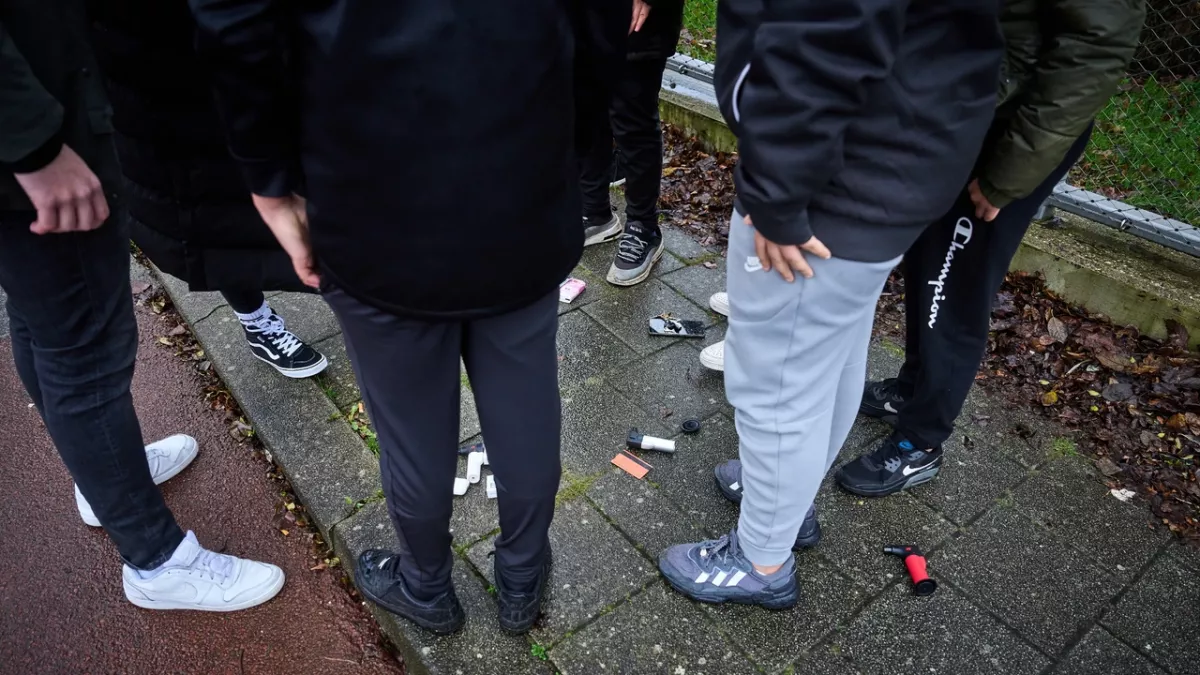
The municipality of Heerenveen is dealing with ongoing nuisance from a group of young people who are setting off dangerous fireworks, which is causing great concern among residents and entrepreneurs. #overlast #Heerenveen #jongeren (translated)

Overlast door groep jongeren in Heerenveen: 'Knopen gasflessen aan vuurwerk'

Johan De Mol wrote that a Member of the European Parliament with a favorable tax status, including a generous tax-free expense allowance and a very high pension, would come to lecture people with a corporation. #Europarlement #FiscaleRegelingen #Ondernemers (translated)

Julien De Wit wrote that a colleague had posted his testimony on LinkedIn and that he found it worth sharing. The self-employed individual mentioned that he had received chemotherapy with Taxotere and Cyclophosphamide three years earlier, followed by radiotherapy. A month after his last radiation treatment, he had returned to work, although his supervising doctor thought it was too soon according to him. He had quickly reduced his replacement income of about 40 euros per day. The colleague wrote that he worked as a self-employed individual without staff through a company and had no fixed salary, paid sick leave, or vacation pay. If he was sick or took a holiday, he earned nothing. With a full schedule ahead, he was afraid of getting sick this month, he wrote. He opposed what he considered to be negative perceptions of self-employed individuals with a management company and called for respect for the risks they themselves bore. https://t.co/JNrZ60Kq3n #zelfstandigen #ondernemen #respect (translated)

L
Le Soir 2d

The free syndicate Synova held a protest action on Friday in front of the AKT headquarters in Namur, where they urged entrepreneurs to make fairer use of the benefits provided by the government, given the growing inequality between the efforts of workers and the benefits for employers. #Synova #EmploiDurable #DialogueSocial (translated)

Le syndicat libre Synova interroge le monde patronal devant le siège d'AKT à Namur (VIDEO)

Caroline van der Plas wrote that she, together with BBB Hilversum-Wijdemeren list leader Stijn Visee, had visited the Verweij family in Nederhorst den Berg. They had discussed the uncertain future of farmers and the consequences of their disappearance for residents. Afterwards, Van der Plas would have a discussion with entrepreneurs and residents at WC Kerkelanden. https://t.co/V8PcNzv3ff #boeren #toekomst #BBB (translated)

The anti-stereotype marketing campaign of Thomas Dermine has attracted the attention of Flemish entrepreneurs by showing them that Charleroi has an emerging economic dynamism, despite prejudices. #Charleroi #Économie #Investissement (translated)

L’opération “anti-clichés wallons” de Thomas Dermine fait mouche auprès des patrons flamands

Bert Slagter wrote that the VVD positioned itself with attention to entrepreneurs, but according to him, at the same time, it introduced box 3 rates that were excessively high, put director-majority shareholders under pressure with rules about loans to their private companies, and destroyed the cryptocurrency sector with the vab. According to Slagter, entrepreneurs wanted a reliable and predictable government, while he claimed that the VVD offered them an unpredictable fiscal policy. #ondernemers #belastingen #VVD (translated)

Maurits Vande Reyde wrote that 300 civil servants at the Opera of Flanders had exceptionally favorable salary conditions and high pensions, which were transferred to their partner upon their death. He stated that, nonetheless, Vooruit pointed to entrepreneurs as the problem in the country. https://t.co/ce4wuZkno6 #ambtenaren #loonsverhoging #pensioen (translated)

Geert Noels stated that a study by Vooruit estimated the annual cost of corporate taxation at 4.2 to 4.7 billion euros, but according to him, due to significant errors, it actually amounted to about 1 billion euros. He argued that this cost could not be offset by higher taxes, which he believed would cause more harm than benefit; he advocated for better oversight of bogus self-employment. Noels identified the main mistake as the comparison between directors via a management company and employees. According to him, directors were legally self-employed and paid contributions up to a ceiling. This comparison would overestimate the estimate by more than 1 billion euros. Moreover, employer contributions were calculated based on the total labor cost instead of the gross salary, resulting in a calculation of 33 percent instead of 25 percent. Noels also disputed that there were four independent estimates: according to him, they used the same rates and distribution keys. He pointed out that estimate C assumed 24 billion euros in shifted profits, compared to about 15 billion euros in total profits in estimate A. Furthermore, factors such as the tax shift, energy crisis, inflation, the reform of corporate tax in 2017, and Pillar 2 were not included as explanations for the macro figures. Also, liquidation reserves of ordinary SMEs would have been counted as leaks. According to Noels, the study also did not take behavior effects into account, such as substitution, cessation, moving abroad, losses, or bankruptcies, and only included companies with profits. He therefore labeled the note as an unreliable basis for policy and believed that bogus self-employment should be addressed directly. Finally, he urged academics, journalists, and politicians to respect the facts when it came to entrepreneurs and risk-takers. #Vennootschapsbelasting #Economie #Belastingen (translated)

Geert Noels wrote that the memo from Vooruit about management companies contained grotesque methodological and accounting errors according to him. He stated that newspapers and parties could easily expose this and said that entrepreneurs in the country were fair game. https://t.co/ErLtEX2K0E #managementvennootschappen #ondernemen #journalistiek (translated)
Jurgen Vluijmans wrote that he had read comments on articles about entrepreneurship and corporations. The familiar arguments stood out to him less than what he described as the strongly negative sentiment towards entrepreneurs in Belgium among people who do not run their own businesses. He stated that this was an observation, not a value judgment, and that the attitude shocked him because it was, in his opinion, much worse than he had expected. #ondernemen #Belgium #sentiment (translated)
Maurits Vande Reyde wrote that "unreliability" was the word he heard most often from people about their governments. He stated that it had been promised to lower inheritance tax by thousands of euros in 2024, but that promise was not fulfilled and was revoked just two years later. Additionally, the registration fees were supposed to be lowered in 2024, only to increase by 5,000 euros per home less than two years later. Vande Reyde said that a budget was presented as "balanced," while the debt, according to him, had risen sharply in recent years and would continue to do so in the coming years. He also referred to a long list of taxes for entrepreneurs, which he claimed was too extensive to enumerate. Not Trump, Putin, or the global economy, but what he deemed a completely unreliable government was the biggest source of mass discontent and anger among people, he wrote. #onbetrouwbaarheid #regering #belasting (translated)

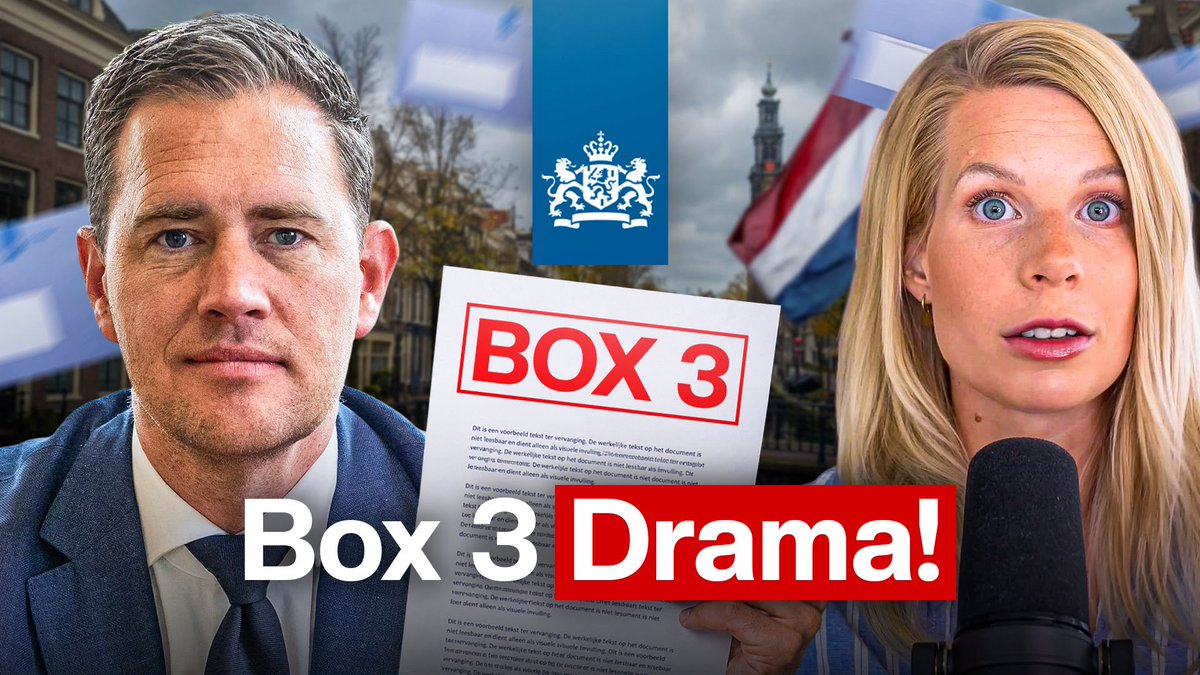
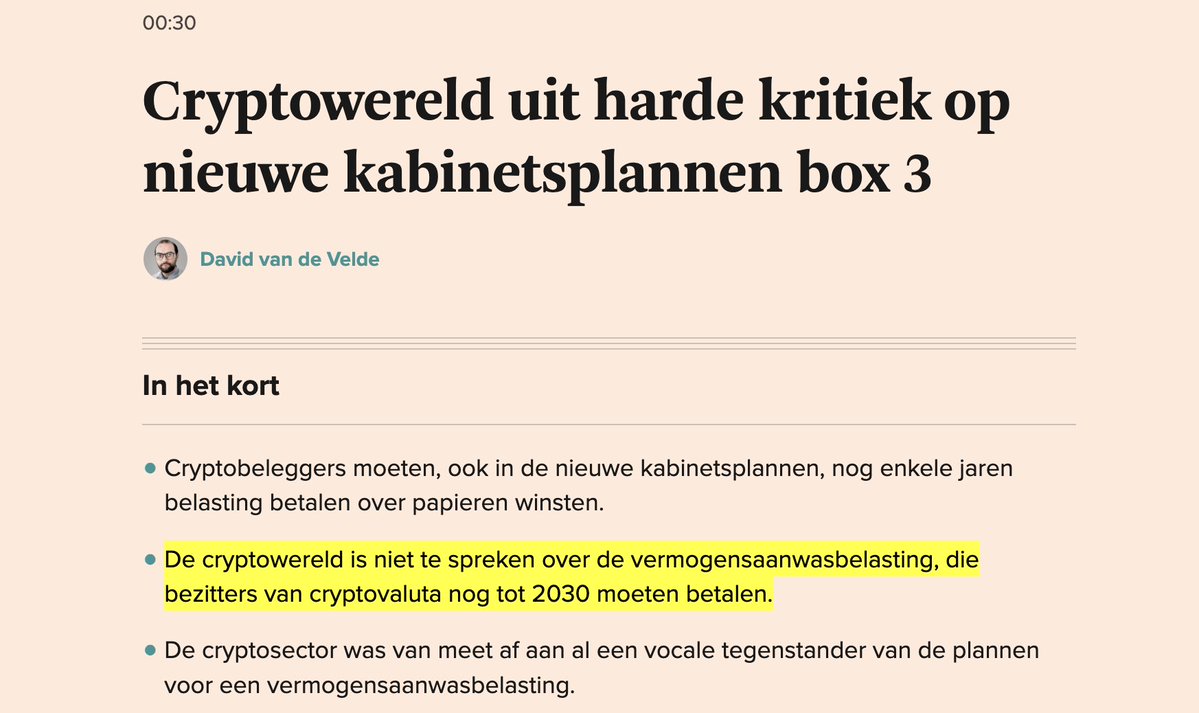
Madelon Vos wrote that the plans for the new box 3 system, which were announced last week, had caused unrest among politicians, savers, entrepreneurs, and investors. Although the capital gains tax was presented as a victory, she argued that small savers and investors would be the victims. Additionally, people would temporarily have to pay taxes annually on paper gains from bitcoin and precious metals, even if they had not sold anything. Vos also pointed to rising global interest rates and a greater interest rate differential between France and Germany. She wondered what that indicated about investor confidence and how much room governments still had if inflation and scarcity of raw materials further pushed up interest rates. According to her, the higher interest rates would also affect the real estate market: Dutch houses could depreciate in real terms next year. In an episode of Madelon Praat, she discussed how taxes, interest, and inflation impacted people's wealth. https://t.co/hVinv3HF4l #belasting #rente #inflatie (translated)

Weird Duk wrote in a YouTube link that farmers, fishermen, brewers, savers, entrepreneurs, and the middle class, according to him, were all going under. #middenstand #boeren #ondernemers (translated)

Jitse Groen wrote that the Netherlands, according to him, pursued economic growth, more housing, a leading position in AI, food security, fewer regulations, better mobility, and energy independence, but simultaneously enacted policies that countered these goals. He mentioned, among other things, taxes on the economy and rental housing, opposition to data centers and farmers, the growth of government, deteriorating infrastructure, and the lack of domestic gas production. Groen warned that box 3, on top of what he described as overreaching legislation, could also drive away entrepreneurs, investors, and crypto companies. The lack of vision, according to him, would be held against the current generation of politicians for a long time. #Economie #Politiek #Toekomst (translated)

NOS 1w

The new Self-Employed Law, which comes into effect in 2028, aims to provide clarity for self-employed individuals and clients by establishing specific conditions for self-employment, including the requirement for self-employed individuals to register with the Chamber of Commerce and work for at least three different clients within two years. #Zelfstandigenwet #zzp #werkgevers (translated)

Vragen over de nieuwe Zelfstandigenwet: wat verandert er per 2028?

The Dutch pays a lot at the pump. 33 cents more tax per liter of gasoline than Germany and 24 cents more than Belgium. Refueling and shopping we do across the border: a disaster for entrepreneurs. My proposal: 💶 17 cents extra tax reduction. One party already says no..👇🏻#AFB #benzine #accijns #ondernemers (translated)

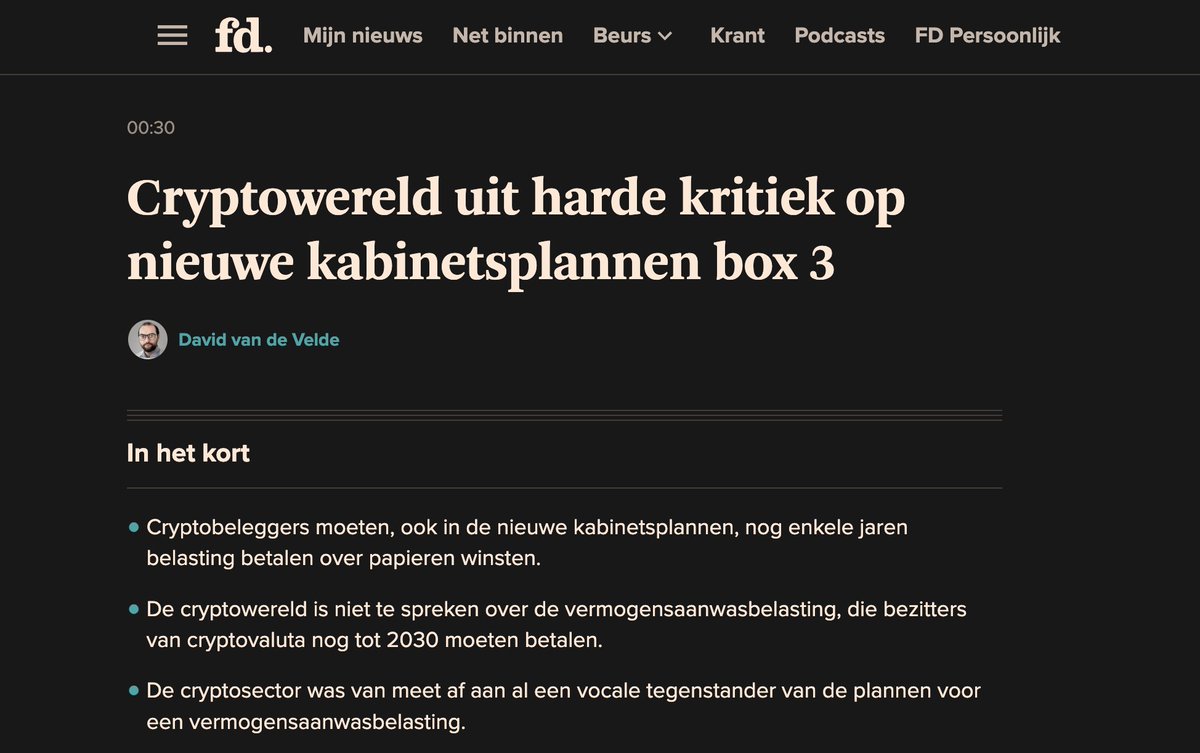
The box 3 plan contains a harmful crypto gap. As a result, it is not fiscally neutral, acts as a competitor disturber, undermines entrepreneurs, incites undesirable behavior among investors, and causes unforeseen costs for citizens. But: recovery can be quick. 👇🧵 https://t.co/wMhByoQFjA #belasting #cryptovaluta #ondernemen (translated)

The VVD destroys the crypto and precious metals sector. The cabinet pushes investors in gold & bitcoin towards ETFs at banks and brokers. At the expense of entrepreneurs in crypto and precious metals. "It's just until 2030" as a sweetener. No guarantee that this will succeed. https://t.co/35VrLYRI7U #crypto #goud #beleggers (translated)