WRLD

Search

#odmowa
Waldemar🇵🇱🇳🇱🏴‍☠️ Wrld summary 2w

Waldemar wrote that Nawrocki went to Trenčín with the belief that he would represent Poland and influence the course of events, but Ursula von der Leyen quickly dampened those expectations by withdrawing from the joint conference. The author considered this gesture as support for Donald Tusk's government and a refusal to legitimize Nawrocki's position in the dispute over the Constitutional Tribunal. He claimed that European leaders saw the difference between actions aimed at restoring the rule of law and deepening the crisis. Waldemar also assessed that the visit undermined the narrative of Nawrocki's international authority and his diplomatic offensive. He wrote that Nawrocki was diminishing the office's stature and becoming a burden, while Tusk was a partner with whom European leaders wanted to engage. #Polska #TrybunałKonstytucyjny #Europa (translated)
3336
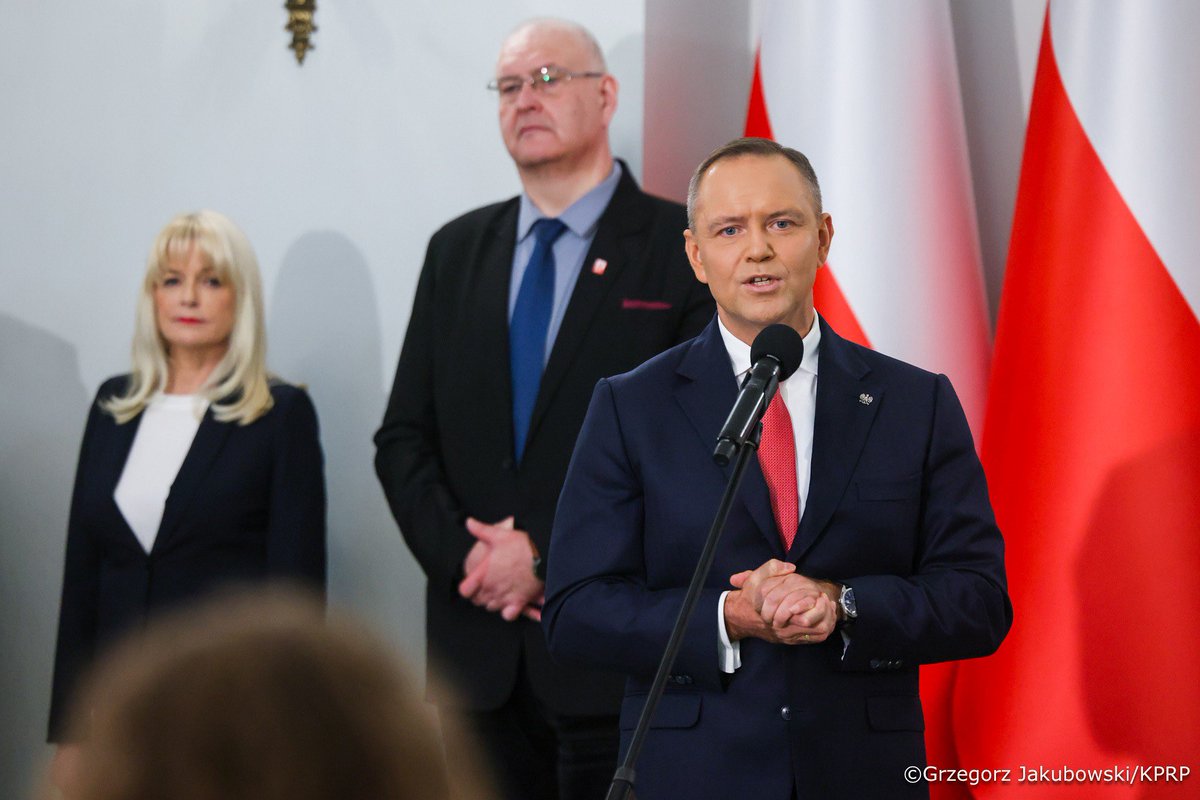
Karol Nawrocki Wrld summary 2w
Polish politician and historian, President of the Republic of Poland since 2025

During a secret meeting of the National Security Council, a dispute arose between the Prime Minister and the President regarding the Constitutional Tribunal — Nawrocki accused Tusk of the entry to the Constitutional Tribunal being a "crime against the Constitution," to which Tusk responded in a similar vein — that refusing to swear in judges is a violation of the Constitution. #TrybunałKonstytucyjny #Polityka #KryzysPraworządności (translated)

3225
Stanisław Żaryn Wrld summary 3w
Polish official, journalist

The author considered Marcin Przydacz's questions very important. He wrote that the deputy minister of foreign affairs does not have a clearance and has allegations against him, and the director of the Ministry of Foreign Affairs recently received a denial. He added that there are more such stories in this team, and stated that there are people in the leadership of some special services who, in his opinion, should not be there. #Polska #polityka #bezpieczeństwo #PL (translated)

3012
Jerzy Kwaśniewski Wrld summary 4w
Polish lawyer

The author of the entry stated that the government that employed the addressee did not publish 85 rulings of the Constitutional Tribunal. He added that each such refusal deprived citizens of the right to constitutional review. #konstytucja #prawo #demokracja #PL (translated)

3481
Kamil Zaradkiewicz Wrld summary Oct 20

Kamil Zaradkiewicz challenged the interpretation of Dr. Berek, according to which refusal to take an oath means renunciation of the office. He pointed out that Article 4, paragraph 2 of the law on the status of Constitutional Tribunal judges states that refusal "is equivalent to renunciation," which — as he explained — establishes a legal fiction equating the effects of both situations, but does not identify them. Zaradkiewicz argued that a person refusing to take an oath does not have the same status as a person renouncing the office. #prawo #sędziowie #ustawa (translated)

3496
Patryk Michalski Wrld summary Oct 20

Patryk Michalski wrote that he did not know whether the president did not understand the difference between appointing judges of common courts, administrative courts, and the Supreme Court, and the selection of judges of the Constitutional Tribunal, or whether he was intentionally misleading. He assessed that in both cases, the president's actions were inappropriate and unbefitting of the head of state. Michalski pointed out that judges of the Tribunal are elected by the Sejm, and the selected person takes an oath before the president. He added that in his opinion, the person becomes a judge even before taking the oath, and the law stipulates that refusal to take the oath means resignation from the position. He noted that a judge of a common court is a person appointed by the president who has taken the oath before him. #Polityka #Prawo #Sędziowie (translated)

3030
Maciej Berek Wrld summary Oct 19

Maciej Berek explained that judges of common and administrative courts are appointed by the President at the request of the National Judicial Council, in accordance with Article 179 of the Constitution, and assuming these positions requires taking an oath before the President. He referred in this context to Article 66 § 1 of the Law on the Organization of Common Courts and Article 5 § 1 of the Law on the Organization of Administrative Courts. He indicated that judges of the Constitutional Tribunal are elected by the Sejm based on Article 194 § 1 of the Constitution, and refusal to take the oath before the President means resigning from the position, in accordance with Article 4 § 1 and 2 of the Act on the Status of Judges of the Constitutional Tribunal. Berek argued that one can only resign from an office that has already been assumed, which — as he wrote — means that the oath is taken by a person who is a judge of the Constitutional Tribunal. He added that he assumes this distinction is understandable to every public authority. #sędziowie #prawo #Konstytucja (translated)

3380
Rzeczpospolita Oct 19

The Main Police Headquarters decided to publicly address the controversy related to the refusal to submit a request for a Red Notice for the Russian spy Pawel Rubcow, accusing "Rzeczpospolita" of false information, while the court confirmed that the request was rejected due to the political nature of the charge. #PolskaPolicja #szpiegostwo #Rzeczpospolita (translated)

www.rp.pl
Prawda o czerwonej nocie wobec rosyjskiego szpiega niewygodna dla policji. Dlatego winnym została „Rzeczpospolita”
2915
Piotr Kusznieruk Wrld summary Oct 18

Piotr Kusznieruk accused Wielowieyska of accepting the police's version as an established fact and assessing the detained individual before the court's decision. He questioned the legal basis for identifying the man who — as he wrote — was calmly standing at the crosswalk, as well as the attempt to take him aside. He asked whether the refusal to provide personal information justified intervention. Kusznieruk noted that pushing away the officers and fleeing did not exempt the assessment of the legality and proportionality of the force used. He also pointed out the choking of the subdued individual, the vulgarities and threats that — as he wrote — were audible on the recording, and questioned whether such behavior was within the standards of human rights. He added that the court had refused to detain the man, and according to the defense, it concluded that the prosecutor had not even demonstrated a high probability of the alleged act being committed. He characterized this as more than just a routine refusal of detention. He deemed the attribution of a crisis to the detainee based on his behavior as public stigmatization. He also believed that publicly presenting him as an aggressor before the court's decision could be seen as incitement, and that journalists should monitor power, rather than act as its spokesperson. #prawaCzłowieka #Polska #policja (translated)

3266
Instytut Ordo Iuris Wrld summary Oct 18

The Ordo Iuris Institute wrote that the refusal to provide an explanation by the suspect should not be a basis for temporary detention. Attorney Magda Majkowska from Ordo Iuris, Piotr's defender, said that this is his right and that the prosecution cannot justify detention based on it. She added that she has never encountered a case where the mere refusal led to detention. In her opinion, this could mean using detention to force the suspect to provide an explanation in order to regain his freedom. The Institute defined the right to remain silent as a fundamental procedural guarantee and stated that exercising it should not be associated with negative consequences. #Prawo #Sprawiedliwość #Obrona (translated)

3033
Krzysztof Sałek KO Stalowa Wola Wrld summary Oct 18

Krzysztof Sałek from KO in Stalowa Wola referenced a statement by Lech Kaczyński about delay despite a clear obligation and the necessity to act according to the Constitution. He claimed that Nawrocki violated the Constitution because inaction also means refusal. He also wrote that the current government wanted to carry out a constitutional reset, but Duda vetoed it, and the recipients of his post voted against it. He accused them of lying. https://t.co/fNpi4xOmEb #Konstytucja #Polska #Kaczyński (translated)

3033
Prawnicy dla Polski Wrld summary Oct 18

Lawyers for Poland stated that Piotr W. did not admit to the charges and refused to provide explanations. According to them, the prosecutor requested a one-month detention, highlighting the need to secure forensic psychiatric evaluations. They added that the prosecutor's spokesperson confirmed the suspect's fainting and his transport to the hospital. The authors emphasized that detention is not a punishment before conviction, and the refusal to provide explanations is the suspect's right and does not prove his guilt. #Prokuratura #Areszt #Prawo (translated)

3500
Piotr Kusznieruk Wrld summary Oct 17

Piotr Kusznieruk wrote that the revealed recordings raised questions about the reason for the police check on the man who was, as he suggested, connected to the protest. According to his reconstruction, the officers followed the man for several dozen meters, demanded his personal information without providing a specific reason for the check, and then incapacitated him inside the building. Kusznieruk noted that the man pushed the officers away and fled inside, but he believed that this did not explain the earlier decision to conduct a check. The author claimed that the man lost consciousness during the intervention, and the knife found with him was not presented as having been used. He also questioned the proportionality of the force used and whether the man deliberately attacked the policewoman when the window broke. Furthermore, he described that several hours later, the detained man was informed that he could meet with lawyer Magdalena Leszczyńska if he provided his details. According to Kusznieruk, the man did not know the lawyer and did not want to see her, while the police considered this a refusal to contact a defense attorney. Kusznieruk also criticized the statement by Prime Minister Donald Tusk, who — as he wrote — linked the matter to President Nawrocki. He asked whether the police acted on the orders of superiors, collected data on demonstration participants, and previously observed the man. He directed questions to the Polish Police and the Ministry of Interior and Administration regarding who ordered the identification of Piotr and on what basis. He warned that if the identification of protesters occurred without legal grounds, it could mean using the state apparatus to control citizens. #Polska #Policja #protesty (translated)

3501
sławek jastrzębowski 🇵🇱 Wrld summary Oct 17

Sławek Jastrzębowski wrote that the police officers did not provide the legal basis for identification. He referred to the ruling of the Supreme Court from December 17, 2025, in case file No. II KK 473/25, brought in cassation by the Ombudsman. He pointed out that the court held that a citizen can refuse to provide data if the request has no legal basis, and the refusal does not constitute an offense. Jastrzębowski added that identification interferes with personal freedom and is subject to legal scrutiny, after which he demanded the immediate release of the policewoman and referred the case to the prosecutor. #prawo #policja #wolność (translated)

3384
Koneser Związku Radzieckiego/X Wrld summary Oct 17

The detainee refused to meet with a lawyer even before refusing to provide his personal information, wrote the Soviet Union's Koneser. He added that when the officer informed the detainee about the possibility of contacting a lawyer, he refused to provide his information as well as to make contact. https://t.co/7JxHgw3kpy #prawo #sprawiedliwość #oszustwo (translated)

3034
Arkadiusz Myrcha Wrld summary Oct 17
Polish politician and deputy

The author encouraged watching the footage from the cameras, which he described as pertaining to the refusal to show documents, an attack on police officers, and a flight. #Policja #Bezpieczeństwo #Prawo #PL (translated)

2801
Onet.pl Oct 15

The president, commenting on the situation related to Maciej Berek's oath, emphasized that it is his duty to refuse to accept the oath from the candidate until his legal qualifications have been confirmed. #Prawo #TrybunałKonstytucyjny #Polityka (translated)

www.onet.pl
Prezydent o ślubowaniu Macieja Berka. "Scenariusz istnego cyrku"
3154
Szalony Reporter Wrld summary Oct 15

The author claimed that "Orange" was working for Russia from the very beginning, not the USA, and only created an illusion. He cited the argument with Zelensky in the White House, the refusal to assist Ukraine, and the tariffs imposed on the EU as examples. He wrote that these actions were beneficial for Russia, from which their author withdrew under the influence of strong reactions from the world. #Polityka #Ukraina #Rosja #RU #US #UA #EU (translated)

3271
Max Hübner Wrld summary Oct 14

Max Hübner assessed that Donald Tusk's recording regarding the restoration of the rule of law was a sign of failure. He noted that the Prime Minister published it in the afternoon, not in the morning as usual, which—according to Hübner—indicated that he had previously expected success. Hübner wrote that taking over the Constitutional Tribunal was supposed to be easy and involve the swearing-in of Berek and entering the CT with the assistance of the SOP and the Police. He claimed that this did not happen thanks to the defenders of the Tribunal and the firm stance of Bogdan Święczkowski. According to him, the recording was meant to calm disappointed government supporters who had been waiting for an announcement of success since the morning, and who later criticized the lack of results from his actions. Hübner added that the refusal of the Warsaw Police garrison to execute the order to storm the CT also hit the rulers hard. He wrote that Tusk was furious and could have been ready to remove the protesters and Święczkowski, or even destroy the Tribunal building to achieve his goal. He believed that the Prime Minister had to take action, as otherwise, he faced a political failure a year before the elections. #Polska #Praworządność #Tusk (translated)

2688
r00t🇪🇺 Wrld summary Oct 14

The author approached Święczkowski to differentiate the selection of a Constitutional Tribunal judge from the statutory conditions for the commencement of their duties. He pointed out that according to Article 194, paragraph 1 of the Constitution, judges of the Tribunal are selected by the Sejm, while Article 5 of the Act on the status of Constitutional Tribunal judges links the establishment of an employment relationship with the taking of an oath. He indicated that these are separate legal actions. He also cited point 8.5.1 of the justification of the judgment K 34/15, which — as he wrote — indicated that the presidential competence to receive the oath does not imply participation in shaping the composition of the Tribunal. He asked what legal basis would allow the president, by refusing to receive the oath, to indefinitely prevent a duly elected Constitutional Tribunal judge from commencing their office. #TrybunałKonstytucyjny #prawo #Polska (translated)

3039