WRLD

Search

#Hyvinvointi

Sture Fjäder wrote to Ulla that in his opinion, it was not the responsibility of society to finance anyone's housing. According to him, everyone should take care of their own housing, which was one of the fundamental principles of a welfare society. #hyvinvointi #yhteiskunta #asuminen (translated)


1581
Roni Arvonen 1d

Roni Arvonen wrote that the aforementioned writing confirmed to him that the recipient hardly cared about the well-being of Finns, nor especially about their safety. #hyvinvointi #turvallisuus #Suomi (translated)

2076
Miko Bergbom 1d

Miko Bergbom wrote that the Green youth hoped for "free money" for immigrants and reminded that, according to him, this was taxpayer money. He stated that Finland could not afford the current situation and demanded a swift transition to a citizenship-based social security system. According to Bergbom, the welfare state was at risk if this was not done, as the money, in his view, was running out. Bergbom claimed that the share of immigrants in certain social benefits clearly exceeded their share of the population. He said that in the capital region, their share of the total amount of social assistance was already about 50 percent. He stated that this situation should raise concerns, but he opposed new unconditional benefits for immigrants proposed by the left. #maahanmuutto #sosiaaliturva #verotus (translated)

2591
Anna-Kaisa Ikonen 4d

The author stated that he had presented a procurement data repository to the government, which he claimed would make the procurements and purchase invoices of the state, municipalities, and welfare regions visible to all. He demanded more transparency in the use of public funds and competition in the market, and mentioned that the processing of the law would begin in parliament on the same day. https://t.co/NBKlUNWm5Y https://t.co/7DUZlMcdTg #avoimuus #hankinnat #eduskunta #FI (translated)

3140
Pauli Vahtera 4d

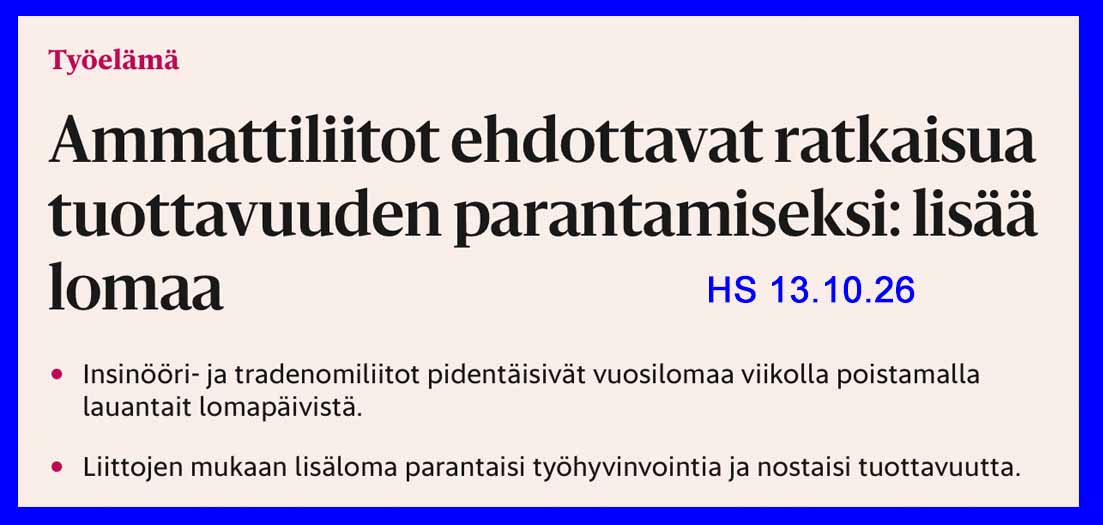
Pauli Vahtera criticized the Engineer Association and Business Professionals for wanting to extend annual leave by a week by removing Saturdays from vacation days. According to him, in the private sector, annual leave accrued to 30 days including Saturdays, which effectively amounts to five weeks, while in the public sector, the majority of employees received 38 days of leave without Saturdays. Vahtera compared this to a two-month vacation if two sick days were included. Vahtera disputed the claims of union leaders that a longer vacation would reduce absenteeism. He wrote that in the public sector, there were more sick days than in the private sector, and absences totaled three months. According to him, absences increased the need for substitutes, and one in four employees was continuously absent in the public sector. Vahtera stated that he had written about public sector vacations for Iltalehti back in 2010 and estimated that standardizing vacations with the private sector would free up 40,000 employees from the public sector to alleviate labor shortages. #työelämä #lomat #yksityissektori (translated)

2927
Veli Karimies 5d

Veli Karimies wrote to a user named Sukkola that the issues of immigration had been properly warned about for decades, but instead of condemning and defaming those who warned, problems should have been addressed in time, in his opinion. He said that warners should have been listened to, as the next group was now emerging. #maahanmuutto #hyvinvointi #keskustelu (translated)

2936
Otto Juote 5d

Otto Juote wrote that the debt limits of the state, municipalities, and welfare regions were starting to be reached and that Finland urgently needed, according to him, a fourth level of government that would have a clean credit history. #Suomi #velka #hallinta (translated)

2938
Piia Metsähonkala 6d

Piia Metsähonkala wrote that the welfare area saved on intensive care and cancer medications. She compared this to the fact that welfare areas spent about 35.3 million euros on interpretation and translation services, referring to information published by Yle on May 19, 2025. #sote #priorisointi https://t.co/Ld05Chzh7F #hyvinvointi #terveydenhuolto #sote (translated)

2946

Sture Fjäder wrote that he agreed with the Minister of Finance and supported lowering income tax as well as reducing the welfare state by cuts. #tuloverotus #verot #talous #hyvinvointi (translated)

3405
Rami Kurimo 1w

Rami Kurimo commented on the government's decision and wrote that in the future, people would have better opportunities to find out what the state, welfare areas, and municipalities purchased, from whom, and for what amount. He referred to Helsingin Sanomat as a source. https://t.co/8ALlDU3Vbc #hallitus #oikeudet #läpinäkyvyys (translated)

3535
Juho Romakkaniemi 1w

Juho Romakkaniemi wrote that taxation was eased for this year and the annual tax revenue estimate was adjusted upward by 1.1 billion. According to him, reducing high marginal tax rates on labor increases economic activity and consumption. Romakkaniemi assessed that raising taxes on high earners would likely not increase tax revenue, but would weaken the overall well-being of Finns. #verotus #talous #hyvinvointi (translated)

2856
Jari Mäkäräinen 2w

Jari Mäkäräinen criticized Yle for often choosing female journalists to incite moral panic, according to him. He interpreted Yle's analysis as showing that support for the National Coalition Party among women had dropped to 12 percent and that the Finns Party had surpassed this party. However, according to Mäkäräinen, women were not punishing the National Coalition Party for its policies but for its austerity measures, and men were supporting the state. Mäkäräinen believed that the decline in women's support was due to the impact of budget cuts on sectors predominantly employing women, such as social services, organizations, and public services. In his view, this did not make the cuts unjust, but rather highlighted their effects. He mentioned the Social Democratic Party, the Left Alliance, and the Centre Party as the most popular parties among women and claimed that the left proposed tax increases amounting to nine billion euros. According to Mäkäräinen, the costs of these increases would fall on men who work overtime, start businesses, and pay progressive taxes. Mäkäräinen assessed that the issue for the National Coalition Party was its attempt to soften difficult decisions, while the Finns Party spoke about the same issues more directly. He argued that men were underrepresented in the care sector and overrepresented in dangerous jobs, entrepreneurship, and at the high end of the tax revenue spectrum. In his opinion, the National Coalition Party should maintain its stance even if it lost some female support, as this could help it win over voters who support the sustainability of the state. https://t.co/DfwLyPN03s #Politiikka #NaistenOikeudet #Taloustieto (translated)

2972
Seida Sohrabi 2w

Seida Sohrabi reported that her initiative to ban face coverings was passed by the Helsinki City Council. According to her, Helsinki will add a requirement for visibility and recognizability of faces in the guidelines for schools, daycare centers, and educational institutions. Sohrabi justified the visibility of faces with safety, identification, interaction, and the principles of a safe space. She also referred to the city’s commitment to supporting girls' equal learning and the goals of the city strategy to enhance the well-being of children and youth and the equal right to education for every child. (translated)

3659
mtvuutiset.fi 2w

The Ministry of Finance proposes a gradual increase of the retirement age to 70, which could increase the number of employed individuals, but at the same time, the ministry intends to cut home care support and reduce the number of municipalities and welfare regions. #Eläke #Työelämä #Politiikka (translated)

www.mtvuutiset.fi
Eläkeikä halutaan nostaa 70 vuoteen – näin se tapahtuisi
2173
Maria Rautanen 💎 #turvemuija 2w

Maria Rautanen wrote that a law was being prepared in Finland that would require the installation of solar panels on existing public buildings larger than 250 m² starting in 2031. She linked the preparation to the EU's Energy Efficiency Directive for Buildings and asked whether the effects of the directive were adequately assessed in Finnish conditions. Rautanen argued that Finland could not be compared to sunny Mediterranean countries that used a lot of fossil fuels. She noted that Finland's electricity consumption emission factor was only 26 g CO₂/kWh in 2025 and pointed out that solar panels produced energy mostly in the summer when the electricity system was already low-emission and energy consumption was lower. She wrote that the solar panel production chain was heavily concentrated in China and that a lot of coal-generated electricity was still used in their manufacturing. According to Rautanen, 78,000 MW of new coal power was commissioned in China in 2025. Rautanen asked who would pay for the new investments while municipalities were balancing their budgets and welfare areas were looking for savings. She demanded a calculation of the costs and financing of the investments, as well as how much the solar panels made in China would reduce Finland's CO₂ emissions over their entire lifespan. She also questioned whether the panels would offset their carbon footprint during production and assessed that the rationality of the directive in Finland could not be determined without a calculation based on Finnish conditions. https://t.co/ba6sqYwZ2l #Aurinkoenergia #Energiatehokkuus #Suomi (translated)

3324
Jari Sarasvuo 2w

Jari Sarasvuo believed that now was a historically opportune moment to get licensing authorities to change their practices. He justified his view with the well-being of the entire nation and called for mines, factories, and other sources of prosperity in Finland. Sarasvuo advocated for the reindustrialization of the country and the streamlining of licensing practices. #hyvinvointi #teollisuus #kaivokset (translated)

3095
Jari Sarasvuo 2w

Jari Sarasvuo wrote that wealthier nations received, according to him, income transfers for their pensions and home renovations. He estimated that this did not affect his own standard of living, but he felt a bit sorry for the young, less fortunate, and the elderly. #tuloerot #sosiaaliturva #hyvinvointi (translated)

2981
Heikki Pursiainen 2w

Heikki Pursiainen criticized Finnish economic discussion as limited based on two recently published columns in Helsingin Sanomat. According to him, Korkman described what should not be cut and believed that adjustments were necessary but did not propose any cuts. Pursiainen claimed that Korkman also criticized the government’s policies without offering alternatives. Pursiainen wrote that he found Teittinen’s reflections good in themselves but believed they underestimated Finns' ability to impact matters. He argued that Teittinen suggested that adjustments would probably be politically impossible and that Finland's fate depended on economic conditions and Russia. Pursiainen assessed that there could be many actions: he mentioned more encouraging social security, cutting business subsidies, tuition fees, and abandoning incentives for staying home as a parent. He added that for conservatives, a smaller public sector was a goal and not a reason for lamenting, and in his view, adjustments did not threaten the foundations of the welfare state. Pursiainen indicated that economists should also present their own solutions for discussion and negotiation. #Suomi #Taloustiede #Politiikka (translated)

2752
Päivi Korpivaara 🇫🇮 2w

Päivi Korpivaara wrote that the focus on degrees in educational institutions, according to her, resulted in degrees instead of skilled professionals. She compared this to welfare areas, whose focus on diagnoses she claimed produced diagnoses instead of treatment. #koulutus #hyvinvointi #osaaminen (translated)
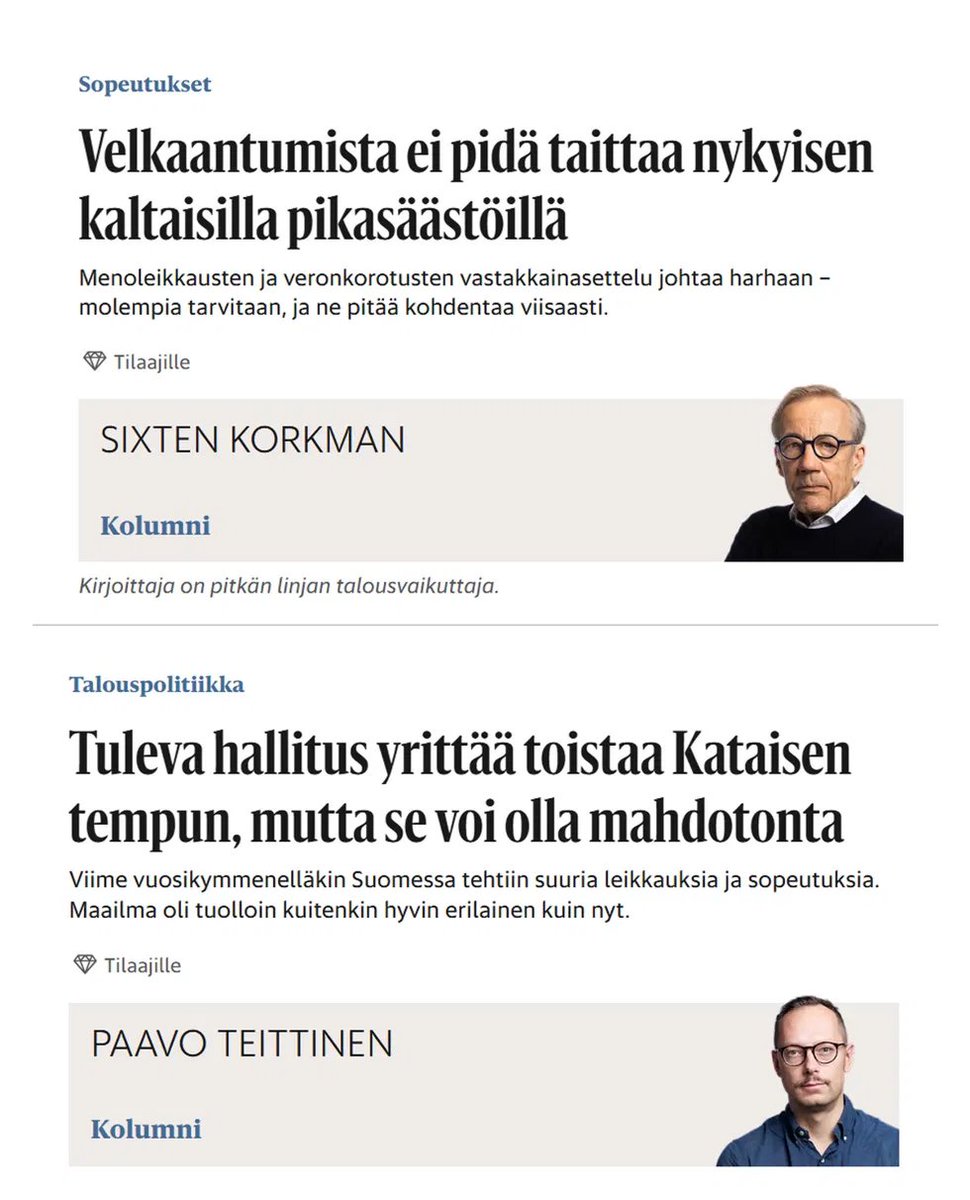
11852
Sami Pakarinen 2w

Distrust leads young people to seek a Plan B. Many save or invest. Faith is also wavering in healthcare and elderly care. Private insurance is being obtained for security. "This could trigger a spiral that destroys the welfare state." This is a completely unfounded fear, where cause and effect are confused. Young people’s Plan B reduces dependence on the state, as it should in this situation. As Milton Friedman noted, tax cuts are the only effective way to force public authority into real spending discipline and efficiency. When people have more of their earned income left in their hands, it also creates room for economic growth, without which no service can function. Our welfare society will renew itself as has happened in Sweden. This development should also be seen in terms of opportunities, not threats. Young people's voluntary preparation will not destroy the welfare state but will make it viable. Forward. https://t.co/3EvGbOOTRS #Hyvinvointivaltio #Nuoret #TaloudellinenKasvu (translated)

12100