BETA nonprofit public democratic european moderated

Search

#julkinen

A young Finnish person reported that British Christian police officer Luke Salmons, 46, won a legal battle against police administration. According to the report, Salmons challenged the claim that Islam is a religion of peace in diversity training and raised questions about jihad, Hamas, and Gaza. He was suspended from work two days after the training, and the police department deemed him guilty of a serious misconduct. Salmons was added to the Police Barred List, which effectively prevented him from working in law enforcement. The young Finnish person wrote that Salmons appealed the decision, and North Yorkshire Chief Constable Tim Forber later determined that it was not a serious misconduct nor a breach of professional standards. Salmons was then removed from the barred list. He subsequently filed a lawsuit for religious discrimination and harassment, as well as for violations of his freedom of religion and speech. North Yorkshire Police settled the matter before it progressed to an employment tribunal, and Salmons received financial compensation from the police. The amount of the settlement was not disclosed in the report. #oikeus #uskonnonvapautta #monimuotoisuus (translated)


Klaus 24h

Klaus said he had responded to a user named Sukkola, who he claimed had blocked him. He stated that his criticism was directed at Said Aw-Musse's position as a religious authority rather than at his personal actions. Klaus described classical Sunni Islam as a tradition in which sharia is seen as divinely ordained and as a legal system superior to human laws. According to him, it included legal, moral, and social rules regarding, among other things, testimony, inheritance, apostasy, and legislative authority. Klaus wrote that Aw-Musse had studied theology in Saudi Arabia and worked in a mosque where the teachings of Muhammad ibn Abd al-Wahhab had been used. He described this figure as an ultra-conservative thinker who demanded the return of Islam to its literal roots. According to Klaus, Aw-Musse's refusal to clarify his position on the primacy of Finnish law and the status of sharia justified suspicion. Merely following the law, in his opinion, did not indicate whether he considered the constitutional order of Finland to be just and final or a temporary imposition. Klaus expressed a desire to know what kind of Finland Aw-Musse envisioned in 50 or 100 years. Klaus believed that questions regarding women's rights, freedom of speech, freedom of religion, and criminal law were not leading him into a trap but were inquiries into whether Aw-Musse accepted the principles of the Finnish rule of law. He deemed Aw-Musse's public stance significant for its societal relevance due to his religious role. According to Klaus, integration required not only adherence to the law but also acceptance of fundamental values. #uskonto #oikeudet #kulttuuri (translated)

Jussi Halme wrote that the price of the 300,000-euro artwork in Hämeenlinna had been justified by tens of thousands of euros spent on public communication and marketing. According to him, the previously unnecessary spending on communication in the public sector was not a valid reason for the price of the artwork. https://t.co/lxOmb8SeZa #Hämeenlinna #julkinensektori #viestintä (translated)

Tuomo Saarni asked why the public sector was allowed to spend money recklessly without consequences. He urged reading about what the welfare area was ready to pay 170,000 euros for without bidding. At the same time, he criticized a person who had stated they wanted to pay higher taxes, deeming this unreasonable. (translated)

Tuomo Saarni pondered the significance of organizations and development aid, stating that he would rather raise the retirement age than give them up. According to him, salaries in the public sector's middle management and above were extremely high while the private sector struggled with profitability. He also wrote that solo entrepreneurs ceased their operations because they could not manage their YEL payments, and believed that the value map of society was misaligned. #kehitysapu #yrittäjyys #julkinensektori (translated)

Raimo Savipakka wrote that he agrees with Jari. He urged to reduce the public sector, development aid, and the status of the nobility, as well as to carry out municipal mergers and reduce the number of social and healthcare regions. According to Savipakka, pensions should not be touched, however. https://t.co/adBi50XaJ9 #Suomi #politiikka #talous (translated)

Jari Mäkäräinen criticized Yle for often choosing female journalists to incite moral panic, according to him. He interpreted Yle's analysis as showing that support for the National Coalition Party among women had dropped to 12 percent and that the Finns Party had surpassed this party. However, according to Mäkäräinen, women were not punishing the National Coalition Party for its policies but for its austerity measures, and men were supporting the state. Mäkäräinen believed that the decline in women's support was due to the impact of budget cuts on sectors predominantly employing women, such as social services, organizations, and public services. In his view, this did not make the cuts unjust, but rather highlighted their effects. He mentioned the Social Democratic Party, the Left Alliance, and the Centre Party as the most popular parties among women and claimed that the left proposed tax increases amounting to nine billion euros. According to Mäkäräinen, the costs of these increases would fall on men who work overtime, start businesses, and pay progressive taxes. Mäkäräinen assessed that the issue for the National Coalition Party was its attempt to soften difficult decisions, while the Finns Party spoke about the same issues more directly. He argued that men were underrepresented in the care sector and overrepresented in dangerous jobs, entrepreneurship, and at the high end of the tax revenue spectrum. In his opinion, the National Coalition Party should maintain its stance even if it lost some female support, as this could help it win over voters who support the sustainability of the state. https://t.co/DfwLyPN03s #Politiikka #NaistenOikeudet #Taloustieto (translated)

The True Finns wrote that there was political chaos in France and named the causes as the crisis of public finances and mass immigration. #PS #perussuomalaiset #Ranska #talous #maahanmuutto https://t.co/NzBg2sl8U4 #Ranska #talous #maahanmuutto (translated)

Pjotr Debatt described the expression "gifted by debt" as accurate and asked why carelessness and waste are accepted in public finances, which would not be tolerated in one's own or family's finances. #talous #julkinensektori #vastuullisuus (translated)

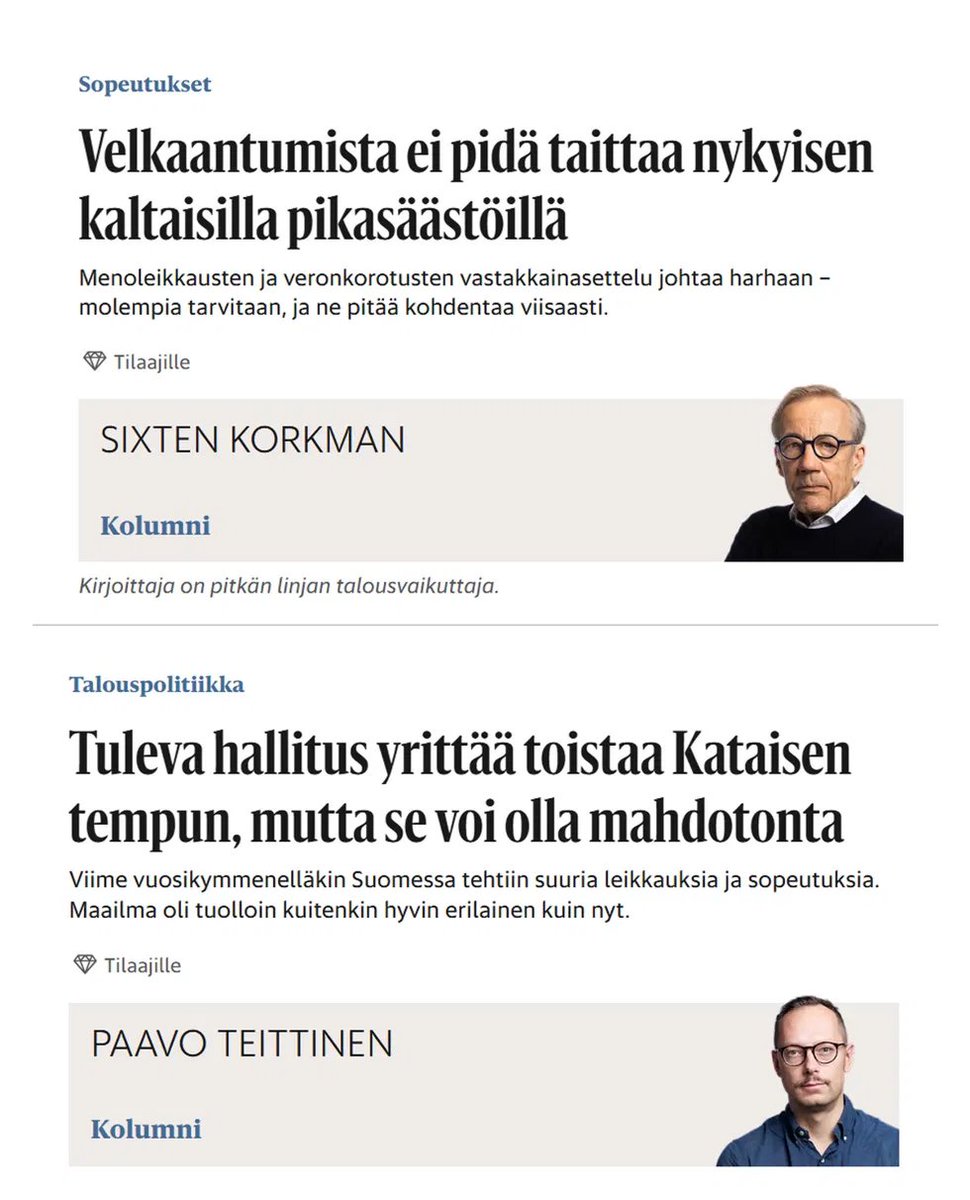
Heikki Pursiainen criticized Finnish economic discussion as limited based on two recently published columns in Helsingin Sanomat. According to him, Korkman described what should not be cut and believed that adjustments were necessary but did not propose any cuts. Pursiainen claimed that Korkman also criticized the government’s policies without offering alternatives. Pursiainen wrote that he found Teittinen’s reflections good in themselves but believed they underestimated Finns' ability to impact matters. He argued that Teittinen suggested that adjustments would probably be politically impossible and that Finland's fate depended on economic conditions and Russia. Pursiainen assessed that there could be many actions: he mentioned more encouraging social security, cutting business subsidies, tuition fees, and abandoning incentives for staying home as a parent. He added that for conservatives, a smaller public sector was a goal and not a reason for lamenting, and in his view, adjustments did not threaten the foundations of the welfare state. Pursiainen indicated that economists should also present their own solutions for discussion and negotiation. #Suomi #Taloustiede #Politiikka (translated)

Mikko Alasaarela wrote that France was in a difficult situation with the share of the public sector having risen to an unsustainable level according to him. He estimated that Finland's share was even larger, at 57.5 percent, and believed that an overly large public sector stifled the private sector. According to Alasaarela, in all other Nordic countries, the public sector's share of GDP remained below 50 percent, and their economies had developed better than Finland's. He also wrote that France's fate would affect the entire European Union and that Finland's economy was in the same situation. #talous #julkinensektori #Etuvaikutus (translated)

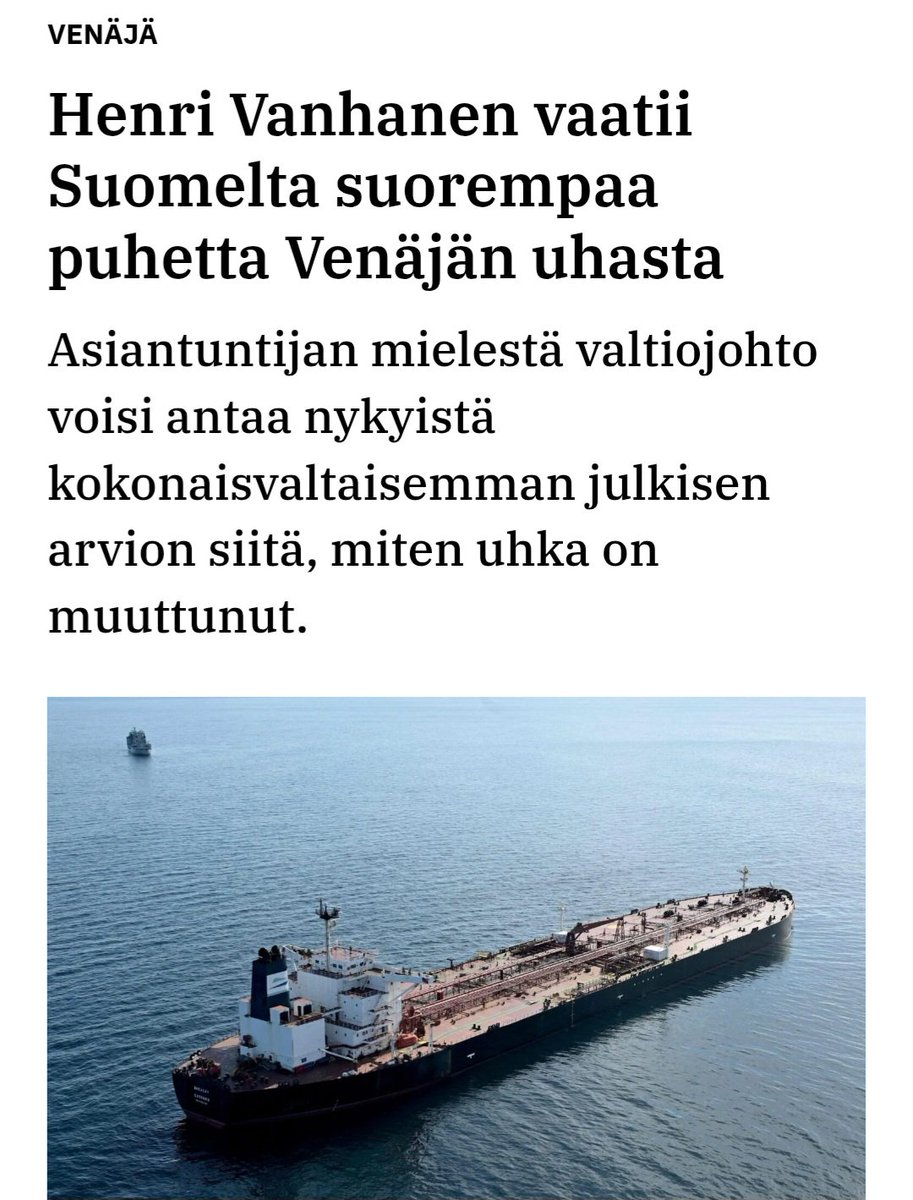
Henri Vanhanen wrote that Finland's security leadership should clearly tell Finns how the threat posed by Russia may have changed. According to him, in Europe, sabotage linked to Russia had become more dangerous, while in Finland there had been warnings about new threats and the self-reinforcing effects of public debate. Vanhanen considered an updated overall assessment of changes in Russian actions and their significance for Finland to be timely. He asked how likely it was that sabotage seen elsewhere in Europe and the recruitment of local actors were considered in Finland, as well as what aspects of the security situation had not changed. He wrote that Finns did not need more reasons to fear Russia but a clearer picture of what was known, what was considered possible, and what had no evidence. https://t.co/pVVdY68NoX #Suomi #Venäjä #turvallisuus (translated)
Distrust leads young people to seek a Plan B. Many save or invest. Faith is also wavering in healthcare and elderly care. Private insurance is being obtained for security. "This could trigger a spiral that destroys the welfare state." This is a completely unfounded fear, where cause and effect are confused. Young people’s Plan B reduces dependence on the state, as it should in this situation. As Milton Friedman noted, tax cuts are the only effective way to force public authority into real spending discipline and efficiency. When people have more of their earned income left in their hands, it also creates room for economic growth, without which no service can function. Our welfare society will renew itself as has happened in Sweden. This development should also be seen in terms of opportunities, not threats. Young people's voluntary preparation will not destroy the welfare state but will make it viable. Forward. https://t.co/3EvGbOOTRS #Hyvinvointivaltio #Nuoret #TaloudellinenKasvu (translated)

A journalist from HS found out the exact reason for the preliminary investigation of my incitement against a population group. Only the police and the prosecutor knew about the matter, as the case is not public. This will be an exciting story – whatever happens! By the way, where did the HS journalist get the information; who knows? #journalismi #uutiset #suomi (translated)

They are managing to prevent the minister from doing the real work with their meaningless publicity stunts. That way our security improves. Shame on you! https://t.co/E05ESh2rQ5 #turvallisuus #poliikka #julkinensanat (translated)

The chief of intelligence of the Main Command, Pekka Turunen, notes that the public discussion about the threat from Russia has taken on a self-perpetuating character, even though the situation has not significantly changed. #Venäjä #uhka #tiedustelu (translated)

Venäjäkö "akuutti vaara"? Tiedustelupomo: "Pelonlietsontaa"

Why hasn't Nahom Hagos been deported? Those demanding deportation clearly don't grasp the kind of public sector employer we are dealing with. One person-year corresponds to about 1,600–1,700 working hours, and Hagos's entire bureaucratic path from the reception center to repeated criminal convictions and victim care has tied up an estimated 14–25 person-years of publicly funded work. Even entry, integration efforts, and the reception center phase consumed a couple of years of work, on top of which come the continuous handling of social assistance, substance abuse social work, and staff resources for shelters for the homeless. With the criminal history, the machinery was really set in motion: three extensive rape investigations, property and drug offenses, and escapes kept the police very busy. Prosecutors, several levels of the judiciary, public defenders, and interpreters in turn worked through about another person-year in the courtrooms. The largest share of the workload comes from incarceration. Daily monitoring, administration, and prison healthcare average about 0.6–0.8 person-years per inmate per year, which, together with long sentences and probation supervision, amounts to 4–6.5 person-years. However, Hagos's widest impact is through the victims: acute hospital care for fractures, forensic examinations, years of trauma therapy, victim support services, and assistance for elderly victims with diminished functionality demand as much as 3–5 person-years from public healthcare and social services. The authority chain caused by a single man thus corresponds at best to the annual total work contribution of a small agency or department. From the perspective of public sector demand, Hagos is a rapacious gold mine. Such a man cannot be deported! #karkottaminen #julkinensektori #rikollisuus (translated)

Finland has crossed two debt thresholds as public debt in relation to gross domestic product has risen above 90 percent. #velka #BKT #MTVUutiset (translated)

Suomi ylitti kaksi velkahaamurajaa

Euroopasta tulee nyt toinen toisensa perään vakavia varoituksia Venäjän toiminnasta. Minusta Suomen tulee päivittää julkinen uhka-arvio, jos viranomaisilla on perusteita arvioida uhkaympäristön muuttuneen. Supon, sotilastiedustelun ja valtiojohdon pitäisi silloin kertoa suomalaisille mahdollisimman selvästi, mistä muutoksessa on kyse, mihin meidän kannattaa varautua ja tarvitaanko uusia varautumisohjeita. Epämääräisten varoitusten sijaan tarvitsemme mahdollisimman selkeän tilannekuvan. https://t.co/tz9hTMbf9N #Venäjä #uhkaympäristö #Suomi

Putin pelkää rauhansopimuksen mahdollisuutta, joka saattaisi heikentää Venäjän vaikutusvaltaa Ukrainassa, kun taas Kremlissä on yhä enemmän halua rauhaan kuin mitä julkinen keskustelu antaa ymmärtää. #UkrainanSota #Putin #Kreml

Putin pelkää ideaa, josta Kremlissä supistaan: "Se ei tiedä, minne ja miksi edetä"