BETA nonprofit public democratic european moderated

Search

#kysymys

Mikko Välimaa wrote that Magnus Ranstorp is one of the most respected researchers in the Nordic countries and said that he posed a question that he hoped would also come up in Finland. Välimaa mentioned that so far only Iltalehti had reported on the exceptional stance of Finnish Members of the European Parliament in the vote concerning the Muslim Brotherhood. #tutkijat #Suomi #politiikka (translated)

Tuomo Saarni asked the True Finns and the National Coalition Party whether this was a proposal that had taken three and a half years to refine. He mentioned that he was desperate about the actions of the right-wing parties and claimed that even a shouting vote held in X would produce better laws. Saarni urged the parties to be ashamed and added that, in his opinion, they would not know how to do that. https://t.co/RjxK41JfOx #politiikka #Suomi #kansalaiset (translated)

Klaus 23h

Klaus said he had responded to a user named Sukkola, who he claimed had blocked him. He stated that his criticism was directed at Said Aw-Musse's position as a religious authority rather than at his personal actions. Klaus described classical Sunni Islam as a tradition in which sharia is seen as divinely ordained and as a legal system superior to human laws. According to him, it included legal, moral, and social rules regarding, among other things, testimony, inheritance, apostasy, and legislative authority. Klaus wrote that Aw-Musse had studied theology in Saudi Arabia and worked in a mosque where the teachings of Muhammad ibn Abd al-Wahhab had been used. He described this figure as an ultra-conservative thinker who demanded the return of Islam to its literal roots. According to Klaus, Aw-Musse's refusal to clarify his position on the primacy of Finnish law and the status of sharia justified suspicion. Merely following the law, in his opinion, did not indicate whether he considered the constitutional order of Finland to be just and final or a temporary imposition. Klaus expressed a desire to know what kind of Finland Aw-Musse envisioned in 50 or 100 years. Klaus believed that questions regarding women's rights, freedom of speech, freedom of religion, and criminal law were not leading him into a trap but were inquiries into whether Aw-Musse accepted the principles of the Finnish rule of law. He deemed Aw-Musse's public stance significant for its societal relevance due to his religious role. According to Klaus, integration required not only adherence to the law but also acceptance of fundamental values. #uskonto #oikeudet #kulttuuri (translated)

L

"With the current administration, everything is always a question mark," Santos says. #kauppasuhteet #EU #Yhdysvallat (translated)

USA:n ja EU:n kauppasuhteet kovilla – tilanne uhkaa kärjistyä
www.mtvuutiset.fi

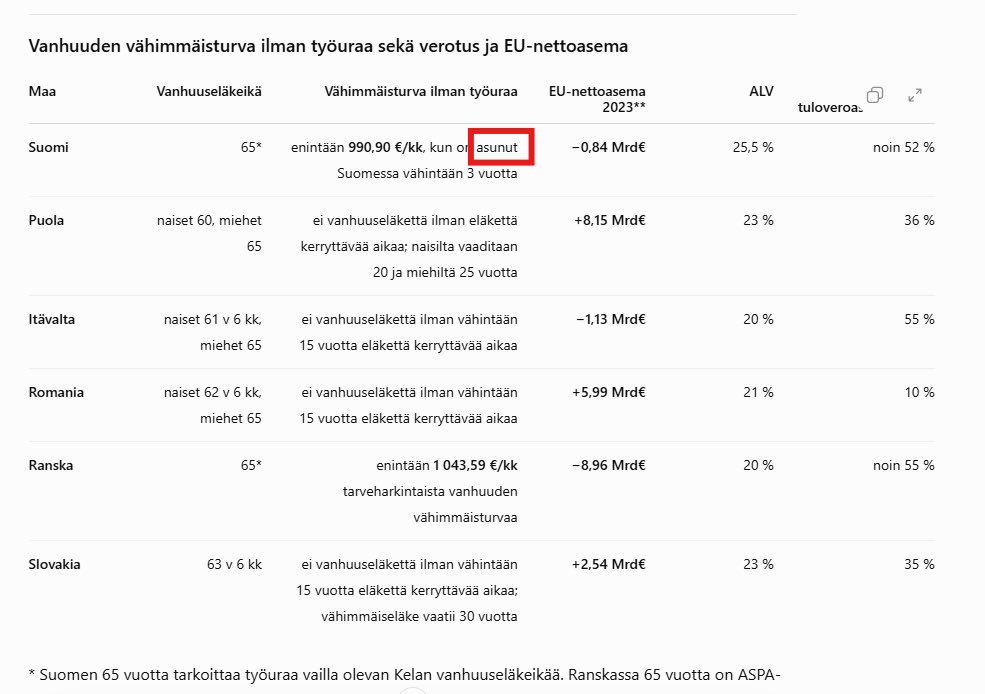
Maarit Aarni-Sirviö asked why pensions were paid in Finland even when the recipient had not contributed to the accumulation of the pension themselves. https://t.co/b0v8P1fmYa #eläke #Suomi #kysymys (translated)

Henri Vanhanen warned about Finland's security and wrote that according to Denmark's Security and Intelligence Service PET, Russia had begun sabotage operations against Danish defense companies. According to him, companies supplying weapons and equipment to Ukraine were particularly targeted. Vanhanen stated that PET assessed that Moscow had aimed to reduce European support for Ukraine through intimidation and harassment and was now trying to harm weapons production and supply chains. Vanhanen wrote that perpetrators of the strikes were recruited via social media and were first paid for photographing and gathering intelligence on targets, and later for sabotage. According to him, this allowed operations without the direct involvement of Russian intelligence officers. He warned that Russia aimed to extend the effects of the war to NATO countries and also assessed that Finland's defense industry's production facilities, subcontractors, personnel, and supply chains could be targets. Vanhanen believed that protecting them required cooperation between companies and authorities, and urged NATO to assess when individual sabotage attacks would constitute a systematic campaign against the alliance's defense capability. https://t.co/CgjnDAjDhY #Turvallisuus #Ukraina #Venäjä (translated)

In the discussion about music education held at Yle, every guest mentioned Islamophobia 7-8 times in their turn, according to Rivie. He noted that it was unclear what the word brought to the discussion of the topic, as it bypassed the journalist's question. He also wondered why the word was repeated so often in the discussion and compared the repetition to a gold nugget-like mantra. #ylenaamu https://t.co/NHIQRcRN5u #musiikki #musikkikasvatus #islamofobia (translated)

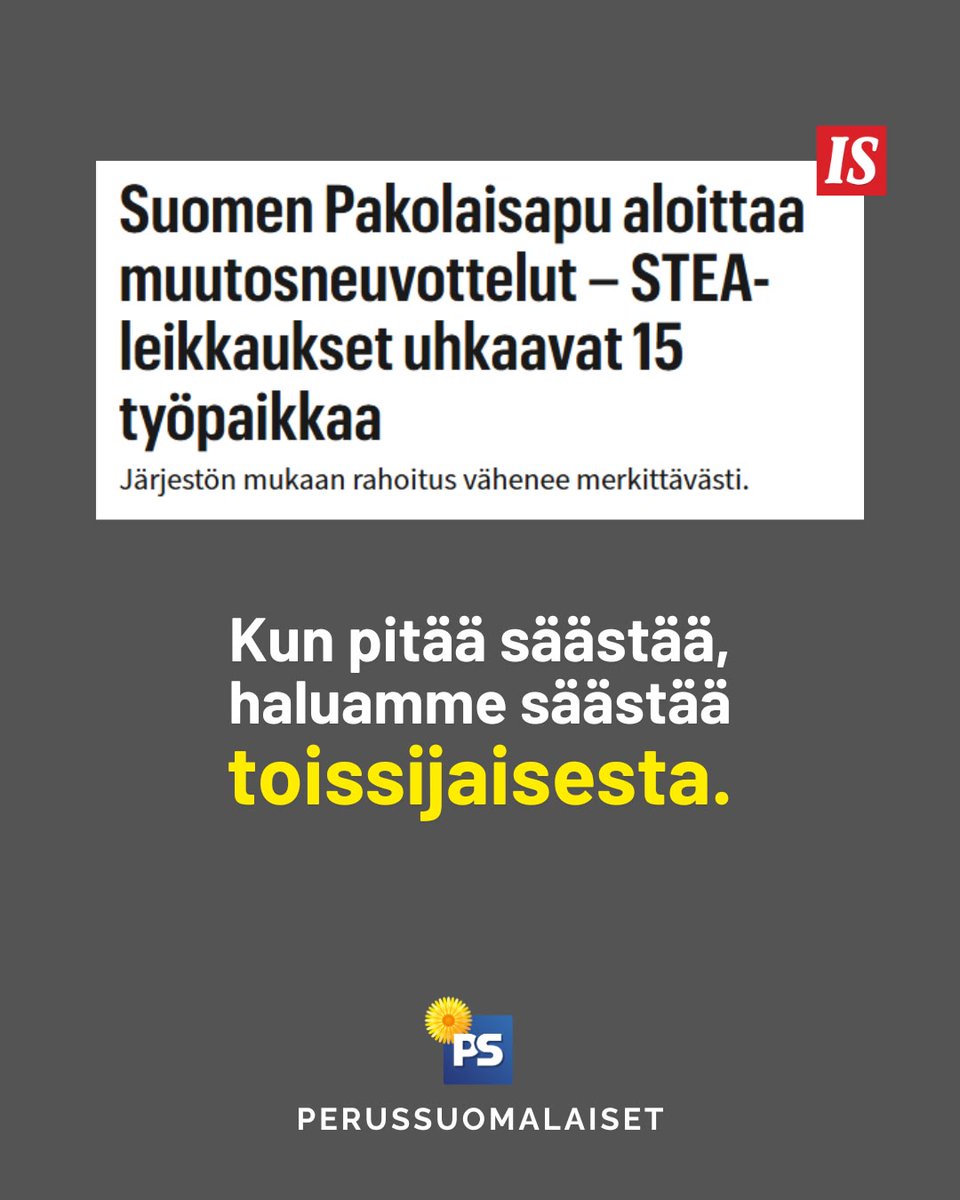
The Finns Party asked how much could be cut from public funding for organizations, as taxpayers' money had been allocated quite generously to various organizations for a long time. The party wrote that not everything needed to be financed with tax funds. #ps #perussuomalaiset #STEA #järjestöt #järjestöt #veronmaksajat #rahoitus (translated)

Jari Sarasvuo believed that now was a historically opportune moment to get licensing authorities to change their practices. He justified his view with the well-being of the entire nation and called for mines, factories, and other sources of prosperity in Finland. Sarasvuo advocated for the reindustrialization of the country and the streamlining of licensing practices. #hyvinvointi #teollisuus #kaivokset (translated)

Henri Vanhanen wrote that he had been calling for a clearer situational picture of Russia's intelligence and influence activities towards Finland for some time. He viewed positively that, according to him, the message from the Security Police and the Defense Forces about the situation was now serious: Russian intelligence operations against Finland had intensified, cyber intelligence was active, and the interest was particularly focused on the defense industry. Vanhanen noted that the chief of the intelligence department of the General Staff had assessed that the intelligence operations targeting society and critical systems could be preparation for sabotage. According to him, Finland could thus become a target of Russian sabotage activities. He also wrote that, according to the Security Police, at least one small Finnish technology company had already been subject to verifiably increased intelligence activities. Vanhanen assessed that Russia aimed to weaken Ukraine's ability to continue the war by also influencing countries, businesses, and supply chains related to Western support. He warned that problems arising for companies supporting Ukraine could raise questions in Finland about the risks of support and serve Russia's objectives. Vanhanen suggested that the security of defense and technology companies should be proactively strengthened. He urged companies to check, among other things, their cybersecurity, the protection of their facilities, approaches to personnel, data access rights, supply chains, and unusual cooperation, recruitment, and investor contacts. He stated that especially small companies should be provided with easily accessible government support for identifying threats and improving security. According to Vanhanen, Russia's goal was to get Western countries to reduce their support for Ukraine. He believed that Finland should respond to possible pressure by better protecting the people and companies enabling support rather than changing its policies. https://t.co/f0INfDq1Zf #Venäjä #Suomi #Kyberturvallisuus (translated)

Sammallahti wrote that Joona Räsänen remarked that cuts do not necessarily kill economic growth. According to Sammallahti, Tytti Tuppurainen noticed that the journalist and photographer from Kuukausiliite were still listening at the door of the hall and directed them outside with her gaze. Sammallahti claimed this had undermined the SDP's most central economic criticism and wrote that the party is aware of this. He asked Antti Lindtman whether the SDP intends to continue scaring and misleading Finns. https://t.co/djE2iX7VHf #politiikka #talous #SDP (translated)

The iron chancellor praised Grok Bot and mentioned that he had implemented bots in several routine tasks. According to him, they managed the calendar, emails, and Drive, reminded about routines and unpaid bills, and retrieved key codes for the cottage by speaking to the car. The iron chancellor also stated that one bot was leading a project that had three coders. Two of them were, according to him, ordinary Grok discussions, and meetings were held using the agents' own email addresses. He said he accepted the question cards raised by the bots and monitored token usage. Additionally, according to him, his bots were already messaging his friends' bots, and he planned to only give others his agent's address in the future and leave Gmail for campaign messages. #tekoäly #automaatiota #teknologia (translated)

Jari Mäkäräinen criticized Yle for what he perceived as giving Timo R. Stewart, whom he describes as a Hamas activist, an unchallenged platform to present his book. According to Mäkäräinen, the article adopted Stewart's view regarding the destruction of Gaza, genocide, and Finland's responsibility due to trade with Israel, without hearing the opposing side. Mäkäräinen emphasized that, in his opinion, genocide does not equate to heavy war. He wrote that the International Court of Justice had not ruled on the case against Israel and that interim measures were not a judgment. In his view, civilian casualties can occur in urban warfare where Hamas places rockets, command centers, and tunnels among civilians without the intent of destroying the group. He compared this to the battles of Mosul, Raqqa, and Fallujah, claiming that Stewart began using the term genocide after Israel succeeded in its war against Hamas. According to Mäkäräinen, the Yle article also lacked the starting point of the war: the attack on October 7, in which he claims over 1,200 people died, and which involved rapes and kidnappings. He wrote that Hamas aims for the end of Israel instead of a Palestinian state. He criticized the figures presented by the Palestinian Ministry of Health in the article—over 21,600 by December 2023 and over 1,400 after ceasefires—and claimed that the ministry was subordinate to Hamas and that its figures did not differentiate between fighters and civilians. In his view, the article also lacked Israel's perspective that a significant portion of the dead were fighters. Regarding the two-state model, Mäkäräinen wrote that its failure was not solely due to Israel. He claimed that Hamas had rejected the model multiple times and that the Palestinian Authority had turned down offers, such as at Camp David in 2000 and Annapolis in 2008. He added that according to polls, the majority of both Palestinians and Israelis had abandoned the model. He described the cessation of support for UNRWA as a reaction to an organization that, according to him, had ample evidence of connections between its facilities and personnel to Hamas. Mäkäräinen believed that Yle, as a publicly funded media, should not advertise a single essayist as an expert. According to him, the article could have included opposing researchers, Israel's official stance, or addressed Hamas's responsibility for hostages and the use of civilians as shields. He concluded by asking why this had not been done. https://t.co/sHriNitmMo #Gaza #Israel #Hamas (translated)

Suvi-Anne Siimes considered the cheaper subscription aimed at young people a good and commendable idea. However, she wondered if the articles aimed at reaching young readers had to be naive and lacking a historical perspective. According to Siimes, this was unfortunately often the case. https://t.co/zi3Qpoy0bO #nuoret #lukeminen #kulttuuri (translated)

"The question of national security" Orpo seriously: It is clear that there has been a visit at the homes of members of parliament – "The question of national security" #UkrainanSota #Venäjä #Kiova (translated)

Venäjältä uhkaava julistus: "Lähtekää Kiovasta"
www.mtvuutiset.fi
Mikko 1w

Mikko asked questions about the riots in France and inquired how burning buses, breaking shop windows, or looting would help if the root cause of the riots was the lack of resources in primary schools. He also asked why, in his opinion, there were no white people seen in the videos of the riots, except for a female police officer who was kicked by ten men. #Ranska #mellakat #kysymykset (translated)

Prime Minister Petteri Orpo expresses concern about the break-ins into the homes of members of parliament, stating that this is a serious national security issue and urges the police to investigate the extent of the incidents. #PetteriOrpo #kansallinenturvallisuus #tunnusmerkit (translated)

Orpo vakavana: Kansanedustajien kodeissa on selvästi käyty – "Kansallisen turvallisuuden kysymys"

Henri Vanhanen wrote that he wanted to correct the interpretations of an article by Helsingin Sanomat that dealt with nuclear weapons and said he remained uncertain about what the article ultimately claimed regarding Finland's security. According to him, Finland did not join the NATO nuclear deterrent with little discussion or unnoticed, but rather joined an alliance whose deterrence and defense had been based on nuclear weapons for decades. He described the strategic nuclear forces of the United States as a key basis for NATO's nuclear deterrent. Vanhanen considered that the bombing of Nagasaki was not an example of the current type of nuclear deterrent because Japan did not have a nuclear weapon nor the ability to respond to a U.S. strike. In his view, Nagasaki demonstrated the destructiveness of nuclear weapons and the human risks of their use, whereas the current deterrent was based on the assumption that an attacker had to consider the possibility of retaliation and uncontrolled escalation. Vanhanen assessed that Trump had increased uncertainty regarding the United States' commitment to the conventional defense of Europe and believed Europe would have to bear more responsibility for it. However, he distinguished this from the claim that the U.S. nuclear deterrent had weakened. According to him, the U.S. ability to use nuclear weapons had not diminished, NATO was not dismantling its nuclear plans or arrangements, systems were being modernized, and F-35 aircraft were being introduced into NATO's nuclear missions. Vanhanen stated that the NATO Nuclear Planning Group had confirmed in June that strategic nuclear forces, particularly U.S. forces, remained the ultimate guarantee of the allies' security and had decided to continue strengthening and modernizing the nuclear deterrent. Vanhanen considered it a central uncertainty whether Moscow would believe that the U.S. president would be willing to use nuclear weapons to defend an ally in an extreme situation. He reminded that the question of the U.S. willingness to endanger its own cities for the sake of Europe had been a concern throughout the history of the extended nuclear deterrent and there had been no complete certainty during the Cold War or at the present time. According to him, Finland's option was not a nuclear deterrent or a nuclear-free security environment, as Russia would have its nuclear weapons in any case. Vanhanen wrote that the crucial issue for the deterrent was that the Russian leadership could not be certain that the United States would defend Finland. https://t.co/3C8aAkuMwj #ydinaseet #Nato #Suomi (translated)

Some things become perpetual motion machines. Now the question of the number of HV areas has become one of them. That number of 5 seemed to circulate in discussions almost 20 years ago when the reform started to be talked about. But does it still have a chance to come true? https://t.co/vYoOuWKhSY #kysymys #uudistus #HValueet (translated)