WRLD

Search

#opowieść
Thorkill 2d

Thorkill linked Donald Trump's story about a Russian general who exited the highway and got stuck in the mud to the march of the 1st Armored Army towards Pryluky in February 2022. He wrote that Trump first told this story in June 2022 and repeated it the day before the publication of the post, adding details that allowed the author to pinpoint a specific operation. According to Thorkill, on February 25, General Sergey Kisiel ordered the vanguard group of the 1st Motorized Rifle Regiment to leave road number 7 Sumy–Kyiv and bypass Pryluky from the north using local routes. The author stated that the troops reached Kołesznyki, covering approximately 70 km that day, and on February 26, they traveled about 30 km and reached Halych. He blamed the delay on the poor condition of the roads, which were damaged by heavy vehicles. Thorkill assessed that the Russian attack on Pryluky could have succeeded because the Ukrainian defense of the city was still being organized and had little anti-tank weapons and mines, and also lacked artillery or engineers capable of blowing up the bridge on the Uday River. According to the author, Kisiel ordered the attack on the city along road number 7 only on February 27. The Ukrainian positions along the Uday then halted the Russian advance, and the column to the north of Sribne was bombed by Ukrainian Su-24s. The author noted that the potential capture of Pryluky could have facilitated actions for the Russian forces, but would not have directly led to the fall of Kyiv. He wrote that the "Center" Group of Forces was to block the city from the east, while the main strike was led by the "East" Group of Forces from the west. Thorkill stated that the failure of the latter determined the defeat of the Russian operation in Kyiv. He also announced the upcoming publication of a book in English about the battle for Kyiv. #Ukraina #wojna #Kijów (translated)

3209
Piotr Kusznieruk 5d

Piotr Kusznieruk wrote that the revealed recordings raised questions about the reason for the police check on the man who was, as he suggested, connected to the protest. According to his reconstruction, the officers followed the man for several dozen meters, demanded his personal information without providing a specific reason for the check, and then incapacitated him inside the building. Kusznieruk noted that the man pushed the officers away and fled inside, but he believed that this did not explain the earlier decision to conduct a check. The author claimed that the man lost consciousness during the intervention, and the knife found with him was not presented as having been used. He also questioned the proportionality of the force used and whether the man deliberately attacked the policewoman when the window broke. Furthermore, he described that several hours later, the detained man was informed that he could meet with lawyer Magdalena Leszczyńska if he provided his details. According to Kusznieruk, the man did not know the lawyer and did not want to see her, while the police considered this a refusal to contact a defense attorney. Kusznieruk also criticized the statement by Prime Minister Donald Tusk, who — as he wrote — linked the matter to President Nawrocki. He asked whether the police acted on the orders of superiors, collected data on demonstration participants, and previously observed the man. He directed questions to the Polish Police and the Ministry of Interior and Administration regarding who ordered the identification of Piotr and on what basis. He warned that if the identification of protesters occurred without legal grounds, it could mean using the state apparatus to control citizens. #Polska #Policja #protesty (translated)

3390
Piotr Kusznieruk 6d

Piotr Kusznieruk questioned the way the police presented the controversial intervention. He wrote that the detained man lost consciousness, and according to witnesses, he was being choked and was taken to the ambulance in handcuffs. He added that there were no recordings from the officers' body cameras, but the available recordings contained screams and the officer's profanity. Kusznieruk pointed out that reports included information about a folding knife that was allegedly hidden under the man's clothing. He asked whether the man threatened with it or took it out, and emphasized that no evidence of the knife's use was presented. In his opinion, simply possessing a knife would not justify choking or the disproportionate use of force. The author suggested that highlighting information about the knife while ignoring the circumstances of losing consciousness and the lack of recordings could serve to build a convenient narrative. He called for the release of recordings, documentation of the intervention, and the basis for the use of specific coercive measures. He added that deliberately distorting facts to justify the officers' actions would be a more serious problem than the controversial intervention itself. #policja #interwencja #manipulacja (translated)

3739
Magda 6d

Magda wrote that Andrzej Michałowicz had two broken teeth and about four per mille of alcohol, and he was taken from the station by an ambulance. She stated that under Ziobro's government, he became the president of the District Court in Słupsk, and the neo-KRS led to his nomination to the Supreme Court. She added that on July 28, Karol Nawrocki handed him the appointment, who — as she noted — spoke about saving courts and the rule of law. Magda assessed that the case of one of his nominees reduced this story to about four per mille. #Polska #prawo #sądownictwo (translated)

3400
r00t🇪🇺 7d

The author criticized Szefernaker's post, stating that instead of calming emotions, it served political mobilization. He pointed out that Szefernaker began with the story of a voter who traveled half of Poland to cast his vote for him, and then — as the author put it — presented Donald Tusk as an unscrupulous salesman, Poland as a state of chaos and high prices, and suggested a political nature to the accusations and arrests. The author also noted the announcement to remove Tusk's government from power within a year. He emphasized that Szefernaker wrote as the head of the Chancellery of the President of the Republic of Poland, while also reminding of his role in Karol Nawrocki's campaign, whom he referred to as a civic candidate. The author accused the Presidential Chancellery and politicians associated with Nawrocki of inconsistency: on one hand, they were supposed to call for an end to political war and calm the mood, while on the other hand — according to the author — they were stoking conflict, presenting government decisions as threats, and mobilizing voters against it. In this context, he recalled statements from Bogucki and Nawrocki about the need to ease tensions. The author noted that the efficiency of the state is not measured solely by the number of accusations or arrests, but added that it should not also depend on whether those in power are protected from responsibility. He assessed that merely labeling the accusations as political does not prove that they had such a nature and announced that he would remind of earlier statements every time the Presidential Chancellery calls for an end to the political conflict. #Polska #Polityka #Emocje (translated)

3522
Kancelaria Prezydenta RP 1w

The Office of the President of the Republic of Poland conveyed that Karol Nawrocki deemed the narrative false, according to which presidential vetoes were the main obstacle to governance. In his opinion, it served the government as an alibi and was intended to distract from its incompetence and poor decisions. #Polska #Polityka #Weta (translated)

3182
Max Hübner 1w

Max Hübner wrote that Karol Nawrocki gave Donald Tusk a gift on the third anniversary of his "victory." He also used a vulgar, offensive term towards the prime minister. Hübner quoted a statement according to which the government's claim that it was being blocked by presidential vetoes was false and served as an alibi for incompetence. He regarded the moment as perfect. https://t.co/wUCySmmmEc #polityka #Tusk #Nawrocki (translated)

2955
Kamil Zaradkiewicz 1w

Kamil Zaradkiewicz wrote that the attack on the president of the Constitutional Tribunal had a specific aim and did not happen by chance at that time. He stated that the goals of its perpetrators were known to him and had been widely described, and he deemed the stories about "restoring to citizens" completely absurd. #Polska #polityka #TK (translated)

2957
Adam Czarnecki 1w

Adam Czarnecki reminded that Donald Tusk was supposed to talk about a ride in an elevator with Jarosław Kaczyński, during which Kaczyński was said to have pulled out a gun and threatened that killing Tusk would be as easy for him as spitting. Czarnecki considered that Berka's story belonged to the same category. #Polityka #Historia #DonaldTusk (translated)

2960
Oskar Szafarowicz 1w

The author of the entry expressed faith in the responsibility of the judges of the Constitutional Tribunal towards the state and rejected media reports about their yielding to regime blackmail. He wrote that a struggle for Poland's independence, the sovereignty of the rule of law, and the preservation of democratic standards is underway. #Polska #suwerenność #prawo #PL (translated)

2961

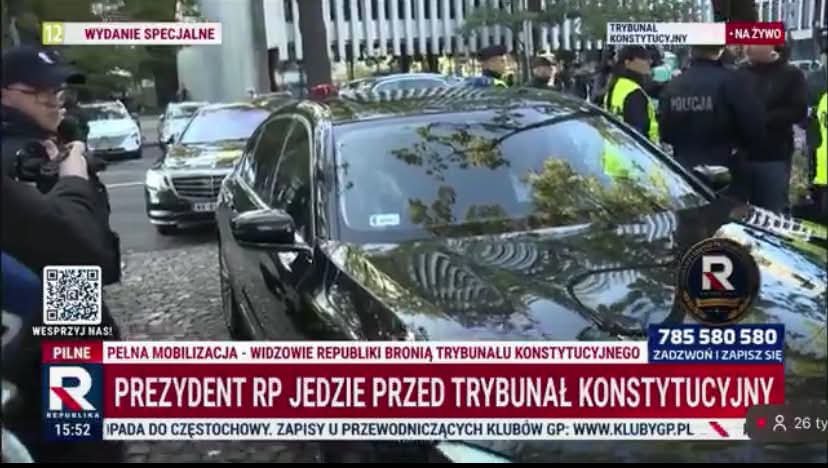
Waldemar criticized Karol Nawrocki's visit to the Constitutional Tribunal, claiming that it took place at the invitation of the president of the Tribunal, Święczkowski. He wrote that Nawrocki arrived before 4:00 PM, spent about half an hour there, and left. The author assessed that there were no young people among those gathered outside the Tribunal, despite calls to defend the actions of PiS. According to Waldemar, Nawrocki's presence demonstrated his political dependence, and the visit was part of the struggle for influence. He added that the president participated in a performance, the script of which — as he wrote — was created in Nowogrodzka. #Polska #TrybunałKonstytucyjny #Polityka (translated)

3530
Magda 1w

Magda wrote that Nawrocki's arrival at the Constitutional Tribunal spoke more about his presidency than stories about the "president of the young." She claimed that despite the appeals, young people did not come to defend PiS's actions or march with the party leadership and clubs of "Gazeta Polska"; the Confederation was also not there. She noted that the president came instead, while the young people remained only in his campaign spot. In her opinion, under the Tribunal, Nawrocki returned to his political environment. #TrybunałKonstytucyjny #Nawrocki #prezydent (translated)

3076
r00t🇪🇺 1w

The author of the entry asked whether the Office of the President of the Republic of Poland had become a tool for promoting Karol Nawrocki. He criticized references to 250 years of ideological closeness, 10 million Poles in the USA, and Nawrocki's personal relationship with Donald Trump. He called on Nawrocki to present the results of diplomacy, including guarantees for Poland and commitments made by the US administration. He assessed that there was more propaganda than foreign policy in the message. He wrote that as the American midterm elections approached, stories about the special bond between Poles and Americans and Nawrocki's friendship with Trump intensified. In his opinion, this could serve to build support for Trump among the American Polish community. The author reminded that Poland is located in Europe and that the Office of the President of the Republic of Poland should represent the interests of the Republic, and once again asked about specific benefits for Poland. #Polska #dyplomacja #Polityka (translated)

3423
r00t🇪🇺 1w

The author questioned whether the Chancellery of the President was conducting foreign policy in the interest of Poland or focusing on building the image of Karol Nawrocki and his relations with Donald Trump. Referring to the American military base in Poland, he wrote that its construction alone does not guarantee security. He cited events in the Middle East over the past six months, during which — he claimed — American installations were among the first targets of attacks, and some of them were damaged or destroyed. He emphasized that he did not question the significance of the presence of U.S. troops in Poland, but demanded specific information regarding guarantees concerning troop numbers, armament, missile defense, and the durability of this presence. He added that talks have been ongoing since 2018 and that up to now, mainly meetings, invitations, and declarations have been heard. The author also asked what Poland would do in the event of diverging interests with Washington and criticized the reliance of a nearly 38-million-strong country's security on personal relations with the President of the United States. In response to the accusation of many months of passivity by the Ministry of National Defense (MON), he recalled that the EDCA agreement was signed in 2020 and that the development of American military infrastructure and command presence in Poland had been ongoing for years. He demanded the specification of concrete neglects by the ministry and questioned attributing merits for long-term defense cooperation to Nawrocki. He also wrote that, in his opinion, Nawrocki's political activity amounted to promoting boxing. Referring to discussions about ambassadors, the author opposed the claim that Prime Minister Donald Tusk should conduct them instead of Minister Radosław Sikorski. He cited Article 146 of the Constitution, which — as he pointed out — entrusts the conduct of foreign policy to the Council of Ministers, and Article 133, paragraph 3, which obliges the president to cooperate with the prime minister and the relevant minister. He also criticized the presentation of DSA regulations as a censorship tool. He demanded the indication of a provision that would prohibit citizens from expressing opinions and wrote that the dispute over the proportionality of mechanisms for removing illegal content does not justify such a description of the regulations. Finally, he accused Przydacz of using the concept of sovereignty for political purposes in statements about its transfer to Brussels. #polityka #bezpieczeństwo #suwerenność (translated)

3083
Jacek Fogiel 1w

Jacek Fogiel criticized Karol Nawrocki's statement for "Rzeczpospolita," in which he described Donald Tusk as a pro-German politician and himself as pro-Atlantic. Fogiel accused Nawrocki of failing to provide evidence for his accusations against Tusk, although he referred to public opinion and alleged anti-Americanism visible in his books and memoirs. Fogiel also wrote that Nawrocki has no real political significance and that Donald Trump regards him as a tool in Polish internal disputes, without any influence on the decisions made. He added that Nawrocki's accusations and declarations were, in his opinion, intended to distract from the lack of concrete results and his powerlessness. #Polityka #Tusk #PiS (translated)

3312
Szymon Jadczak 2w

Szymon Jadczak wrote to Jarosław Pucki that he described the applicable laws and regulations. He added that the stories of stadium hooligans had no legal power in Poland. #prawo #regulamin #kibole (translated)

2750
Kacper Kita 2w

Kacper Kita found it surprising that in Poland the view gaining support is that the country's prosperity should depend on Russia's compliance with the agreement, rather than Norway's. He argued that Russia is not primarily driven by economic calculations and seeks political expansion. In his opinion, the outbreak of war in Ukraine showed that earning from the sale of raw materials was not the most important thing for Vladimir Putin. Kita called achieving independence from Russia one of the more significant accomplishments of the Polish state in recent years. Kita asserted that warnings about high prices of Norwegian gas and a collapse of the European economy after cutting off Russian supplies were spread by lobbyists and politicians opposed to the Baltic Pipe. According to him, the creation of the gas pipeline undermined those predictions. He also criticized attributing Poland's cut-off from Russian gas to Americans, Ukrainians, Jews, or reptilians, labeling such claims as transferring German narratives to the Polish context. He added that Krzysztof Wojczal demonstrated the impossibility of Poland's participation in Nord Stream, citing technical and legal conditions. https://t.co/hXhgXHdD03 #Polska #Rosja #BalticPipe (translated)

3327
Pani Prezes 👠 2w

Madam President wrote that the Sejm passed the law on blocking illegal content on the internet, gaining 242 votes in favor. According to her, 133 PiS deputies abstained from voting, and four were against; Confederation and Korona also voted against. Rozwój Plus cast 33 votes against and three abstentions. The author added that Jarosław Kaczyński accused the government of seeking "political gain, rather than protecting children," although — as she emphasized — his party did not cast a single vote in favor of the law. She also asked President Nawrocki whether he would sign it or would again speak about "censorship." #Sejm #Prawo #Internet (translated)

2989
Marek Miśko, czuwaj! 2w

Marek Miśko supported a tough tactic and stated that people writing such comments should be afraid of publishing them. He pointed out that the issue concerns common security, not distant topics. He suggested sending the person who — as he assessed — was talking nonsense to a laundromat, where they could say whatever they want. He added that the latest "Czuwaj" was already available on the channel and wished the audience a good day. #bezpieczeństwo #taktyka #komentarze (translated)

2991
Marcin Józefaciuk 2w

Marcin Józefaciuk criticized the response of Deputy Minister Sławomir Ćwik to a question about paternity testing at the request of a parent and the responsibility for knowingly misleading a man. As he wrote, in the League of Debates Portal Zero, Ćwik accused the question of stereotyping women and said he trusts his wife. Józefaciuk believed that instead of addressing legal protections, the deputy minister assessed the intentions of the questioner and referenced personal experience. Józefaciuk reminded that — as he pointed out — the law establishes paternity by presumption concerning the mother's husband, acknowledgment of paternity, or court ruling, without universal DNA verification. He also noted that the test result does not, in itself, change the legal status of a father. He criticized Ćwik's statement that a man can test a child despite the mother's objection, invoking Article 97 § 2 of the Family and Guardianship Code, which — according to him — requires joint decision-making by parents on significant matters concerning the child and provides for court resolution in case of disagreement. The author wrote that the mother's husband essentially has a year from obtaining information about the lack of biological paternity to file a lawsuit for its denial, no later than until the child reaches adulthood. He also cited case III CZP 91/11, in which the Supreme Court described the case of a man who acknowledged a child in 1998, and his acknowledgment was annulled in 2006 after paternity was excluded by DNA testing. Józefaciuk called for presenting data on such proceedings and considering the available procedure for paternity testing, taking into account the protection of the child and the possibility of judicial resolution of the other parent's objections. He also advocated for a discussion about the consequences of proven, deliberate misleading. He qualified that the DNA result alone does not prove fraud nor automatically grant the right to recover expenses, and the child should not be held accountable for the actions of adults. #Polska #ojcostwo #prawo (translated)

3109