BETA nonprofit public democratic european moderated

Search

#propagandă

The author wrote that Ukraine has attacked several Russian data centers and the number of Russian bots on X has sharply decreased as a result. Weakening Russian propaganda is an important war aim for Ukraine; attacks on data centers are just as important as attacks on refineries. #Ukraine #Russland #Propaganda #UA #RU (translated)

Luka Svetina wrote that the turnaround in the referendum on the parliamentary inquiry indicates that the propaganda on March 8 about the alleged "political police" scared the oldest voters, aged 65 and older, which polls seem to suggest. He assessed that the opponent does not choose means, so the coalition should prepare for a similar campaign regarding the intervention law. According to him, they would communicate to voters that retirees would be left without pensions, salaries in the public sector would be reduced, while Blaž Brodnjak would have more money. He wished the coalition good luck. #referendum #politika #upokojenci (translated)

Traven Bine wrote that Markeš claimed that all parishes have become outposts of the SDS. He labeled Markeš as a convert from theologian to a radical leftist propagandist and wondered if he was under the influence of Neostika, baking powder, or baking soda. #SDS #propaganda #slovenija (translated)

D. Trump's actions, including the call to remove V. Zelensky, provoke criticism and serve as propaganda for the Kremlin, as they create the impression that the West is losing resolve against Russia's aggression. #Zelenskis #Putinas #TrumpoKritiškaRetorika (translated)

D. Trumpo veiksmai – tarsi balzamas Rusijos ausims: prestižinis leidinys rėžė negailestingai

The Keulpaka Institute wrote again that a victory over Putin would also initiate the decline of the right-wing extremists. One must not underestimate how much Russian propaganda has contributed to their rise. #Putin #Rechtsradikalismus #Propaganda (translated)

The author claimed that Texas’s MAGA leaders had imposed strict state controls on teaching, research and discussion in universities, presenting the measures as a fight against left-wing propaganda and indoctrination. The author said the controls were intended to ensure universities taught MAGA propaganda and indoctrination. https://t.co/N4BY9ON4J3 #MAGA #Education #FreeSpeech #US

Jonas Zuschke accused TV2 Echo of manipulation and propaganda. He wrote that the media continued to portray the demonstrators as school students protesting against poor conditions at schools, and claimed that the coverage did not reflect reality. He also criticized the journalist's final question about what could make the viewer go out onto the streets, calling it extremely inappropriate. Zuschke urged people to share the post. #TV2Echo #Manipulation #Propaganda (translated)

Renato Souza reported that the TSE ordered the removal of an electoral advertisement of Lula that said Flávio was being investigated in the Master Case. #Eleições2024 #Lula #Justiça (translated)

The author of the post wrote that the biggest news portals reported a "deadly serious threat" to the life of the prime minister, which was supposed to have been sent by email. He stated that even propagandists joked about the matter because — as he claimed — it was supposed to divert attention from Kołodziejczak. https://t.co/rimiMzPNtK #zagrożenie #premier #propaganda #PL (translated)

ADAM 10h

Adam recalled that on September 4 of this year, KO politician Bartosz Arłukowicz wrote on X that a war is ongoing and there is no time for hesitation. Adam argued that in wartime, truth is the first casualty of events, and journalism becomes an adversary to all sides. He added that propaganda does not need to reach a wide audience at that time, because people seek it out themselves, wanting to gain moral support in a conflict perceived as a struggle between good and evil. According to Adam, journalists then face a difficult question of whether propaganda deemed righteous can be more important than uncomfortable facts. #wojna #dziennikarstwo #propaganda (translated)

Leo Kasura stated that the president of the TSE suspended a PT advertisement that, according to him, associated Flávio and Alfredo Gaspar with scandals. Kasura said that the piece linked Gaspar to an accusation of rape from which he had already been acquitted and tried to relate Flávio to corruption in the Master case, which the author attributed to the PT of Bahia. He also claimed that the PT was trying to distance itself from a bribe from Vorcaro intended for Lula's film. #Justiça #Política #Brasil (translated)

The author wrote that she would not allow neutrality to be used as a justification for spreading Russian propaganda or weakening support for Ukraine as Foreign Minister. According to her, Austria must decide about its future by itself and without influence from Moscow, Beijing, or Washington. #Österreich #Neutralität #UkrainischeKrise #AT #RU #UA #CN #US (translated)

Aneta ObserwatorXY quoted Bartosz Arłukowicz, who stated that the medium associated with PiS, threatening the death of all children on Friday, should lose its license and cease to exist. He described it as propagandistic and used an offensive term towards it. #KawaNaŁawę #Polityka #PiS #Propaganda (translated)

Eva Selsing wrote that her criticism of modern art in B.T. could also be directed at Jens Galschiøt's Trump sculpture, which she described as vulgar kitsch. She believed that much modern art was poorly conceived and executed political contributions that conveyed propaganda for an oikophobic establishment rather than uplift or give spirit to the human condition. Selsing stated that she was not surprised that the Danish Arts Foundation supported that type of projects. She pointed out that artists, works, funds, and museums, in her view, were influenced by left-leaning individuals, and that the result was often works characterized by ugliness, death, something unpleasant, and meaninglessness. She emphasized that her criticism was not about art being provocative, but that provocation had been highlighted for decades as the only or most important task of art. She asked why art should not also show beauty, and called provocation that followed the demands of the time ideological commission work. Selsing rejected that she had the sole right to define art but believed that works that could be reduced to poorly conceived political contributions were not good art—if they were even art at all. She referred to most modern art as societal-degrading kitsch. #ModerneKunst #Kitsch #KunstDebat (translated)

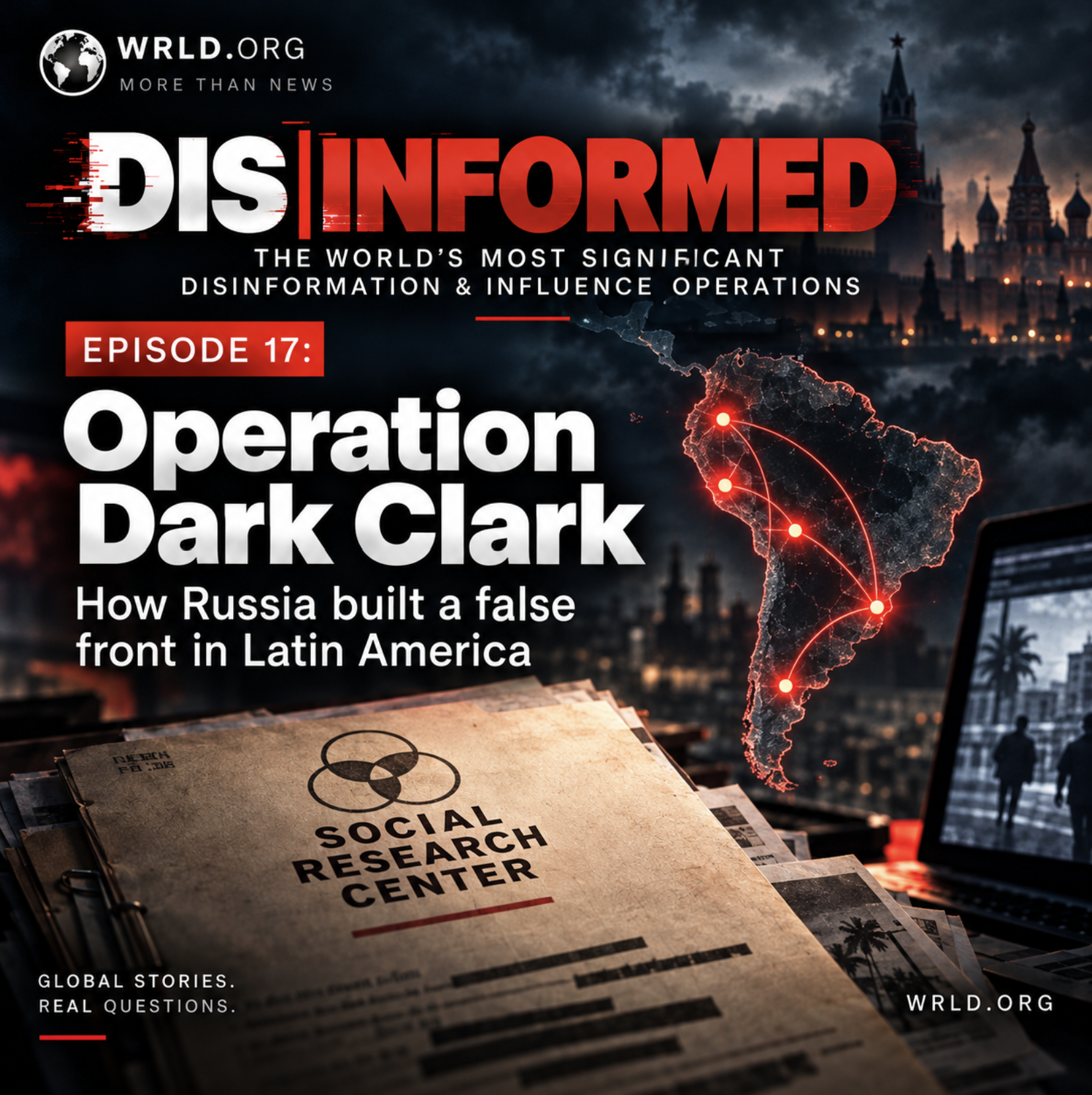
Operation Dark Clark – Russia built a real organisation around a false identity Most influence operations create fake people, fake websites or fake news stories. Operation Dark Clark appears to have gone considerably further: Russian operators built what looked like a functioning research organisation in Latin America, employed real people to produce genuine research and concealed from those employees who was ultimately directing their work. OpenAI disclosed the operation on 8 October after banning a cluster of accounts originating in Russia. The actors used ChatGPT while targeting countries across Latin America, principally to damage Ukraine’s reputation, manipulate domestic political debates and manage a self-described research organisation called the Social Research Center, or SRC. OpenAI assessed Dark Clark as Category Five on the six-level Breakout Scale, the first operation it has disrupted since beginning its influence-operation reporting to reach that level. A front organisation with real employees The SRC presented itself as a research platform studying subjects including Latin America’s relationship with India and the Indian diaspora. OpenAI found more than 60 articles on its website, most of them apparently original rather than plagiarised. Internal reports produced by the Russian operators discussed hiring, dismissals, salary scales, staffing and unfinished research projects, strongly suggesting that the operators controlled the organisation rather than merely collaborating with it. At the centre of the structure was “Mia Clark”, a fictitious identity reportedly used to manage social-media activity and communicate with staff. According to OpenAI, the available evidence indicates that employees working for SRC in Latin America were probably unaware that the organisation was being directed by Russian actors. They interviewed experts, conducted research and wrote papers in what appears to have been good faith. The deception therefore existed primarily at the organisational level: much of the work was real, but the identity and strategic purpose of the institution commissioning it were not. OpenAI This is one reason Dark Clark differs from the familiar model of a troll farm. A reader encountering an SRC paper might be looking at research genuinely written by a Latin American employee based on genuine interviews. The manipulation lies further upstream, in who built the institution, selected its direction and controlled its infrastructure. From forged emails to real events The operation also appears to have attempted something more ambitious than online persuasion: inducing real people to produce events that could later be turned into propaganda. In May 2026, according to the operators’ internal reports, they created an email address impersonating Lima’s regional education authorities and instructed schools to organise activities about Ukraine for a cultural-diversity event. The instructions included references to Stepan Bandera, whose historical legacy remains particularly contentious in Poland and parts of Eastern Europe. The operators claimed that some schools complied, replied to the false address and sent photographs of the events. OpenAI could not independently verify every claim contained in the operators’ reports. It did, however, find Peruvian reporting matching the story, followed by publications in Poland and an English-language outlet in Hungary. Some coverage included comments from a Polish MEP calling for people displaying what he described as anti-Polish attitudes to be declared persona non grata. OpenAI therefore concluded that the fabricated starting point appears to have entered genuine political debate across national borders. The mechanism is unusually effective because the final photographs need not themselves be fabricated. If people can be tricked into staging a real event on the basis of a forged instruction, the operation creates authentic visual evidence of something that was artificially initiated. The same method in Ecuador and Bolivia Dark Clark’s internal reports describe similar efforts elsewhere. In Ecuador, the operators claimed they used a fake education email to encourage schools to stage ceremonies involving President Daniel Noboa and Erik Prince, the former head of Blackwater. Ecuadorian media subsequently covered a matching controversy, and the country’s education minister issued a detailed denial. Other Ecuador-focused material included fabricated audio attributed to Ukraine’s consul and a false television report alleging that Noboa’s government was recruiting Ecuadorians to fight in Ukraine. Local fact-checker Lupa found that the supposed Teleamazonas report had never been broadcast, that images had been taken from Instagram, that the audio was AI-generated and that a company named in a supposed recruitment contract did not exist in Ecuador’s corporate registry. In Bolivia, an internal report described a fake audio recording supposedly made by an employee of state water company EPSAS during anti-government protests. It claimed that water supplies to La Paz would be cut and a state of emergency declared. The allegation produced a fact-check and an official denial. OpenAI says the operators explicitly described their objective as worsening the political crisis surrounding the demonstrations. Possible links to the post-Wagner influence machine Dark Clark did not emerge in a vacuum. The operators repeatedly asked ChatGPT about Politology and La Compania, names associated in previous investigations with the Russian influence apparatus that developed from structures once connected to Yevgeny Prigozhin. Forbidden Stories and its partners obtained 1,431 pages of internal documents describing a network known as “The Company”, which they reported had grown to almost 100 operatives and was conducting influence projects across roughly 30 Global South countries. Their investigation found that the organisation moved under the supervision of Russia’s Foreign Intelligence Service, the SVR, after Prigozhin’s death. Its documented budget for ten months of activity in 2024 was approximately €7.3 million. Two older Argentina campaigns claimed in Dark Clark’s internal reports — a false story about Javier Milei buying Cartier collars for his dogs and the staging of anti-Milei graffiti — had already been independently attributed by investigative journalists to Politology/La Compania. That is significant corroboration, but it is not enough to prove that every Dark Clark activity was run by the same organisational structure. AI was the back office, not the mastermind Perhaps the most important finding concerns artificial intelligence itself. In most documented cases, the Russians were not using ChatGPT to generate the propaganda seen by the public. Their principal use was administrative: drafting reports for an unknown superior, summarising operations, translating material and recording the supposed success of campaigns. Those reports also expose a weakness in the operators’ own measurement. OpenAI found instances in which they tried to claim credit for developments they had probably not caused, suggesting that they were not only attempting to manipulate Latin American audiences but also presenting an inflated picture of their effectiveness to whoever was supervising them. Dark Clark nevertheless broke further into the real world than any influence operation OpenAI had previously disrupted. Under the Brookings framework, Category Five means that an operation has escaped its original network and been amplified by high-profile individuals such as politicians. Dark Clark crossed that threshold because fabricated narratives appear to have provoked governmental denials, mainstream reporting and political comment in several countries. Its most important innovation was therefore not a particularly convincing deepfake. It was the construction of a partly genuine institution around a concealed foreign controller. The research could be real. The employees could be real. The interviews could be real. What was false was who they were ultimately working for. Sources OpenAI — Disrupting AI-enabled “false front” operations https://openai.com/index/disrupting-ai-enabled-false-front-operations/ Forbidden Stories — Propaganda Machine: Russia’s foreign influence strategy across three continents https://forbiddenstories.org/propaganda-machine-secret-documents-reveal-russias-foreign-influence-strategy-across-three-continents/ Forbidden Stories — Ghost Journalists, Cash and Kremlin Scripts: Argentina https://forbiddenstories.org/ghost-journalists-cash-and-kremlin-scripts-how-russian-operatives-tried-to-influence-argentinian-media/ openDemocracy — Russian influence operation in Bolivia https://www.opendemocracy.net/en/russia-bolivia-south-america-putin-evo-morales-wagner-prigozhin-covert-operations-propaganda-disinformation-foreign-interference/ Lupa Media — Fake Teleamazonas report about recruiting Ecuadorians for Ukraine https://lupa.com.ec/verificaciones/noboa-mercenarios-ucrania-ecuador/ Brookings Institution — The Breakout Scale https://www.brookings.edu/articles/the-breakout-scale-measuring-the-impact-of-influence-operations/ Keywords: #DISINFORMED #Episode17 #OperationDarkClark #DarkClark #Russia #LatinAmerica #RussianInfluence #RussianDisinformation #Disinformation #InformationWarfare #InfluenceOperations #ForeignInterference #FIMI #FalseFront #FrontOrganisation #FakeInstitution #SocialResearchCenter #SRC #ArtificialIntelligence #AI #GenerativeAI #ChatGPT #OpenAI #NarrativeManipulation #SourceLaundering #InstitutionalManipulation #ForgedDocuments #FakeAudio #PoliticalInfluence #CovertInfluence #Peru #Ecuador #Bolivia #Argentina #Ukraine #Politology #LaCompania #TheCompany #SVR #WagnerLegacy #PropagandaMachine #GlobalSouth #BreakoutScale #OSINT #MediaManipulation #WRLD

The author claimed that more than 1,000 high-ranking Russians had taken luxury trips to Europe costing over €30,000, mostly to France, and that a third involved private jets. They asked why English-language media did not report on the trips and contrasted them with Russian propaganda portraying life in the EU as bad. #Russia #LuxuryTravel #MediaBias #RU #EU #FR

Anne Nevgi wrote that she had read Hiilamo's column and found it full of ideological and anti-Israel interpretations. According to her, the bias of the column was evident in that the facts presented were interpreted in an anti-Israel way and events were framed through colonialism, racism, and whiteness. Nevgi argued that Hamas's brutality was not addressed and the origins of the Gaza conflict were not considered. She stated that the column created a misleading picture and inaccurately equated two different wars. #IsraelinKonflikti #Ideologiat #Propaganda (translated)

The author wrote that Putin has wanted the Donbas to be handed over to him for two years, although he cannot conquer the area militarily. Putin has repeatedly presented this demand to Trump, portraying it as his "deal." What the US President makes of it, the author described as Russian propaganda. https://t.co/2PZ8MNKHJ5 #Putin #Donbas #RussischePropaganda #RU #US #UA (translated)

Luigi Marattin responded to Corrado Formigli, who in the Corriere had described as "an embarrassing confusion" what the deputy said on Piazzapulita. Marattin mentioned that he has been reading investigative journalism and historical studies on conflicts for decades and cited Il Legionario, a book about Giustino De Vuono, arguing that its author documented the presented theses. Marattin accused the documentary Naza of making unfounded accusations. He cited the bombing which, according to the mentioned reconstruction, would have killed 500 civilians, stating that no evidence of either the attack or the death toll had been presented. He argued that the only source was Hamas's word, treated as truth, while Israeli accounts were dismissed as propaganda. He added that he had said on air that, in wartime, he did not consider the reports of the involved parties reliable and preferred those from independent observers. For this reason, he described Israel's decision not to allow foreign journalists into Gaza, even at their own risk, as a mistake. Marattin accused Formigli of not listening to this point and of silencing dissenters, imposing his own opinion. Finally, he wrote that he would have liked to read a "mea culpa" from the host for his statements about Israeli children on October 7. #giornalismodinchiesta #storia #media (translated)

Regina Laska criticized that Michail Swintschuk, despite his inclusion on the EU sanctions list in June 2023, apparently managed to travel from Germany to Bosnia and Herzegovina. According to Bosnian media, the founder of the Russian propaganda channel Rybar flew from Memmingen Airport to Sarajevo on October 2. The Bosnian portal Detector reported that he had been arrested a few days later in Montenegro and expelled for reasons of national security. During the arrest, the police seized high-resolution cameras, a drone, and several cell phones; it was unclear whether Swintschuk had these with him in Memmingen. Laska pointed out that, according to her account, Swintschuk is subject to an EU entry ban and is not allowed to enter or transit EU territory. Since a flight from Memmingen to Sarajevo leads over a Schengen external border, she asked how Swintschuk got to Germany, who issued him a visa, and whether his sanctioning had been recognized upon departure. According to Laska, there has been no confirmation of the trip by German authorities so far. She contrasted border controls at Memmingen Airport with those ordered by Federal Interior Minister Alexander Dobrindt (CSU) at the Austrian border. There, small cars are searched for refugees, whereas Swintschuk, according to her account, departed from the airport. She also pointed out that the Bavarian border police, which conducts checks at the airport, was established in 2018 by Markus Söder. Laska expressed outrage over what Russian nationals are still allowed to do in Germany and ironically asked whether RT chief Margarita Simonjan could soon book a wellness vacation in Garmisch. #EUSanktionen #Russland #Einreiseverbot (translated)